|
The challenge for Scott Gillingham and Kevin Klein, the undisputed front-runners for this fall’s mayoral election, will be convincing Winnipeggers the next four years will be better than the last four.
Advertisement

On that count, Gillingham has some negative momentum to overcome: our poll earlier this summer shows Winnipeggers believe the city became worse off during his reign. The news over that time frame certainly seems to support that view.
Restaurants torched and/or closed, storefronts boarded up, homeless encampments, drug use, petty crime, random homicides, abandoned housing projects, vacant house fires, fentanyl folds, panhandling, rising taxes and declining services, parking, red tape… all seem to be worse.
The challenge for voters will be to critically analyze the campaign promises coming between now and Oct. 28. History has typically shown campaign promises to be like piñatas: pretty to look at but ultimately destined to be broken.
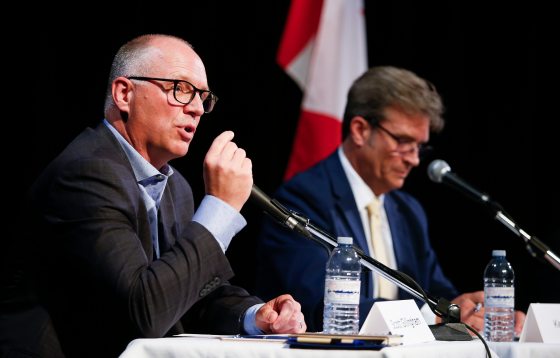
Scott Gillingham (left) and Kevin Klein, together again: Klein’s announced candidacy for mayor certainly makes the Oct. 28 election a race. (John Woods / Free Press files)
Whether Klein’s campaign promises are little more than what he thinks the public wants to hear won’t be known until after the election, if he’s the victor. Gillingham’s track record seems to speak for itself.
That both are from the same side of the political spectrum also offers some opportunity for skepticism: the problems facing the city are complex, and some of the fixes go against right-wing ideology, which typically embraces a pull-yourself-up-by-the-bootstraps ethos and leaves little sympathy for those who can’t afford bootstraps.
Or, to be fair, seems to want to offload that sympathy to charities such as Agape Table or Siloam Mission. Charities that are struggling under the workload.
Is it time to revisit Mincome, that short-lived and by all accounts successful pilot project from the 1970s? It ran from 1974 to 1979 in parts of Winnipeg and all of Dauphin and used a negative income-tax scheme to provide top-ups to people below a certain income level. The goal was to see whether such a scheme would promote shiftlessness, whether benefactors would take the free money as an excuse to not work.
The program incorporated a small penalty for dollars earned, which helped reduce its costs but wasn’t so punitive as to discourage work, the way today’s employment income assistance programs do.
“This created incentive for people to work because they were always better off if they worked than if they didn’t,” said Evelyn Forget, an economist who has written extensively on Mincome, in a report by the Canadian Museum for Human Rights. “At the same time, it meant a lot of the working poor would receive at least some supplement under this program they would not have been eligible for under welfare.”
The program didn’t encourage laziness, studies since have found. Instead, it was reflected in higher graduation rates, less mental health treatments and better health. Two cohorts did use the program to not work: new mothers who stayed home longer to care for their babies and teenagers who used it to graduate high school.
Because it only topped up incomes, it was also arguably less expensive than welfare.
There’s a quote from Daxx Kennedy, a care team member with N’Dinawemak, an Indigenous-led community organization, that to me put into perspective this city’s drug crisis. “They don’t choose addiction,” she said. “Usually, it’s to numb a pain they can’t fix.”
Mincome would be a radical change to current thinking. Then again, current thinking has worked so well, hasn’t it? Actually finding ways to solve problems at the low end of the economic ladder can only spread benefits upwards.
|