What is it?
Can you name this plant? Look for the answer below.
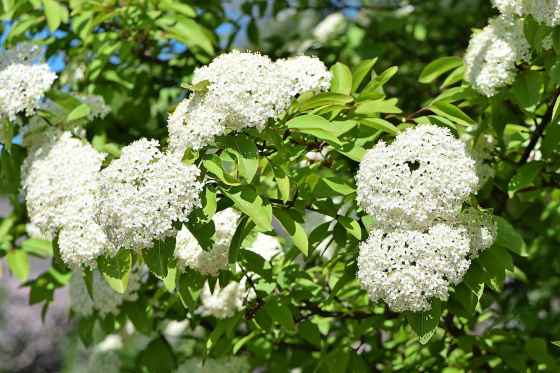
Wikimedia
Pruning hydrangeas
Typically, the end of April is a good time to prune hydrangeas before new growth starts.
If you grow more than one species of hydrangea, start by pruning Hydrangea paniculata.

Hydrangea paniculata example: Puffer Fish (Proven Winners)
Not sure if your hydrangea is a paniculata? Consider the shape of the inflorescence or what we commonly refer to as the flower. Panicle hydrangeas have cone-shaped or pointy flowers. A great example is Puffer Fish Hydrangea.
The easiest method is to make the pruning cut below the inflorescence and about one-half inch (1.27 cm) above new bud growth on the stem.
This especially applies to recently planted hydrangea shrubs, which should only be minimally pruned in the first few years after planting.
Remove any dead or damaged branches. Look for signs of feeding by voles or rabbits. Remove any branches that have had their bark stripped all the way around. If the bark has been damaged on just one side of a branch, it has a good chance of recovering.
Paniculata hydrangeas bloom on new wood and are the easiest hydrangea species to grow in our cold climate. Older cultivars that are no longer producing an abundance of flowers or that no longer have an attractive shape can be cut back in early spring by one-half or more. This will encourage larger flowers; however, they will be fewer in number for the first year.

Hydrangea arborescence: Incrediball (Proven Winners)
Hydrangea arborescens, commonly known as the smooth hydrangea, also flower on new wood. Perhaps the best-known example is Annabelle, a traditional favourite. Incrediball is a more recent smooth hydrangea introduction.
The flowers are typically large — indeed, enormous — with a rounded shape. The leaves on H. arborescens are dark green with toothed edges.
It is recommended to prune smooth hydrangeas each spring by one-third before new growth appears. This may seem drastic, but your smooth hydrangea will reward you with more flowers.

Hydrangea macrophylla, Bigleaf “mophead”: Endless Summer (Colleen Zacharias photo)
Hydrangea macrophylla, also known as the Bigleaf hydrangea for its large leaves, is not as hardy in our climate as panicle or smooth hydrangeas. The best-known example is the Endless Summer series, which is hardy to Zone 4.
The flowers may be mopheads (perfectly round) or lacecap flowers comprised of multiple bead-like florets. In our alkaline soil conditions, H. macrophylla flowers are white or pink. Acidifying the soil with aluminum sulfate is a temporary way to change the flower colour to blue. Changing the colour of the flower is not possible with panicle or smooth hydrangeas, only macrophylla.
Macrophylla hydrangeas bloom on old wood and new wood. The basic rule of thumb is to never prune macrophylla hydrangeas in fall as this removes the buds for the following year’s flowers. Rather, the flowers should be pruned immediately after they bloom in summer. This allows time for the shrub to set new flower buds that will bloom the following year.
In spring, wait until you see signs of new leafy growth before pruning. In our growing zone, the chances are that new growth will be found closer to the bottom of stems. Snip off the top of a stem to see if there is any green growth inside.
But — new growth may not even appear on any of the dried stems. Don’t despair. Be patient. Macrophylla hydrangeas that are hardy to Zone 4 like to take their time. Eventually new growth will push up from the ground. I usually wait until mid-June before removing the dried stalks of Hydrangea macrophylla.
Another option is to exclusively grow panicle or smooth hydrangea cultivars, as they are guaranteed to bloom reliably in Zone 3b!
Hanging basket hydrangea
I first wrote about Haba mophead hydrangea in August 2024 after visiting the gardens at Ball Horticultural in Chicago. Haba is the ideal hanging basket hydrangea.
Last year it was available at a handful of local garden centres. This year, it will be available at just two local garden centres.
What makes this a must-have plant, even though it is a floral hydrangea that can only be grown as an annual in our cold climate?
Picture this: designed specifically for hanging baskets, Haba is an award-winning mophead hydrangea with large double flowers on stems that naturally cascade. Haba is available in four colours — blue, soft blue, pink, and soft pink.
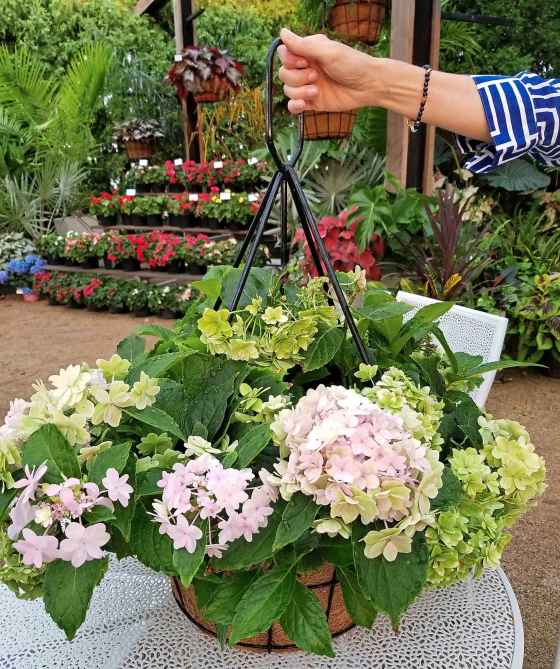
Hydrangea Haba for hanging baskets (Colleen Zacharias photo)
Best of all, it is a unique flowering option for locations that provide morning sun and dappled shade in the afternoon.
Where can I — I mean, you — find it?
Jensen’s Nursery and Garden Centre, 2550 McGillivray Blvd., and Green Oak Gardens located two kilometres east of Beausejour will be offering Haba Hydrangea.
You heard it here!
Easy Sunday Garden
In the March edition of Winnipeg Gardener, we learned about Erin Lebar’s plans to redesign the garden beds located on either side of the steps leading to her front entrance.
Lebar, manager of audience engagement for news at the Free Press, wants a relaxing, easy-to-maintain garden, a top garden design trend called the Sunday Garden.
Last fall, Lebar met with Sam Greenberg, landscape designer at Lacoste Garden Centre, for a consultation. Her timing was ideal.
“It always pays to plan early for a landscape project,” says Greenberg. Work will get underway this spring as soon as the soil is no longer frozen.

The plant list for Erin Lebar’s landscape project from Lacoste Garden Centre (Sam Greenberg)
Greenberg expects to complete the excavation, bed preparation, and planting all in one day.
“We’re going to be doing a full bed excavation which involves removing all the plants that currently exist apart from one that Erin wants to keep,” he says.
“Next, we will do a deep skim of the soil to remove all the existing root systems. Once the excavation is completed, we will add a fresh four-way soil mixture.”
Grading the flower bed away from the house is essential, says Greenberg. “You always want good drainage.”
Creating a stable base is also important. In the landscape trade, this is called compaction which helps to prevent the soil from structural failure (settling). Note that compaction in the landscape trade differs from compacted soil! The first refers to a very specific purpose while the latter describes soil that has very few air pockets.
“After compaction is completed, we will lay out new landscape fabric and install all the plants,” says Greenberg.
If all goes well, Lebar’s garden makeover could be completed as early as sometime in May!
Stay tuned.
An intriguing plant
It’s not every day you come across Viburnum prunifolium, commonly known as Blackhaw viburnum.
Indeed, this unique specimen plant is rarely, if ever, found in our local nursery trade. But it can be found in Erin Lebar’s garden, where it has grown for several years.
Lebar inherited the plant from her home’s previous owners. It will be carefully transplanted into the new garden bed that she is planning later this spring.
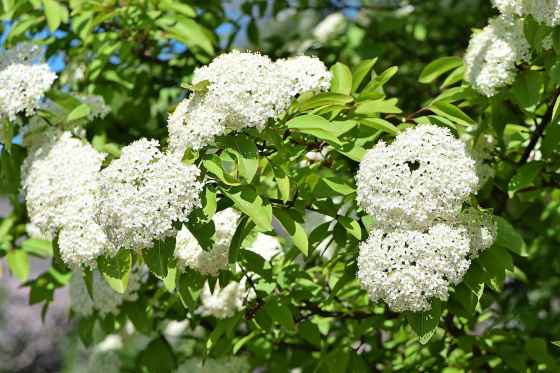
Name this plant: Viburnum prunifolium (Wikimedia Commons)
Native to the northeastern United States, Viburnum prunifolium produces creamy-white flat-topped flower clusters. It is a closely related to Viburnum lentago Nannyberry, a hardy native plant that also produces creamy flat-topped flower clusters.
“We get a few blooms in late June into July,” says Lebar. She is hopeful that by starting fresh with new soil along with some TLC, Viburnum prunifolium will be encouraged to produce more blooms.
Ash Burkowski owns Northern Wildscapes Plants+Design, a local native plant nursery. She is a botany research assistant at Manitoba Museum.
“The natural edge of the range of Viburnum prunifolium is southern Illinois and parts of southern Michigan,” says Burkowski. Some populations may exist on the very southernmost tip of Ontario.
“There’s one confirmed identification on iNaturalist in southern Ontario. This would put plants from that population around Zone 4a. The Database of Vascular Plants of Canada (VASCAN) does not recognize Viburnum prunifolium as native to Canada.”
But let’s dig a little deeper to understand the different ways that Viburnum prunifolium may have found its way to Lebar’s Winnipeg garden and settled in so nicely.
“It’s a beneficial survival strategy for organisms to try something different occasionally,” says Burkowski.
“Sometimes that difference adapts better to the organism’s current environment than the status quo — a potentially powerful strategy with a rapidly changing climate. With a plant that normally lives further south, occasionally one will have genes that are better adapted to the cold. Still, it might not grow as vigorously as it would in its home range.
“It’s definitely possible that a more cold-adapted seed was brought here, planted and sprouted. Birds are a possible culprit. Cedar waxwings migrate through that range and are heavy berry feeders.”
Burkowski also has another hypothesis.
“It could also have been introduced by humans inadvertently — imported (whether by an individual or a greenhouse), then spread by birds, or perhaps some mislabelled or mixed/assorted nursery stock.”
Burkowski says Viburnum prunifolium has been used medicinally by various First Nations.
With climate change, she says, we can expect that we may see more plants and animals out of their home ranges without human transport.
Painting gardens
Anne Toth loves to paint flowers and gardens. Today she makes her home in Calgary, but the former Winnipegger lived in Crescentwood and enjoys visiting Manitoba every summer.
“I go every week to a studio for about three hours,” she says. She prefers painting with acrylic paints to watercolours.
“Acrylic paints give me a wider range of bold, bright colours that stay bold and bright,” says Toth. She also prefers to paint on canvas.

Painter Anne Toth (Supplied)
Each year, Toth visits her friend Cheryl Geske who has a lakeside garden in Gimli. “I’m always amazed at her beautiful garden,” says Toth, who has created several paintings of Geske’s plants and her spacious garden.
Geske is thrilled to have a painting of her garden by Toth. “I have other flower paintings, too, that Anne has painted,” says Geske. “Peonies, for example. So amazing!”

Painting of a garden peony in acrylics (Supplied / Anne Toth)
Toth’s paintings of peonies, orchids, waterlilies, and more are captivating. “I often paint from photographs of plants or parts of a garden,” she says.
Toth has a large following for the peonies that she paints. “There are so many petals in some peony varieties. Sometimes it can take me up to 50 or more hours to complete a painting.

Cheryl Geske’s garden in acrylics by Anne Toth (Supplied)
Wouldn’t a painting by Toth be an amazing Mother’s Day gift? Or a gift to yourself!
If you would like to contact Toth about painting your garden or a favourite plant, contact her at aetoth@telus.net.
Rust-coloured branches
It’s not a pretty sight when rust-coloured needles appear on the otherwise beautiful foliage of Colorado spruce trees. Could it signal the presence of fungus, perhaps, or some other disease?
On the one hand, Cytospora canker, a fungal pathogen which attacks many species of conifer, including Colorado spruce, was indeed a problem in our area in 2025.

What’s wrong with this Colorado blue spruce? (Colleen Zacharias photo)
“It was pretty rampant everywhere,” says Carla Antonation, an ISA-certified arborist who is co-owner of Trilogy Tree Services. “Branches turned a purple-orange colour and then they died off. In areas where the needles haven’t dropped, you can still see some evidence of branches that were killed by Cytospora.”
However, if you are noticing rust-coloured needles more recently, says Antonation, the problem may be due to winter desiccation.
The Colorado spruce (Picea pungens) is not native to Manitoba. The past few years of drought-like conditions have contributed to stress in this species.
“If you are noticing signs of winter desiccation in your trees, one recommendation is to water them in the spring,” says Antonation. “The amount of water needed depends on how much snow cover there is and the amount of snow melt.”
To prevent winter desiccation, it is important to water conifers well until the soil freezes in fall, says Antonation.
If you are unsure about any tree problems you may be seeing, talk to a certified ISA arborist. It’s the safest, most effective way to come up with a solution.
New RRC Polytech course
Would you like to learn about plant propagation and care, irrigation system design, pest and nutrient management, and greenhouse operations?
Develop practical skills and train for the future of greenhouse and sustainable farming by registering for Greenhouse Practices and Operational Management, a new micro-credential course at RRC Polytech.
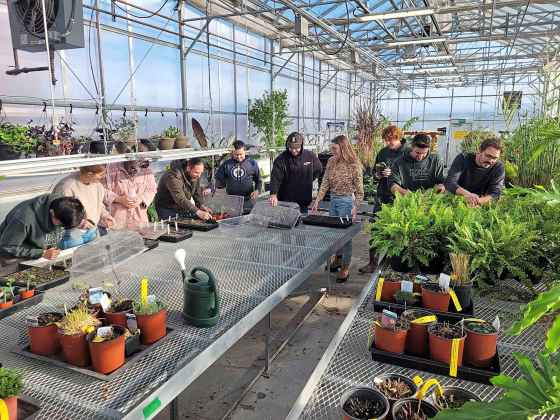
New course at RRC Polytech (Guy Dowhy photo)
Craig Gillespie, horticulture supervisor of outdoor gardens at the Assiniboine Park Conservancy, is one of the instructors for this new program.
Space is limited. To register, click here.
Mark your calendar
🏡The 2026 Winnipeg Home and Garden Show returns to the RBC Convention Centre April 9 – 12. Several local experts are participating in this year’s show who can offer timely advice and practical inspiration for homeowners looking at renovation or outdoor projects this spring.
🖼️ Back by popular demand, the Manitoba Nursery Landscape Association will host Ask a Landscaper. Gordon Galay, owner of Meadows Way Landscaping and Garden Centre will be at the show along with B. Rocke Landscaping. Andrea Purcell, owner of Addison Taylor Design, will unveil the floral studio at the show and share spring floral trends.
For a complete list of exhibitors or to buy tickets, click here.
🌱 On April 11, the St. Vital Agricultural Society will host a Gardeners Afternoon at St. Mary’s United Church, 613 St. Mary’s Rd., from 1 to 5 p.m. Complimentary admission includes speakers, plant sale, vendors, basket raffle, and refreshments. For more details, click here.
🌼 On April 11, from 9 a.m. to 4 p.m., the Manitoba Regional Lily Society hosts its annual spring seminar at the Bourkevale Community Club, 100 Ferry Road. There will be presentations throughout the day as well as the opportunity to purchase specialty bulbs that will be for sale. Registration is $35. To ensure meal availability, please email mmp99m@mymts.net.
FREE seed starting workshop on Monday, April 13 from 2 to 4:30 p.m. Hosted by the West Broadway Community Organization, this workshop is open to everyone. Participants will learn from Master Gardener Igor Kaftan how to grow plants from seed for transplanting to outdoor gardens.
Afterwards, participants will plant seedlings for use in WBCO’s community gardens. Take-home gardening trays will be available to participants who wish to grow seedlings at home. Light refreshments and door prizes. For more information, contact gardens@westbroadway.mb.ca.
🎉Spring is here and it’s time to party! On Saturday, April 18, the Manitoba Horticultural Association hosts its second annual Garden Party. This year’s event is being held at Brandon University Harvest Hall, 270-18th St., Brandon, from 8:30 a.m. to 4 p.m.
Featuring vendors, workshops and an exciting lineup of presenters. Registration includes lunch. A vegetarian option is available. To register, please click here.

Garden Party poster (Manitoba Horticultural Association)
🌳Trees Please Winnipeg invites you to attend the Trees Count Town Hall which will be held on Monday, April 20, 7 to 9 p.m. at 100 Poplar Ave. This important event features special guests Martha Barwinsky, City of Winnipeg’s Chief Forester, Erna Buffie and Charles Feaver. Discussion will focus on how to prioritize tree protection for the benefit of all. Attendance is limited to 100 people. To register, click here.
|