|
“Fool me once, shame on you; fool me twice, shame on me.”
— Proverb
The tobacco industry is trumpeting its efforts to create a “smoke-free” future. Should anyone believe anything that Big Tobacco says?
Advertisement

The Macro
I recently returned from two weeks in the United Kingdom, making stops in Belfast, Dublin and Edinburgh. And while my itinerary did not qualify as “research,” I can say without a doubt that these cities have been overrun by vaping.
In dense, busy core areas of all three cities, it was simply impossible to escape the fragrant, foggy clouds of vape emissions. Store workers standing in front of entrances having a few puffs. School kids in uniform passing vape mods among them. In pubs, adults and young adults sit away in back corners sucking on mods or e-cigarettes and then holding the aerosol for extended periods of time to cut down on the amount of vapour.
Turns out my anecdote-based conclusions are rather spot-on.
In 2025, public health officials in Great Britain — which is one of the most vape-crazy nations on earth — found for the first time, there were more people vaping than smoking traditional combustible tobacco products. The Office for National Statistics reported there were an estimated 5.4 million citizens aged 16 and over vaping; compared to 4.9 million smoking traditional tobacco products.
This is a statistical trend seen all over the world.
Rates of smoking are, in a global context, going down. The World Health Organization reports despite steady reductions in the number of people smoking tobacco, one in five people worldwide, or 1.2 billion in total, still light up.
Although the total number of vapers is much smaller — the WHO estimated more than 100 million people, including 15 million children aged 13-15, use e-cigarettes — it is growing quickly thanks to aggressive marketing by tobacco companies scrambling to backfill their shrinking tobacco markets. “E-cigarettes are fuelling a new wave of nicotine addiction,” said Etienne Krug, WHO Director of Health Determinants, Promotion and Prevention Department. “They are marketed as harm reduction but, in reality, are hooking kids on nicotine earlier and risk undermining decades of progress.”
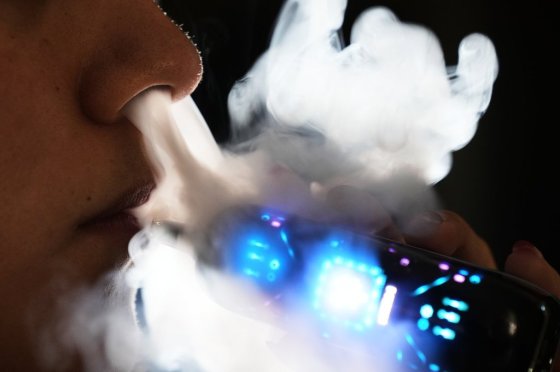
The WHO estimates more than 100 million people use e-cigarettes. (Marco Ugarte / The Associated Press files)
Aggressive marketing indeed. While browsing on my laptop in Belfast, I started seeing increasing numbers of advertisements about how the tobacco industry is pivoting towards vaping and nicotine pouches — small satchels of nicotine-laced product you put between your cheek and gums — as a “safer” alternative.
After decades of denial, misinformation and corruption, it’s a lot to ask anyone to believe anything the tobacco industry says. That’s why everyone should be very concerned and skeptical now that Big Tobacco has ramped up efforts to convince people vaping is safe.
Companies such as Philip Morris International promote the no-harm properties of e-cigarettes on the basis that — wait for it — nicotine is completely misunderstood.
“It is a common misconception that nicotine causers cancer,” PMI says not once, but multiple times across its website, intimating that because nicotine is not necessarily carcinogenic, it is somehow healthy.
According to PMI, nicotine pouches and e-cigarettes are “quality, scientifically substantiated” products which are “much better choices than continued smoking.”
“Our vision is that our smoke-free products will one day replace cigarettes.”
There’s a lot to unpack in PMI’s revised sales pitch, but suffice to say it hearkens back to an era nearly a century ago when Big Tobacco started claiming in advertisements that cigarettes were healthy products that protected your throat, aided digestion, eased nervous conditions and — the big one — promoted weight loss.
And how were they able to make those claims? Cigarette advertising featured pictures of, and testimonials from, physicians claiming medical science backed the idea cigarettes were good for you.
The entire talk track of the current smokeless nicotine product marketing narrative is no less deceitful than the original advertising campaigns that have been revealed as deliberately and willfully misleading.
Smokeless nicotine products may have been “scientifically substantiated” as less harmful than tobacco, but that certainly doesn’t mean they are not harmful. That is essentially the same as saying that falls from a 50-storey building are less harmful that those from a 100-storey building; it’s the sudden stop at the end that is deadly.
For the record, vaping is dangerous. Comprehensive scientific research has concluded, as the U.S. Centre for Disease Control so eloquently stated, vaping poses significant cardiovascular, respiratory and neurological threats. The liquid used to create the aerosol contains volatile organic compounds, toxic chemicals and heavy metals.
It’s the same with nicotine pouches, marketing as a safe smoking cessation product which medical professionals have described as a dangerous gateway to severe nicotine addiction.
Bottom line? Same evil corporate empire; same evil corporate purpose; same threat to public health.
How’s that for a slogan?
|