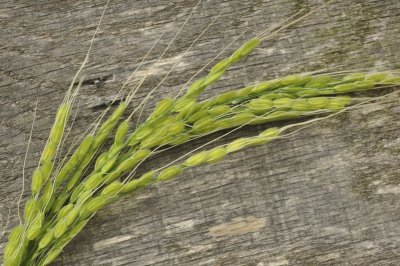
Name This Plant
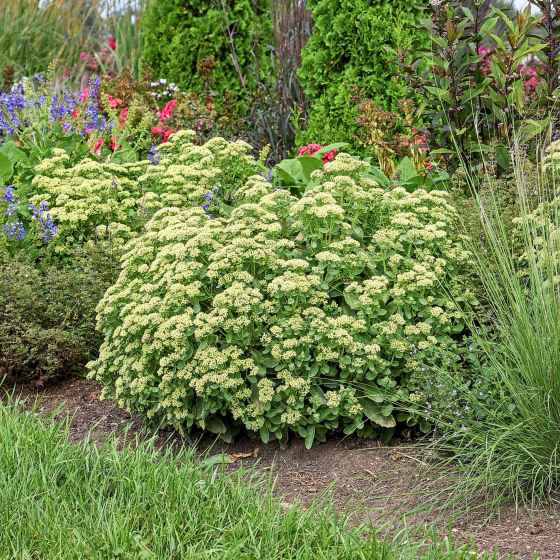
What am I? (Walters Gardens photo)
Read to the bottom for the answer. Hint: it’s not Autumn Joy.
Timing fertilizer
Time to fertilize? It depends on how much time has lapsed since you added a slow-release fertilizer.
If you added slow-release fertilizer in late May, annual plants such as flowers and vegetables will benefit now from the application of a water-soluble fertilizer such as a seaweed solution. Once every two weeks is recommended.
Flowering shrubs such as hydrangeas are heavy feeders and are pumping out blooms at this time of year. Dr. Michael A. Dirr, renowned hydrangea breeder and author of The Hydrangea Book: The Authoritative Guide and Hydrangeas for American Gardens, recommends fertilizing hydrangeas in early spring, prior to leaf emergence. He uses four ounces (113 grams) of 10-10-10 granular fertilizer such as Osmocote scattered around the base of the plant.
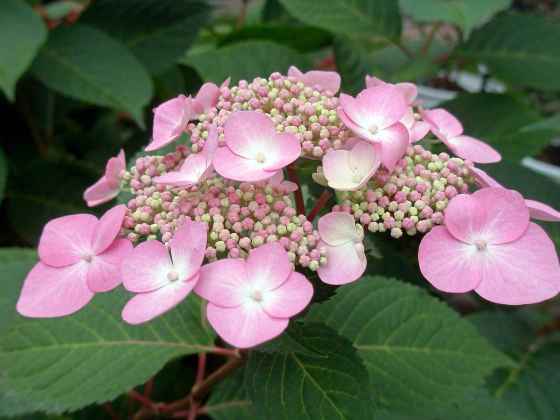
Do not fertilize trees, shrubs or perennials in August. Shown: Endless Summer hydrangea. (Colleen Zacharias photo)
Dirr also recommends a second fertilizer application (10-10-10) AFTER flowering. But in our short-season climate, this method would only be suitable for panicle hydrangeas that bloom in July. Often, older generation Limelight hydrangeas as well as bigleaf macrophylla hydrangeas such as the Endless Summer series do not bloom until August.
It is important to NOT fertilize hydrangeas or other shrubs or any perennials after the August long weekend. Fertilizing perennials and shrubs after early August results in lush green growth that won’t harden off in time for winter.
Tailor fertilizing to your specific type of plant and keep your eye on the calendar.
Other key tasks in June
🌸 Deadhead the spent blooms on flowering plants to promote rebloom. It also helps plants to direct their energy down into their root system rather than expending it on seed production.
🌱 Trying a new plant in your garden for the first time? Take note of the light conditions and how your plant is performing. Too few blooms or consistent wilting or leaf scorch? Your plant may be asking for more or less sun exposure. Dig it up as soon as possible and replant in a better location. You’ll both be happier.
✂️ Is there a self-seeding plant, such as Astrantia, or a rampant beast, such as Rudbeckia laciniata Tall Coneflower, that you would be fonder of if only it would behave? There are two solutions.
For aggressive self-seeders, off with their heads as soon as they finish blooming!

Deadhead to control the spread of self-seeding plants such as Astrantia Sparkling Stars Pink. (De Vroomen Bulb Canada photo)
For plants that want to grow way beyond their allotted space or hog all the available light from neighboring plants, regularly prune back stems at the base of the plant. In fall, sink a spade into the root ball to reduce its size. Gift the division to a friend or your local garden club.
Guess who’s coming to dinner
Aphids. Cabbage moths. Spider mites. Barberry looper. And they have big appetites for plants!
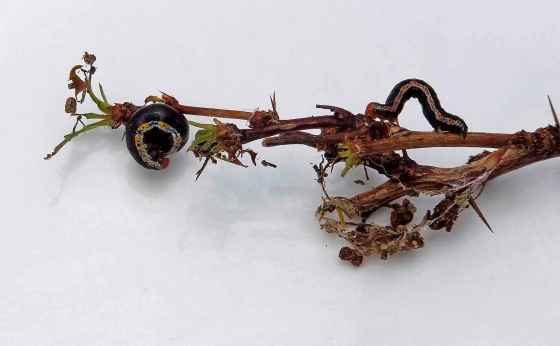
A Barberry looper on a defoliated branch. (Colleen Zacharias photo)
Keep on the lookout for these and other uninvited “guests” in your garden. Scout regularly for signs of pest damage, especially if you have had previous infestations.
Early monitoring can be successful in reducing pest populations.
Great deals on plants
Sale! Check your local garden centre for sales on perennials and the last remaining annuals. You can find savings of up to 50 per cent on some items.
Don’t pass up perennials that need a little TLC. Find a good spot, add some compost in and around the planting hole, water regularly, and your new plant will reward you with healthy growth.
My find: Penstemon barbatus Elfin Pink Beard Tongue. Gotta love the name. Compact with narrow, grass-like leaves. Marked down to $3! Admittedly, a bit ragged-looking at the time of purchase, but it is settling in nicely and just starting to bloom.
Also: Algerian ivy, 50 per cent off. I love it. Large dark green leaves with deep reddish- purple leaves. The only ivy I will ever buy again. I paired it with red and white non-stop begonias and tucked in some Scotch moss.
Smoke gets in your… plants?
Special air quality statements are a regular occurrence these days, unfortunately. Smoke-filled air is irritating to the eyes, nose and throat. As smoke levels increase, it can impact our activities.
But what impact does air quality have on plants? I reached out to Tim Lynham, a forest-fire researcher and fire scientist who worked for more than 35 years with the Canadian Forest Service.
“When wildfire smoke is in the air, trees essentially close their tiny pores (stomata) on their leaves, preventing the intake of carbon dioxide and the release of oxygen. This is a defensive mechanism to avoid the harmful effects of the smoke. Smoke may slow growth for a few days or weeks, but the smoke doesn’t kill the trees.”
Lynham used trees as an example, but all living plants have the same protective mechanism he describes.

The leaves of all types of plants close their tiny pores when smoke is in the air. (Karen Loewen photo)
An easy project
Carlos Ferreira created this simple but appealing container design that is perfect for a tiny space.
Here’s what you will need:
- A broomstick handle
- 6-inch (15 cm) clay pots
- Potting soil
- Wire (optional)
- An outer wall or backdrop in a full sun location
- A mix of sun-loving, drought-tolerant plants.
Stack the pots one on top of one another, but on the opposite side of the broomstick so it creates a ladder-type of look.
Tilt each pot so part of it rests on the rim of the pot beneath. If desired, a bit of wire through the drainage hole of the pots can be used to secure the pots to the broomstick handle.
The lowest pot should sit evenly on the ground.
Ferreira used a mix of cacti, succulents, geraniums, and Kangaroo Paw (Anigozanthos).
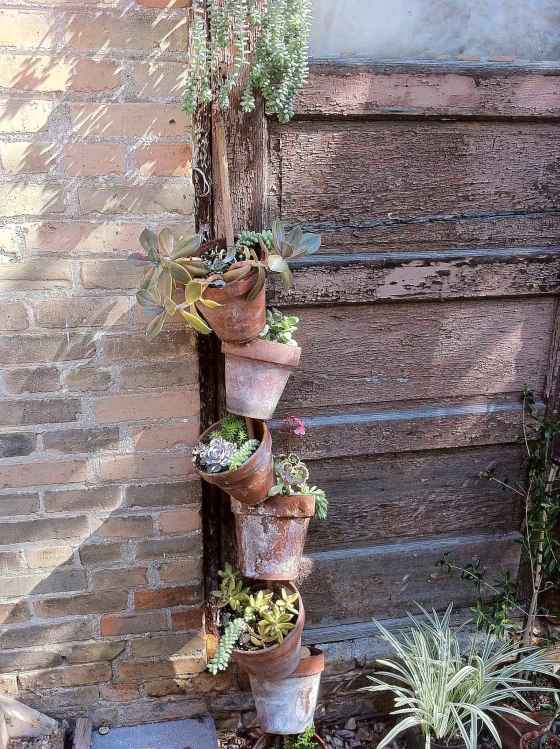
A clay pot ladder (Carlos Ferreira photo)
Bloom alert!
Leila Wegert says she is delighted that a plant given to her three or four years ago by a fellow gardener, Ayleen Ewbank, is blooming for the first time!
“It is called Penstemon strictus Rocky Mountain,” says Wegert. “I have never seen it in any garden centre. It has lovely blue and purple flowers, but it is slow to spread and doesn’t seem to reseed. This year it finally has about eight flowering stalks. I like penstemon in general but haven’t been successful with some varieties, so I am glad this one is happy.”
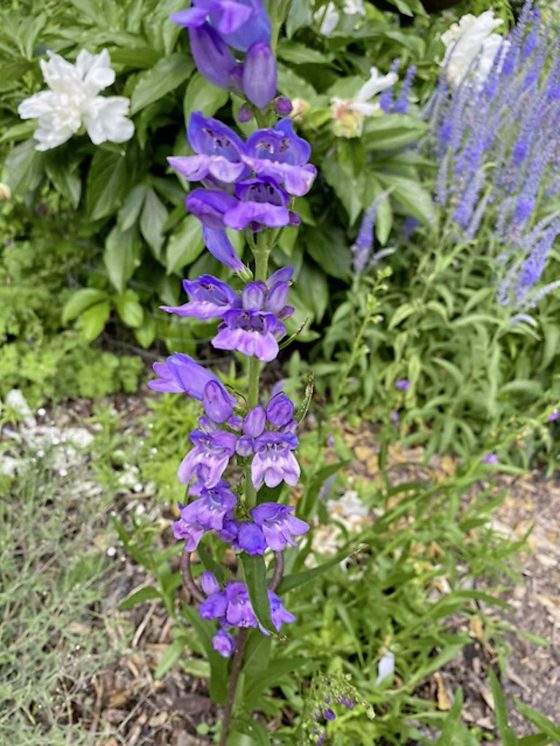
Penstemon strictus Rocky Mountain (Leila Wegert photo)
Inspired to grow more penstemon, Wegert recently purchased three pink-flowered Penstemon Grandiflora plants for just $5 each. “It is supposed to grow to 61 to 122 cm tall and is hardy to -40 C. The leaves are quite large and a sort of bluish green. Maybe these will grow for me!”
Hypertufa
In addition to experimenting with penstemon, Wegert, a member of the Selkirk & District Horticulture Society, enjoys making hypertufa, a substance that looks like rock but is lighter and moldable.
She gave a workshop earlier this month on how to make hypertufa leaves and whimsical mushrooms.
Wegert says many recipes for hypertufa are out there, but she uses:
- 1 part cement
- 1 part sand
- 1 part peat moss
- 1 part vermiculite or perlite, and
- about 1 and 1/4 parts water.
“Start with less water and add as needed for the right consistency. It should hold its shape if you make a ball and should be well mixed. It makes a strong product that is lighter than concrete. Cover with plastic until cured (three to four days), then unmold.”
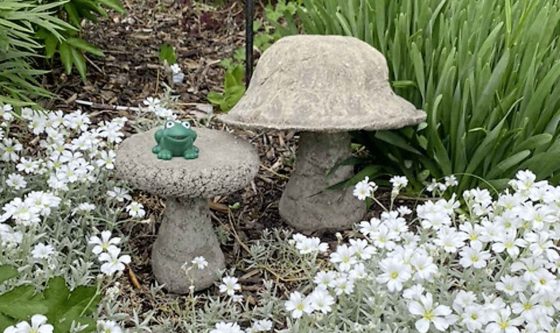
Hypertufa mushrooms (Leila Wegert photo)
Wegert says that the stems for the mushrooms were made in a nylon stocking so that they could be shaped at will. She has made several for her Selkirk garden.
“It was fun making these samples, so the workshop should go smoothly as I have already made all the mistakes!”
Check out these giant butterflies crafted from plastic coat hangers and window screens that were made at a society workshop in spring.

Butterflies made from coat hangers and window screens. (Leila Wegert photo)
“I finally mounted them,” says Wegert. “I am actually not a big fan of ‘kitschy’ garden art, which I suppose these are, but they do add interest to my garage wall.”
Do you have a project or an upcoming workshop that you would like to share? Hit reply on this email and let us know.
Red and white fever
Lois Wales, president of Red River North Tourism, is thrilled with the response by residents and businesses in Selkirk, St. Clements, and St. Andrews to RRNT’s initiative to plant red and white flowers.
Homeowners rushed to deplete the stock of Canadian flags and flag-themed whirligigs and solar lights that were sold at two local dollar stores, says Wales.
“The City of Selkirk has all their planters done – red canna lilies with white flowers and some grasses. We have a lot of pride in our community.”
Did you plant red and white container gardens this year? I combined red and white non-stop begonias in a moss-lined wire basket. We’d love to see what you created!
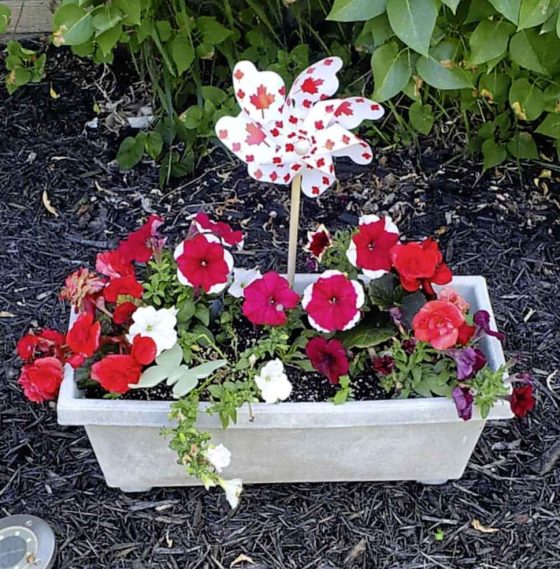
A Canada Day red and white container. (Lois Wales photo)
Hail damage
In the past few weeks, thunderstorms have brought large hail to parts of Manitoba.
Hail damage to infrastructure is costly — but hail damage to plants can break a gardener’s heart.
In the case of severe hail damage, woody plants such as trees and shrubs can gradually recover. Hail-damaged perennials generally recover fully.
If your garden is affected by hail, start by cleaning up debris. Leave in place any foliage — even torn bits of leaves — on damaged plants, as these will utilize photosynthesis for the plant’s growth and recovery.
If perennials and shrubs are completely defoliated, maintain adequate moisture and be patient.
Take heart from Irene Rajfur’s experience. When a large hailstorm ripped through North Winnipeg in August 2023, many plants, including perennials and shrubs in Rajfur’s garden were badly damaged.
At the time, Rajfur wrote in an email to Winnipeg Gardener, perennials such as rudbeckia, Russian Sage, and Shasta daisies were “totally flattened.” Hydrangea shrubs and Cotinus smoke bushes were also defoliated.
But two months later, the hail-damaged plants in Rajfur’s garden were already showing signs of recovery with healthy new growth, and they returned the following year.
Summer reading challenge
This summer, explore the healing power of medicinal plants.
A Cabinet Full of Medicinal Plants: A practical card deck by Monique Simmonds, Melanie-Jayne Howes and Jason Irving, offers the complete package.

(Kaddo / The Quarto Group photo)
Test your knowledge and discover the power of plants! Packaged in an elegant gift box that you will want to display within easy reach, this unique collection includes 60 beautifully illustrated cards, each one offering insight into a different medicinal plant with details like height, parts used, and alternative uses.
The set is divided into eight categories: circulation, digestion, inflammation, infections, skin issues, pain relief, respiratory conditions, and mental well-being.
Endorsed by the experts at the Royal Botanic Gardens, Kew, this educational tool is rooted in scientific knowledge. You will discover many insights into medicinal plants that you can grow indoors or outdoors.
Consider Comfrey, aka boneset or knitbone, a common herb grown locally in many gardens. Known as a traditional medicine for healing wounds, sprains, and bones by making a poultice from boiled leaves, comfrey has been studied in many trials, several of which support its efficacy for pain relief.
About the authors: Melanie-Jayne Howes has a PhD in phytochemistry and is a senior research leader at the Royal Botanic Gardens, Kew. Monique Simmonds is director of the Commercial Innovation Unit and deputy director of science at the Royal Botanic Gardens, Kew, and Jason Irving is an experienced forager, herbalist, and ethnobotanist who is currently undertaking a PhD on the trade of medicinal plants.
I love this card deck and think you will, too!
Upcoming events
Garden-tour season is in full swing with many opportunities to visit Manitoba’s most beautiful gardens.

Garden tours are in full swing. (Val Thomson photo)
• The Charleswood Garden Club’s bus tour to Altona on July 12 is sold out! Registrants are excited to visit Elemental Stone, a two-hectare property that is home to the creations of famed stone artist, Todd Braun.
The tour also includes a visit to Altona’s Gallery in the Park and the Altona Community Garden, which includes an orchard.
• The 3rd Annual Holiday Avenue Project Garden Tour in Portage la Prairie takes place on Saturday, July 12 from 9:30 a.m. to 3 p.m. Visit nine gardens including beautiful Island Park as well as the winner of the 2024 Burgess Shield Award for Best Urban Home Grounds.
The tour also includes an outdoor market. Tickets are $25 and are available at Solomon’s Home & Garden Gift, a local greenhouse in Portage. For more information or to purchase tickets, email holidayaveproject@gmail.com.
• The Manitoba Master Gardener Association’s Annual Garden Tour is on July 19, 9 a.m. to 4 p.m. Featuring nine beautiful gardens in the Kildonan and Transcona areas, visitors will have a chance to talk with master gardeners at each of the gardens.
Tickets are $20. For more information or to purchase tickets, visit the Manitoba Master Gardener Association.
• Birtle Centre for the Arts hosts its annual Garden Tour of Birtle and Area Gardens on July 19 from 10 a.m. to 4 p.m. The tour starts at the Birtle Centre for the Arts, 617 Main Street, Birtle. Tickets are $10; email info@birtlearts.ca or phone 204-842-3846.
• On July 19 and 20, the City of Brandon hosts Brandon’s Open Garden Tours from 10 a.m. to 2 p.m. Follow City of Brandon Parks & Recreation Services on Facebook for garden locations. Tickets are free!
• The Red River North Tourism Garden and Art Tour will be held on Sunday, July 20 from 10 a.m. to 4 p.m. Featuring 10 beautiful private and public gardens in St. Andrews, St. Clements, and Selkirk, this self-guided tour also includes the opportunity to enjoy 15 talented artists showcasing their artwork.
Stroll through gardens while listening to live music from local musicians. Tickets are $25. For more details, visit Red River North Tourism.
Other gardening events for your calendar:
• On August 8 and 9, the St. Vital Agricultural Society will present an annual fair like none other in its storied history. The theme for the 114th Annual Display and Fair is “Cultural Diversity – our shared stories, our shared future” in celebration of Winnipeg’s diverse community.
Plan to attend! St. Vital Centennial Arena, Meadowood and Ste. Annes Road. For more details, visit the society’s website.
• On Saturday, July 19, the Manitoba Regional Lily Society invites you to come to the St. Vital Shopping Centre for the 41st Annual Lily Show.
Enjoy a stunning display of hardy lilies grown in Manitoba by gardeners from many different areas of our province. There will also be lovely floral arrangements to admire. MRLS volunteers will be pleased to answer your questions about growing lilies and creating flower arrangements.
Members of the public are welcome to bring their lily stems and designs for judging. There will be volunteers available to help you stage, classify and enter your stems and designs.
Tips for Showing Lilies:
- Pack up your stems carefully in buckets or other secure holders. Stem holders for the show table will be provided.
- No sign of disease should be apparent on the stem.
- At least one bud must be fully open. More open blooms are great, but none should be faded or past their prime.
- Flowers and foliage should be fresh, clean, undamaged, with no distortions. Some allowances are made at the head judge’s discretion if local weather has been severe.
- When cutting your stems, leave at least one-third of the stem in the garden to feed the remaining bulb, and cut two-thirds of the stem for the show.
- Do not remove the pollen and anthers, but you can clean off the pollen on the petals.
- A show stem is a clean stem, so clean off all debris like spider webs, dirt, etc. Small paint brushes, Q-Tips, small sharp scissors and something to hold the stem in the holder provided, like rhubarb, pipe wrap foam etc., should be brought with you to the show for staging purposes.
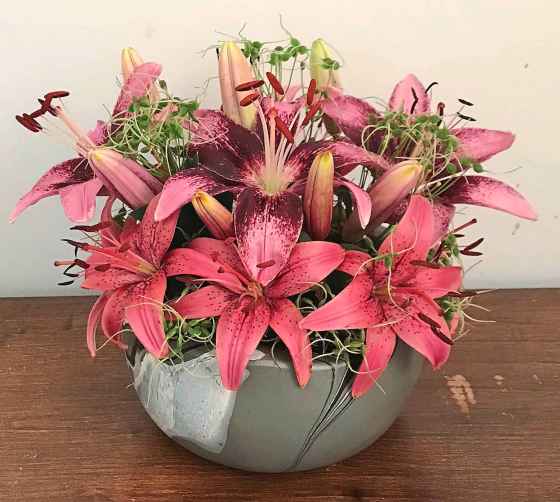
The 41st Annual Lily Show will be held July 19. (Manitoba Regional Lily Society photo)
Name this Plant
Sedum ‘Lemonjade,’ Rock ‘N Grow Collection, Walters Gardens
Unlike most autumn stonecrops, which have pink flowers, Lemonjade features large five- to seven-inch panicles of bright citron yellow flowers in early fall and grey-green toothed foliage. Plant height is 16 to 18 inches (40 to 48 cm); spread is 26 to 28 inches (66 to 71 cm).
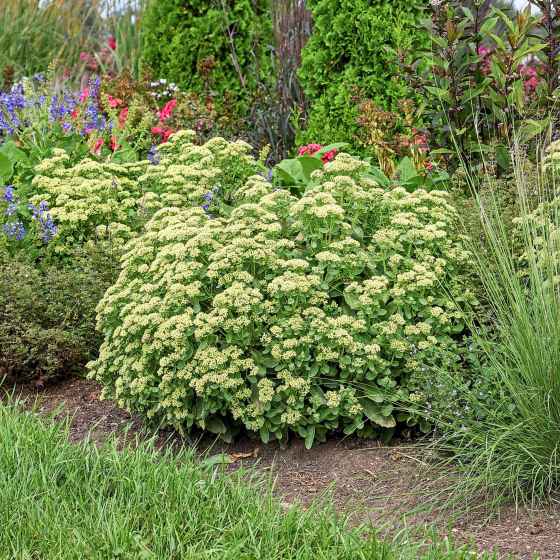
Sedum Lemonjade Rock ‘N Grow Collection (Walters Gardens photo)
The flowerheads bloom in early fall and take on rosy peach tones as temperatures drop.
In addition to its unique colour, Lemonjade sedum does not split open when it blooms, a common problem with older types of sedum.
In winter, the dried flower heads provide food for birds.
|