FIVE STORIES ON TURTLE ISLAND
First Nations continue to unite and demand Canadian governments do not forget their constitutional and treaty relationships amidst trade threats by President Donald Trump and his U.S. government.
This was the subject of outgoing Québec regional AFN chief Ghislain Picard’s final speech as he leaves the role he has held since 1992.
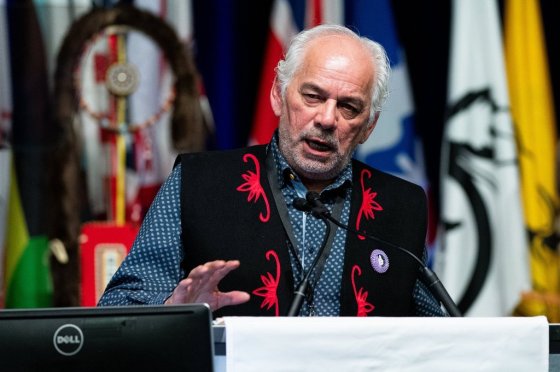
Outgoing Quebec-Labrador Regional Chief Ghislain Picard (Spencer Colby/Canadian Press files)
Pointing specifically to Québec premier Francois Legault’s recent promise to ramp up provincial energy and resource projects, Picard reminded Canada: “It seems like the government of Quebec is trying to stage a response that has not a single consideration for First Nations peoples and their role… But we shouldn’t forget the fact that we have to sit down with First Nations and get their approval.”
Meanwhile, First Nations leader Chief Rodger Redman of Standing Buffalo Dakota Nation told CBC that when he hears “talk of a 51st state” it reminds him to “continue to assert our rights… our message is clear: First Nations] sovereignty isn’t negotiable.”
After nearly 50 years in prison, 80-year-old Anishinaabe activist Leonard Peltier has returned home — having had his sentence commuted in one of outgoing U.S. president Joe Biden’s final acts.
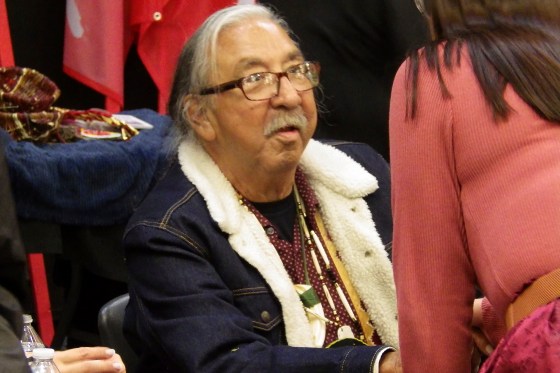
Leonard Peltier greets well-wishers during a welcome event on Feb. 19 at the Sky Dancer Casino Resort near Belcourt, N.D. (Jack Dura/The Associated Press files)
Peltier, a well-known American Indian Movement leader, was convicted of murdering two FBI agents in 1975 during a shootout on Pine Ridge Indian Reservation — a crime Peltier has always said he was wrongly convicted for.
“I spent 49 years straight in prison for something I didn’t do,” he told the audience welcoming him home at the Turtle Mountain Band of Chippewas Nation.
“I didn’t think I was going to make it… [but] I beat the bastards.”
Evidence exists that suggests the FBI falsified evidence in his trial and withheld information that could clear Peltier.
Meanwhile, Peltier’s alleged role in the murder of activist Anna Mae Pictou Aquash around the same time, lingers over him — leading some First Nations leaders, such as those at the Assembly of First Nations, to reverse their nearly 40-year resolution to support his release.
Chiefs and Indigenous leaders across Canada are split over the $47-billion child-welfare deal negotiated between leaders at the Assembly of First Nations (AFN), Chiefs of Ontario, the Nishnawbe Aski Nation and the federal government.
The agreement, which was designed to respond to multiple Canadian Human Rights Tribunal (CHRT) rulings demanding something be done to stop First Nations children being driven into the child-welfare system, was to take place over 10 years and be applied on First Nations across the country.
In October 2024, the majority of chiefs at the AFN — encouraged by First Nations Child and Family Caring Society of Canada executive director Cindy Blackstock (the main proponent who drove the issue at the CHRT) — voted it down and demanded re-negotiation. This led to chiefs in Ontario forging ahead with the deal.
Now, chiefs outside of Ontario, such as Pine Creek Chief Derek Nepinak here in Manitoba, are calling on the AFN to create a “committee of the willing” for those who like the deal and disagree with who he called “non-chiefs taking up space, discrediting the settlement agreement and unfortunately winning enough popular support and criticism to strike down the only solution that we’ve been offered in many, many years.”
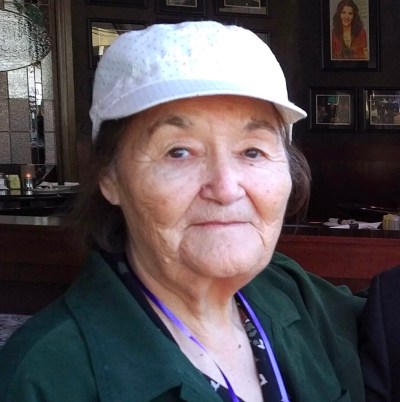
Marion Ironquill Meadmore, the first Indigenous woman to become a lawyer in Canada, has passed away at 89 years of age.
Meadmore was born in 1935 at Peepeekisis Cree Nation, where she attended File Hills Residential school and Birtle Residential School and then moved to Winnipeg, where she eventually became a graduate of law school at the University of Manitoba.
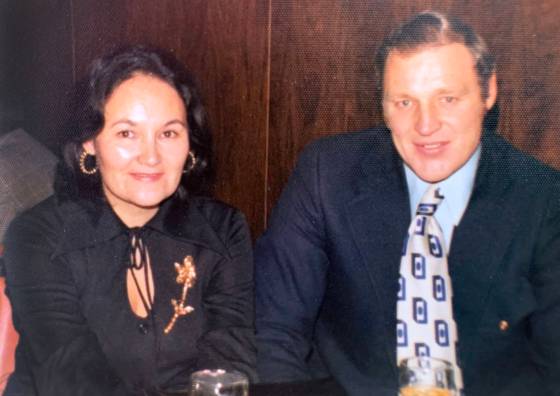
Marion Ironquil Meadmore and husband Ron Meadmore. (Supplied)
In 1956, she married Ron Meadmore, a player for the Winnipeg Blue Bombers. The couple would host the team at their farm in Culross, Man., becoming a significant part of the team during their runs to three Grey Cups in 1958, 1959, and 1961.
Meadmore had an incredible career, winning many awards such as the Order of Canada and an honourary doctorate from the University of Manitoba.
She also co-founded the first friendship centre in Canada and was a crucial part of initial leaders who formed the Assembly of First Nations and the Assembly of Manitoba Chiefs.
In the Free Press this past week, local leader Shaun Loney — Meadmore’s friend and mentee — wrote this touching tribute to her legacy.
This week, the government of Canada launched the $5-billion Indigenous Loan Guarantee Program, aimed at helping Indigenous communities access capital to partake in, as well as instigate and own, natural resource and energy projects.
The program, launched through the Canada Indigenous Loan Guarantee Corporation, started last December.
It is set to provide up to $5 billion in loan guarantees, making it easier for Indigenous groups to pursue ownership and equity in resource development projects.
Enabling Indigenous groups to overcome historic barriers and access resources that will help them navigate business and become meaningful equity partners and owners of natural resource and energy projects, loan guarantees provide a guarantee that the debt will be repaid by the guarantor (the federal government) should the borrower (Indigenous groups) be unable to repay.
IN PICTURES
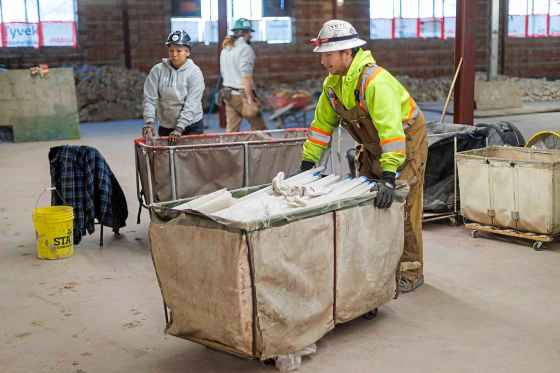
Work is underway on a new Indigenous food hub Ma Mawi Wi Chi Itata Centre and Harvest Manitoba expect to open by 2026. (Mike Deal / Free Press files)
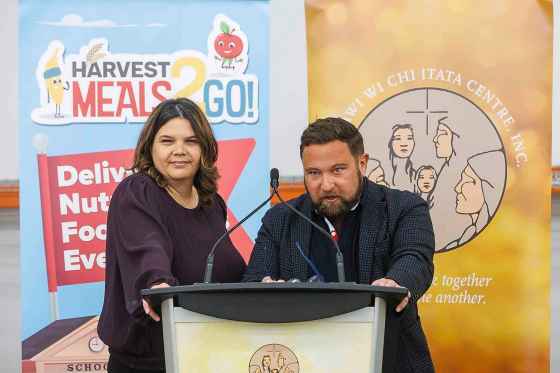
Ma Mawi executive director Tammy Christensen (left) and Harvest CEO Vince Barletta (right) announced a new project to address food insecurity. (Mike Deal / Free Press files)
RECONCILI-ACTION OF THE WEEK
Every week I highlight an action, moment, or milestone forwarding reconciliation, illustrating how far Canada has come – and how far the country has yet to go.
This week, the Urban Circle Training Centre in Winnipeg’s North End has launched a new holistic course in co-operation with the province to recruit more early child-care educators —many of them Indigenous — and increase diversity and cultural competency among daycare staff across Winnipeg.

The Urban Circle training centre has launched a new course for early-childhood educators. (Mike Aporius / Free Press files)
Research shows culturally specific child care supports Indigenous children in gaining a positive sense of identity, culture, school readiness, health and familial relationships — all crucial elements that promote later success and achievement.
The education provides Canadian children with the same elements but also a stronger sense of connection to place, employable skills and an understanding of what it means to be a citizen of Manitoba and Canada.
Joining with Red River College Polytechnic (which has had a nearly 30-year partnership with Urban Circle co-running heath care, family support and early childhood education programs) the two organizations will now use more than $200,000 in funding from the province of Manitoba to operate an accredited diploma program that will recruit child-care educators and equip them with academic and Indigenous cultural knowledge.
Since 1991, Urban Circle has quietly provided culturally appropriate education and training to First Nations, Metis and Inuit people, and other communities across Winnipeg.
|