Things to do in June
This won’t hurt a bit. Pinching off the top portion of flowering annuals really does work. Removing the pretty flowers of annuals that I bring home from the garden centre doesn’t come naturally to me and I almost have to be shamed into doing it by a gardening friend who inevitably says, “What?! You haven’t pinched your plants yet?” But if I don’t pinch off the top of my petunias, coleus, salvia, verbena, and other flowering annuals, she will have bushier plants with more flowers than mine and I can’t have that.
It’s easy enough to do. Just pinch off the top portion above the next set of leaves (the leaf node). In addition to flowering annuals, some other types of plants such as herbs (basil, oregano, rosemary) and late-flowering perennials (phlox, Russian sage, Autumn Joy sedum) also benefit from pinching early in the growing season.
Looking for a quick and easy container idea? Or just tired of the same old same old thriller, filler, spillers? Monoculture container designs use just one type of plant per pot. This type of design works well with small containers such as a low bowl. Depending on the size of your container you may need three or more of the same plant. Mounding annuals with bright chartreuse foliage such as Lemon Coral sedum or Sweet Caroline Medusa Green sweet potato vine look splendid in monoculture designs.
Container garden tips: Group plants according to light and moisture requirements – it’s less work for everyone. Fertilize with a slow-release fertilizer and water in well. (Did you know that Evolve Organic Fertilizer is made right here in Stonewall, Man.? Includes kelp and rock phosphate.) For regular watering, I fill a tall container with water and let the water stand overnight, which takes the chill off the water.
Plant ground covers to control weeds. Planting ground covers shades the ground and suppresses weed growth. Creeping thyme, for example, covers a lot of ground.
And forget the old rule about leaving plenty of bare black soil between rose bushes. Fill up the spaces with pollinator-friendly plants such as Echinacea coneflower, Lady’s Mantle, milkweed, Millenium or Windy City ornamental onion, Russian sage, thyme, yarrow as a natural pest deterrent strategy.
This really works and is the new way of growing roses at Royal Botanical Garden in Ontario as well as the New York Botanical Garden. I wrote about this back in 2020; you can read that article here. I’m also planting a clove of garlic beside each of my roses to deter pests.
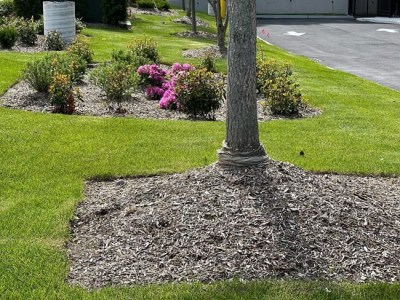
Plant a new tree. Replacing turf grass with a mulch ring (3-ft diameter) around your newly planted tree decreases competition for nutrients and aids in the tree’s growth. A mulch ring also results in less risk of injury to bark on the lower part of your tree when mowing. Register your newly planted tree at Trees Winnipeg.
Water new perennials. Drought tolerant plants, including native plants, need regular watering the first two years so that they become well-established in your garden.
Insect prevention: Were cutworms a problem last year for your in-ground tomato or cabbage plants? Make a collar for your seedlings by placing a can around the base of plants. A plastic cup works well, too. For flea beetles, row covers are a better choice than chemical options. Hand-pick pests on lilies or roses. When you’ve nabbed the pesky bugs, drop them into soapy water. Check the undersides of leaves for signs of larvae. Holes or spots on foliage can be the first sign of a problem.
What to do about rabbits: Rabbits can’t resist munching on new, tender leafy shoots. Protect the favourite plants on their menu with hardware cloth fencing. Please don’t use cayenne pepper, which can cause suffering.
Plant red flowers. 2022 is Canada’s Year of the Garden, and June 18 is Garden Day. Celebrate by planting red flowers. The Plant Red campaign honours front-line workers and those who lost their lives in the pandemic. Dipladenia, also known as bush mandevilla, is a sensational red flowered annual which blooms all summer long right until frost.
Save your plant tags. Rust-proof and weather-proof plant markers made of metal, with name plates for recording name of plant and date planted, are a great way to keep track of your newly planted plants. With perennials, you will thank yourself next year when you are walking through your garden in spring wondering what’s coming up.
Happening this month: The first garden tour of the year is the Urban Retreats Garden Tour, Saturday June 25, 10 a.m. to 4 p.m., rain or shine. Self-guided tour of beautiful Scotia Heights gardens in support of 1JustCity’s West End Drop-in. Tickets are $20. See more details here.
15 beautiful plants for damp shade
In response to my last newsletter, several readers wrote in looking for advice about what to plant in shady areas of the garden. I’m going to tackle damp, shady areas this month.
Keep in mind the usual conditions of your garden, though: a damp area this spring might not be as wet under more normal weather conditions!
There are so many plant options for creating a lush tapestry of scintillating shade-loving plants that will thrive in rich, moist soil and provide a range of textures and beautiful colour from spring through fall.
Try these in container gardens, too, for shady balconies or patios. All are winter-hardy and some are excellent for cutting.

A dappled shade garden planted with astrantia, hydrangea, ferns and more. (Colleen Zacharaias / Winnipeg Free Press files)
Ajuga — A versatile ground cover that comes in many different shades. A carpet of blue flowers in late spring to early summer. The new kid on the block is the Ajuga Feathered Friends series, available in multiple shades of green including bright chartreuse. Deer resistant.
Annabelle Hydrangea arborescence — This floriferous hydrangea shrub steals the show in part shade gardens with its huge white flower heads. Easy to grow and very long-lived in the garden. Benefits from support (a short wire fence) when it is in full bloom or plant in a grouping.
Aralia Sun King Golden Japanese Spikenard — The name is a mouthful, but look for Sun King in the shade perennials section at your garden centre — you can’t miss it. A must-have plant for the shade garden, Sun King’s heart-shaped foliage is bright chartreuse to lime-green in full shade but more of a golden yellow in partial sun. Sun King sleeps longer in the spring than some other perennials in the garden but reliably shows up in late May to early June. It’s a go-to plant in my shade garden. Mature height and width is 3 feet (almost one metre).
Aruncus Goat’s Beard — Beautiful texture and creamy white flowers. Look for Giant Goat’s Beard (4-5 ft/120-150 cm) for the back of the part-shade border or Dwarf Goat’s Beard for the front of the border.
Astilbe – Plant this perennial in part shade to full shade. Create maximum impact with a mix of varieties in a range of heights and that have different bloom times. For early blooms at the front of the border, try the compact Younique Series (12-16 inches/30-40 cm) which comes in three assorted colours, white, pink, and ruby-red. ‘Chocolate Shogun’ is a medium-height astilbe (30 inches/76 cm) with unique chocolate-bronze foliage and soft pinkish-white flower plumes in midsummer. Room for a mighty big astilbe? Mighty Chocolate Cherry grows to 4 feet (1.2 m.) and features velvety red flower spikes in mid- to late summer.
Astrantia — An underused perennial for the part-shade garden. Dainty pincushion-like flowers float on slender stems above a skirt of deeply cut green foliage. With a little deadheading, Astrantia blooms throughout the summer.
Bergenia — A low-growing perennial with large, waxy leaves and upright pink flower clusters May to June.
Brunnera Siberian Bugloss — One of my favourite perennials for areas that receive dappled shade. Masses of electric blue flowers (similar to forget-me-nots) in mid-May to mid-June. Brunnera ‘Jack Frost’ grows to about 12 inches tall (30 cm) and has large, silvery heart-shaped leaves to brighten up shade areas of the garden.
Bugbane — The name isn’t glamorous, but this is a beautiful perennial for part shade to full shade. Blooms August to September. Fragrant, creamy white flower spires float above a dense skirt of deeply cut, dark foliage. For the front of the shade border, try ‘James Compton’ bugbane (2.5-3 ft/76-90 cm). ‘Brunette’ is much taller at 59-70 inches, 150-180 cm and has stunning purple-black foliage and tall fluffy pink flower spikes. Bugbane is deer and rabbit resistant!
Chelone Tiny Tortuga turtlehead — Chelone rhymes with baloney. Spreads to form a low hedge (12-15 inches, 30-38 cm) with dark green foliage. Gorgeous late season colour in the part shade to full shade border starting in late August through to October. Benefits from a location that receives some morning sun. The fuchsia pink flowers provide late-season nectar for hummingbirds ahead of their winter migration.
Diervilla Kodiak Orange — A versatile go-to shrub that can be grown in sun or shade, moist or dry soil. Native to North America; compact (one metre tall and wide at maturity); typically not bothered by deer; pollinator friendly (yellow tubular flowers during the summer; 2021 landscape shrub of the year by Proven Winners; fabulous orange-red foliage in fall.
Ferns — The feathery fronds of ferns add soft texture in part shade to full shade. ‘Lady in Red’ fern is a fast-growing variety that looks stunning by the first week in June.
Hosta — Contrary to popular belief, hosta is not a drought tolerant plant and prefers rich, moist, well-draining soil. To brighten up a shady area, select varieties with cream or white variegation.
Proven Winners 2022 Hosta of the Year is ‘Shadowland Diamond Lake’ which has thick blue, slug-resistant foliage.
The American Hosta Growers Association has selected ‘Island Breeze’ as its Hosta of the Year for 2022. ‘Island Breeze’ is an outstanding selection with thick leaves that have bright chartreuse centres and dark green margins and intriguing red petioles (the portion of the stem beneath the foliage).
Room enough for a substantial hosta? ‘Sum and Substance’ is an architectural beauty (36 inches tall or 90 cm and a spread of 5 ft or 1.5 m.). Her enormous golden-green leaves have good slug resistance.
Ligularia — Choose from several popular cultivars for different bloom types, intense foliage colour, a range of heights, and incredible, surreal blooms. Look for ‘Britt-Marie Crawford’, ‘The Rocket’, ‘Othello’, ‘Desdemona’, and ‘Osiris Café Noir’.
Yew — A dense evergreen shrub that can be grown in heavy shade. Dark green foliage. Yew is a hardy, underused shrub with dark green foliage. It has a mature height of 3-4 ft (1.25 m.) and tolerates shearing to the size that suits you best.
A couple more notes on shady, damp gardens:
If you have a deep-shade situation under a tree, limbing up the lower branches or having the tree thinned professionally by a certified arborist allows more light and air to filter through, giving you more options for plant varieties you can grow. If the soil is chronically saturated, consider building a raised bed.
After all this talk about soil that is moist or very moist, it’s important to keep in mind that whenever you install a new plant, water deeply at the time of planting and mulch with a layer of organic matter, which will help feed the soil and create a healthy environment for plants.
Did someone forward this newsletter to you? Sign up to have it delivered to your own inbox.
Your questions, answered
Have a question for a gardening expert? Email us and we’ll dig up an answer for a future issue of this newsletter.
Which gardening tools are your favourite essentials?
If my shed were on fire or about to float away (either seems possible with the weather this last few years) and I could only save one or two gardening tools, it would have to be my Yankee weeder (for stubborn weeds between paving stones) and swoe (a long-handled hoe for quickly weeding flower or vegetable beds). But wait, where are my hand pruners and weeding fork?
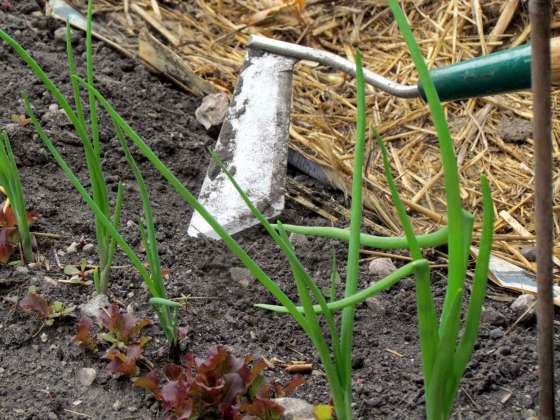
(Colleen Zacharias / Winnipeg Free Press) A swoe is an indispensable garden tool for weeding.
Should I add Epsom salts to my garden?
Every spring, jugs of Epsom salts are displayed front and centre at grocery and hardware stores. Is that because spring is the best time of year for a comforting foot soak? No. Epsom salts contain magnesium sulfate and have long been used as a popular home remedy to correct a supposed magnesium deficiency in soil or, more commonly, to prevent the dreaded blossom end rot (a brown spot at the bottom of a tomato).
A soil test is the only way to determine whether the soil in your home garden has an actual magnesium deficiency. Adding Epsom salts to soil that does not have a magnesium deficiency can injure plants and interfere with the uptake of other nutrients such as calcium.
Blossom end rot in tomatoes is caused by a calcium deficiency, so adding Epsom salts can make blossom end rot worse. The calcium deficiency in your plant may not be caused by a lack of calcium in your soil, so don’t hurry to add calcium to the garden, either. To prevent blossom end rot, water tomatoes and peppers regularly. Avoid letting the soil dry out and maintain even soil moisture around your plants with a layer of organic mulch.
“Please admire my plant!”
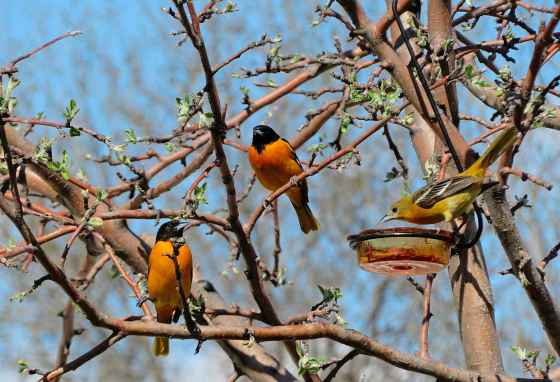
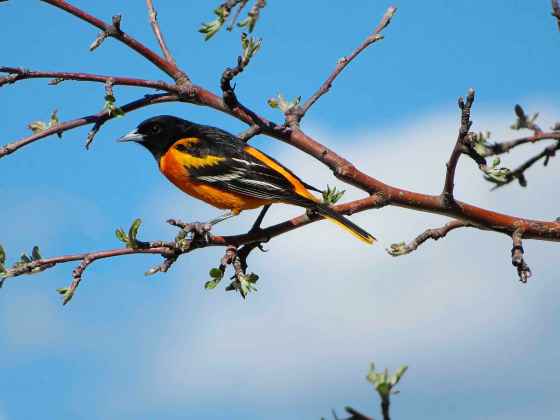
We’ve got a handsome tree leafing out in these photos, but the real stars are the orioles Debbie and Stuart Innes spotted in their south Winnipeg backyard on May 22.
“We put our feeder up and 15 minutes later they were there!”
(Debbie and Stuart Innes)
(Debbie and Stuart Innes)
Got a fabulous flower blooming in your garden? A handsome houseplant? A ravishing radish or elegant eggplant? An attractive annual or pulchritudinous perennial? We want to see it.
Send your submission to us and we’ll feature your gorgeous growth in future issues of this newsletter. Please include a photograph, the name of the plant, your name and any details our readers might want to know about it. Please submit a photograph only if you took it yourself.
|