FIVE STORIES ON TURTLE ISLAND
Prime Minister Mark Carney’s cutting of 16,000 full-time equivalent positions in the public service are resulting in deep gashes to the Department of Justice’s Indigenous rights and relations portfolio— jobs that were expected to be critical to the government’s plans to implement several “nation-building projects.”
Despite Carney’s repeated verbal commitments to respect the legal, constitutional duty to consult Indigenous Peoples on anything impacting Indigenous and treaty rights, many academics and critics – including from the Indigenous thinktank Yellowhead Institute — are warning that the Ottawa’s actions suggest something quite different.
Some Indigenous activists are now openly accusing Carney of playing a “divide and conquer” game with Indigenous leaders by offering loans and economic development instead of recognizing rights.
The Southern Chiefs’ Organization began an advertising campaign this week seeking an amendment to federal legislation that limits First Nations status to certain descendants — what is often called the “second-generation cut-off” under the Indian Act.
Right now, Canadian law stipulates after two consecutive generations of parenting with individuals who do not have First Nations status (or are ineligible), the third generation is ineligible for status.
This policy is, simply, problematic and embedded in fraught and racist ideas of blood quantum — and a perfect way to undermine Indigenous ways of defining who are members of communities.
The federal government has proposed bill S-2 to amend the law and it is making its way through Parliament but is now undergoing extensive “consultation” that is slowing the process of implementation to a halt.
The SCO advertising campaign seeks to end the delay and give Indian status back to thousands of Indigenous peoples who have lost it due to no fault of their own.
This week, the government of Canada joined First Nations organizations in issuing travel advisories to Indigenous travellers visiting the United States due to recent actions by U.S. Immigration and Customs Enforcement (ICE) – advising the use of passports instead of status cards or other tribal identification.
This is a complicated and thorny issue for many Indigenous peoples.
As I point out in this CTV interview, it raises a complicated question of how one wishes to self-identify and allow external forces to control Indigenous identity; it’s a struggle Indigenous peoples have dealt with for generations.
Meanwhile, Native Americans in the United States continue to be harrassed, unlawfully detained, and even assaulted by ICE officers in U.S. cities.
The annual Indspire awards, formerly known as the National Aboriginal Achievement Awards, list is out this week — with several Manitoba connections amongst the winners.
This year’s Métis youth winner is Garrett Hrechka, a member of the Manitoba Métis Federation hailing from Dauphin. The former field hockey star is now building artificial intelligence programs that can assist Indigenous communities.
Elder Fred Kelly (Kizhebowse Makwa), who is honoured for lifetime achievement, comes from the Ojibways of Onigaming in northwestern Ontario and is the uncle of Premier Wab Kinew. Kelly works in Winnipeg sharing his teachings with students and community members, and is a well-deserving recipient.
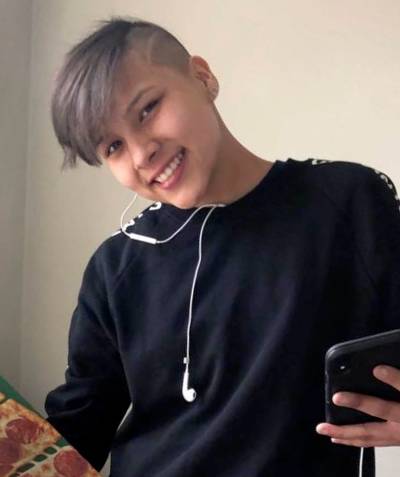
Tia Wood, a winner in the First Nations youth category, is a musician from Saddle Lake Cree Nation in Alberta — but she cut her teeth here in Manitoba, performing at venues such as the Winnipeg Folk Festival and the sākihiwē festival.
Congrats to all winners!
I had an opportunity to hang out for a few hours in the Vancouver airport with new Manitoba Hydro chairperson and former Manitoba Treaty Relations commissioner Jamie Wilson, and was reminded how interesting of a career he has had.
My Free Press colleague Gabrielle Piché has a feature on Wilson this week and I encourage everyone to read it.
I’ve written about the monumental task Wilson has as Manitoba Hydro scrambles and stumbles in Manitoba’s north and have said the provincial Crown corporation will need his savvy and diplomacy more than ever.
IN PICTURES
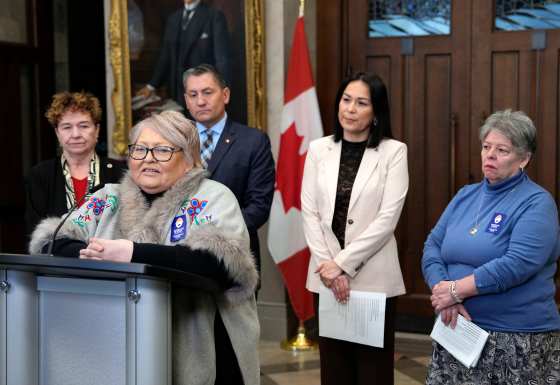
Heather Bear, a survivor with the Survivors Circle for Reproductive Justice, speaks at a news conference calling on the government to pass Bill S-228, An Act to amend the Criminal Code (sterilization procedures), in the Foyer of the House of Commons on Parliament Hill in Ottawa on Tuesday, Feb. 24, 2026. (Justin Tang / The Canadian Press)
RECONCILI-ACTION OF THE WEEK
Every week I highlight an action, moment, or milestone forwarding reconciliation, illustrating how far Canada has come — and how far the country has yet to go.
This week’s reconcili-action of the week is a huge aho! and congratulations to Indigenous Tourism Manitoba,which won the award for provincial or Territorial Association of the Year at the 2026 Indigenous Tourism Awards taking place at the 13th annual International Indigenous Tourism (IIT) Conference last weekend in Edmonton.
Other winners of the best and brightest in Indigenous tourism in Canada are available here.
A non-profit organization, Indigenous Tourism Manitoba supports Indigenous entrepreneurs and features Manitoba Indigenous tour operators in Manitoba. In Manitoba, Indigenous tourism is worth $91 million to the provincial economy and employs nearly 1,600 people working for 170 Indigenous-owned businesses.
As further proof of the great work they are doing, Indigenous Tourism Manitoba will host next year’s IIT Conference right here on Treaty 1 in Winnipeg — bringing more attention and economic development to one of this province’s most important growing industries.
|