|
I’ve been thinking a lot about “third places” lately.
Not “third place” as in bronze-medalling in a competition, but the concept of “third places” as defined in the 1980s by sociologist Ray Oldenburg.
“Third places” are places that are neither home (first place) nor work (second place). Third places usually have low or no barriers to entry and have a strong social element. Libraries, cafes, pubs, gyms, places of worship, community centres, parks, playgrounds — these are all examples of third places. They are places that might have “regulars,” that can foster community and belonging. Third places, Oldenburg argued, are important pillars of a healthy society.
Advertisement

Notice the list above also describes the kinds of places that closed during various pandemic-related shutdowns. All our places became the same place.
When the world began reopening, there was a renewed emphasis on the role of third places, particularly those located outdoors. Hence the proliferation of outdoor pop-up patios.
But a lot of third places never came back, or were being slowly phased out long before the pandemic for a host of socioeconomic reasons, including gentrification.

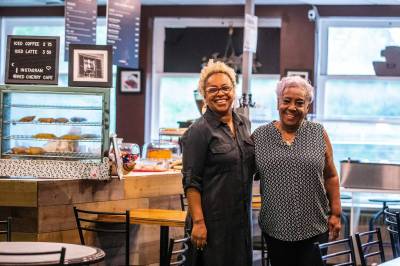
Le Patio 340 is a community space run by the Centre culturel franco-manitobain in St. Boniface. (Supplied)
I personally feel hard up for third places. I’m not a “regular” anywhere. What I really want is a ’90s-style coffee house, complete with those bowl-sized mugs and overstuffed furniture.
I want a place you can really linger in. Third-wave coffee shops seem very opposed to lingering; I don’t want to sit on a raw-edge wooden block for any length of time, thank you so much.
For generations of teenagers, the third place was the mall. We stretched our babysitting money to buy chai lattes from Second Cup (‘90s coffee house!), satsuma lip balm from The Body Shop, or sale-bin underwear from La Vie en Rose. Maybe go halfsies on some New York Fries.
But mostly, it was an easy place to hang, impervious to Winnipeg winters and centrally located. I also tagged along to a lot of my friends’ youth groups; despite having no or little money and being underage, it was almost easier to have third places as a child.
Part of Oldenburg’s vision of third places is that they are places at which you could meet someone new. I remember, as a kid, visiting my great-grandmother in Lethbridge, Alta., and striking up a two-week friendship with a girl I happened to meet on the playground (my third place when I was there). I saw her almost every day of our trip. We instantly got along.
But I didn’t know her last name, and we didn’t exchange mailing addresses (this was the early ’90s). So, I went to the park the following summer, hoping, maybe, she’d be there. I waited and waited, until the sun started sinking and it started to get cold. I never saw her again.
Many people have bemoaned the erosion of physical third places because of the internet. But, a small thought experiment, here: isn’t social media a third place?
If the definition of a third place is a community in which we spend time, that has no or low barriers to entry, that exposes us to new people and, therefore, new ideas, then I think social media is certainly a third place.
But we’re losing those virtual third spaces, too. I used to make friends on social media — or, at least, have banter with friendly strangers. Now, increasingly, being on social media feels like posting into the void.
Where are your third places?
|