|
“In politics, some deceit or moral dishonesty is the oil without which the machinery would not work.”
— British journalist and politician Woodrow Wyatt
Political advertising seems to be reaching new levels of dishonesty. But are ads produced by governments or parties worse now than they’ve ever been?
Advertisement
The Macro
I am colour-blind and would have missed the deception. Thankfully there are enough people at the Toronto Star who are colour-capable, thus allowing them to catch the Ontario Progressive Conservatives in an act of Photoshop dishonesty.
Over the weekend, the Ontario PCs posted numerous videos and photos on social media showing the crowd attending a “Ford Fest” barbecue in a Scarborough park last Friday night. The event — an homage to political barbecues Ford and his infamous brother Rob Ford held in the backyard of their West End home when they were just getting into politics — was touted by the governing party of Canada’s largest province as an opportunity to celebrate community and (by clear implication) pay tribute to “Ford Nation,” the self-aggrandizing slogan the bombastic Ontario premier has attached to the electorate of his province.
Of course, Ford Nation is somewhat fractured right now as the great man at the helm of the political movement he named for himself is struggling. A recent Angus Reid poll found Ford’s approval rating had dropped to 21 per cent, the lowest level he has seen since becoming premier in 2018.
So, it was not surprising the Scarborough Ford Fest event was less like a love-in and more like an anti-Ford government protest. According to the Star, the crowd was dominated by members of the Ontario Public Service Employees Union (OPSEU), a huge public sector labour group representing more than 200,000 provincial civil servants.
Here’s where the issue of colour comes in.
PC party operatives had attempted to paint the crowd in Tory blue T-shirts, Ford Nation hand-held flags and other Ford Nation schwag. Unfortunately, those efforts were undone by a much larger group of OPSEU protesters wearing purple T-shirts emblazoned with the slogan “Worth Fighting For,” a campaign to protect public services from the Ford government’s austerity. The OPSEU protesters actually drowned out Ford’s comments when he attempted to address the crowd.
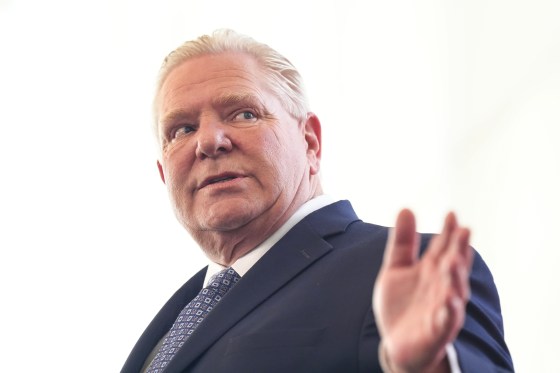
Ontario Premier Doug Ford (Chris Young / The Canadian Press files)
Then, images of the event started appearing on social media. And despite the fact that angry purple-shirted protesters had dominated the crowd — turning their back on the premier and drowning him out with boos and whistles — the photos posted by the party and members of the Tory caucus seemed to show only blue T-shirts.
The PC party later said they had only “colour balanced” the image as part of normal photo editing to make it more vivid when it was posted online. Various media outlets showed the photos to professional photographer and image manipulation experts who suggested efforts had been made to change the actual colours in the photo. “This is manipulation,” said Gaëlle Morel, curator at the The Image Centre, a photo archive at Toronto Metropolitan University.
It should be noted there is nothing particularly new about allegations of dishonesty and deceit in political advertising. Lies, exaggerations and deceitful hyperbole are a foundational commodity in all nations and have been since the dawn of democracy. And yet, as the Ontario Tories have shown, technology is opening up whole new frontiers of deception.
While Ontario Tories were struggling to explain their grasp of primary colours, the federal Conservatives were dealing with their own mini-controversy over technology and political advertising. Turns out an ad run by the Tories on social media — which riffs off comments by Prime Minister Mark Carney about the nature of “technical recessions” — was created solely with AI-generated actors.
Once you know the “actors” in the spot are AI-generated, the entire thing takes on a nefarious feel. Politicians have long been using actors to portray exaggerated scenarios to push political messaging. But somehow, when the “people” in the ads aren’t really people, it makes ads like this seem particularly disingenuous and dangerous.
I could go through the growing global trend to ban AI from campaigning, and the growing concerns about how bad actors are using AI deepfakes to manipulate elections, and how deliberately fake stories and rumours generated by those same bad actors are now part of elections all over the world. Thankfully, I don’t have to, because columnist David McLaughlin — a veteran political operative — has done it for me. Read his thorough analysis to see how big this problem has become, and how big it will likely be in the future.
AI is here to stay, as is Photoshop and — more importantly — the moral and ethical flexibility of politicians and parties to do and say anything to win an election.
|