Canadians spent $5.7B on cannabis in 2017: StatsCan The government's data agency also wants Canadians to share details of their recent marijuana purchases (anonymously, of course)
Read this article for free:
or
Already have an account? Log in here »
To continue reading, please subscribe:

Digital Subscription
One year of digital access for only $205*
- Enjoy unlimited reading on winnipegfreepress.com
- Read the E-Edition, our digital replica newspaper
- Access News Break, our award-winning app
- Play interactive puzzles
*First annual payment billed as $205.00 + GST for one year. This annual subscription will automatically renew at $233.00 + GST every 52 weeks (10% off the regular annual price of $259.35). Offer available to new and qualified returning subscribers only. Cancel any time.
To continue reading, please subscribe:
Add Free Press access to your Brandon Sun subscription for only an additional
$1 for the first 4 weeks*
- Enjoy unlimited reading on winnipegfreepress.com
- Read the E-Edition, our digital replica newspaper
- Access News Break, our award-winning app
- Play interactive puzzles
*Your next Brandon Sun subscription payment will increase by $1.00 and you will be charged $17.95 plus GST for four weeks. After four weeks, your payment will increase to $24.95 plus GST every four weeks.
Read unlimited articles for free today:
or
Already have an account? Log in here »
Hey there, time traveller!
This article was published 25/01/2018 (3142 days ago), so information in it may no longer be current.
It’s official, according to Canada’s government statistics agency: Canadians spent a ton of money on weed last year.
To be exact, Statistics Canada estimates 4.9 million Canucks between the ages of 15 and 64 shelled out $5.7 billion for marijuana in 2017. For comparison, Statistics Canada offered 2016 household spending data for two other popular drugs — $22.3 billion on alcohol, and $16 billion on tobacco.
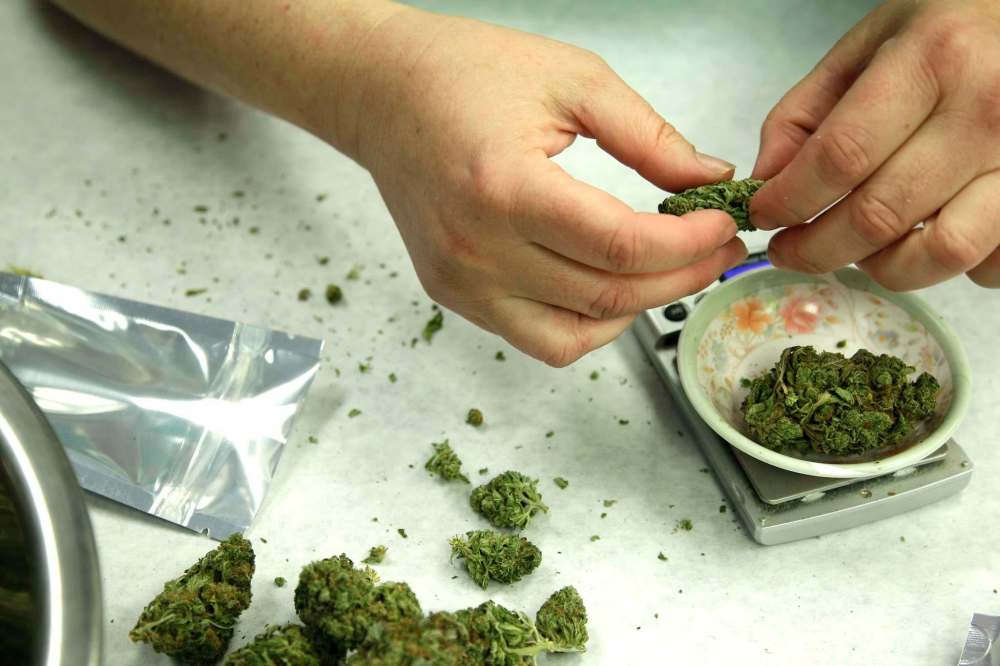
The $5.7 billion figure, released Thursday morning, covers cannabis purchases for both medical and recreational purposes. More than 90 per cent of that spending was on cannabis used for non-medical purposes.
Even though Canadians spent much more on booze and smokes than they did on weed last year, Statistics Canada notes the size of the domestic cannabis industry (an estimated $3.4 billion in 2014) was larger than the domestic alcohol and tobacco industries that year ($2.9 billion and $1 billion, respectively).
“A substantial amount of the tobacco and alcohol consumed in Canada is imported, which contributes to the smaller size of these industries compared with cannabis,” wrote Statistics Canada in its online release.
The vast majority of the cannabis purchased was produced in Canada, said Statistics Canada, with about $300 million purchased from outside the country. Statistics Canada estimates Canadian cannabis producers sold $1.2 billion worth of product internationally (and illegally) in 2017.
Statistics Canada also estimated Canadian cannabis prices going back to 1961, and said those prices have risen by an average of 6 per cent annually between then and 2017. The average national price for one gram of cannabis in 1961 was around $5 in 1961 dollars, peaking at $12 per gram in 1989. The estimated national average price for non-medical cannabis in 2017 was $7.43, compared to $8.18 for cannabis for medical purposes.
Understanding Statistics Canada’s methodology
This data isn’t perfect. Statistics Canada is clear that its estimates should be considered “provisional and subject to potentially large revisions because they rely heavily on a number of assumptions, models and sparse data sources related to the production of the mostly illegal cannabis industry.”
Statistics Canada researchers have been working on this report since summer 2017, said James Tebrake, director general of Statistics Canada’s Macroeconomic Accounts Branch.
“The biggest activity was trying to find data in order to put something out that’s credible and can be a good start for talking about the cannabis industry and cannabis expenditures in Canada,” he said.
Statistics Canada started by going through decades of government surveys, some of which ask Canadians for details about their drug consumption.
“What we’ve done is, we’ve taken that whole history of data (and) put all those data points together,” said Tebrake. “Where we have missing years, we would interpolate or model those missing years to get a time series of consumption.”
“People have been consuming cannabis for the last 50 years. It’s always been there. Just because it’s above-ground doesn’t mean that there’s new growth.”–James Tebrake
After creating those historical estimates of how many Canadians consume cannabis and how frequently they do so, Statistics Canada developed estimates of the average amount of cannabis consumed by Canadians every year.
The next step was to estimate prices, said Tebrake. Modern pricing data was derived “mostly” from data collected by PriceOfWeed.com, an online cannabis price crowdsourcing tool.
“Prior to that, we relied on a number of research studies that periodically report prices as part of their research,” he said.
“But prior to about the 1990s, there’s really not a lot of information. So what our assumption was is that the price is going to be reflective of the cost of the inputs to produce the cannabis. So if, for instance, electricity prices were increasing, then whoever’s producing cannabis would need to raise their price to cover the increasing price of the inputs.”
Collecting better data for the future
Even though the agency’s estimates of past cannabis prices are imperfect, it’s important to have some kind of historical starting point for the price of cannabis, said Tebrake.
“One of my jobs is to tell Canadians, every quarter, every month, did the economy grow or not, and by how much,” he explained.
“If I were to just put cannabis in in the third quarter of 2018, assuming it’s legalized in July, I would then say, ‘Oh, the economy grew (by) probably one of the higher growth rates we’ve ever seen because we’ve legalized cannabis.’ But that’s not an accurate reading at all because people have been consuming cannabis for the last 50 years. It’s always been there. Just because it’s above-ground doesn’t mean that there’s new growth.”
Estimating prices all the way back to 1961 is useful for regulators and policymakers who need datasets that cover long periods of time to do their work, he said.
As Statistics Canada improves its data collection methods on cannabis prices, it will be revising its figures for 2017 and previous years, Tebrake said.
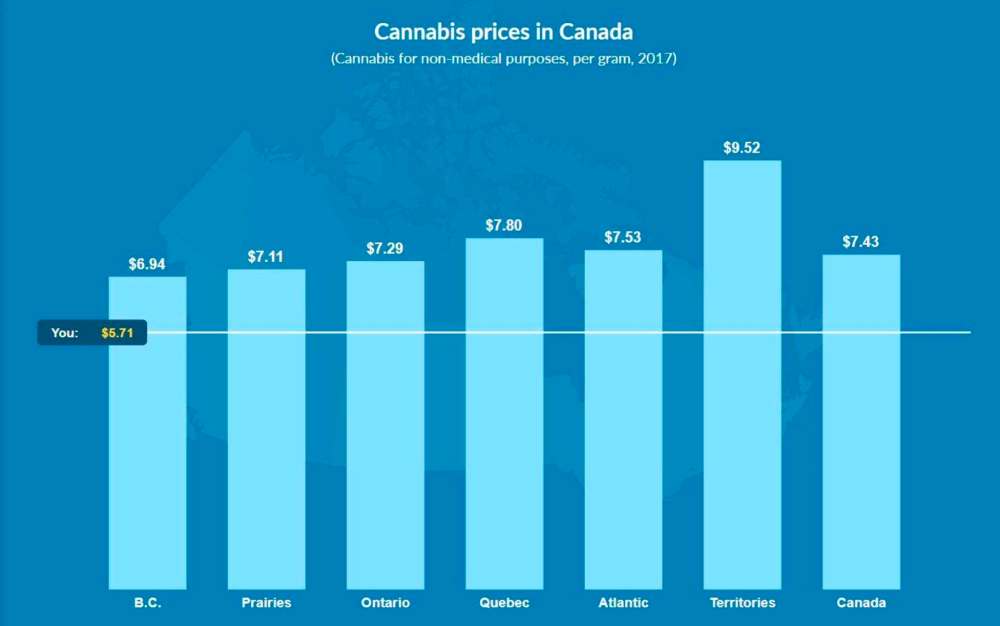
To that end, the agency has unveiled its own crowdsourced data tool to collect data about Canadian cannabis spending. Users can anonymously submit data on the prices and quantities of their own cannabis purchases, and also share information about how much cannabis they use on a monthly basis. As a reward of sorts, submitters are presented with a chart showing how their purchase price compares with average prices by region.
Canadians are already using the tool to share their cannabis price data with Statistics Canada, said Tebrake.
“We’ve already got a few quotes in, and they look very reasonable compared to what we’ve come up with, so that’s encouraging.”
solomon.israel@theleafnews.com @sol_israel