The domino effect Changes impact food sources, animal populations
Read this article for free:
or
Already have an account? Log in here »
To continue reading, please subscribe:
Digital Subscription
One year of digital access for only $1.44 a week*
- Enjoy unlimited reading on winnipegfreepress.com
- Read the E-Edition, our digital replica newspaper
- Access News Break, our award-winning app
- Play interactive puzzles
*Billed as $5.77 plus GST every four weeks. After 52 weeks, price increases to the regular rate of $19.95 plus GST every four weeks. Offer available to new and qualified returning subscribers only. Cancel any time.
To continue reading, please subscribe:
Add Free Press access to your Brandon Sun subscription for only an additional
$1 for the first 4 weeks*
- Enjoy unlimited reading on winnipegfreepress.com
- Read the E-Edition, our digital replica newspaper
- Access News Break, our award-winning app
- Play interactive puzzles
*Your next Brandon Sun subscription payment will increase by $1.00 and you will be charged $17.95 plus GST for four weeks. After four weeks, your payment will increase to $24.95 plus GST every four weeks.
Read unlimited articles for free today:
or
Already have an account? Log in here »
Hey there, time traveller!
This article was published 23/10/2020 (2190 days ago), so information in it may no longer be current.
Each species feels the weight of climate change in different ways, which then leads to cascading effects through food webs and entire ecosystems.
The stressed Arctic fox population offers a superb example in northern Manitoba.
This cute, fuzzy species of the canine family stands about 30 cm tall, about two thirds of the size of their red fox cousins. It is, despite its small stature, the primary terrestrial predator in the Arctic.
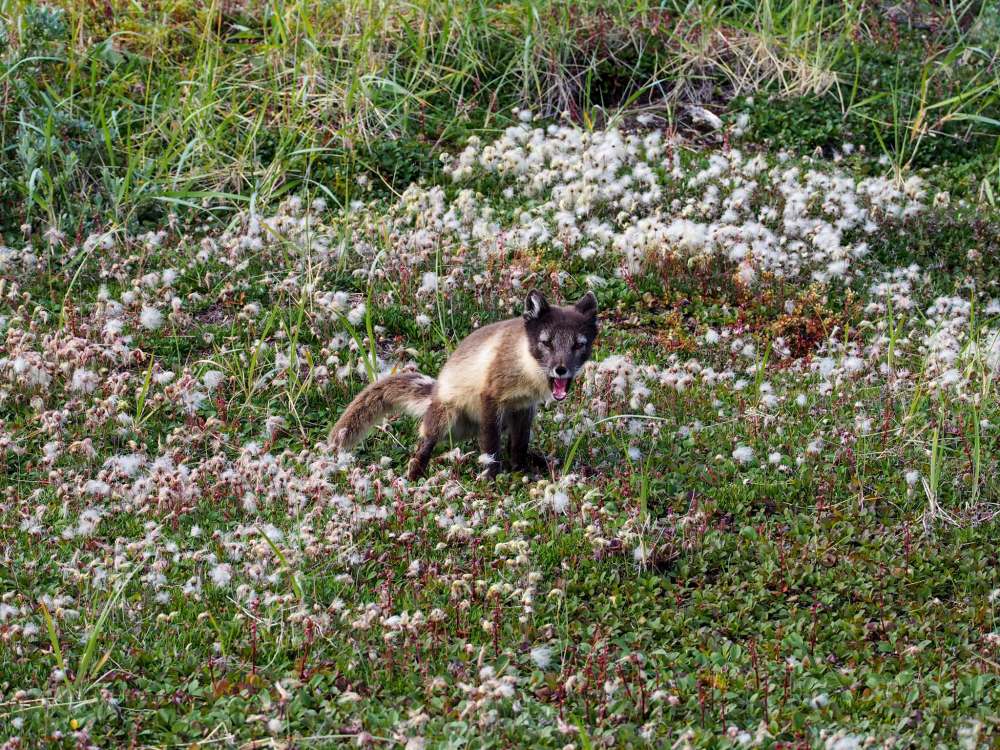
Arctic foxes experience climate change through several mechanisms. First, they are (and always have been) heavily influenced by the fluctuations in the population size of lemmings, a rodent that acts as their primary food source, especially critical in the spring. But the lemming population is declining.
Arctic foxes are also impacted by changes in the sea-ice ecosystem, since they’re known to scavenge the remains of kills left behind by the likes of polar bears. So, when polar bears have a good year, historically, the foxes do, too. But polar bears are having fewer good years.
“We’ve found there’s a long-term decline in the Arctic fox numbers in this area,” says Jim Roth, a professor of biological science at the University of Manitoba.

“There’s lots of annual variation. Some years, people still see lots of Arctic foxes around, other years not so many…. But, if you look at the long-term trend over the last 50, 60 years there has been a decrease.”
Roth and his team of researchers regularly monitor 120 fox dens in the area and they use data on the number of animals trappers have harvested as an index to follow and monitor the population’s health.
But there’s another ripple in the story: Arctic foxes now have competition for resources.
“We are finding more red foxes out on the tundra,” Roth says.
Climate change is expected to create a more hospitable environment for the red fox on the northern limits of its habitat, and with that, the population is expected to prosper. Roth is fascinated by the southern creature’s encroachment into a new biome. But that change might come at the cost of the health of the Arctic fox population here.
“Competitors can compete indirectly by eating all the food… or directly through interference,” he says. “Red foxes are known to kill Arctic foxes.”

In 2015 the photo that garnered the award for wildlife photographer of the year, was captured by an amateur photographer who spotted a bloodied, deceased Arctic fox grasped in the mouth of a red fox near Cape Churchill.
“Churchill is such a cool place, because you’ve got the intersection of these three different biomes — you’ve got the forest, the tundra, you’ve got the marine environment — and so I’m really interested not only in interactions between species, but species that are crossing ecosystem boundaries.”
From their study of fox dens, which are used repeatedly over hundreds of years, the researchers are finding more inhabited by red foxes.
Both foxes are impacted by lemming numbers.
“Churchill is such a cool place, because you’ve got the intersection of these three different biomes– you’ve got the forest, the tundra, you’ve got the marine environment.”
– Jim Roth, professor of biological science at the University of Manitoba
“I’m really interested in food webs. Species interactions. How changes amongst one species affects others, both directly and indirectly,” Roth says.
“Lemmings are, arguably, the most important species for wildlife on the tundra. They have these dramatic fluctuations in abundance. When they’re really abundant all the predators have lots to eat. Then they reproduce and so predator populations go up. Then when the lemming populations crash, the predators have to feed on something else. Then they nail all the birds and everything else.”
Lemmings rely on snow to burrow into and protect them throughout the harsh winters. But climate change has brought about changes in snow quality, which Roth believes has led to a dampening of the lemming populations. The good years aren’t as good as they once were.
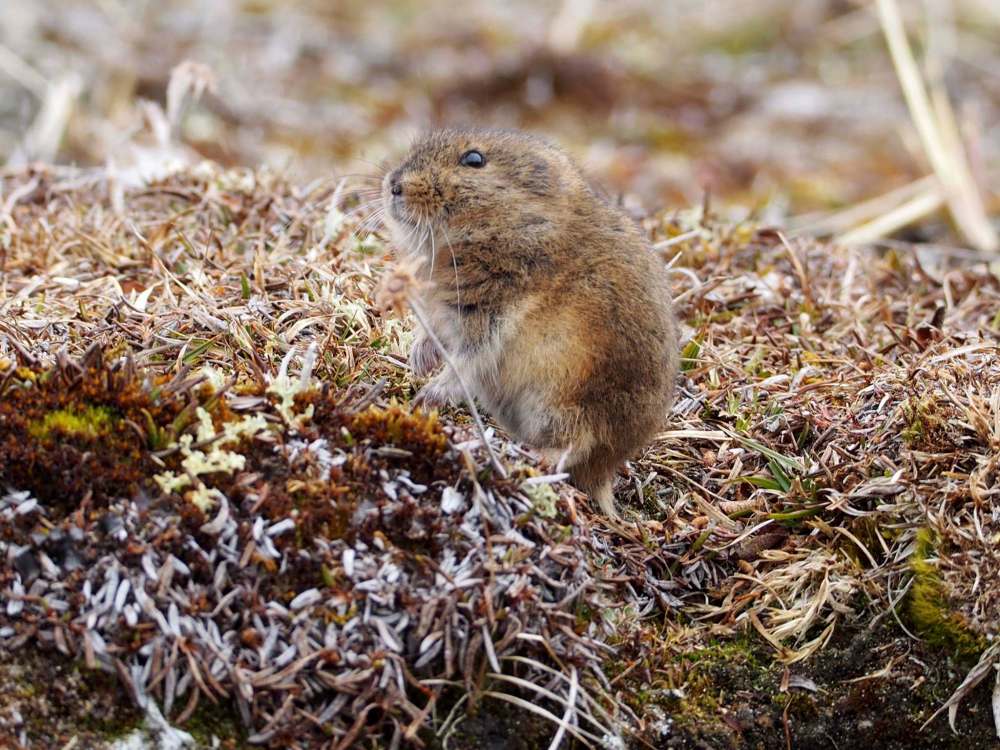
When he was a graduate student in the mid-1990s, in a good year lemming populations would be about 12 animals per hectare — now it’s two, he says.
“That’s a peak year now,” he says. “Which is just bizarre, given how important lemmings are.”
The possible silver lining here might be that red foxes are not the only southern dwellers that are picking up and moving north. While lemmings have traditionally been the dominant rodent in these parts, Roth and his research team have also begun trapping more meadow voles, which could potentially act as a new food source for both foxes.
DNA analysis of fox fecal matter by one of Roth’s graduate students has shown that the animals are just as likely to have eaten voles now as lemmings.
The more research Roth and his team pursues, the more questions they have. But without a doubt the world for the Arctic fox in this subarctic region is changing.
“I think the biggest change is the change in the distribution of species,” he says.
“We’re getting more of these southern generalists moving up north into where you typically have these Arctic-adapted species, because southern species couldn’t persist. It’s getting (to the point that) lots of tourists come up in the fall to see polar bears, and they never see an Arctic fox, they see red foxes.”
sarah.lawrynuik@freepress.mb.ca