Still standing A year post-invasion, defiant Ukrainians have truly come together to build something, even in the face of Russian atrocities and destruction

The images still feel fresh in my mind — of bombs falling on Kyiv, of people crying as they sheltered in the metros, of millions of people boarding trains to flee, kissing their fathers, brothers, husbands goodbye, not knowing if they would ever see them again.

Read this article for free:


or

Already have an account? Log in here »

To continue reading, please subscribe:

Subscribe and receive a limited-edition Free Press branded hat or tote.

Digital Subscription

One year of digital access for only $205*

  • Enjoy unlimited reading on winnipegfreepress.com
  • Read the E-Edition, our digital replica newspaper
  • Access News Break, our award-winning app
  • Play interactive puzzles

*First annual payment billed as $205.00 + GST for one year. This annual subscription will automatically renew at $233.00 + GST every 52 weeks (10% off the regular annual price of $259.35). Offer available to new and qualified returning subscribers only. Cancel any time.

To continue reading, please subscribe:

Add Free Press access to your Brandon Sun subscription for only an additional

$1 for the first 4 weeks*

  • Enjoy unlimited reading on winnipegfreepress.com
  • Read the E-Edition, our digital replica newspaper
  • Access News Break, our award-winning app
  • Play interactive puzzles
Start now

*Your next Brandon Sun subscription payment will increase by $1.00 and you will be charged $17.95 plus GST for four weeks. After four weeks, your payment will increase to $24.95 plus GST every four weeks.

Opinion

Hey there, time traveller!
This article was published 25/02/2023 (1295 days ago), so information in it may no longer be current.

The images still feel fresh in my mind — of bombs falling on Kyiv, of people crying as they sheltered in the metros, of millions of people boarding trains to flee, kissing their fathers, brothers, husbands goodbye, not knowing if they would ever see them again.

But those images from one year ago, I watched from a distance, on TV and computer screens from the safety of my home in Winnipeg.

This year, on the anniversary of the Russian invasion of Ukraine, I will stand in Kyiv’s Maidan (Independence) Square and take a deep breath in — savouring the fact this country still stands.

Make no mistake, this country stands because of the strength of its people, not because of gaffes and miscalculations made by the Russian invaders, though there were many of those.

Worse than those images of bombs falling in the first days of the invasion were the ones that came months later. The people with hands tied behind their backs and executed in the streets of Bucha and Irpin. The mass grave of Izyum. This immense pain and sadness should have been enough to swallow the country whole, but Ukraine has seen worse, and its people are stronger than hate.

Bearing witness to this chapter in Ukraine’s long and winding history has both broken my heart, and made it completely whole, renewing my faith in the goodness and strength of humans. The Ukrainians who shared their stories through me this year are the epitome of resilience, and defiance.

In the midst of an attempted genocide, Ukrainians have worked to build a stronger country and to care for one another more deeply than ever before. But the immense pain cast on the people of this country will have ripple effects for generations.

Last year, as Russian tanks rolled towards the capital of Kyiv, I wrote in this paper about my fear that Ukrainians would be plagued with the intergenerational trauma that has plagued my family that fled Ukraine for Canada after the Second World War.

That fear, I know now, was justified and has been realized. Nearly every life here has been irrevocably changed.

Kate, 33, a digital design artist living in Kharkiv dreamed of starting a family before the invasion, but is now too afraid to be in such a vulnerable state. She says she is afraid of her phone ringing because she has received too many calls this year of lost loved ones.

Illia, a soldier recovering in the now-overflowing rehab hospital in Lviv, will spend the rest of his life being reminded of this war every time he looks in the mirror as his face shows the burns resulting from the explosion of an anti-tank mine. But he hopes to represent his country one day in the Paralympics.

Nastia, 28, while she raised her infant daughter, watched from central Ukraine all year with the hope Ukrainian forces would liberate her home city of Kherson. But when they did, Russians began shelling the city to such an extent it has become far more dangerous now than it ever was under Russian occupation.

Nastia, this month, made the same decision my grandparents did and she stopped waiting for peace in her country and instead came to Canada.

One soldier told me this year that while both sides of this war have soldiers, one side is building while the other destroys, that’s how Ukrainians differentiate themselves, he said.

That is what I have witnessed in Ukraine this year — the building up of that shared national identity. It’s been an honour of a lifetime to document this chapter in this country’s history. For me, it had the added benefit of helping me to better understand my own family’s history in a deeper and more meaningful way.
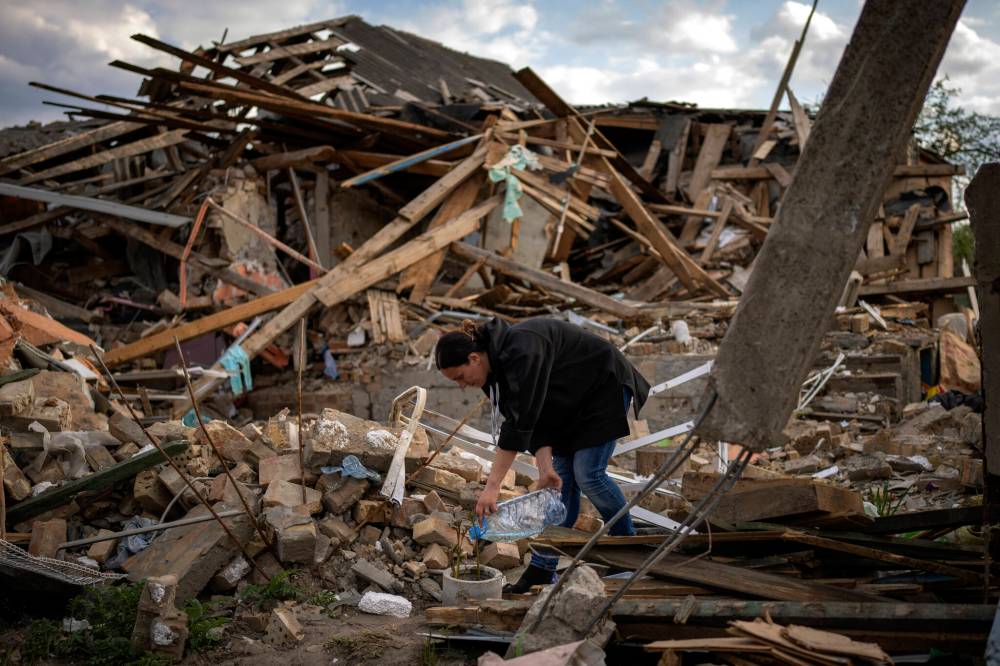
Anna Shevchenko, 35, waters the few flowers that survived in the garden of her home in Irpin, near Kyiv, last May. The house, built by her grandparents, was nearly completely destroyed by Russian bombing last March. (Emilio Morenatti / The Associated Press files)

I always knew I had Ukrainian roots, but two generations removed, I’d never taken an active role in engaging with that cultural background. This year, I was inspired by the actions of Ukrainians to change that. I’ve begun language classes. This summer my brother and I got tattoos to remind us of where we came from. Sunflowers now dance across my shoulder while the Ukrainian tryzub (the country’s coat of arms) was the national symbol he opted for.

I very selfishly hope to earn the right to truly call myself Ukrainian one day.

This year has changed every Ukrainian — and the country’s identity. I hope they continue to use this horrific destruction to build something beautiful, something even better than before. I hope the world will continue to take notice of this resilience, and I hope to be here to document every step of that effort.

Sarah Lawrynuik is a Canadian-Ukrainian freelance journalist, and former Free Press reporter, who’s reported extensively on Russia’s war in Ukraine.

Report Error Submit a Tip

More Stories

Lone Manitoba 9/11 victim's legacy lives on helping Inuit students become nurses

Melissa Martin 13 minute read Preview

Lone Manitoba 9/11 victim's legacy lives on helping Inuit students become nurses

Melissa Martin 13 minute read Yesterday at 5:24 PM CDT

On the night before the morning that everyone remembers, Ellen Judd spoke to her partner, Christine Egan, several times on the phone. Egan was in New York, where she’d gone to look after her nephews so her beloved brother, Michael, and his wife, Anna, could treat themselves to an anniversary vacation.

Usually, Judd would have been there, too. The couple had been together for more than 15 years, and loved sharing all the good parts of life. But at the time, she was an anthropology professor at the University of Manitoba, and the school year was just starting; she had classes the next day. Staying connected by phone would have to suffice.

In their calls that night, Judd remembers, Egan was happy. Christmas was the main topic. They were planning to spend the holiday with Judd’s family in Ontario, and talked about when to book flights. Egan was looking forward to that visit; Judd’s family “loved her to bits,” the now-retired professor says, and the affection was mutual.

The next day, Egan said, she planned to go into Manhattan with Michael. He was an executive at Aon, a global risk, retirement and health services corporation, and had an office on the 105th floor of the World Trade Centre’s South Tower.

Read
Yesterday at 5:24 PM CDT

Artist’s inspired work brings Red River Métis story back to Portage and Main

Conrad Sweatman 8 minute read Preview

Artist’s inspired work brings Red River Métis story back to Portage and Main

Conrad Sweatman 8 minute read Updated: 2:47 PM CDT

Jennine Krauchi calls them the “grandmothers.” “They speak to you very silently. You never hear a word, but they speak,” Krauchi says, referring to the antique pieces of Métis needlework she’s carefully studied for years. But there are few precedents for her latest art project: a 85-foot-wide by 32-foot-high chain curtain of Métis needlework that drapes over the historic Bank of Montreal’s neoclassical facade.

Read
Updated: 2:47 PM CDT

It all comes down to the Banjo Bowl

Taylor Allen 7 minute read Preview

It all comes down to the Banjo Bowl

Taylor Allen 7 minute read 7:26 PM CDT

It all started with a comment made by a kicker.

In 2003, Troy Westwood referred to the fine folks of Saskatchewan as “banjo-pickin’ inbreds.”

The following season, the Banjo Bowl was officially born, and it quickly became one of the most notable annual events on the Prairies.

The 22nd edition kicks off today, with the Winnipeg Blue Bombers (6-6) hosting the Saskatchewan Roughriders (8-4) at 3 p.m. in a crucial West Division showdown.

Read
7:26 PM CDT

Canadians loving Carney’s decision to stand tall against floundering U.S. bully

Tom Brodbeck 5 minute read Preview

Canadians loving Carney’s decision to stand tall against floundering U.S. bully

Tom Brodbeck 5 minute read 12:11 PM CDT

It’s hard to imagine a more dramatic political contrast than the one unfolding on opposite sides of the Canada-U.S. border.

Mark Carney is fighting a trade war with Donald Trump, taking the occasional verbal punch from the American president and imposing retaliatory tariffs on U.S. products.

And the prime minister is being rewarded for it politically.

Trump, meanwhile, is fighting pretty much everyone he can find — including some of America’s closest allies — and his own voters are increasingly giving him the political equivalent of a raised middle finger. That’s quite a tale of two leaders.

Read
12:11 PM CDT

Hip-hop artist ready to release meticulously constructed album

Conrad Sweatman 4 minute read Preview

Hip-hop artist ready to release meticulously constructed album

Conrad Sweatman 4 minute read 6:39 PM CDT

The techniques of digital music production today are finicky.

Dizzingly so: a little surgical EQ to make your hi-hats less shrill, the subtle boost in the 30-Hz range to get your kick drum thumping just so, drawing out a reverb swell with a visual artist’s meticulousness.

If the artist is visually impaired, the challenge might seem next to impossible.

“It’s so tough. Spending hours on a little piece of audio, or, like, I want the delay on the word ‘home’ exactly — not the syllable after or before,” says Winnipeg-based musician Matthew Monias, whose stage name is Mattmac.

Read
6:39 PM CDT

‘Dynacare sucks’: premier muses about bringing lab services back into public system

Carol Sanders 6 minute read Preview

‘Dynacare sucks’: premier muses about bringing lab services back into public system

Carol Sanders 6 minute read Wednesday, Sep. 9, 2026

Premier Wab Kinew says Manitoba may bring Dynacare’s diagnostic lab services back into the public system rather than continue to sign contracts with the for-profit company.

“Dynacare sucks. They’ve made an absolute mess of this situation,” the premier said Wednesday, the day the company’s 350 employees reported back to work after the labour board halted their strike after just one day.

Kinew first made the remark about Dynacare in a CBC radio interview Wednesday morning and added he is “not happy with them.”

Dynacare performs the majority of non-emergency blood and urine tests in the province.

Read
Wednesday, Sep. 9, 2026