Private nursing costs Manitoba $60M Westman most expensive region, where spending almost doubled
Read this article for free:
or
Already have an account? Log in here »
To continue reading, please subscribe:
Digital Subscription
One year of digital access for only $1.44 a week*
- Enjoy unlimited reading on winnipegfreepress.com
- Read the E-Edition, our digital replica newspaper
- Access News Break, our award-winning app
- Play interactive puzzles
*Billed as $5.77 plus GST every four weeks. After 52 weeks, price increases to the regular rate of $19.95 plus GST every four weeks. Offer available to new and qualified returning subscribers only. Cancel any time.
To continue reading, please subscribe:
Add Free Press access to your Brandon Sun subscription for only an additional
$1 for the first 4 weeks*
- Enjoy unlimited reading on winnipegfreepress.com
- Read the E-Edition, our digital replica newspaper
- Access News Break, our award-winning app
- Play interactive puzzles
*Your next Brandon Sun subscription payment will increase by $1.00 and you will be charged $17.95 plus GST for four weeks. After four weeks, your payment will increase to $24.95 plus GST every four weeks.
Read unlimited articles for free today:
or
Already have an account? Log in here »
Hey there, time traveller!
This article was published 06/07/2023 (1202 days ago), so information in it may no longer be current.
Manitoba health authorities’ dependence on agency nurses cost taxpayers $19 million more in the past fiscal year, including in Westman, where spending on private, temporary staff skyrocketed by more than 80 per cent.
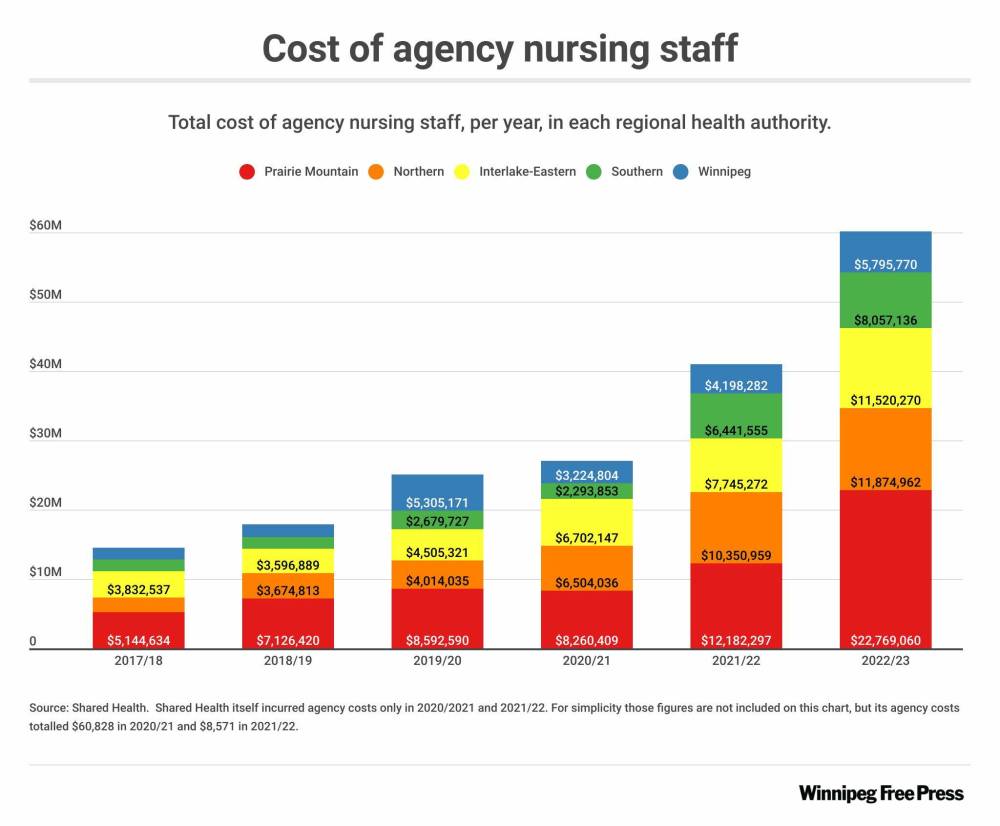
The province’s five regional health authorities spent a combined $60 million on agency nurses in the 2022-23 fiscal year, which represents an increase of 47 per cent over 2021-22, preliminary numbers provided by Shared Health show.
The provincial health authority responsible for the Health Sciences Centre did not record any spending on agency nurses.
“What we’ve basically done is exhausted our nurses in this province with the use of overtime and mandated overtime. We’re now at a point where those nurses can no longer sustain the workloads and the lack of work-life balance they’ve had,” Manitoba Nurses Union president Darlene Jackson said.
Mikaela MacKenzie/Winnipeg Free Press Files Preliminary numbers provided by Shared Health show Manitoba’s five regional health authorities spent a combined $60 million on agency nurses in the 2022-23 fiscal year, an increase of 47 per cent over 2021-22.
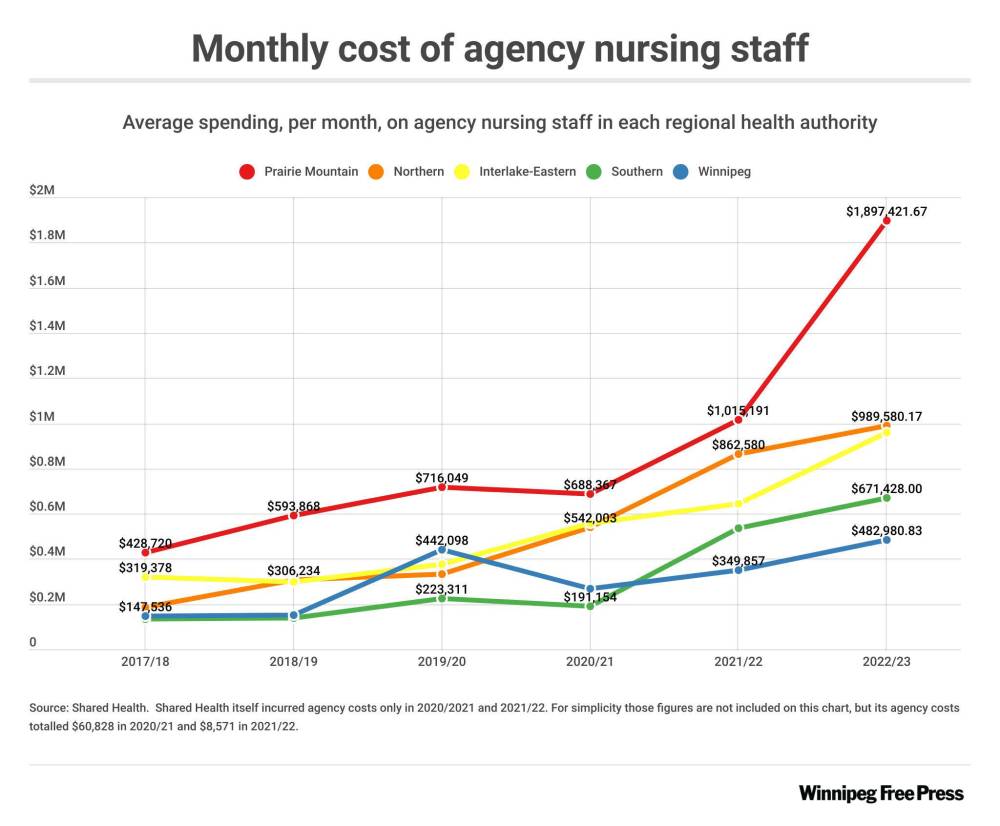
Prairie Mountain Health reported the greatest increase in spending on agency nurses in 2022-23, with total expenses jumping by 87 per cent.
The health authority, which is responsible for delivering care in communities from Treherne to the Saskatchewan border and the City of Brandon, funnelled $22.7 million to private nursing agencies compared to $12.1 million in 2021-22.
The expense bought approximately 296,000 hours of nursing care, numbers provided by the nurses union show. One year earlier, the region used agency nurses to cover 190,350 hours.
“What we’ve basically done is exhausted our nurses in this province with the use of overtime and mandated overtime.”–Darlene Jackson, MNU
Jackson said more nurses in Westman are taking jobs with agencies and the availability of private-sector staff is growing. The exodus continues in all health regions despite incentives and initiatives offered by the provincial government to rebuild the public-sector workforce, she said.
Last November, Health Minister Audrey Gordon released a $200-million HR plan that included a commitment to end mandated overtime for nurses. The plan centred on a suite of incentives to encourage nurses to volunteer for weekend shifts; take full-time positions; and return to the public sector from agencies.
Jackson said nurses feel they are no longer able to take shifts over and above their regular jobs. The high nurse vacancy rate in Prairie Mountain Health and the aging workforce may have driven the dramatic increase in agency nurse spending in western Manitoba, Jackson said.
The average age of a nurse in Manitoba is 47.4 years.
“The incentives have been helpful, somewhat,” she said, adding nurses have seen an improvement in weekend coverage. However, members say it’s demoralizing to work alongside agency nurses who are reaping financial benefits not offered in the public sector, she said.
“This government is going to have to go a lot further to level that playing field between nurses in the public system and nurses in the private system,” Jackson said.
PMH did not make anyone available for an interview. In a statement, the region said it must spend more on agency nurses owing to higher costs for travel to distant locations. Expenses paid by the region include travel costs to and from the nurse’s residence, travel time, and accommodations.
JOHN WOODS / WINNIPEG FREE PRESS FILES Manitoba Nurses Union president Darlene Jackson.
An unidentified spokesperson said PMH is trying to reduce its use of agency nurses by tapping into the new provincial nursing float pool and partnering with local schools so students can train closer to home.
Other incentives offered through the HR action plan are helping, the region said. However, if a staff member is not able to fill an open shift, agency staff must be used.
“We believe these initiatives will reduce our reliance on agency nurses over the long term,” the spokesperson said. “In the meantime, we will continue to utilize staffing agencies as needed to ensure continued safe, quality care for our clients, patients and residents.”
In Winnipeg, agency nurse spending increased by 38 per cent to $5,795,770. Interlake-Eastern reported a jump of 48.7 per cent, followed by Southern Health at 25 per cent, and the Northern Regional Health Authority at 14.7 per cent.
The health minister said she remains concerned by the cost of agency nurses and wants staff to return to the public payroll.
“This government is going to have to go a lot further to level that playing field between nurses in the public system and nurses in the private system.”–Darlene Jackson
“We’re already starting to see some movement there with the agency nurses coming into our nursing float pool,” Gordon said at an unrelated announcement Thursday.
“What we are doing is ensuring that Manitobans receive the care they need while we make these investments in the health human resource action plan and other recruitment, retention and training initiatives,” she said.
Manitoba Liberal leader Dougald Lamont said the skyrocketing costs are a symptom of a system in panic. He lamented the loss of nurses to agencies and the funnelling of tax dollars to for-profit businesses.
“It’s a situation where because the PCs and Shared Health can’t get their act together to take care of nurses properly and have reasonable schedules for them, you’re seeing people fleeing the public system,” Lamont said.
The escalating cost of hiring agency nurses in PMH is a deliberate choice, Lamont argued.
NDP health critic Uzoma Asagwara described the spending as “out of control.” The money would have been better spent bringing nurses back into the public health system, the Union Station MLA said.
“The PC’s approach means that they’re spending more and Manitobans are getting less in terms of quality health care,” Asagwara said.
“Rural health care requires dedicated investments and a dedicated strategy to make sure that rural Manitobans have access to the health care they need and to support rural health care workers wanting to stay and work in rural Manitoba.”
— with files from Malak Abas
danielle.dasilva@freepress.mb.ca