On the road, saving lives Ridealong with mobile overdose prevention crew highlights range of harm reduction services available
Read this article for free:
or
Already have an account? Log in here »
To continue reading, please subscribe:

Digital Subscription
One year of digital access for only $205*
- Enjoy unlimited reading on winnipegfreepress.com
- Read the E-Edition, our digital replica newspaper
- Access News Break, our award-winning app
- Play interactive puzzles
*First annual payment billed as $205.00 + GST for one year. This annual subscription will automatically renew at $233.00 + GST every 52 weeks (10% off the regular annual price of $259.35). Offer available to new and qualified returning subscribers only. Cancel any time.
To continue reading, please subscribe:
Add Free Press access to your Brandon Sun subscription for only an additional
$1 for the first 4 weeks*
- Enjoy unlimited reading on winnipegfreepress.com
- Read the E-Edition, our digital replica newspaper
- Access News Break, our award-winning app
- Play interactive puzzles
*Your next Brandon Sun subscription payment will increase by $1.00 and you will be charged $17.95 plus GST for four weeks. After four weeks, your payment will increase to $24.95 plus GST every four weeks.
Read unlimited articles for free today:
or
Already have an account? Log in here »
Hey there, time traveller!
This article was published 25/08/2023 (1107 days ago), so information in it may no longer be current.
Lisa Eastman starts her day as a peer support worker with Sunshine House filling paper cups with generous pours of sugar.
The cups are for coffee, but the heaping spoonfuls of sugar are for people coming down off drugs who will soon be looking for something to help ease their withdrawal.
By the end of the day, the cups will be gone, handed out to the 200-plus folks who will visit a retrofitted RV later that afternoon to use drugs in a safe environment, pick up supplies like clean needles, test their substances or chat with staff.
MIKE DEAL / WINNIPEG FREE PRESS MOPS driver Lisa Eastman pours sugar into coffee cups at Sunshine House. Super sweet coffee is in high demand by clients who may be experiencing withdrawal.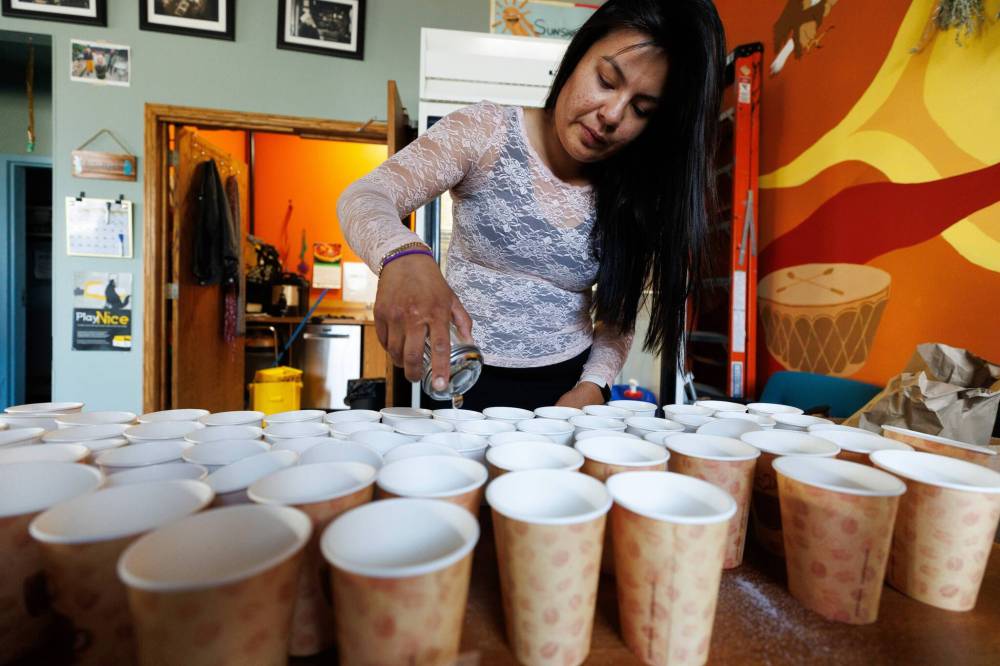
Harm reduction isn’t complicated. Sometimes it’s the simple things, like super-sweet coffee.
The staff from Sunshine House who operate the RV, formally called the Mobile Overdose Prevention Site (MOPS), know this. They wish the people who pull the pursestrings and dictate how they operate knew it too.
The RV’s existence is in limbo. Sunshine House recently found out they will be losing the federal funding they received to operate the mobile site. It runs out in October. The federal government has encouraged the organization to reapply, but the red tape means there will be a months-long gap in service unless the non-profit can raise $275,000.

Earlier this month, the Free Press spent a day riding along with MOPS, meeting those who rely on the service and seeing how things work in action.
The first stop of the day is Main Street Project’s parking lot. The downtown lot is tucked away from busy street traffic and tricky to access by car due to construction in the area. But people in the know, know where it is — MOPS spends most of each operating day (Wednesday to Sunday in the summer) at the location.
Staying in one place offers a consistent schedule to people who use the service, instead of having MOPS drive around the city searching for them.
Even before the vehicle pulls up at 11:45 a.m., people are waiting nearby in the shade. Soon, the tunes are blaring from a boom box, an information bulletin board is posted — one note tells clients the Free Press is visiting but won’t take their photo without permission — and the lineup for coffee and water is steadily growing.
“I spread the word, tell (people) where to come for a clean injection site, clean smoking. They got your back, come here.”–Damien
A man named Damien is greeted by Sunshine House staff. One fondly rubs his shaved head, complimenting the haircut. He walks up to reporters, pushing his bike. He doesn’t do drugs, he explains, but he’s here almost every day to take care of the people who do.
“I’m the muscle,” he says, grinning.
Damien’s connection to the program stems from the day he was panhandling nearby when one of the MOPS staff called him over, looking for help deescalating a confrontation unfolding at the RV. Damien stepped in, helped resolve the situation, and has been coming back to offer his services since.
“I spread the word, tell (people) where to come for a clean injection site, clean smoking. They got your back, come here,” he says.
He’s heard the federal funding for the site is running out. Asked what the community will lose if MOPS shuts down, Damien responds immediately: “People.” They’re going to die without MOPS, he says.
“We need more of this,” he says, not less.
Sunshine House always knew MOPS was a time-limited pilot project, executive director Levi Foy said in an interview, but it was supposed to last 18 months.
MIKE DEAL / WINNIPEG FREE PRESS Levi Foy, executive director of Sunshine House, said they’re doing anything they can to make sure they don’t go dark for the people they serve.
Foy said they were supposed to receive federal funding for the project in April of last year. The process of getting the federal exemption that allowed them to operate MOPS delayed the project, and they weren’t able to hit the road until October. Now, for reasons out of their hands, the project is losing funding six months earlier than planned.
It’s not ideal to fundraise to keep a crucial public health service afloat, but at this point, they’re doing anything they can to make sure they don’t go dark for the people they serve.
“What other funding is available when the province has been openly hostile to this project?” Foy said.
Meanwhile, back at the RV site, a stream of people are picking up harm reduction supplies and trickling into an inhalation tent, a pop-up canopy mostly surrounded by plastic. Smoking has to happen outside — snorting and injecting happens inside the RV — but the tent offers privacy and dignity.
On this blustery day, it’s standing against all odds.
MIKE DEAL / WINNIPEG FREE PRESS MOPS driver Val Ballantyne-Lewis sets up the inhalation tent. 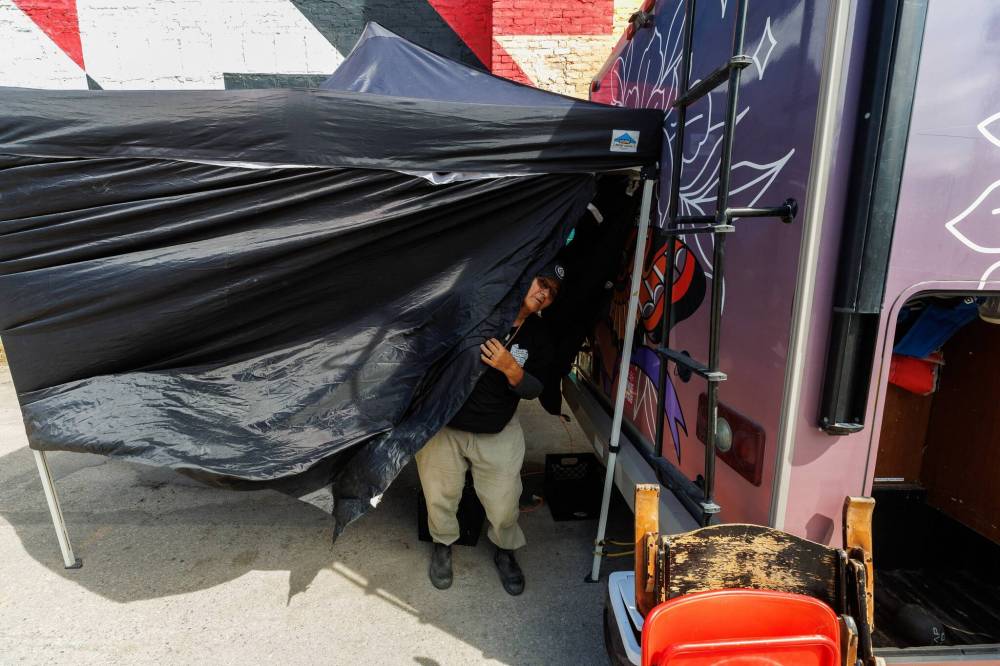
“Whoaaa!” people shout in unison as the wind pulls at the plastic. Staff attach bricks and dumbells to weigh the makeshift structure down. It holds.
It’s representative of how MOPS operates: with a bit of organized chaos, elbow grease and determination.
Inside the RV, peer worker Vida Lamour is sorting out emergency housing for a Sunshine House client. Another peer support worker, Ally Seidlitz, is manning the passenger side window, greeting people, tracking how many visit and what they’re there for.
Within the first hour, she’s tallied 25 visits, with some picking up “bubbles” (glass pipes for smoking substances), clean needles, naloxone (which reverses overdoses) and clothing. And, of course, coffee.
“I’ve got to cut you off eventually,” Seidlitz tells a jittery client who has grabbed nine coffees.
Another visitor hangs back, but by early afternoon, they’ve joined the group of people hanging out around the RV.
MIKE DEAL / WINNIPEG FREE PRESS Ally Seidlitz hands over supplies to a client.
Casey has been visiting the van for several months now. He sees it as a safe space to smoke methamphetamine without fear of what he calls “rowdy people” — folks withdrawing from drugs who will get aggressive if they see someone else using — but it’s an opportunity to socialize, too.
“Basically, it’s somewhere to feel safe. A lot of the people that come here (I) feel comfortable around, it’s not rowdy,” the 49-year-old says.
“And the crew, they’re pretty nice too, they supply everything but the drugs. A lot of people seem to like it.”
Casey is soft-spoken and chooses his words carefully. He mentions he’s First Aid and CPR certified “if people OD,” but he hasn’t had to use those skills here yet, luckily.
MOPS just isn’t about safety to him. It’s about getting a minute to use in a quiet, private place, something not always afforded to the people here he knows.
“I’d like to see a lot less people on the streets doing their drugs,” he says
Another visitor, Andrew, is a natural storyteller. He’s from Holland, but a string of life events brought him to Main Street Project’s shelter.
“We have like things like this all over Amsterdam, in a lot of the parks,” he says. “It reminds me of home a little bit. Nobody overdoses.”
MIKE DEAL / WINNIPEG FREE PRESS Andrew with a small bit of marijuana that he plans to smoke with friends in the inhalation tent.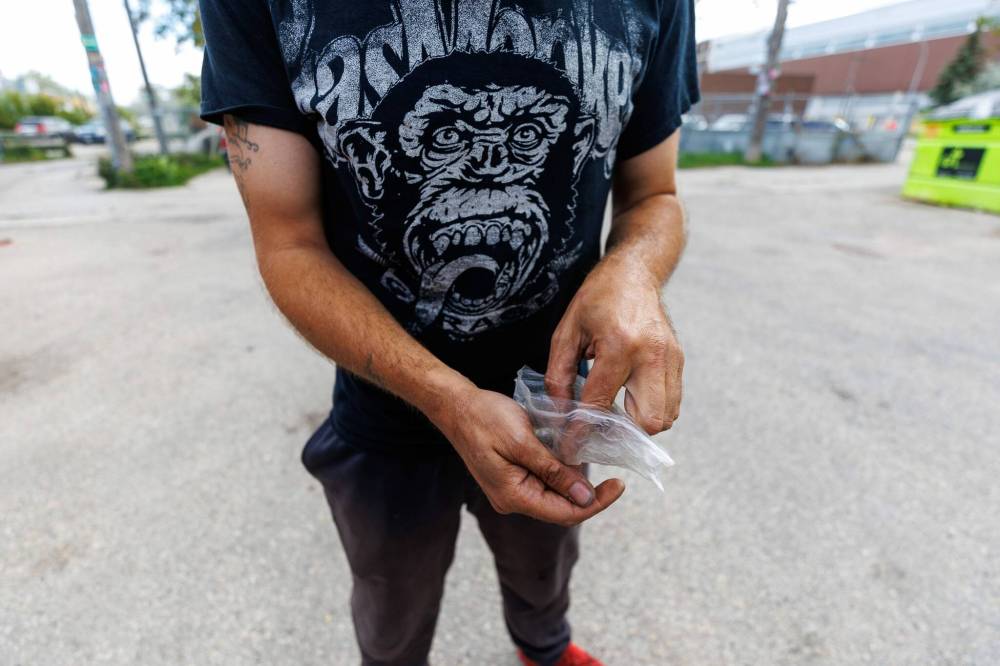
He’s here with a legal substance — a small bit of marijuana in a plastic bag — that he plans to smoke with friends using the inhalation tent.
“I like that they enforce the rules here,” he says.
Andrew lingers after getting his coffee and taking a minute in the tent. He joins a chatty group forming around Sunshine House staffer Val Ballantyne, who sits in a small wooden rocking chair outside of the tent. She’s kookum — “grandmother” in Cree — to many here and she fits the role perfectly.
“Come here, my grandson, I’ll tell you a story!” she slaps her knee and shouts at a visitor, cracking up the crowd.
“The other day, someone was getting upset and we had to ask them to leave, and as they were leaving, they (told Ballantyne), ‘I’m sorry, kookum,’” says MOPS peer co-ordinator, Davey Cole, and everyone breaks into a laugh again.
MOPS by the numbers
• More than 14,000 visits between Oct. 28, 2022 and June 30, 2023 (an estimated 2,500 unique visitors).
• Distributed 13,574 harm reduction supplies and 2,393 naloxone kits.
• Supervised 5,172 instances of drug use with 19 overdoses requiring intervention and 0 deaths. Four Ambulance Transports to hospital at the request of the participant.
• Provided 18 referrals to detox and treatment programs or health care support.
• Provided 200 HIV rapid tests.
Mentorship from elders and Indigenous leadership is built into the programming at MOPS. Every Friday, it’s the site of Go Ask Auntie, a window of time where an Indigenous nurse and a community matriarch will come by to give advice and point people to resources.
It’s health care at the most grassroots level — Cole describes one MOPS visitor, an unhoused pregnant woman, who had refused to accept medical care during her pregnancy. Sunshine House reached out to the nurse visiting on Fridays, who told them to call the next time the pregnant woman visited so she could talk to her directly.
“Those are the strategies we have to use to get folks into community health care,” Cole says.
Harm reduction is giving people to autonomy to monitor their own health, too, Cole explains, describing the HIV self-tests MOPS regularly hands out.
“It kind of changes the way people take care of themselves,” Cole says.
As the day goes on, people come and go quickly, while others stay for hours. A woman cheers and dances in front of the small radio playing 2000s hits. Cole leaves for a bit to buy cigarettes to hand out.
Some visitors are wary, others are eager to share their story. One woman, clutching a lipstick-stained styrofoam coffee cup, is an open book, sharing her experiences using a methadone clinic to manage her addiction and troubles with cravings. She explains that without MOPS, she’d likely be trying to use at the shelter she’s staying at and she’s thankful she’s not at risk of being kicked out because this site is available to her.
“Any more questions?” she asks in between sips and stories.
By early afternoon, the coffee is gone. A few hours later, after serving hundreds of people, the staff begin dismantling the site, preparing for the final hour of the day at their second location.
At 5:30 p.m. on the dot, the RV pulls up to the Nine Circles parking lot in West Broadway a few kilometres away. It’s quiet here. The only people waiting are two Nine Circles staff hoping to do a quick tour of the RV.
MIKE DEAL / WINNIPEG FREE PRESS Dawn Lavand uses the mobile mass spectrometer, an unassuming $65,000 machine that can determine the components of illicit drugs.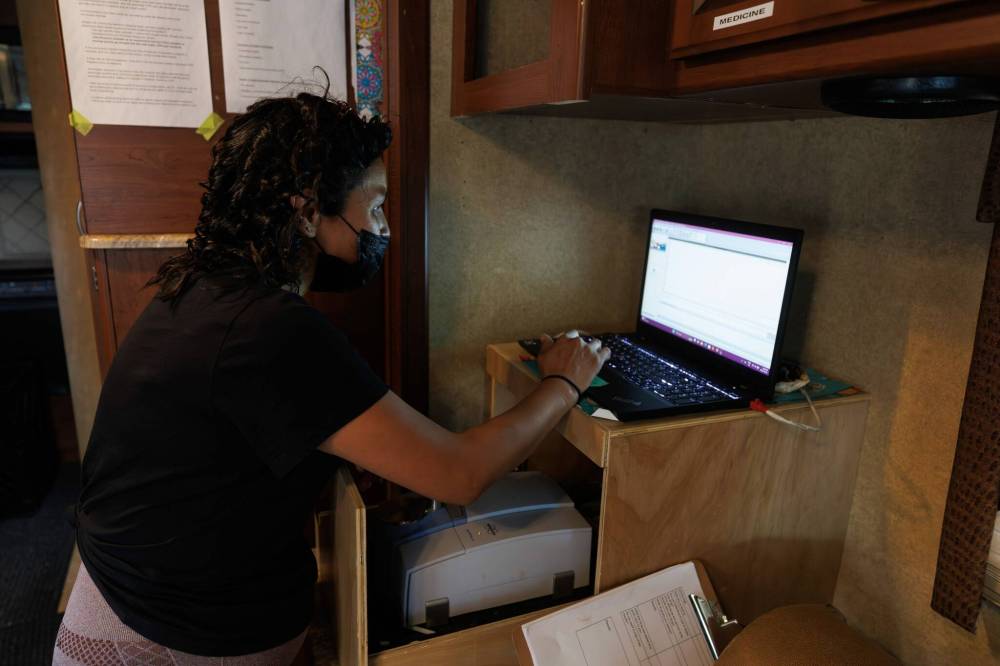
Rain starts to fall. About three people come by over the next hour, picking up naloxone and other supplies. Staff say there was a tent encampment nearby but it recently disappeared. They’re still figuring out the best spots to meet community needs, something that can change week to week.
Inside, peer support worker Dawn Lavand is learning how to look up results from MOPS’s drug testing machine, called a mass spectrometer. Lavand calls it the “robot,” joking that it gets high off the tiny amounts of substances it tests. (MOPS had to fundraise to afford the unassuming $65,000 machine that they use to determine the components of illicit drugs.)
“Once time I brought in a sample of (what) was supposed to be fentanyl,” she says. “There was 30 per cent cream of wheat and 30 per cent tanning solution. There was no down — fentanyl — in it whatsoever. People were ingesting that.”
Staff will flag bad drugs to others who might be using the same supply. A group called the SaferSites Coalition also puts out notices when there’s a bad batch of toxic drugs on the street.
Lavand wants the public to know MOPS is helping the whole community, not just drug users.
“If you don’t create a safe place for people to use drugs then every place becomes a place to use drugs.”–Dawn Lavand
“If you don’t create a safe place for people to use drugs then every place becomes a place to use drugs,” Lavand says.
While driving the RV through downtown rush-hour traffic, Ballantyne points out a framed photo of a young man in a corner of the vehicle.
“He was our first one that we saved here,” she says, recalling giving him CPR while someone else administered naloxone and another person called 911. “We were so scared.”
Eventually, he started breathing. Ballantyne said a little prayer.
A few months later, staff found out he died while using somewhere else.
“If we were there, we could have saved him,” she says.
malak.abas@freepress.mb.ca
katrina.clarke@freepress.mb.ca

Malak Abas is a city reporter at the Free Press. Born and raised in Winnipeg's North End, she led the campus paper at the University of Manitoba before joining the Free Press in 2020.

Katrina Clarke
Investigative reporter
Katrina Clarke is an investigative reporter with the Winnipeg Free Press.
Our newsroom depends on a growing audience of readers to power our journalism. If you are not a paid reader, please consider becoming a subscriber.
Our newsroom depends on its audience of readers to power our journalism. Thank you for your support.
Related Articles
‘Go low and slow’: keeping drug users safe