Parties split on how to tackle toxic drug crisis PCs, NDP and Liberals questioned about their harm reduction plans

Read this article for free:
or
Already have an account? Log in here »
To continue reading, please subscribe:

Digital Subscription
One year of digital access for only $205*
- Enjoy unlimited reading on winnipegfreepress.com
- Read the E-Edition, our digital replica newspaper
- Access News Break, our award-winning app
- Play interactive puzzles
*First annual payment billed as $205.00 + GST for one year. This annual subscription will automatically renew at $233.00 + GST every 52 weeks (10% off the regular annual price of $259.35). Offer available to new and qualified returning subscribers only. Cancel any time.
To continue reading, please subscribe:
Add Free Press access to your Brandon Sun subscription for only an additional
$1 for the first 4 weeks*
- Enjoy unlimited reading on winnipegfreepress.com
- Read the E-Edition, our digital replica newspaper
- Access News Break, our award-winning app
- Play interactive puzzles
*Your next Brandon Sun subscription payment will increase by $1.00 and you will be charged $17.95 plus GST for four weeks. After four weeks, your payment will increase to $24.95 plus GST every four weeks.
Read unlimited articles for free today:
or
Already have an account? Log in here »
Hey there, time traveller!
This article was published 15/09/2023 (1122 days ago), so information in it may no longer be current.
One week before the writ dropped, Arlene Last-Kolb stood atop the steps of the Manitoba legislature and kicked off a hot-button election debate: How should government care for those who use drugs? How do we stop people from dying?
RUTH BONNEVILLE / WINNIPEG FREE PRESS FILES Arlene Kolb-Last, Manitoba regional director of grassroots group Moms Stop the Harm.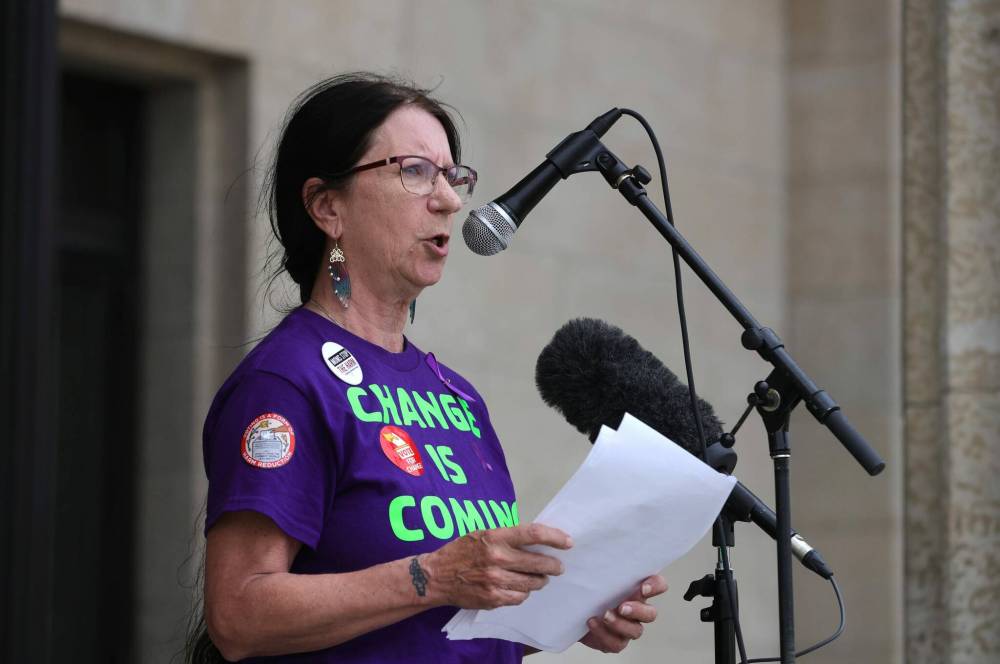
“My message is simple,” Last-Kolb told the crowd gathered for International Overdose Awareness Day in late August. “Vote for change.”
Last-Kolb has been advocating on behalf of drug users and their families for nearly a decade. Her devotion to the issue came following the 2014 death of her son, Jessie, who overdosed on fentanyl at age 24.
She’s been hounding the government ever since. She wants a safer supply of drugs, she wants supervised consumption sites and she wants faster access to treatment.
These are the issues she hopes voters care about, too.
In the first four months of this year, at least 131 Manitobans died from suspected drug overdoses. For all of 2022, that number was 418 and in 2021, it was 424.
The deaths don’t surprise advocates or drug users. They say the drug supply in the province is toxic, there is little in the way of government-backed harm reduction approaches and access to treatment is limited or difficult to access.
Change could be afoot, but Manitoba’s three major political parties remain split on how they would tackle the public-health emergency.
One approach deemed life-saving by harm reduction advocates but controversial by opponents: supervised consumption sites.
Manitoba remains the only province outside of the Atlantic region without these permanent spaces, where people can use their own drugs under the supervision of people trained to revive them if they overdose.
(While Manitoba has one “overdose prevention site” — a pilot project run by Sunhine House’s peer support staff who drive a retrofitted RV to city locations in which people can use drugs — their federal funding is soon to run out, and the provincial government doesn’t support the operation.)
Either way, advocates for people who use drugs say treatment and harm reduction must go hand-in-hand. Too often, those seeking to get help are turned away from the in-demand services or told they must first get sober.
Another hurdle: accessing timely data. Manitoba’s overdose death data is currently five months out of date, something the Progressive Conservative government has made no commitment to improving.
Advocates say timely data is critical for understanding the scope of the toxic drug crisis and formulating a plan for saving lives.
The Free Press asked the major parties about their stance on supervised consumption sites, tacking the toxic drug crisis and making critical data public.
How does your party plan to address the toxic drug crisis in Manitoba?
The Free Press asked the major parties about their stance on supervised consumption sites, tacking the toxic drug crisis and making critical data public.
How does your party plan to address the toxic drug crisis in Manitoba?
NDP: The Manitoba NDP would work with community organizations, health-care workers and advocates to introduce evidence-based harm reduction policies. We would connect people living with addictions with primary care and treatment.
If the Manitoba NDP forms government on Oct. 3, we will lead with compassion and follow the advice of health-care workers and experts to save lives and connect more Manitobans with treatment.
We will hire 100 mental health workers and work to end chronic homelessness by connecting people with wraparound supports and housing.
Liberals: First, we need a focus on diversion and prevention. We have committed putting mental health coverage under medicare, which is preventive in terms of catching and treating mental illnesses early.
We have committed to programs of safe spaces and recreation to give young people activities away from drugs. We are committed to anti-gang and gang-disruption programs. Part of our plan includes cracking down on illicit drug sales in the community as well as online.
Second, we have committed to ensuring that mental health and addictions programs are offered together. We will fund the creation of mental health and addictions crisis teams who can work independently or in tandem with law enforcement, to de-escalate situations and provide appropriate care.
There are no standards whatsoever for addictions providers. We will work with current service providers to establish provincewide standards for addictions treatment, and make sure funding is available to bring current providers up to new standards.
Lastly, we will fund a 24/7 addictions referral line for treatments so people seeking help can get immediate access to detox.
What is your party’s position on supervised consumption sites?
NDP: The Manitoba NDP have called for a supervised consumption site for years and are committed to working with heath-care workers and experts to implement one.
Liberals: We will support organizations that run overdose prevention centres to ensure that people with addictions can receive timely treatment, counselling and mental health services focusing on prevention, treatment and recovery.
We know that supervised consumption sites save lives, while reducing other unsafe substance-use practices and blood-borne illnesses.
However, we know that standards need to be put in place to ensure that health requirements are followed to the highest standards. We will work in partnership with staff with front-line experience and addictions medicine practitioners so the rollout of this plan will be done safely.
Would your party commit to making preliminary overdose death data available to the public in a timely manner?
NDP: Heather Stefanson continues to hide data on overdose deaths despite calls to make it public. The Manitoba NDP has stood with families and advocates to demand the government publicize this vital information.
An NDP government would ensure that the public and medical experts have access to reliable monthly data on drug overdose deaths as well as information on type of drugs related to each death, so public health has an accurate depiction of the crisis.
Liberals: Yes, we absolutely will ensure overdose death data becomes available to the public. We need to make sure that this data is available to policy makers and front-line staff as one of the first steps to tackle the drug crisis.
The Progressive Conservatives did not respond to specific questions but sent a statement: Our party is focused on supporting and helping people recover from addictions.
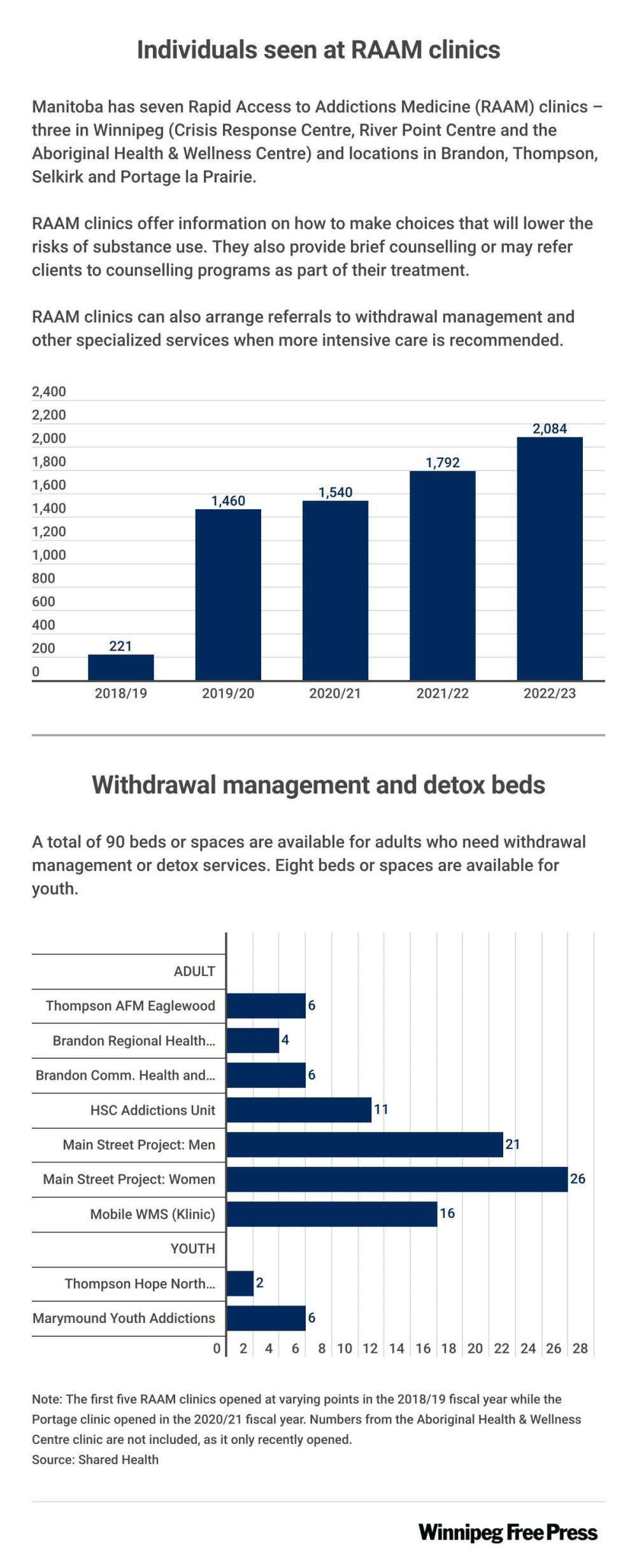
We have funded over 1,600 new addictions treatments spaces, and have built multiple RAAM (Rapid Access to Addictions Medicine) clinics — in fact, the first RAAM clinic in Manitoba was built by our PC government in September of 2018. The NDP voted against these initiatives at every turn.
We look forward to saying more on this important issue as the election unfolds.
– This Q and A has been edited for clarity and length.
The NDP say they support supervised consumption sites and have committed to implementing one if elected. They say they will work with community organizations, health-care workers and advocates to introduce evidence-based harm reduction policies. They have vowed to hire 100 mental health workers and work to end chronic homelessness by connecting people with supports and housing.
The Liberals say they are in favour of implementing a permanent supervised consumption site, but want addictions services regulated. Additionally, they vow to crack down on the sale of illegal drugs, create programs that could divert kids away from using drugs, ensure mental health and addictions programs are offered in tandem and put mental health coverage under medicare.
Both the Liberals and the NDP committed to making overdose data public in a timely manner.
The PCs did not answer the questions directly, but issued a statement instead.
“Our party is focused on supporting and helping people recover from addictions. We have funded over 1,600 new addictions treatments spaces, and have built multiple RAAM (Rapid Access to Addictions Medicine) clinics,” said party spokesperson Shannon Martin. “We look forward to saying more on this important issue as the election unfolds.”
The Tory government’s drug-policy record has been controversial.
Last November, then-minister of mental health and community wellness, Sarah Guillemard, put out a press release after a trip to B.C., in which she spoke of “seeing” and having “witnessed” supervised consumption sites. Her experiences bolstered her confidence in the government’s decision not to support similar sites in Manitoba, she said.
The Free Press later confirmed she never actually visited supervised injection sites.
In March, the PCs introduced Bill 33, the Addiction Services Act. The government upheld the bill as a step that would ensure people seeking help for addiction were getting proper care, but Sunshine House and other advocates for those who use drugs said its rigid operating requirements would shutter essential services. The NDP eventually chose Bill 33 as one of its five allotted bills to die on the order paper.
MIKE DEAL / WINNIPEG FREE PRESS FILES Coffee and Naloxone kits are free along with many other supplies to anyone who drops by at the Sunshine House RV or MOPS (Mobile Overdose Prevention Site) at the location in the parking lot of 631 Main Street. 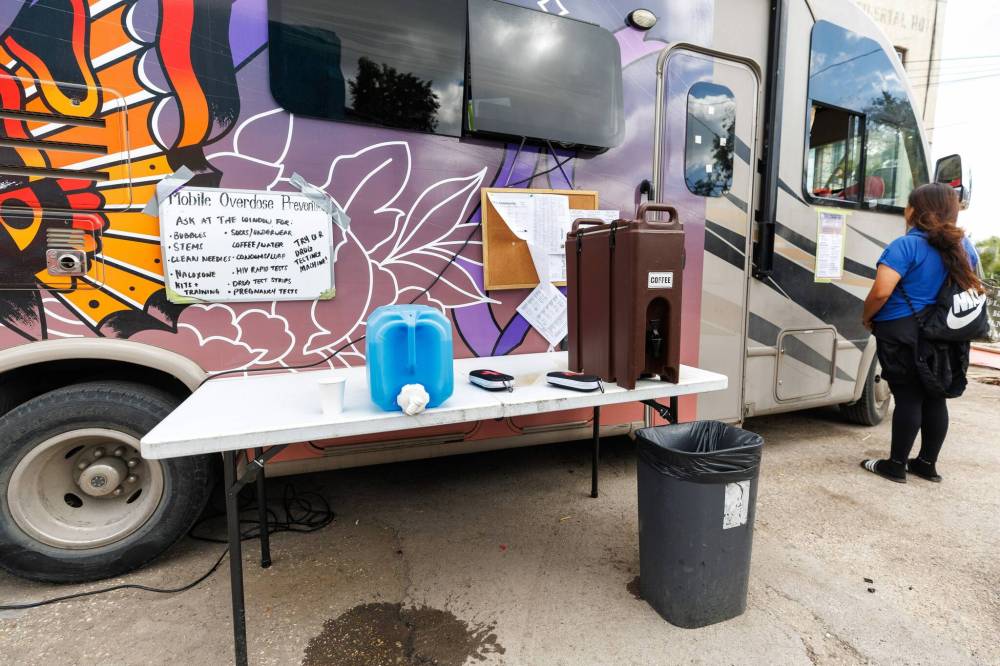
And Manitoba remains the only province that doesn’t provide timely data to the Public Health Agency of Canada for its national reports on opioid overdose deaths. The provincial government has said it doesn’t release preliminary data and “chooses” to only share finalized data, which is more than a year out-of-date.
Under pressure, the province started posting monthly preliminary data to the provincial website.
However, at the time of writing, the most recent data posted is from April. The Free Press also later revealed that, according to internal emails, the province’s reliance on paper records could be the reason why the data is delayed.
Advocates have called on the province to modernize and invest in systems that would allow faster reporting.
While the province resists calls supporting safe consumption sites, other levels of government and grassroots groups have kept the conversation alive.
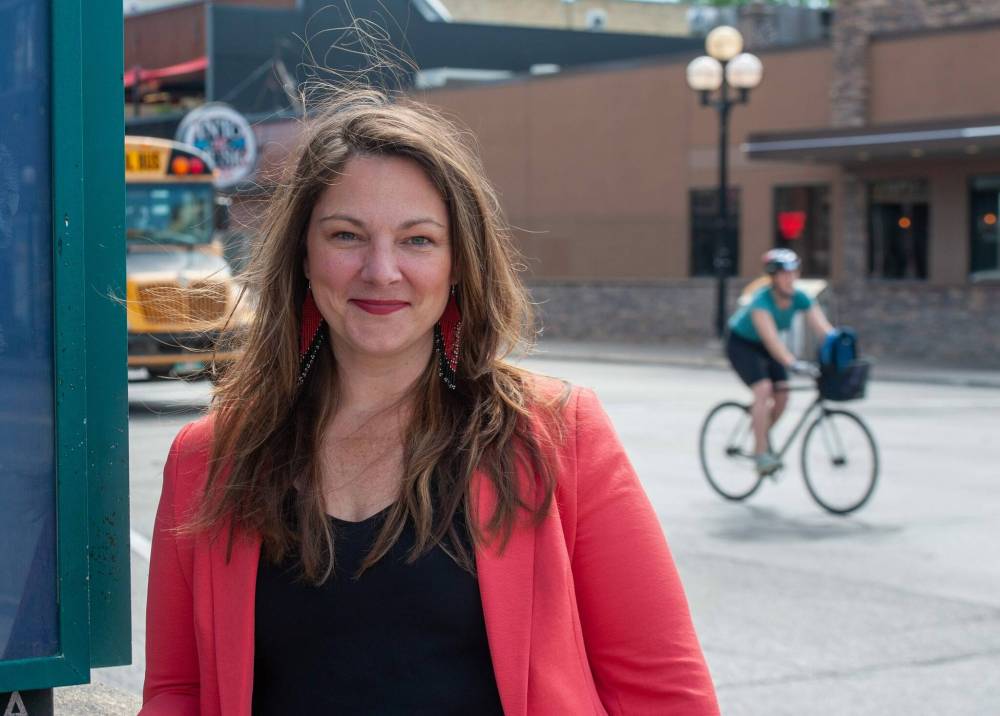
Over the past few years, Coun. Sherri Rollins (Fort Rouge-East Fort Garry) has asked city council for a feasibility study on the sites, pitched decriminalization of small amounts of drugs and written letters to the federal government in support of Sunshine House’s mobile overdose prevention site.
She describes seeking provincial input on the issue as fruitless, calling herself, other supportive councillors, and front-line community organizations as “the only open door” for those in need.
“I think the last few years has been characterized by an absolute absence of work by the provincial government. And yes, we know from their interviews on the topic of harm reduction, they are hostile to it and only want to concentrate on one note in the song, which is the recovery model,” said Rollins, who is an NDP party member.
“I think the last few years has been characterized by an absolute absence of work by the provincial government.”–Coun. Sherri Rollins
“The issues for front-line agencies … is that it’s piled on the work, because not only is everyone now leaning on front-line agencies to do everything, including the policy work, including the funding and including being the only open door for community.”
The city needs to see a more involved provincial government on the topic of harm reduction over the next four years, Rollins said.
“I’ve spent time with other municipalities, from Thompson, to Brandon to Winnipeg, they all share the same results of an inactive and immature provincial health, primary health and addiction services model that isn’t working for any municipality in this province, so I really want that engagement at every doorstep or else I will be, yet again, alone.”
This summer, the difficulty of providing life-saving services to drug users in Manitoba was laid bare by a naloxone shortage.
Naloxone, which can be used to reverse the effects of an overdose, is supplied through Manitoba Health and then distributed to people in need and organizations.
MIKE DEAL / WINNIPEG FREE PRESS FILES A participant with Naloxone kits and some baseball cards at Sunshine House RV or MOPS (Mobile Overdose Prevention Site).
Supply began to dry up in mid-May, leaving community groups receiving fewer kits more irregularly during a season that typically sees a spike in drug overdoses in Manitoba.
Desperate, some organizations reached out to peer agencies in other provinces to supply them with hundreds of kits.
By July, the province said the supply chain disruption was over.
Breda Vosters from Resource Assistance for Youth says it never really went away.
“We currently have a very limited supply yet again,” she said, noting other community groups had recently reached out to RaY with their own shortage issues.
“It’s not resolved. What was, apparently, a backlog in ordering, is either still a backlog in ordering or they just haven’t adjusted appropriately to be able to accommodate the increased need.”
It capped off what Vosters has described as four years of a “severe lack of urgency around harm reduction efforts” that has had repercussions community groups and the people they serve are feeling today.
“I think there are a lot of initiatives that we could have been taking on over the last few years that would have saved lives, had they had the right amounts of support. Supervised consumption sites are kind of the key one, but there are a lot of other more tertiary repercussions,” she said.
“One of which is that, and we’ve heard it from people directly on the streets, is that they feel like their lives are not looked at as important. We’ve even had some folks get as extreme as saying that they feel like governments and people in charge actually want them to die.”
“We’ve even had some folks get as extreme as saying that they feel like governments and people in charge actually want them to die.”–Breda Vosters
While RaY is a non-partisan group, Vosters is following the election campaign closely. While she was happy to see the NDP in support of bringing safe consumption sites to Manitoba, she said she would like to see every party offer more tangible solutions before voters make their choice.
“I think everybody should understand that harm reduction and substance-use interventions are a broad spectrum of things, and we need to tap into all of them.
“We can’t say, ‘No, we don’t need supervised consumption sites, we need more detox beds.’ What we really need is both and everything in between,” she said.
When these issues become a “political lightning rod,” voters lose out, she said.
“It leads to misconceptions about what harm reduction is, and it leads to misconceptions about about how to help substance users, and how to help our whole community.”
At the International Overdose Awareness Day in August, Last-Kolb said she was speaking for those who cannot — loved ones who have died from toxic drugs.
“Every day someone dies in Manitoba. Every. Single. Day,” she said from her podium. “How many people do we let a government let die before we say enough? How many more of our sons and daughters have to die?”
She told the crowd if Premier Heather Stefanson was in the position of so many gathered that day — a parent whose child died from drugs — she wouldn’t accept the status quo. But those at the rally have no choice but to grieve, suffer and plead for action.
Last-Kolb hopes that soon changes.
katrina.clarke@freepress.mb.ca; malak.abas@freepress.mb.ca

Katrina Clarke
Investigative reporter
Katrina Clarke is an investigative reporter with the Winnipeg Free Press.

Malak Abas is a city reporter at the Free Press. Born and raised in Winnipeg's North End, she led the campus paper at the University of Manitoba before joining the Free Press in 2020.
Our newsroom depends on a growing audience of readers to power our journalism. If you are not a paid reader, please consider becoming a subscriber.
Our newsroom depends on its audience of readers to power our journalism. Thank you for your support.
Related Articles
Meet your candidate: We invited would-be MLAs to introduce themselves to you