Language arts After entire album in Wolastoqey, Jeremy Dutcher finds writing in English a challenge
Read this article for free:
or
Already have an account? Log in here »
To continue reading, please subscribe:

Digital Subscription
One year of digital access for only $205*
- Enjoy unlimited reading on winnipegfreepress.com
- Read the E-Edition, our digital replica newspaper
- Access News Break, our award-winning app
- Play interactive puzzles
*First annual payment billed as $205.00 + GST for one year. This annual subscription will automatically renew at $233.00 + GST every 52 weeks (10% off the regular annual price of $259.35). Offer available to new and qualified returning subscribers only. Cancel any time.
To continue reading, please subscribe:
Add Free Press access to your Brandon Sun subscription for only an additional
$1 for the first 4 weeks*
- Enjoy unlimited reading on winnipegfreepress.com
- Read the E-Edition, our digital replica newspaper
- Access News Break, our award-winning app
- Play interactive puzzles
*Your next Brandon Sun subscription payment will increase by $1.00 and you will be charged $17.95 plus GST for four weeks. After four weeks, your payment will increase to $24.95 plus GST every four weeks.
Read unlimited articles for free today:
or
Already have an account? Log in here »
Hey there, time traveller!
This article was published 26/10/2023 (1058 days ago), so information in it may no longer be current.
It’s been said when you change your language, you change your thoughts.
Few know this better than singer Jeremy Dutcher, who is one of about 100 people in the world who speak Wolastoqey, the language of the Wolastoqiyik, the People of the Beautiful River, of Tobique First Nation in New Brunswick.
He gained national prominence in 2018 with Wolastoqiyik Lintuwakonawa, an album he sung solely in Wolastoqey after listening to hours of archived recordings of his ancestors from the Canadian Museum of History. It earned the Polaris Music Prize and a Juno Award.
He’s included six English-language songs on his recently released second album, Motewolonuwok, and while he’s fluent in English, he was surprised at how challenging it was to write and sing songs using it.
“Sometimes the space between things when we’re translating, we kind of lose the nature and the meaning of the word,” says Dutcher, who performs at the Burton Cummings Theatre Saturday night.
“It’s definitely a different approach.”
Concert preview
Jeremy Dutcher
● Saturday, 8 p.m.
● Burton Cummings Theatre
● Tickets $57 at Ticketmaster
He had help from Treaty 2 territory in Manitoba, specifically Gayle Pruden, an elder from Little Saskatchewan First Nation whose spirit name is Dancing Bear. He calls Pruden a local legend.
Pruden and Dutcher, who are both two-spirit, appear together at the end of the video for Take My Hand, and she describes the differences between sharing feelings in Aninshinaabemowin, or Ojibwe, her mother tongue, and English.
“When I’m speaking Ojibwe, I’m speaking from here, directly from here. No thinking, no nothing,” she tells Dutcher, holding her hands to her heart. “When it comes to the English language, you’ve got to really think. The words, how to put them together without being harmful. All the process before you can even deliver that message.”
Dutcher felt her mentorship was so essential to the record he had to include her as part of the song.
“Gayle is Manitoba’s finest for me, a queer elder that I’ve been guided by for many years of my life,” he says. “Even though I was singing in English, I wanted to invite her and speak her language, Anishinaabemowin. Even though we’re doing this English song, having her language present felt important.”
Lisa Kirk photo Jeremy Dutcher won the Polaris Prize and a Juno Award for his debut album, Wolastoqiyik Lintuwakonawa, which he performed entirely in Wolastoqey.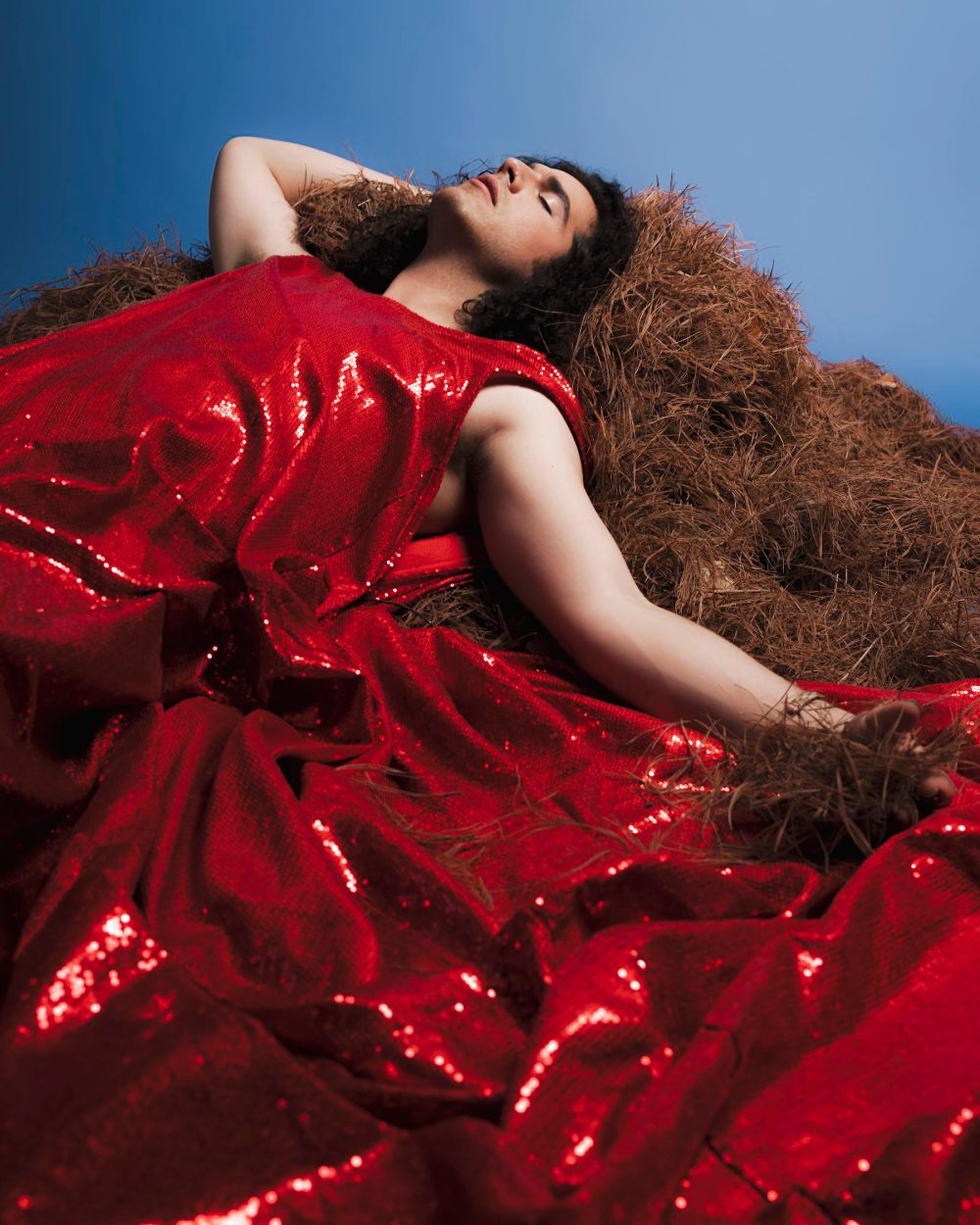
Dutcher has also gone all-in on videos for Motewolonuwok. Some are recordings of Dutcher performing songs in a studio, but in the video for the bilingual song Pomawsuwinuwok Wonakiyawolotuwok, which Dutcher translates as “people are rising,” was filmed at a Tobique First Nation powwow in the summer.
The documentary-style footage — it was shot using 16mm film, which gives it an old home-movie look — includes adult and children costumed dancers as well as Indigenous, non-Indigenous and two-spirit people enjoying the festivities.
“I’ve been going to that gathering since I was a young person, so it’s always a family affair. My brother is the organizer,” Dutcher says. “My greatest pleasure is to go back to where I come from, where people speak the language. When I wanted to make a video, it felt like a good place to start.”
Dutcher will have his touring band with him when he takes the stage at the Burt Saturday. When he was last at the theatre, in 2019, the Winnipeg Symphony Orchestra accompanied him.
“I think people are still going to be in for a treat. We’re going to give them a lot of music even if it’s not the full orchestra and the choir,” Dutcher says.
“The people are gathering. One of my favourite parts of my show, especially when we do it in Winnipeg, is so many neechies (friends) come out.”
Another departure for Dutcher was musical in nature, a move toward pop and jazz he describes as breaking away from the confines of classical music. The classically trained tenor’s songs on his debut record were more operatic in nature.
The combination of Wolastoqey (it’s pronounced wool-las-duh-gwey) and classical music blend into his new sound on the album’s first track, one of four songs based on archival recordings of his ancestors.

Skiciniwihkuk (pronounced Ski-jin-oo-wee-gook and meaning Indian Land) begins and ends with a recording of a Wolastoqiyik man from the 1960s, quoting wisdom passed down from the 18th century.
“As long as there is a child among my people, we will protect the land,” is the translation Dutcher provides on the video.
“That’s so beautiful and is such a statement of sovereignty,” Dutcher says. “So much of my first work was looking at the ancestors and what they had to say. This felt like a cool way to bring that way and still showing a more contemporary side, and it doesn’t take long for the music to change. A different direction for sure.”
Dutcher sees hope on the horizon for the Wolastoqey language, one that is deemed endangered. A Wolastoqey immersion school just opened near Fredericton, N.B., which means a new generation of speakers will be around, not just to protect the land, but to protect the language.
“We’re doing the work now so I have someone to talk to when I’m an old man,” the 32-year-old says with laugh.
“It’s a really exciting time. This generation that’s coming up now, they’re going to be in a much better place to learn their language than we were.”
Alan.Small@winnipegfreepress.com
X: @AlanDSmall
If you value coverage of Manitoba’s arts scene, help us do more.
Your contribution of $10, $25 or more will allow the Free Press to deepen our reporting on theatre, dance, music and galleries while also ensuring the broadest possible audience can access our arts journalism.
BECOME AN ARTS JOURNALISM SUPPORTER
Click here to learn more about the project.

Alan Small
Reporter
Alan Small was a journalist at the Free Press for more than 22 years in a variety of roles, the last being a reporter in the Arts and Life section.
Our newsroom depends on a growing audience of readers to power our journalism. If you are not a paid reader, please consider becoming a subscriber.
Our newsroom depends on its audience of readers to power our journalism. Thank you for your support.