Door-to-door deliberations At-home sales continue — and remain profitable — in digital era
Read this article for free:
or
Already have an account? Log in here »
To continue reading, please subscribe:

Digital Subscription
One year of digital access for only $205*
- Enjoy unlimited reading on winnipegfreepress.com
- Read the E-Edition, our digital replica newspaper
- Access News Break, our award-winning app
- Play interactive puzzles
*First annual payment billed as $205.00 + GST for one year. This annual subscription will automatically renew at $233.00 + GST every 52 weeks (10% off the regular annual price of $259.35). Offer available to new and qualified returning subscribers only. Cancel any time.
To continue reading, please subscribe:
Add Free Press access to your Brandon Sun subscription for only an additional
$1 for the first 4 weeks*
- Enjoy unlimited reading on winnipegfreepress.com
- Read the E-Edition, our digital replica newspaper
- Access News Break, our award-winning app
- Play interactive puzzles
*Your next Brandon Sun subscription payment will increase by $1.00 and you will be charged $17.95 plus GST for four weeks. After four weeks, your payment will increase to $24.95 plus GST every four weeks.
Read unlimited articles for free today:
or
Already have an account? Log in here »
Hey there, time traveller!
This article was published 05/02/2024 (953 days ago), so information in it may no longer be current.
Brittany Dales had just got her one-year-old to sleep and the house was quiet.
That is, until two door-to-door salespeople, ignoring a prominent sign asking that solicitors not knock, banged on the door of her Crestview home.
Then they rang the doorbell. Twice.
Inside, the chaos began almost immediately. The family pet, a rescue named Kaos that Dales describes as a “very large dog with a very deep bark,” began barking and their son began to wail. Dales’ husband, frustrated, scooped up the tot and ran to the front door to yell at the solicitors to leave, before slamming the door.
The lifelong Winnipeggers moved from a quiet area to a busier street more than a year ago, and with it came an increase in solicitations from pedlars, members of religious groups and political candidates.
Dales said she is tired of the random visits from strangers, which leave her feeling unsafe.
“If I’m home alone, or home alone with my baby, I’m not as inclined to answer the door if I can’t see who it is, just for safety precautions,” she said.
JOHN WOODS / WINNIPEG FREE PRESS Despite signs telling people not to knock, some solicitors still do.
After repeated visits during the late summer-early fall provincial election campaign, the family bought a sign to discourage door-knockers that has helped, but not eliminated the problem.
“I know it’s their job to go door to door. It’s a little outdated, but whatever,” she says.
“But just look and see — if you can see that there’s a sign on the door, take a look at what it says. If it says, ‘Please don’t knock,’ then just don’t.”
While the rise of digital methods to reach customers, voters and those seeking religion has put a damper on the door-to-door sales pitch, the practice has yet to fully fade away — so much so that legislation on direct sales was being introduced as recently as 2020 when the province banned door-to-door sales of furnaces, air conditioners and other household systems through an amendment to the Consumer Protection Act.
The law puts restrictions on that commerce, including requiring a 10-day cancellation period for any sale, and the licensing of direct sales agencies includes a required paid bond, which can be used if a customer makes a claim to recoup unfair losses.
“But just look and see — if you can see that there’s a sign on the door, take a look at what it says. If it says, ‘Please don’t knock,’ then just don’t”–Brittany Dales
Those restrictions don’t mean the process hasn’t remained profitable for some industries. Telecommunications companies, including Bell MTS and Telus, continue to send salespeople door to door in search of customers.
A steady stream of the customer base at Tower Security Systems, a family business operating out of East St. Paul, is made up of people who were previously pressured into buying an expensive, long-term security system agreement at their front door.
A system purchased on the doorstep often includes an excessive monthly fee, and some companies will even use an encrypted system that can’t be used or repaired by different provider in the future.
Sometimes, the company is difficult or impossible to reach after the sale, Tower Security co-founder Reg Siemens says.
That’s when customers come to him seeking a whole new setup.
“We ended up with a lot of our customers where they would finally, to get rid of these people, sign the agreement. And then within minutes, (the company) would come in and replace all of their hardware,” Siemens says.

“And even when the customer realized, ‘OK, this is probably a scam, but I’ll look it up after they’re gone,’ they are now stuck with the fact that their system that was working isn’t anymore. And so then they’d call us.”
While it’s happening less frequently than it was even a decade ago, it still happens. Siemens said he will sit down with those customers and ask what about the pitch intrigued them; he’ll try to meet their needs from there. What he often hears is that the sales are done impulsively in a high-pressure setting.
Siemens called it “borderline an unethical situation” he would like to see the Consumer Protection Act amended to address.
“What I find is it’s profitable for a short period of time. Usually what we see is different players enter the industry, go nuts and do this for a while, and then they sell off,” he says.
“And then it takes another company a year or two later to start it over again.”
Not every solicitor is knocking on your door looking for a sale. Some are looking for a vote.
MIKAELA MACKENZIE / WINNIPEG FREE PRESS files Candidates such as Robert Falcon-Oullette still find meeting people at the door effective.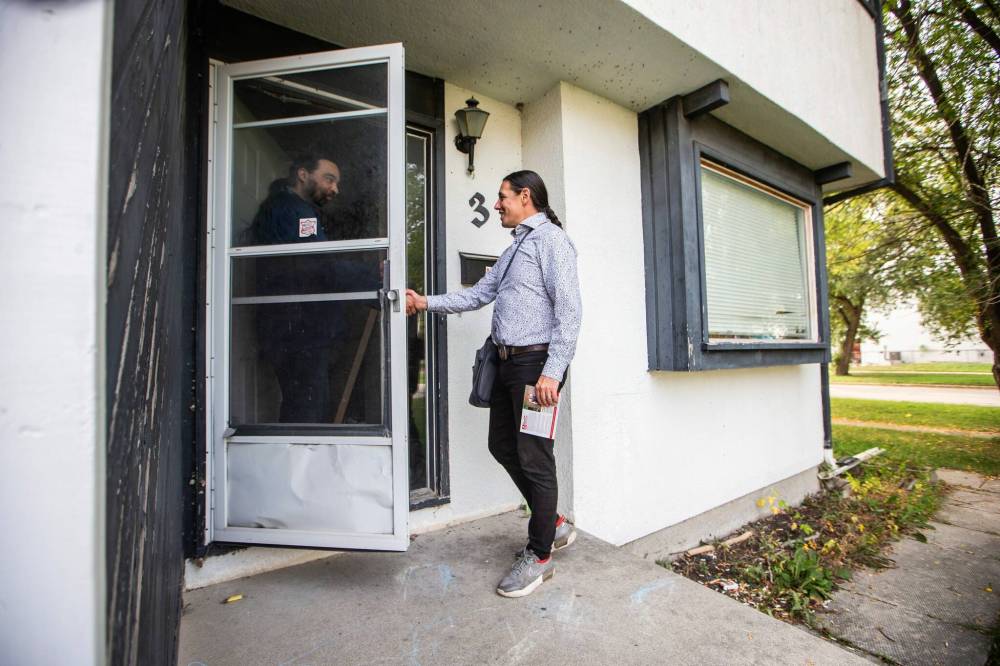
Like sales, door-to-door canvassing has declined in recent years as electronic data collection (survey research and polling are now exclusively done over the phone or online) increased in popularity, but it remained a part of the recent campaign period, says Christopher Adams, an adjunct professor in political studies at the University of Manitoba.
“It gives a human face to the campaign, and there are people who volunteer, so you want to use your volunteers in a way that helps the campaign,” he says.
Door-knocking remains particularly useful in swing areas, and campaign offices will collect data that shows where people are more likely to be swayed by a visit from a candidate, Adams says.
The process remains a valuable tool, one Adams doesn’t foresee being removed from political parties’ repertoire any time soon.
“It’s important for the candidate to learn what people are saying, it’s important for voters to get a sense that this candidate really cares about the neighbourhood and hearing what people at the door have to say.”
Not every organization going door to door considers itself a solicitor.
“It’s important for the candidate to learn what people are saying, it’s important for voters to get a sense that this candidate really cares about the neighbourhood and hearing what people at the door have to say”–Christopher Adams
Manitoba’s 3,607 Jehovah’s Witnesses, a denomination of Christianity, are tasked with spending time at least once a week “witnessing” — or preaching the word of God — but don’t consider themselves solicitors because they’re not seeking donations, sales or votes.
While the faith group has long approached people that way, its approach has shifted with the times, said Prairie spokesperson Joel Ramcharan.
“Before, we would go with, maybe, a presentation or a thought in mind; now we’re trying to be more adaptable to what people want to talk about,” he says.
It may be working. Jehovah’s Witnesses put their weekly door-to-door visits on hold during the COVID-19 pandemic but have started again, and Ramcharan said there has been a spike in interest.
“In Winnipeg, what we have been finding is that people really do want to talk,” he says.
“They were isolated for such a long period of time, and we’re just finding people want to talk about a variety of different subjects.”
malak.abas@winnipegfreepress.com

Malak Abas is a city reporter at the Free Press. Born and raised in Winnipeg’s North End, she led the campus paper at the University of Manitoba before joining the Free Press in 2020. Read more about Malak.
Every piece of reporting Malak produces is reviewed by an editing team before it is posted online or published in print — part of the Free Press‘s tradition, since 1872, of producing reliable independent journalism. Read more about Free Press’s history and mandate, and learn how our newsroom operates.
Our newsroom depends on a growing audience of readers to power our journalism. If you are not a paid reader, please consider becoming a subscriber.
Our newsroom depends on its audience of readers to power our journalism. Thank you for your support.