Bang for the buck, or downmarket dross? While the record boom in dollar stores comes at time of high inflation and soaring costs, there are concerns about the retailers’ marketing of less-durable ‘throwaway’ goods and products more likely to contain harmful substances
Read this article for free:
or
Already have an account? Log in here »
To continue reading, please subscribe:

Digital Subscription
One year of digital access for only $205*
- Enjoy unlimited reading on winnipegfreepress.com
- Read the E-Edition, our digital replica newspaper
- Access News Break, our award-winning app
- Play interactive puzzles
*First annual payment billed as $205.00 + GST for one year. This annual subscription will automatically renew at $233.00 + GST every 52 weeks (10% off the regular annual price of $259.35). Offer available to new and qualified returning subscribers only. Cancel any time.
To continue reading, please subscribe:
Add Free Press access to your Brandon Sun subscription for only an additional
$1 for the first 4 weeks*
- Enjoy unlimited reading on winnipegfreepress.com
- Read the E-Edition, our digital replica newspaper
- Access News Break, our award-winning app
- Play interactive puzzles
*Your next Brandon Sun subscription payment will increase by $1.00 and you will be charged $17.95 plus GST for four weeks. After four weeks, your payment will increase to $24.95 plus GST every four weeks.
Read unlimited articles for free today:
or
Already have an account? Log in here »
Hey there, time traveller!
This article was published 21/03/2024 (916 days ago), so information in it may no longer be current.
Dollarama’s green and yellow loonie-esque sign pops against the Manitoba night sky, a beacon to those on the hunt for a bargain.
Walking underneath, Caryle Stefura feels its pull.
“The urge to not buy… every day is the hard thing,” she says, laughing.
Stefura regularly visits the Fort Richmond location after dropping off her daughter, an employee at the store. Stefura takes stock whenever she’s in, quickly spotting new bargains: just recently, the location began selling Hanes underwear for $5.
JOHN WOODS / FREE PRESS Caryle Stefura started her Winnipeg Dollarama Page on Facebook in July 2020 as a resource where shoppers can share their dollar-store purchases.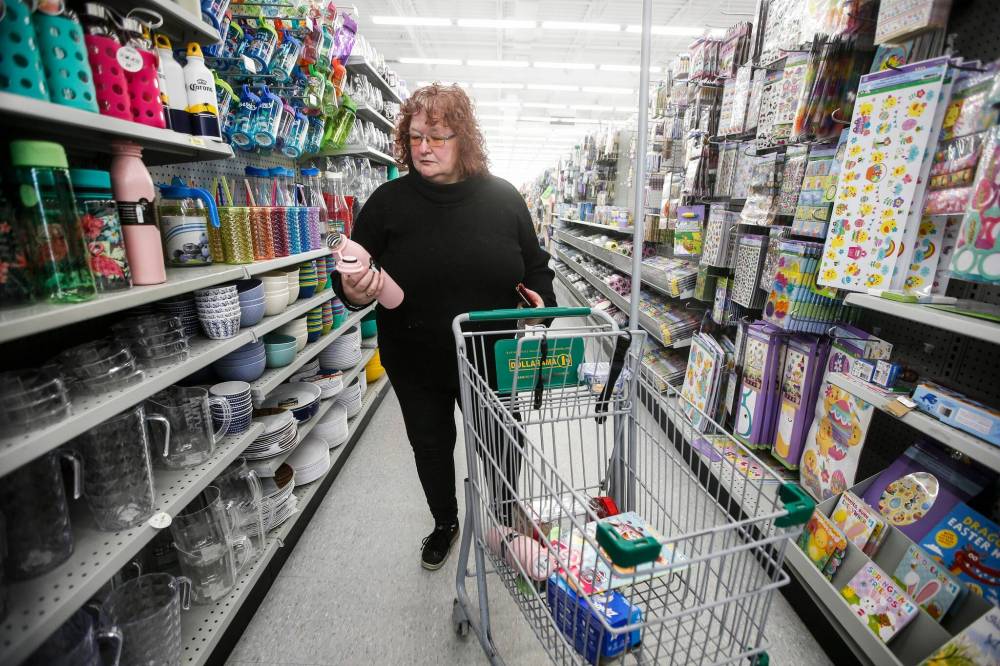
Nearby, there’s Jamieson vitamins for $4; a couple aisles away, cookie boxes at $1.50.
She gazes down a grocery aisle where a handful of customers are shopping for breakfast cereal and canned goods.
“There’s more and more people coming in… on a daily basis,” Stefura says. “It’s getting harder and harder to find the shelves stocked.”
It’s not her imagination. In a period of high inflation, dollar stores have become a major draw for consumers who are trying to get the most bang for their limited bucks.
Stefura has clocked the growth online, too. She began the Winnipeg Dollarama Page on Facebook in July 2020. It’s a resource where shoppers share their Dollarama purchases.
“There’s more and more people coming in… on a daily basis.”–Caryle Stefura
Its membership has surpassed 16,800 users in less than four years, a pattern of growth on the same upward trajectory as Dollarama’s sales and store count.
The chain, which boasts more than $5 billion in sales, has more than doubled its number of Manitoba stores over the past decade. Nationally, Dollarama already has more Canadian locations than McDonald’s or Walmart.
While the traditional corner store fades from the urban landscape, Dollarama and its competitors have aggressive expansion plans for the province and beyond. There will likely be an oversaturation, one dollar-store owner cautions, but Canada is nowhere near that point.
Meanwhile, opponents decry the cheapening of goods and increase in consumerism, but say the stores’ growth reflects today’s society.
In some ways, south Winnipeg is the epicentre of the dollar-store explosion. Three Dollaramas and one Dollar Tree are located within a half-kilometre radius near St. Vital Centre.
Other city quadrants, like Transcona, also boast high concentrations of the stores.
“They’re just like mushrooms,” Roby Chan says of stores that seemingly keep popping up.
Chan visits often. She films her trips, such as her discovery of persimmon chips and Jell-O sour cherry candy squares, and posts videos on social media under the moniker Chan da Wonderer. The clips garner a couple thousand views each.
Chan makes the content to give people money-saving ideas.
“I think that’s everyone’s goal right now,” she says. “With our economy, everything goes up.”
Manitoba boasts 53 Dollaramas, up from 26 in early 2014. And there are now at least 13 Dollar Trees and five Great Canadian Dollar Stores in the province.
There are also independents, such as Morden’s Dollar Store Plus More, and low-price lifestyle shops like Oomomo.
Dollarama, a Quebec-based chain, has about 1,540 stores nationally, up substantially from 690 in 2012. It’s been adding 65 new locations a year.
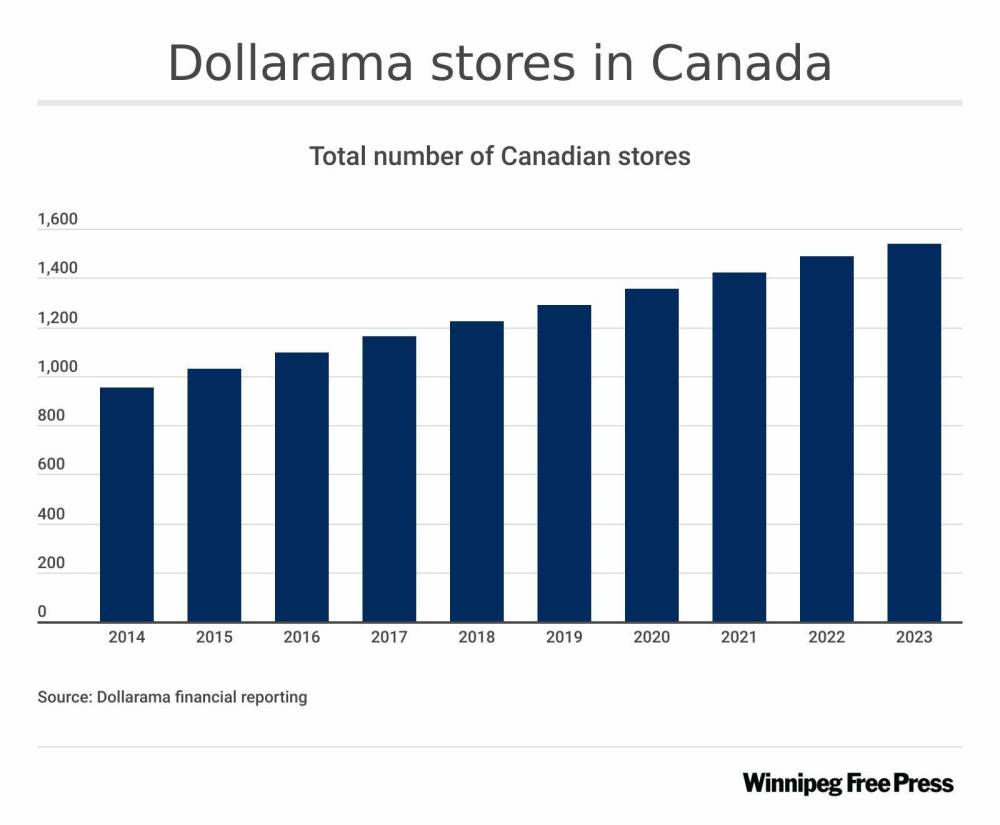
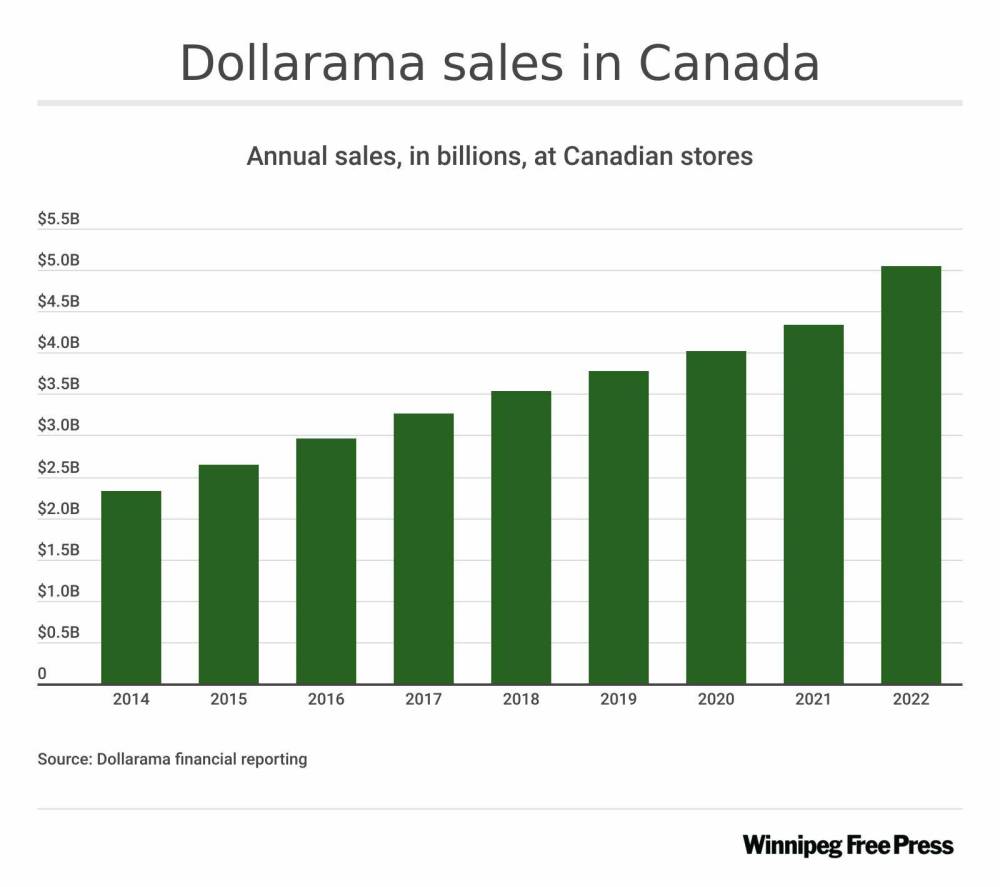
Meanwhile, the chain’s sales have steadily increased. Dollarama counted $4.2 billion in sales during the first nine months of 2023, an 18 per cent increase over the same time period the previous year. Dollarama’s overall sales totalled $5.05 billion in 2022. Reflecting that robust growth, Dollarama’s CEO pay doubled in 2022 from pre-pandemic levels, from $3.8 million to $7.83 million, the Globe and Mail reported at the time.
Roughly 85 per cent of Canadian households live within 10 kilometres of a Dollarama, which recorded, on average, six million customers per week in 2022.
The retailer aims to operate 2,000 Canadian stores by 2031, spokeswoman Maxime Illick says.
Walmart, by comparison, has roughly 400 stores across Canada. McDonald’s has opened upwards of 1,400 Canadian locations.
The CEO of the Great Canadian Dollar Store says oversaturation will eventually be a concern, but not in the near future.
Instead, Kevin Kane hopes to open 15 more stores in Manitoba over the next three years. The New Brunswick-based chain currently operates in Thompson, Niverville, Altona, Morden and Steinbach — and he isn’t ruling out Winnipeg.
He’s watched demand increase in recent years, with a pronounced uptick in the grocery aisles. Kane wouldn’t offer specifics other than saying it’s been “very noticeable.” As a result, the chain has expanded its food offerings.
“At one time, it was middle- to lower-income only,” Kane says of the clientele. “Now we see more and more income of all levels at our stores.”
New locations aren’t franchised as in the past; they’re run by the corporation.
“It’s just easier if corporate expands — they can do it much (more) quickly and have access to more,” Kane says. “It becomes (a) big business, and usually not that attractive to a small ma-and-pa type operator.”
The Great Canadian Dollar Store, which has 120 shops nationally, seeks cheap rent and empty buildings. Kane has heard of backlash in towns in the United States — it’s happened in Virginia, North Carolina, Georgia and Ohio, among other states — as communities fear the stores will undercut local grocers and shops.
“Now we see more and more income of all levels at our stores.”–Kevin Kane
That hasn’t been Kane’s experience.
“Because we go into smaller communities… where there’s not a lot of retailers, usually the opposite would happen,” Kane says. “We’re welcomed with open arms.”
Opposition to a dollar store flared up in Winnipeg two years ago when some River Park South residents opposed a proposed development at 1500 Dakota St. that was going to include a Dollarama.
Speaking at community council meetings, they argued the developer, Qualico, did not consult them about three commercial buildings to be erected. Council directed Qualico to discuss its plans with community residents. Almost two years later, the proposed Dollarama has not been built.
The developer has been including the neighbourhood in its plans, one resident told the Free Press. People weren’t necessarily opposed to a dollar store; it was more a question of why it was needed when there are six within 2.3 km of one another, the resident says. Qualico didn’t respond to questions about the site’s status by publication deadline.
While Dollarama and Great Canadian Dollar Store plan further expansion, the outlook isn’t as rosy for Dollar Tree. Dollar Tree Inc. is headquartered in Virginia and helms Dollar Tree, Dollar Tree Canada and Family Dollar. Its consolidated net sales, across upwards of 15,500 stores in Canada and the U.S., reached $30.6 billion for the latest fiscal year.
Still, the international chain posted a fourth-quarter loss and plans to close nearly 1,000 U.S. stores this year.
Chan searches online for crafting inspiration, then takes those ideas to the dollar store where she stocks up on canvases, kitchen supplies and greeting cards. Lately, she’s likened checking out to paying at the gas pump.
“Even… a dollar store, their prices are increasing,” Chan says.
MIKAELA MACKENZIE / FREE PRESS Roby Chan, an avid dollar-store shopper, often films her finds to share on social media under the moniker Chan da Wonderer.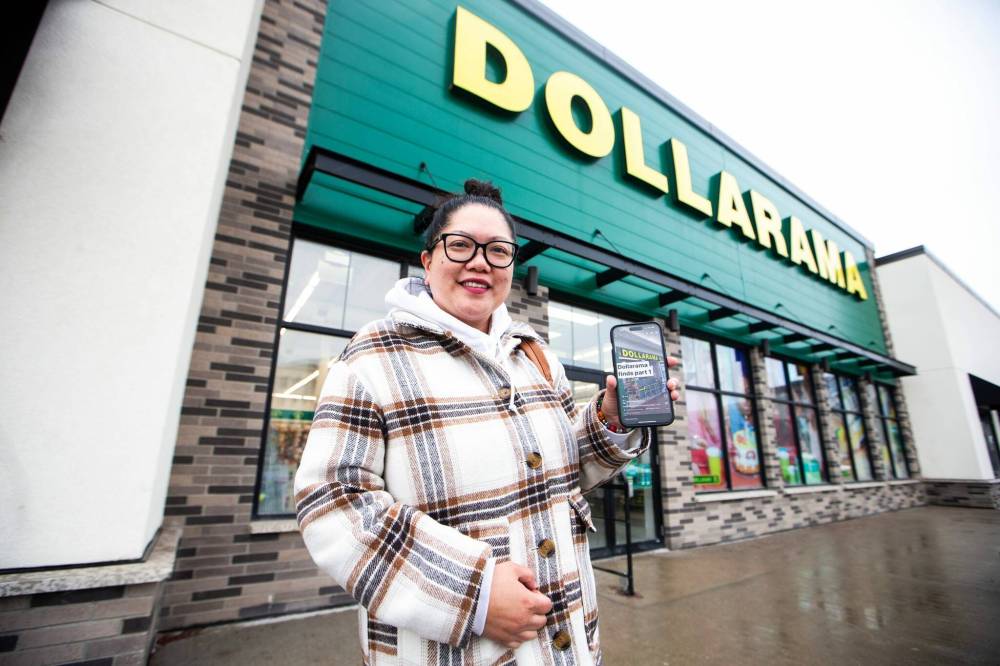
In 2022, Dollarama rolled out $5 items, its highest price point yet.
Selling items for multiple dollars has allowed the stores to increase their product breadth — they’ve become, in a way, a melting pot of places like Shoppers Drug Mart, Canadian Tire and Walmart, says Sean Buchanan, a University of Manitoba professor who studies social issues in business.
He considers dollar stores “a reflection of this broader sort of consumer culture.”
“Basically the nature of consumption these days is, if you don’t pay a lot of money for something, it’s OK it doesn’t last very long,” Buchanan says. “You can throw it out, because you can just replace it.”
Dollar stores serve a need for people struggling financially, but they’ve also become useful to people who “don’t want to like them,” Buchanan says.
“It’s very different now than it was say 30, 40 years ago, when you would want to… have something for 30 years,” he says.
“Basically the nature of consumption these days is, if you don’t pay a lot of money for something, it’s OK it doesn’t last very long.”–Sean Buchanan
Companies have shifted to planned obsolescence, where items are made for replacement. It has led to a “huge amount of waste” — a trend dollar stores exacerbate, Buchanan says.
He believes the continued expansion of dollar stores could lead to a loss of local businesses, however Manitoba Chambers of Commerce president Chuck Davidson takes a different view.
“I don’t necessarily look at them as competition,” he says. “It’s about customer service, it’s about what service you’re providing.”
And competition isn’t always a bad thing, he adds. “It encourages everyone to up their game. In the end, it’s the consumer that’s going to benefit.”
“It (competition) encourages everyone to up their game. In the end, it’s the consumer that’s going to benefit.”–Chuck Davidson
Party Stuff co-owner Jen Skerritt echoes Davidson. She doesn’t consider dollar stores direct competition, though it’s hard to pinpoint how much they affect Party Stuff’s customer count.
The Winnipeg-based company provides a different experience — higher-quality products, trained staff whose wages exceed the minimum and more expertise, Skerritt says.
“We’re interested in really being part of the communities where we operate,” she says, adding that large chain dollar stores aren’t necessarily “interested in the health of a community.”
“Local, independent business is,” Skerritt says.
In the 1990s, when dollar stores were first taking root in Winnipeg, names like A Buck or Two stood out. There are fewer options now.
Consolidation within the dollar-store industry mirrors other sectors in Canada, notes Sarah Elvins, a University of Manitoba professor who studies the history of retailing.
“If you don’t have an actual monopoly, then you have a few major groups that are battling it out,” Elvins says, highlighting Canada’s grocery sector.
Canada no longer has Zellers at the scale it once did, nor Kmart and Woolworth. Elvins calls dollar stores “one of the last remaining areas really catering to that lower market.”
However, the stigma surrounding dollar store shopping seems to have disappeared, Elvins says, with people sharing their purchases on social media and others having crafting pages dedicated to transforming dollar-store goods.
The business model is envied across North America for being “incredibly profitable,” she says, since the stores have a smaller footprint, don’t spend money on elaborate displays or signage, and require little advertising, plus, their labour costs are relatively low.
“I know the deals I get at Dollarama are the best ones.”–Sylvain Charlebois
Sylvain Charlebois, a Canadian expert in food distribution, security and safety, has said the surge in food inflation has transformed Canadians into bargain-hunters who have become less loyal to specific brands and stores.
Case in point, he now buys his peanut butter from dollar stores.
“I know the deals I get at Dollarama are the best ones,” the director of Dalhousie University’s Agri-Food Analytics Lab says.
While the stores use a different business model than grocery retailers, they’re still a “significant threat” to the grocery industry, he believes.
In Canada, non-traditional food stores are breaking into the mainstream. Giant Tiger ranked fifth as the preferred retailer for discounted food, behind Superstore, Walmart, Costco and Metro (which operates in Ontario and Quebec), according to a February Agri-Food Analytics Lab survey.
Despite dollar stores’ promises of low costs, grocery giants can still be cheaper, Leah Boss says.
Pointing to the $1.75 price tag on a pasta can at a Portage Avenue Dollarama, the Winnipeg resident makes her case: “Ravioli… last week, Walmart did like 87 cents a can.”
Poor quality
While the news tends to focus on bargains at dollar stores, incidents involving poor product quality have also made headlines. One in four dollar-store products tested positive for substances managed under the Canadian Environmental Protection Act, a 2022 analysis from Environmental Defence found.
The organization called for more transparency and better enforcement to protect Canadians from exposure to lead, cadmium and other toxic chemicals.
Buchanan, the University of Manitoba professor, would like to see more government-implemented measures to improve product quality and decrease planned obsolescence.
“Those are the kinds of things that I think are going to need to be done, eventually, to respond to environmental crises,” he says.
Under Dollarama’s bright fluorescent lights, Luman Ni weaves in and out of the aisles before stopping in her favourite — the seasonal section.
Easter signs hang on one side; feather-covered chicks pepper shelves.
It’s a treat, says the once-a-week Dollarama shopper, seeing all these items that can’t be found elsewhere. She, like many others, finds happiness in the dollar-store shopping experience.
Ni gathers her items and heads to the checkout, joining an ever-flowing stream of shoppers out the door.
gabrielle.piche@winnipegfreepress.com

Gabrielle Piché reports on business for the Free Press. She interned at the Free Press and worked for its sister outlet, Canstar Community News, before entering the business beat in 2021. Read more about Gabrielle.
Every piece of reporting Gabrielle produces is reviewed by an editing team before it is posted online or published in print — part of the Free Press‘s tradition, since 1872, of producing reliable independent journalism. Read more about Free Press’s history and mandate, and learn how our newsroom operates.
Our newsroom depends on a growing audience of readers to power our journalism. If you are not a paid reader, please consider becoming a subscriber.
Our newsroom depends on its audience of readers to power our journalism. Thank you for your support.