Taking on a ‘silent killer’ Governments are ramping up strategies to address the devastating impacts of extreme heat
Read this article for free:
or
Already have an account? Log in here »
To continue reading, please subscribe:

Digital Subscription
One year of digital access for only $205*
- Enjoy unlimited reading on winnipegfreepress.com
- Read the E-Edition, our digital replica newspaper
- Access News Break, our award-winning app
- Play interactive puzzles
*First annual payment billed as $205.00 + GST for one year. This annual subscription will automatically renew at $233.00 + GST every 52 weeks (10% off the regular annual price of $259.35). Offer available to new and qualified returning subscribers only. Cancel any time.
To continue reading, please subscribe:
Add Free Press access to your Brandon Sun subscription for only an additional
$1 for the first 4 weeks*
- Enjoy unlimited reading on winnipegfreepress.com
- Read the E-Edition, our digital replica newspaper
- Access News Break, our award-winning app
- Play interactive puzzles
*Your next Brandon Sun subscription payment will increase by $1.00 and you will be charged $17.95 plus GST for four weeks. After four weeks, your payment will increase to $24.95 plus GST every four weeks.
Read unlimited articles for free today:
or
Already have an account? Log in here »
Hey there, time traveller!
This article was published 02/08/2024 (801 days ago), so information in it may no longer be current.
It’s only halfway through summer but the world has already experienced its hottest day ever — twice.
On July 21, the global average temperature nudged past the all-time record of 17.08 C set a year ago. The next day was even hotter, reaching 17.16 C, where it hovered for another day.
Before 2023, the hottest day on record was 16.8 C set in August 2016. As of July, that temperature has been exceeded 59 times in just over a year. July also marked the 13th consecutive month to break global temperature records.
“We are not prepared,” United Nations Secretary General Antonio Guterres said in a call to action last week urging governments to address the threat of extreme heat. “Deadly heat is becoming commonplace.”
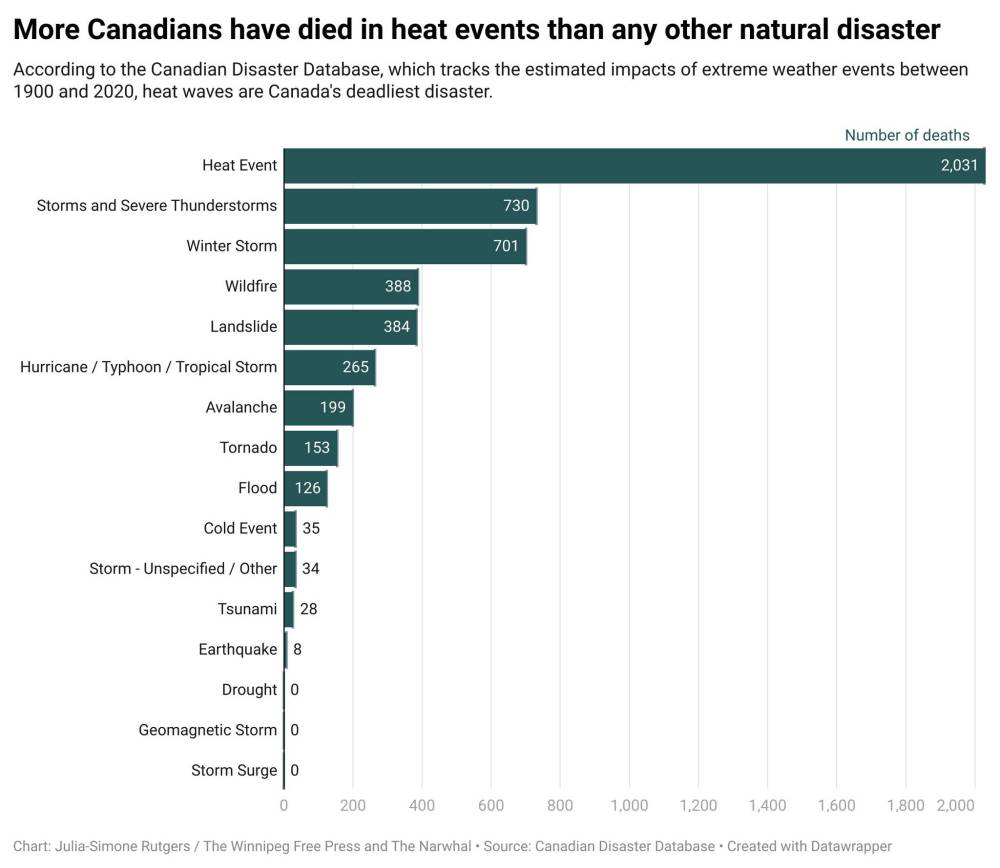
Extreme heat is among the world’s most deadly natural disasters, killing nearly 500,000 people worldwide annually. In Canada and the United States, extreme heat kills more people than any other weather event.
But unlike other natural disasters, it is a largely invisible emergency: it comes on slowly, targets vulnerable populations and kills behind closed doors.
As a result, “policies to address extreme heat so far remain scattered, disjointed and underfunded,” Guterres said in the UN report.
According to Manitoba Public Health officials, messaging and education is critical in keeping the community — especially vulnerable populations — safe.
As Manitobans sweat out a late July heat wave, Public Health released a bulletin advising outdoor workers and their employers to take extra precautions and be aware of the signs of heat stress.
But a rise in frequency and severity of heat waves in Canada is prompting a new perception of extreme risks among policymakers and the public alike.
“It’s become rightly recognized as something much more serious and potentially devastating,” said Sarah Miller, adaptation research lead at the Canadian Climate Institute.
“We no longer see heat waves as something fun that happens in the summer where you go to the beach to cool off. We’re starting to take it seriously.”
It’s estimated nearly 500,000 people globally died as a result of extreme heat each year from 2000 to 2019.
According to an analysis of Canada’s disaster database, which tracks the impacts of severe weather events stretching back to 1900, heat waves caused more than 2,000 deaths between 1900 and 2020, representing 40 per cent of all natural disaster fatalities in that time.
That figure doesn’t include the 2021 heat dome that killed 619 people in British Columbia — the deadliest natural disaster in Canadian history. Manitoba currently does not collect data on heat-related mortality.
“Termed the ‘silent killer,’ extreme heat dwarfs the impact of more visible weather hazards,” Guterres said.
Older adults are most at risk, with the UN reporting an 85 per cent increase in heat deaths among the demographic in recent years, compared to the early 2000s. Children, people with pre-existing health conditions, employees in outdoor or poorly ventilated workplaces and athletes also face more heat-stress risks.
But according to the World Health Organization’s Global Heat Health Information Network, almost all deaths directly due to excess heat can be prevented provided governments develop action plans and early-warning systems.
As Miller at the Canadian Climate Institute explained, timely heat warnings are key.
“One of the best practices is clear and consistent heat-warning systems that clearly differentiate between heat warnings and extreme-heat emergencies,” she said.
The goal is to help the public understand when a heat wave is severe — for example, when temperatures are far higher than normal, don’t fall at night and stick around for a prolonged period of time — “all of which really ratchet up the severity of health implications,” Miller said.
Though it does not differentiate between heat warnings and heat emergencies like Ontario and British Columbia, Manitoba has had a public health plan for extreme heat for more than a decade, Jennifer Chiarotto, the province’s executive director of population and public health, said in an interview.
That plan was refreshed this year and included in a Heat Alert and Response System guide, which makes recommendations to government departments, municipalities and other agencies.
In Manitoba, as in other provinces, Environment and Climate Change Canada takes the lead on early heat warnings, medical officer of health Peter Benoit explained. The provinces work with their federal counterparts to track forecasts and be on alert for weather that exceeds the extreme-heat threshold.
Mikaela Mackenzie / Free Press The sun beats down on downtown Winnipeg, with the concrete and lack of green spaces amplifying the natural heat.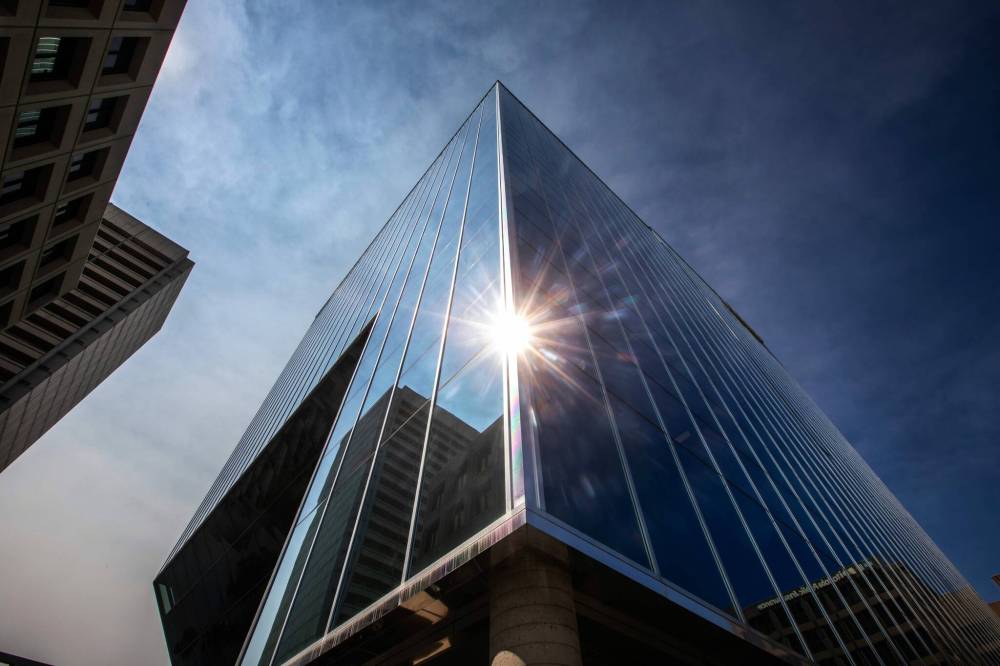
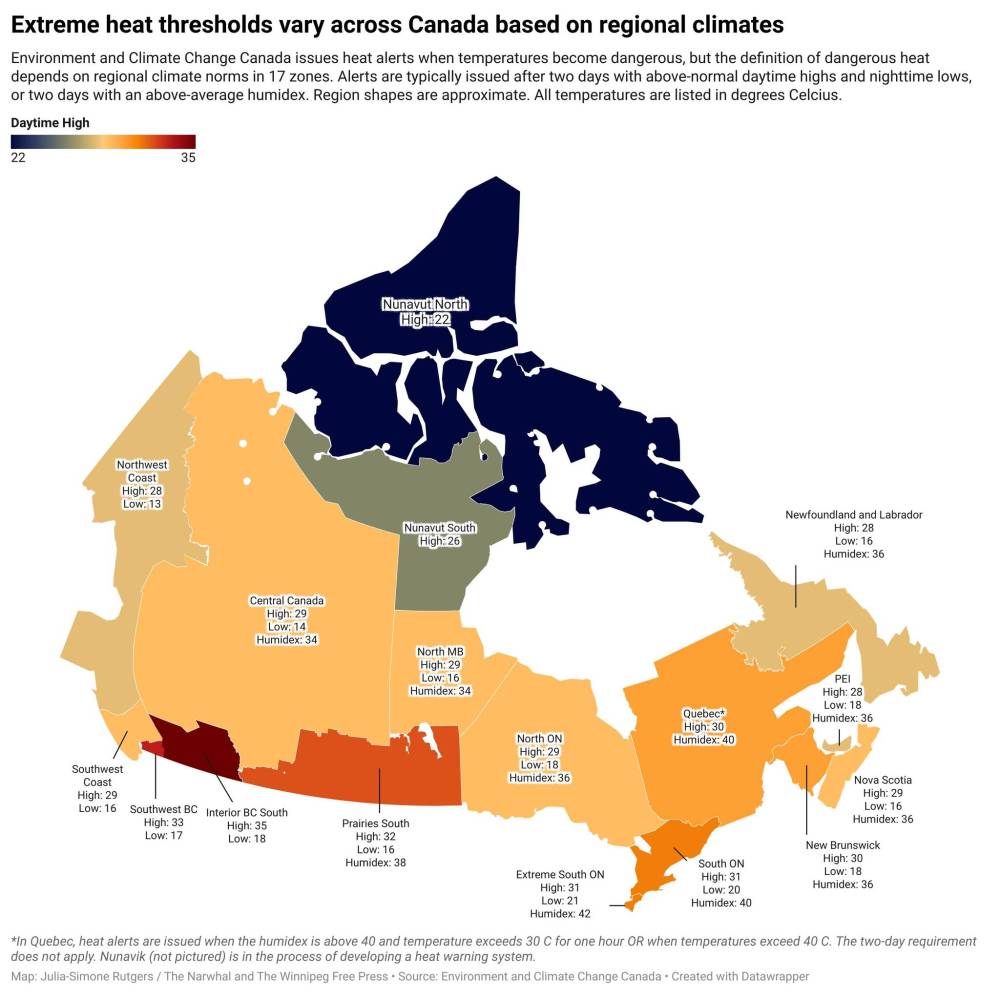
Those thresholds differ across jurisdictions. Extreme heat warnings are issued in southern Manitoba when forecasts predict two days with either daytime highs above 32 C and nighttime lows above 16 C, or a humidex over 38 C. The threshold is a few degrees lower in northern Manitoba, where temperatures tend to be cooler.
Once a heat alert is triggered, the province puts out messaging to residents, municipalities, health-care facilities and other agencies advising the public — particularly vulnerable populations — to take precautions and put localized heat response plans in motion.
“We want people to be cool and have access to the tools that they need for that — we want people to be able to drink water, attend green spaces and so forth,” Chiarotto said. “The function is very much focused on prevention.”
Unlike other natural disasters, heat does discriminate.
“Heat targets the most vulnerable in our society,” Peter Kimbell, an Environment and Climate Change Canada warning preparedness meteorologist, said in an interview.
Hot days are even hotter in urban centres, where human-driven activities, such as vehicles, transportation networks and mechanical systems, combined with the heat-absorbing properties of asphalt and pavement can increase air temperatures by 3 C in the day and up to 12 C at night.
Ruth Bonneville / Free Press Madison and her mom Priscilla stop to fill up a water bottle at one of eight hydration stations the city has installed in recent years. The stations are part of the city’s response to extreme heat concerns.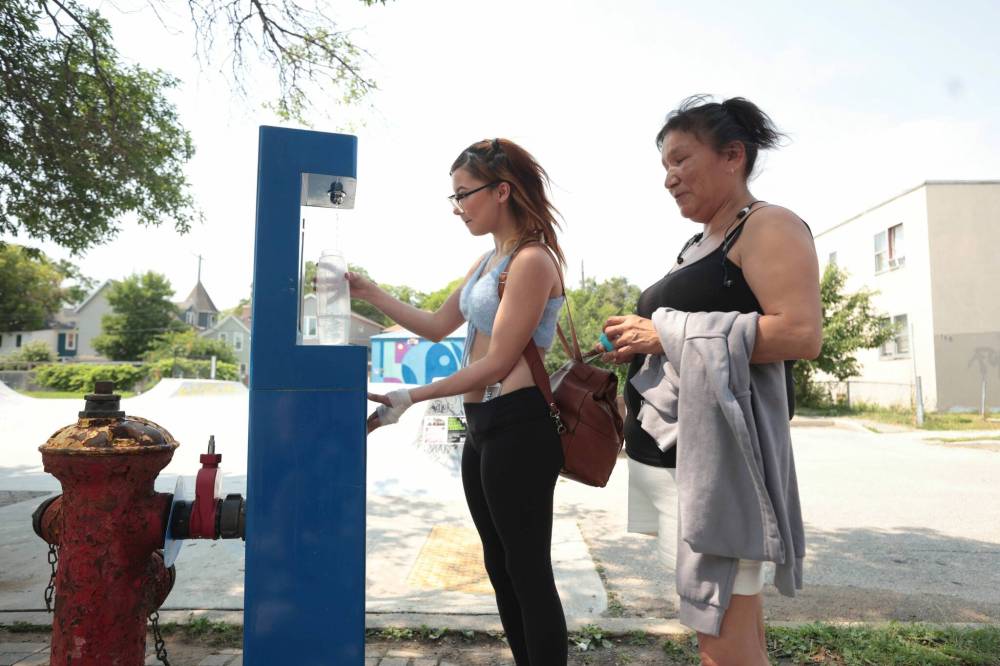
That leaves low-income neighbourhoods, particularly those with little tree cover and green space, to experience the worst of what’s called a heat-island effect.
A 2023 Statistics Canada study found less than half of those living on the Prairies have access to air conditioning, compared to a national average of 61 per cent. Among racialized and low-income groups, 37 per cent had access to air conditioning. For non-homeowners, access fell to 35.5 per cent.
“It’s seniors in apartments without air conditioning who are most vulnerable,” Kimbell said.
In Winnipeg, emergency management co-ordinator Mike Olczyk said response plans are tailored to protect the most vulnerable.
Since 2022, the city has installed a handful of hydration stations — effectively water bottle filling stations — in high-need areas. This year, the number of stations was increased from three to eight.
Several community centres open their doors to provide respite, bottled water and information to help residents identify heat-related health symptoms. Other public facilities, such as libraries, swimming pools and spray pads, can also offer relief.
The city worked with an extreme weather response group made up of shelters and other community agencies serving vulnerable populations to decide where to locate hydration and cooling stations.
“We try to get as close as we can to some of the shelters,” Olczyk said.
The city’s emergency response also focuses on helping residents understand the risks of extreme weather, urging people to check in on family, friends and neighbours who might live alone or lack air conditioning, or encouraging parents to keep their children and pets hydrated and out of the sun during the hottest hours of the day.
Canada is beginning to treat extreme heat with the same urgency it does other natural disasters, Miller said, noting emergencies such as floods are much more dramatic, not only due to the images they produce, but also in terms of financial impacts to individuals and governments.
“It’s easier to talk about the severity of those disasters and then plan for them … I think just because of the visibility of those disasters and the massive price tag attached, whereas the impacts of extreme heat are primarily on people’s health.”
Mikaela Mackenzie / Free Press
And more specifically, on the health of vulnerable people — often in private or at home.
“Those factors combine to make extreme heat more of an invisible emergency,” Miller said. “That has hindered the flow of funding and the visibility of it as a disaster.”
But the perception is starting to change.
“Economic growth is reduced, labour productivity diminished, water supplies exhausted, energy demand increased, precious crops decimated, school days missed, key infrastructure degraded and homes made uninhabitable, all of which puts more pressure on already-stretched public services and may overwhelm humanitarian assistance,” the UN said in its call to action on extreme heat.
Labour productivity drops as the mercury starts to climb above 24 C, according to the UN. Beyond 34 C, productivity is cut in half. The International Labour Organization estimates the economic losses from heat stress at work is expected to rise to US$2.4 trillion by 2030 — equivalent to losing 80 million full-time jobs. Mikaela Mackenzie / Free Press
WorkSafe BC found heat-related workplace injuries increased 180 per cent during the 2021 heat dome, including a significant increase in claims from indoor workers such as kitchen and warehouse staff. Many workplaces closed or cut hours, predominantly those without working ventilation or air conditioning. Ten of 12 public school districts in the lower mainland closed. It’s estimated workers lost more than $205 million in income.
Meanwhile, the heat dome cost B.C. $25 million in agricultural losses and put intensive strain on the its hydroelectric grid, causing several local outages, according to an analysis by the Canadian Climate Institute.
The heat dome exposed weaknesses in provincial heat response systems and prompted government to put more emphasis on early preparedness to protect both people and the economy, Miller explained.
BC Hydro recently implemented a program offering free portable air conditioning units to low-income residents and people with medical needs. The government is starting to stock air conditioners for institutions such as prisons, long-term care facilities and subsidized housing units.
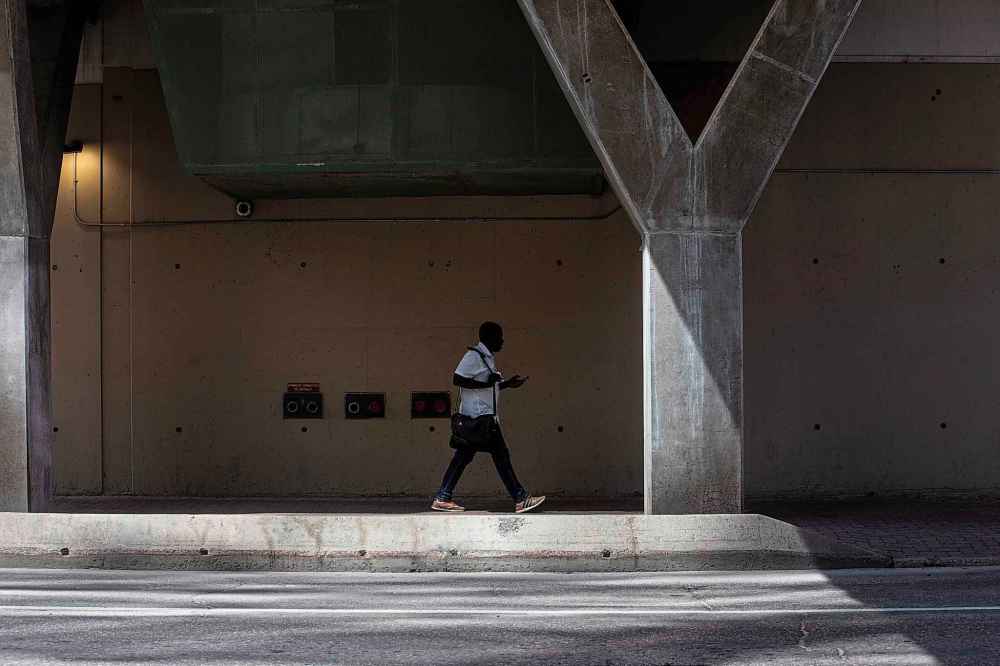
Municipalities are looking at increasing tree cover, particularly in low-income urban neighbourhoods, and adapting building codes and bylaws to protect residents — particularly renters — from the impacts of extreme heat.
Governments have started developing clear guidelines for employers to have heat plans at work, and have invested in programs to support the agricultural sector in keeping livestock cool, Miller said.
Manitoba’s public health officials are trying to be more proactive by issuing safety messaging early in the summer before heat waves hit, which can help normalize preventative behaviours like packing extra water or staying in cool locations when temperatures rise, Chiarotto said.
The province is continually adapting its messaging but longer and more severe heat waves might require a different approach to public health messaging or community-wide adaptation, Benoit said.
So far in Winnipeg, Olczyk said the focus on early warnings and persistent messaging has had an impact.
“Anecdotally, I would say people are adapting their activities,” he said, be it outdoor workers taking more breaks or athletes shifting their daily run to the cooler hours of the day.
“With the effects of climate change and seeing more frequency and intensity of events, I think the perception of this hazard is growing.”
julia-simone.rutgers@freepress.mb.ca

Julia-Simone Rutgers is an investigative reporter who joined the Free Press in 2020. Read more about Julia-Simone.
Every piece of reporting Julia-Simone produces is reviewed by an editing team before it is posted online or published in print — part of the Free Press‘s tradition, since 1872, of producing reliable independent journalism. Read more about Free Press’s history and mandate, and learn how our newsroom operates.
Our newsroom depends on a growing audience of readers to power our journalism. If you are not a paid reader, please consider becoming a subscriber.
Our newsroom depends on its audience of readers to power our journalism. Thank you for your support.