Bee’s needs Entomology student’s research, photography aims to help save ‘one of the most important’ bugs on the planet
Read this article for free:
or
Already have an account? Log in here »
To continue reading, please subscribe:
Digital Subscription
One year of digital access for only $1.44 a week*
- Enjoy unlimited reading on winnipegfreepress.com
- Read the E-Edition, our digital replica newspaper
- Access News Break, our award-winning app
- Play interactive puzzles
*Billed as $5.77 plus GST every four weeks. After 52 weeks, price increases to the regular rate of $19.95 plus GST every four weeks. Offer available to new and qualified returning subscribers only. Cancel any time.
To continue reading, please subscribe:
Add Free Press access to your Brandon Sun subscription for only an additional
$1 for the first 4 weeks*
- Enjoy unlimited reading on winnipegfreepress.com
- Read the E-Edition, our digital replica newspaper
- Access News Break, our award-winning app
- Play interactive puzzles
*Your next Brandon Sun subscription payment will increase by $1.00 and you will be charged $17.95 plus GST for four weeks. After four weeks, your payment will increase to $24.95 plus GST every four weeks.
Read unlimited articles for free today:
or
Already have an account? Log in here »
Hey there, time traveller!
This article was published 17/09/2024 (768 days ago), so information in it may no longer be current.
Shoulder-high big bluestem grasses sway in graceful unison as a stiff west wind gusts through the south block of the Manitoba Tall Grass Prairie Preserve.
Thilina Hettiarachchi, a PhD student in the department of entomology at the University of Manitoba, and Reid Miller, a U of M field research assistant, are checking various sampling stations for bees and other pollinators.
A journalist is tramping along with them through the narrow, barely discernible trail on this luminous late August day.
Ruth Bonneville / Free Press Thilina Hettiarachchi is internationally recognized for his macrophotography of bees and other insects. 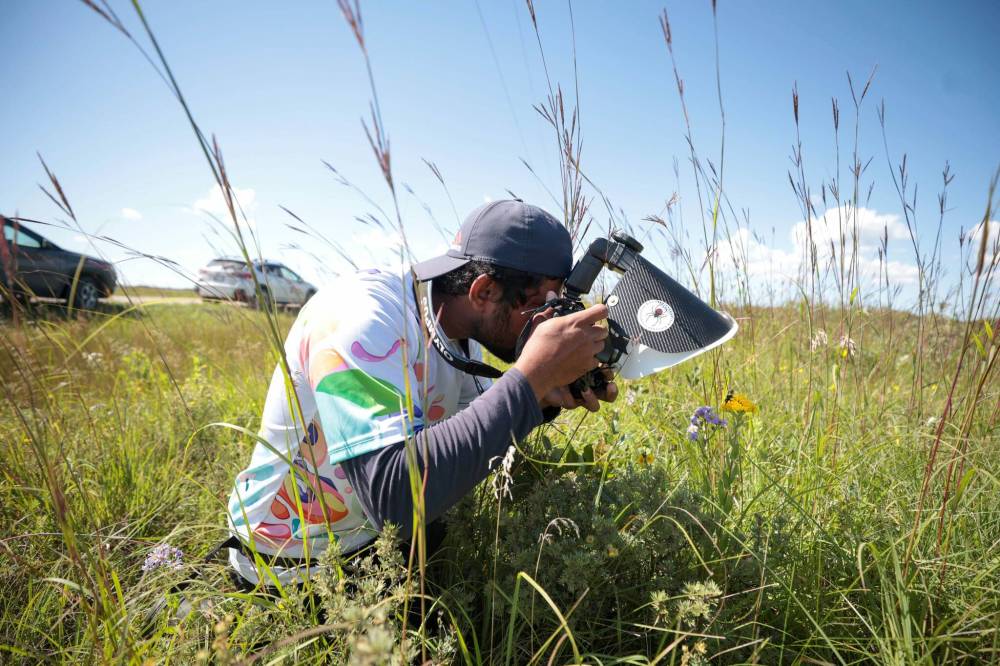
Hettiarachchi, a native of Sri Lanka, is studying bee diversity in grassland ecosystems in Manitoba and Saskatchewan. His research is part of a Genome Canada-funded project called Grassland Genomics for Green House Gas Mitigation.
Along with the tall grasses, blue asters, goldenrod and wild sunflowers contribute to the vibrant natural palette in this portion of the last remaining stand of tall grass prairie in Manitoba, located on the west side of the dusty gravel Provincial Road 209, near the hamlet of Tolstoi, just off Highway 59.
Tall grass prairie
The Manitoba Tall Grass Prairie Preserve, where Thilina Hettiarachchi is studying bees and other insects for his PhD in entomology at the University of Manitoba, represents the largest remaining tract of tall grass prairie in the province.
The Manitoba Tall Grass Prairie Preserve, where Thilina Hettiarachchi is studying bees and other insects for his PhD in entomology at the University of Manitoba, represents the largest remaining tract of tall grass prairie in the province.
Originally covering 650,000 square kilometres from southern Manitoba to the Texas border, this ecosystem was, as its name suggests, dominated by tall grasses. More than 1,000 species depend on this diverse habitat; 16 species that are on provincial or national endangered species list reside within the area.
Today, less than 0.1 per cent of this endangered ecosystem remains in North America. Tall grass prairie in Manitoba is only a fraction of its former 6,000 square kilometres of wildlife.
This was the most productive type of prairie in North America. Its very richness, however, spelled its doom. With deep fertile soils, the prairie was soon transformed by settlers. Cereal and forage crops are now cultivated where orchids, lilies and grasses once thrived.
Several groups and organizations help in land preservation in the Manitoba Tall Grass Prairie, such as the Nature Conservancy of Canada, Nature Manitoba, Environment Canada, Manitoba Conservation and the Manitoba Habitat Heritage Corporation.
Sources: Living Prairie Museum, Nature North, Nature Conservancy Canada
Trembling aspen, oak trees and shrubby cinquefoil, with its sculpted yellow blooms, are also part of the flora fusion.
This is all part of the Tallgrass Aspen Parkland conservation area in Manitoba and Minnesota. Only about 0.5 per cent of the original 6,000 kilometres of tall grass prairie in Manitoba remains.
“What we are doing here is sampling bees and other insects in these bee bowls of three different colours — yellow, blue, white,” Hettiarachchi says, as he and Miller stop at one of the stations set up at intervals on the Prairie site.
The bee bowls are about the size of single-serve yogurt cups. Three bowls are attached near the top of sticks, which are adjusted to the height of nearby vegetation.
“We are using a simple technique,” Hettiarachchi explains. “The bowls are filled with soapy water to reduce the surface tension. Insects are drawn inside and collected.”
The bee bowls were placed on the site 24 hours earlier, he observes, noting that there are 10 stations at this particular site. The stations are spaced 50 metres apart to make sure each one is independent from the others, or at least semi-independent.
The bee bowls are painted fluorescent colours to trick the bees into believing they are flowers, adds Miller, who has a master’s in entomology from the U of M.
Ruth Bonneville / Free Press Hettiarachchi sets up a elevated bee bowl sampling station in the field at the south station, at the Manitoba Tall Grass Prairie Preserve.
“Thilina and I are both naturalists with a fascination for insects,” he says.
The bee project not only covers a large swath of the environment; it is broad in its scope.
“We are collaborating with the University of Saskatchewan,” says Hettiarachchi, who graduated with a bachelor of science from Peradeniya University in Sri Lanka.
“They are looking for the soil and the plants and other insects. We are also sampling ground-dwelling insects using shallow pitfall traps at each station and sending the samples to the University of Saskatchewan,” he explains.
Ruth Bonneville / Free Press Hettiarachchi shows off a Melissodes bee.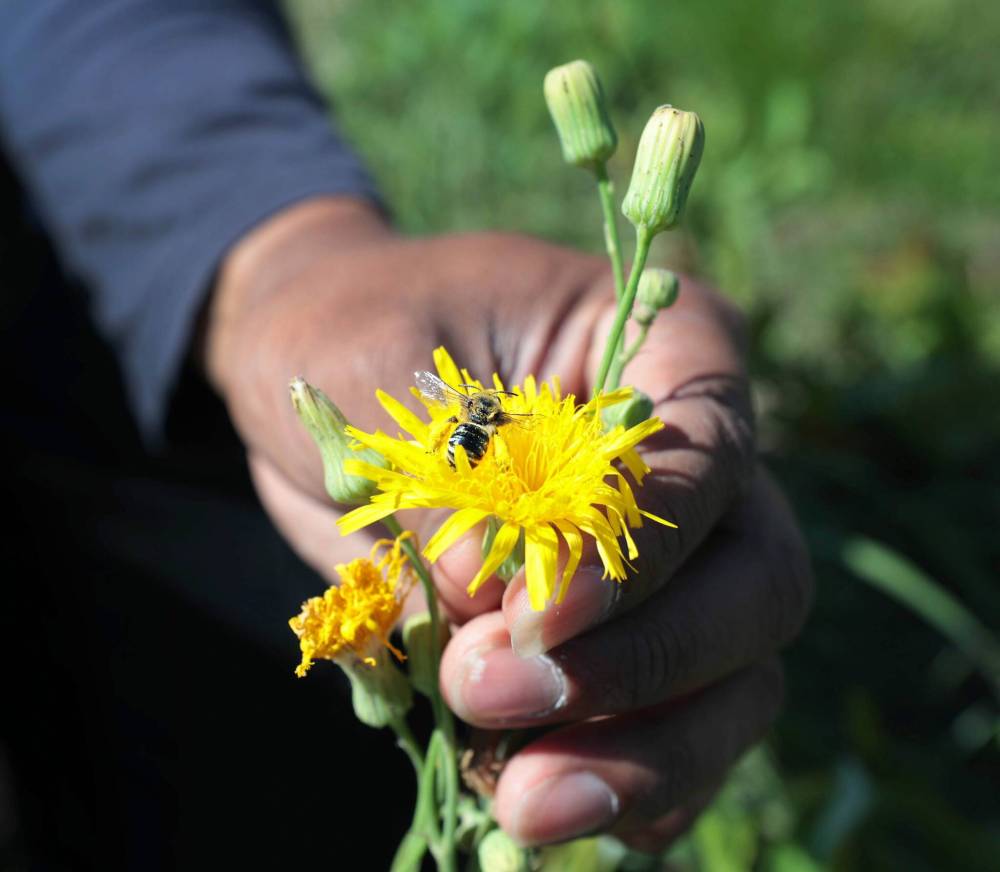
“We primarily focus on bees in our bee bowls. I am retaining the bees, along with some wasps and flies, while the other specimens are sent to the University of Saskatchewan.
“We are recording the flowers from which each specimen is sampled. All of these specimens will be examined later in the lab to identify their species.”
The insects sampled on this afternoon only include a few bumblebee species, long-horned bees, a small Lasioglossum bee and a few hover flies. Otherwise, the duo snag lots of other species, using both active netting and bee bowls.
That morning, for example, they had sampled some leafcutter bees, long-horned bees and a few Protandrena bees.
“We have to examine them under the microscope to identify them precisely,” Hettiarachchi says.
Danielle Da Silva/Canstar/Sou’wester Jason Gibbs is an assistant professor in entomology at the University of Manitoba.
“Bees play a crucial role as the planet’s top pollinators, making them vital for keeping natural ecosystems running smoothly. That’s why it’s so important to study them and learn about the different species we have around us.”
He maintains six sites near the preserve, four sites in the Interlake, one at Canadian Forces Base Shilo, one at Camp Hughes, one at Birds Hills Provincial Park, one at Fort Ellice and another at Horod Moraine , among other places in southern Manitoba.
Ready for his close-up
Jason Gibbs, associate professor department of entomology at the University of Manitoba, has high praise for his PhD student Thilina Hettiarachchi — and not just for his academic work, in which he has described species that are new to science.
Jason Gibbs, associate professor department of entomology at the University of Manitoba, has high praise for his PhD student Thilina Hettiarachchi — and not just for his academic work, in which he has described species that are new to science.
“The beauty of insects is often not appreciated by the layperson. But Thilina’s photography provides a new perspective that can engage people effectively,” Gibbs says. “His photos are gorgeous. As an amateur macrophotographer, he makes my pictures look terrible. Actually, my own photographs have improved immensely since knowing Thilina.
Gibbs points out that it’s critical for biodiversity research to be able to recognize and describe minute details of insects.
“Thilina’s photography brings these into sharp focus. His keen eye for details was evident in his taxonomic research, in which he was able to recognize subtle differences between closely related bees.”
Taxonomy is the foundation for biodiversity research and conservation, Gibbs says, adding that Hettiarachchi’s skills have improved the overall quality of taxonomic studies emerging from the lab, “as we are now all better and taking high-quality images of our insects.”
Hettiarachchi completed his MSc in the department of entomology at the U of M under the supervision of Jason Gibbs, a world-famous bee researcher.
“One of the most prestigious milestones in my life has been the opportunity to pursue both my master’s and now my PhD at the University of Manitoba,” he says, crediting Gibbs with “immense support.”
As he talks, the 31-year-old researcher pours the contents of a bee bowl into a bigger container, which is then packed into a large plastic zip-top bag and placed into one of the two plastic tubs he and Miller carry with them.
Scientists at the University of Saskatchewan will later analyze the DNA inside the liquid, explains Hettiarachchi.
One of the key chapters of his earlier research has already been published in a scientific journal.
“I described three new species of Lasioglossum (Sphecodogastra) bees (gathered by other entomologists from sites in Arizona, California and Baja California) and provided an updated key for the North American Lasioglossum subgenera,” Hettiarachchi says, brushing away an insect buzzing around his face.
SUPPLIED Closeup of a male broad-handed leafcutter bee.
“My thesis work also contains additional fascinating discoveries, including more new species in the subgenus Lasioglossum (Hemihalictus), which are expected to be published in the future.”
There are nearly 400 bee species in Manitoba; the energetic entomologist is hoping to find even more with this survey.
“In the future, I’ll be analyzing their DNA and doing a phylogenomic study of bee species in the Canadian Prairies. This approach will help us understand how different species are related, which is really important for planning conservation efforts and saving one of the most important groups of animals on the planet — the bees.”
Hettiarachchi also uses macrophotography as a tool.
“Capturing detailed images is essential in modern taxonomy (the science of classification of organisms), as it can enhance the clarity of taxonomic descriptions,” says the self-taught photographer. “Beyond my research, I enjoy photographing arthropods, using this medium as a tool to digitally document these tiny creatures.”
SUPPLIED The Ghost Tiger Beetle.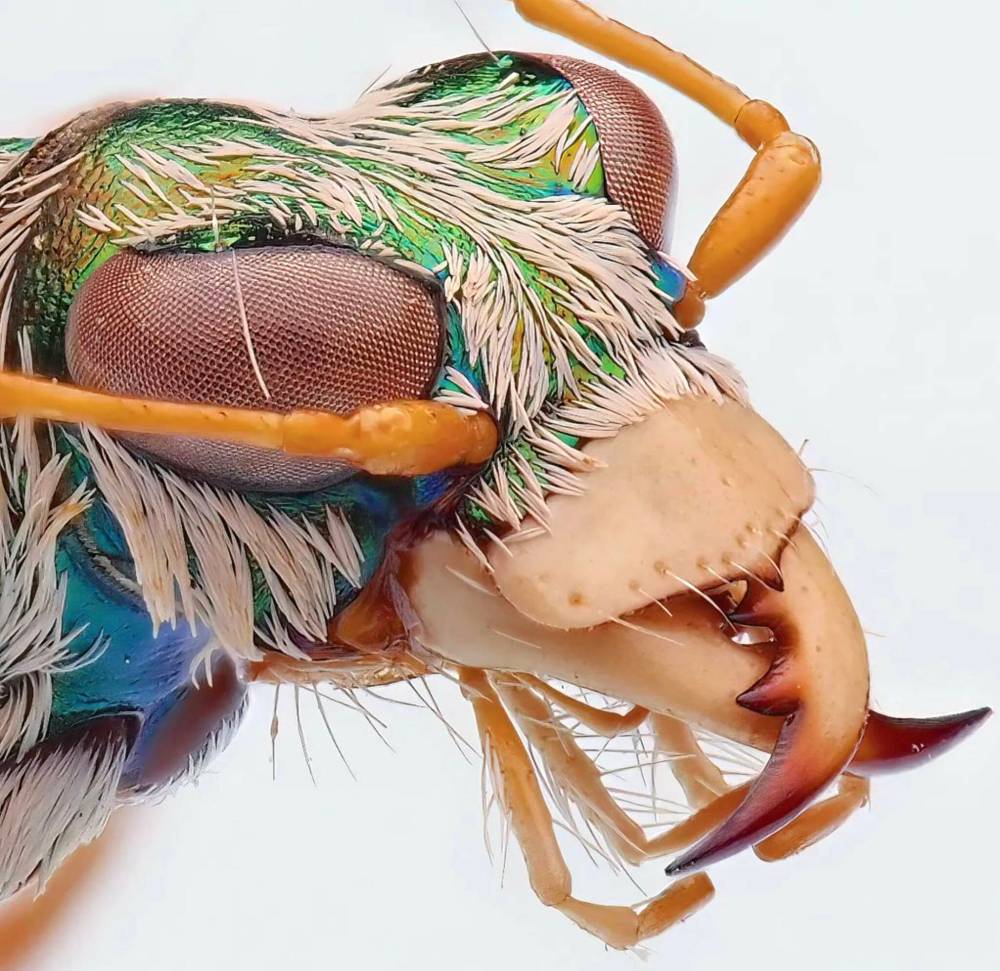
His photogrpahy, which he calls one of his greatest passions, has earned considerable attention on Instagram (@bugsnapz), and has been featured at the Imaginari Art Gallery in New York. His work has been selected for the World Insect Calendar, organized by the Entomological Society of America, for three consecutive years.
“Additionally, I was awarded first place in the Entomological Society of Canada’s insect photo contest in 2023, and my images have graced the covers of various journals and newsletters.”
Gibbs has high praise for Hettiarachchi’s academic work, in which he has described species that are new to science, as well as his photography.
“The beauty of insects is often not appreciated by the layperson. But Thilina’s photography provides a new perspective that can engage people effectively,” Gibbs says. “His photos are gorgeous. As an amateur macrophotographer, he makes my pictures look terrible. Actually, my own photographs have improved immensely since knowing Thilina.
Gibbs points out that it’s critical for biodiversity research to be able to recognize and describe minute details of insects.
SUPPLIED Phymata americana feeding on a bumble bee. Hettiarachchi says he is using macrophotography to change how people see insects.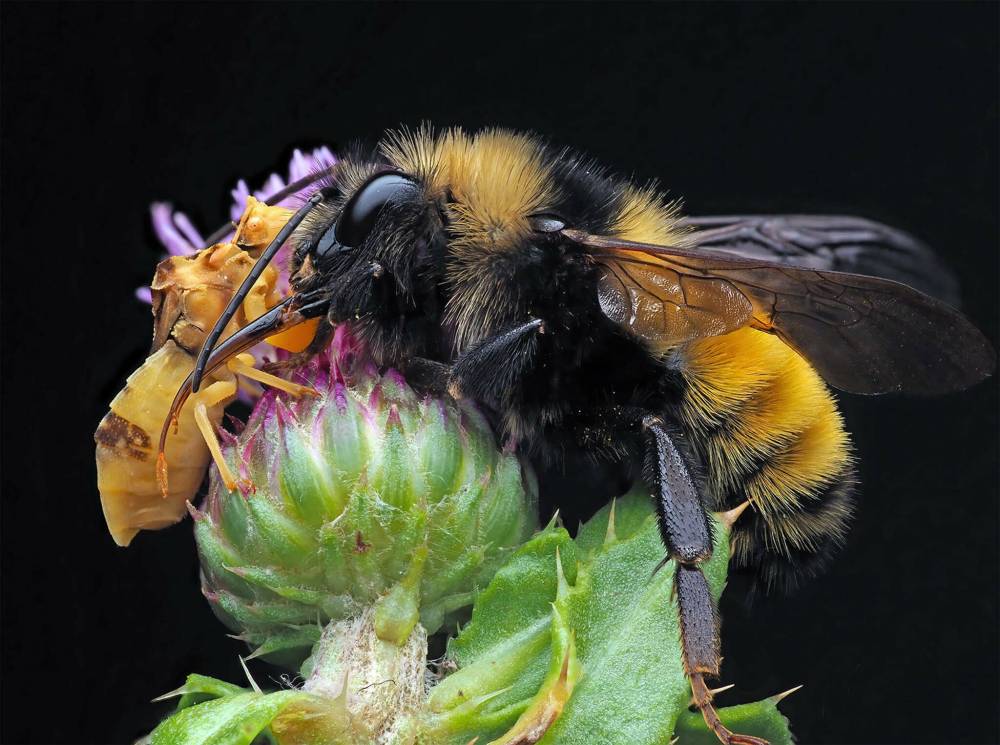
“Thilina’s photography brings these into sharp focus. His keen eye for details was evident in his taxonomic research, in which he was able to recognize subtle differences between closely related bees.”
Taxonomy is the foundation for biodiversity research and conservation, Gibbs says, adding that Hettiarachchi’s skills have improved the overall quality of taxonomic studies emerging from the lab, “as we are now all better and taking high-quality images of our insects.”
Some of Hettiarachchi’s photographs have captured rare observations, including the first Canadian record of certain species, providing valuable behavioural insights.
“Macrophotography lets us reveal a hidden world that you can’t see with the naked eye. I’m using it to change how people see insects — showing that what might seem ugly at first can actually be beautiful,” he says. “By doing this, I hope to change public perception and boost conservation efforts by drawing more attention to the insect world.”
arts@freepress.mb.ca

The buzz about bees
● A bee (superfamily Apoidea) is one of more than 20,000 species of insects within the suborder Apocrita, part of the order Hymenoptera. This diverse group includes the familiar honey bees (Apis) and bumblebees (Bombus), along with thousands of other species that resemble wasps and flies.
● Bees are closely related to certain types of wasps, the principal biological difference between them being that bees (except for parasitic bees) provide their young with pollen and sometimes nectar, whereas wasps feed their young animal food or provision their nests with insects or spiders. Associated with this difference are certain structural differences, the most essential being that wasps are covered with unbranched hairs, whereas bees have at least a few branched or feathered hairs to which pollen often clings.
● Bees are entirely dependent on flowers for food, which consists of pollen and nectar, the latter sometimes modified and stored as honey. As bees go from flower to flower gathering pollen, a small amount is rubbed from their bodies and deposited on the flowers they visit, often resulting in cross-pollination of plants. The practical value of bees as pollinators is far greater than the value of their honey and wax production. Male bees are usually short-lived and never collect pollen, nor do they provide for the young. Female bees do all the work of nest-making and provisioning, and usually have special anatomical structures that assist them in carrying pollen.
● Most North American bees are ground-nesting and solitary, though some congregate in areas of good habitat, even sharing the same entrance. Native bees do not produce honey.
● North America has over 4,000 species of bee and Manitoba has more than 300, but this number is expanding, thanks to the work of Dr. Jason Gibbs at the University of Manitoba.