You are here, and there Street and house scenes in My City Is a Graveyard aim to frame lives lived
Read this article for free:
or
Already have an account? Log in here »
To continue reading, please subscribe:

Digital Subscription
One year of digital access for only $205*
- Enjoy unlimited reading on winnipegfreepress.com
- Read the E-Edition, our digital replica newspaper
- Access News Break, our award-winning app
- Play interactive puzzles
*First annual payment billed as $205.00 + GST for one year. This annual subscription will automatically renew at $233.00 + GST every 52 weeks (10% off the regular annual price of $259.35). Offer available to new and qualified returning subscribers only. Cancel any time.
To continue reading, please subscribe:
Add Free Press access to your Brandon Sun subscription for only an additional
$1 for the first 4 weeks*
- Enjoy unlimited reading on winnipegfreepress.com
- Read the E-Edition, our digital replica newspaper
- Access News Break, our award-winning app
- Play interactive puzzles
*Your next Brandon Sun subscription payment will increase by $1.00 and you will be charged $17.95 plus GST for four weeks. After four weeks, your payment will increase to $24.95 plus GST every four weeks.
Read unlimited articles for free today:
or
Already have an account? Log in here »
Hey there, time traveller!
This article was published 09/01/2025 (643 days ago), so information in it may no longer be current.
A typical bungalow planted at an obscure angle on an irregular lot in North Kildonan will never grace the cover of Architectural Digest, but that doesn’t mean it’s a historically insignificant residence.
Exhibition preview
My City Is a Graveyard
By Morgan Traa
Aceartinc., 206 Princess St.
Opens Jan. 10, runs to Feb. 28
The first place we live is one to which we never stop returning, even if, as it was for artist Morgan Traa, the initial address was marked by the trembling quiet that follows a premature eulogy.
That’s the house Traa painted in Cenotaph, its shingles shorn to reveal the vulnerability of its mid-century structure, its exterior white as a snowball, its curtains drawn to obscure the most private chapters of a single storey unfolding inside.
“It’s for sale right now, for quite a bit of money,” says Traa, 30, who left home as a teenager following the death of her mother, a longtime Manitoba Hydro administrator.
Would the artist buy it? “Oh geez, would that not be morbid? I think a big part of making this art is learning to let it all go.”
SUPPLIED Morgan Traa’s Cenotaph
“This art” is how Traa refers to the 18 pieces she’s selected for My City Is a Graveyard, her first solo exhibition, opening Friday, Jan. 10, at Aceartinc.
A semi-photorealist, post-hoc survey of adolescent waystations, the collection’s finest pieces have the morbidly warm sensibilities of an artist revisiting the flimsy boxes that furnished her earliest conceptions of relative spatial and sequential identities.
If a typical trajectory does exist, its arc doesn’t match Traa’s in terms of its timing.
After her mother’s death and her father’s experience with a now-healthily resolved brain tumour, she couch-surfed before an aunt co-signed for an apartment on Colony Street, a few concrete steps away from the Winnipeg Art Gallery.
“I spent a lot of my adolescence displaced from my home, on my own, downtown way too young,” she says.
RUTH BONNEVILLE / FREE PRESS Morgan Traa Traa developed her approach while taking walks with her iPhone camera in hand before returning to her studio to transfer the images to canvas.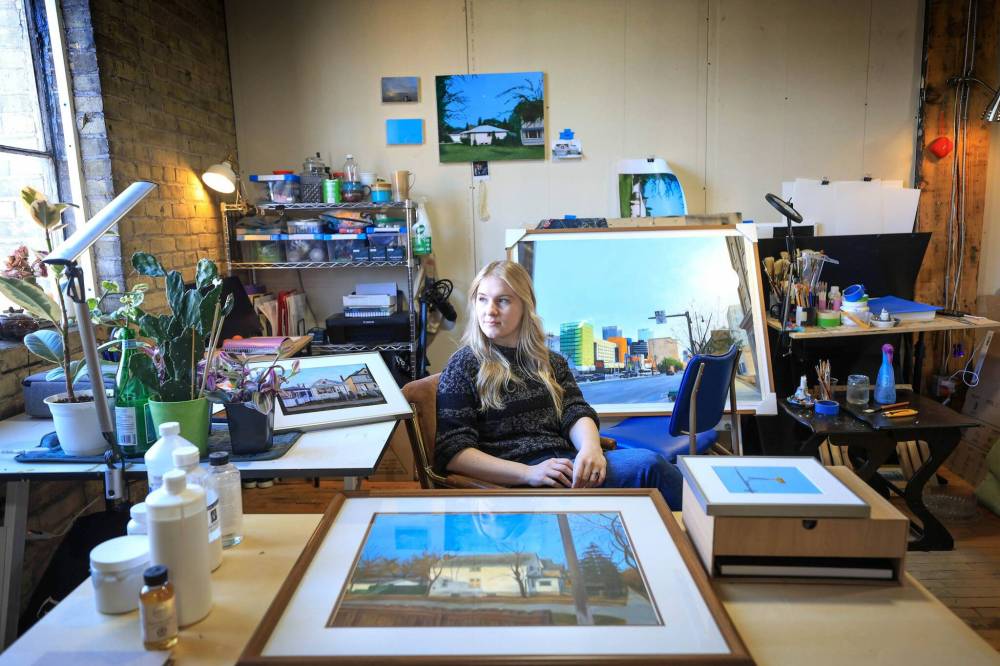
From there, Traa regained her footing, graduating from the University of Manitoba’s bachelor of fine arts program in 2022, earning her stripes in the film industry as a unionized set decorator and props professional to cover the costs of education and the costs of living.
After starting to shoot her own short films in 2015, she became a director’s assistant on the second season of Channel Zero, a horror anthology series. Her first on-set gig was as an intern on the seventh Grudge feature.
“There was a lot of fake blood I cleaned that didn’t make the cut,” says Traa, who most recently worked on The Zealot, a Dark Castle production directed by Vadim Perelman (House of Sand and Fog) and starring Oscar nominees Djimon Hounsou (Gladiator) and Kodi Smit-McPhee (Jane Campion’s The Power of the Dog).
“I didn’t want to do portraits or figure work, which I was told is what sells.”–Morgan Traa
Off-set, in her former studio above a Full House Grocery, a Main Street convenience store, Traa developed her approach to mixed-media urban documentary, taking walks with her iPhone camera in hand before returning to her studio to transfer the images — with stylistic alterations – to canvas.
“I didn’t want to do portraits or figure work, which I was told is what sells,” she says.
“I really kept my studies and research focused on voyeurism, Edward Hopper’s American realism, and trying to find my voice through what was keeping me focused on the canvas, which were pictures I took while waiting for the bus.”
SUPPLIED Morgan Traa’s With a Can Full of Gas and Hand Full of Matches
Through that approach, Traa says, she considered questions of belonging.
“What is my place here? How do you stay in a place that sometimes feels like it’s begging you to leave?” she asks.
The answer came in “finding the peace in choosing to stay,” as well as in the work of Canadian photographers such as Ken Lum and Jeff Wall, “who make you question what’s in the image and what’s outside.”
Traa’s sibling, a scientist, often tells her that she spends too much time painting places that nobody else recognizes. That brotherly assessment, and the “inside-outside” idea, are best illustrated in the works With a Can Full of Gas and a Hand Full of Matches and Every House.
SUPPLIED Morgan Traa’s Every House
In Can, Traa paints a corner home to detail, but purposefully obscures the street name above the stop sign and the numbers beside the front door.
As with much memory-based work, the readily identifiable features are in the blurred signage — for discount gyms, dollar stores and automotive repair shops — that linger behind the clouded telephone wires. Squint, if you must, and you can deduce the bus route.
Every House is a head-on residential glance, but the picture-perfect framing is guttered by swollen tree trunks, giving the feeling that the photograph that inspired the painting was taken from the window of an idling sedan, its driver deciding when they’ve overstayed polite welcome.
SUPPLIED Morgan Traa’s Early Sunday Night
Throughout the collection, and most literally in Every House, Traa highlights the built environment of relatively similar domiciles while hinting at the explosive variety inherent to any image captured beneath the Prairie sky. “It all depends on the sunlight,” she says.
Last March, as she was preparing the material for this exhibition of localized displacement, Traa’s work of deconstructed nostalgia took on new meaning when her former studio was hit by a neighbouring fire a mere 12 hours after she’d packed up all her things to move to a new studio on McDermot Avenue.
“The landlord called me and we watched it burn at 3 a.m.,” she says.
Another tombstone to revisit.
ben.waldman@winnipegfreepress.com

Ben Waldman is a National Newspaper Award-nominated reporter on the Arts & Life desk at the Free Press. Born and raised in Winnipeg, Ben completed three internships with the Free Press while earning his degree at Ryerson University’s (now Toronto Metropolitan University’s) School of Journalism before joining the newsroom full-time in 2019. Read more about Ben.
Every piece of reporting Ben produces is reviewed by an editing team before it is posted online or published in print — part of the Free Press‘s tradition, since 1872, of producing reliable independent journalism. Read more about Free Press’s history and mandate, and learn how our newsroom operates.
Our newsroom depends on a growing audience of readers to power our journalism. If you are not a paid reader, please consider becoming a subscriber.
Our newsroom depends on its audience of readers to power our journalism. Thank you for your support.
History
Updated on Saturday, January 11, 2025 2:47 PM CST: Corrects that The Zealot is a Dark Castle production