On the front lines of the wildfire battle Command centre’s dawn-to-dusk operations keeps crisis in check
Read this article for free:
or
Already have an account? Log in here »
To continue reading, please subscribe:

Digital Subscription
One year of digital access for only $205*
- Enjoy unlimited reading on winnipegfreepress.com
- Read the E-Edition, our digital replica newspaper
- Access News Break, our award-winning app
- Play interactive puzzles
*First annual payment billed as $205.00 + GST for one year. This annual subscription will automatically renew at $233.00 + GST every 52 weeks (10% off the regular annual price of $259.35). Offer available to new and qualified returning subscribers only. Cancel any time.
To continue reading, please subscribe:
Add Free Press access to your Brandon Sun subscription for only an additional
$1 for the first 4 weeks*
- Enjoy unlimited reading on winnipegfreepress.com
- Read the E-Edition, our digital replica newspaper
- Access News Break, our award-winning app
- Play interactive puzzles
*Your next Brandon Sun subscription payment will increase by $1.00 and you will be charged $17.95 plus GST for four weeks. After four weeks, your payment will increase to $24.95 plus GST every four weeks.
Read unlimited articles for free today:
or
Already have an account? Log in here »
Hey there, time traveller!
This article was published 16/05/2025 (492 days ago), so information in it may no longer be current.
LAC DU BONNET — If John Fleming wasn’t holding a phone to his ear, he was scribbling notes, scanning fire maps or absorbing the latest briefing — all from a cluster of folding tables at the town’s fire hall, where the emergency operations centre has become the nerve centre of the wildfire crisis.
The retired RCMP staff sergeant with 36 years in law enforcement — including stints on the force’s search and rescue and crisis negotiation teams — Fleming leads the volunteer team for the Rural Municipality of Lac du Bonnet. Since moving to the community in 2012, he’s been preparing for the worst.
MIKAELA MACKENZIE / FREE PRESS Emergency coordinator John Fleming at the command centre on Friday in Lac du Bonnet where all of the emergency response coordination is taking place.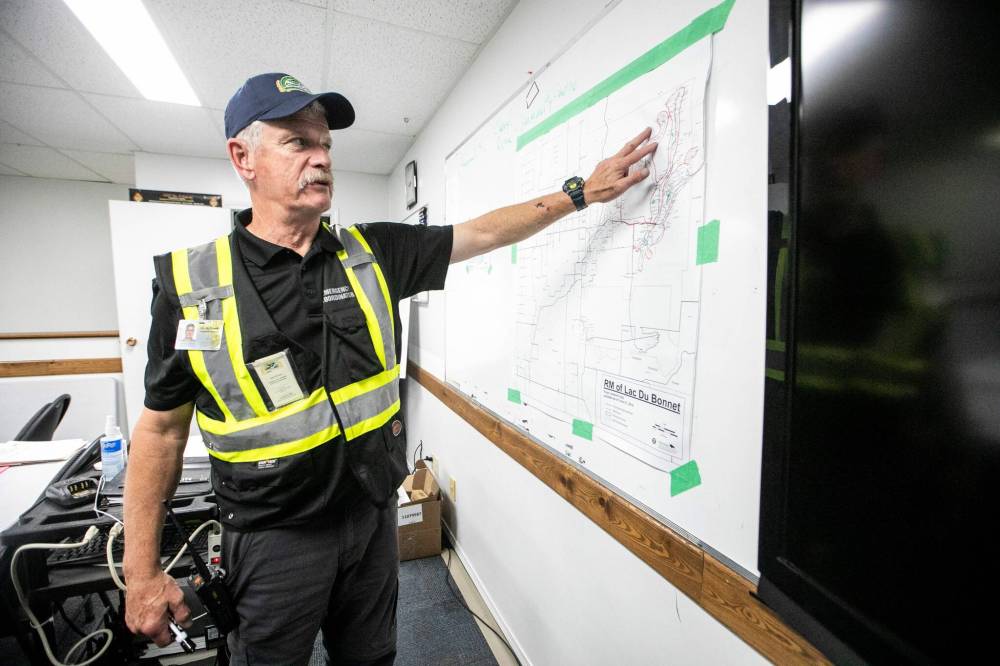
Then came Tuesday morning.
“The fire sparked on the worst place on the worst day,” Fleming said Friday about the blaze that started at 11 a.m. in a ditch between Highway 313 and Old Pointe Road.
He and his team of a dozen volunteers, all with individual skill sets from years of work in different fields and industries, came together quickly to get a handle on the situation.
“The command and control experience is thick,” he said.
“By 2:30 p.m. — within three hours — the fire had already reached the area where we saw major destruction and, unfortunately, our two fatalities,” Fleming said. Richard and Sue Nowell died after being trapped in the fire zone.
By that night, they had evacuated six zones and dozens of people.
MIKAELA MACKENZIE / FREE PRESS The command centre hums with urgent updates and calls for co-ordination.
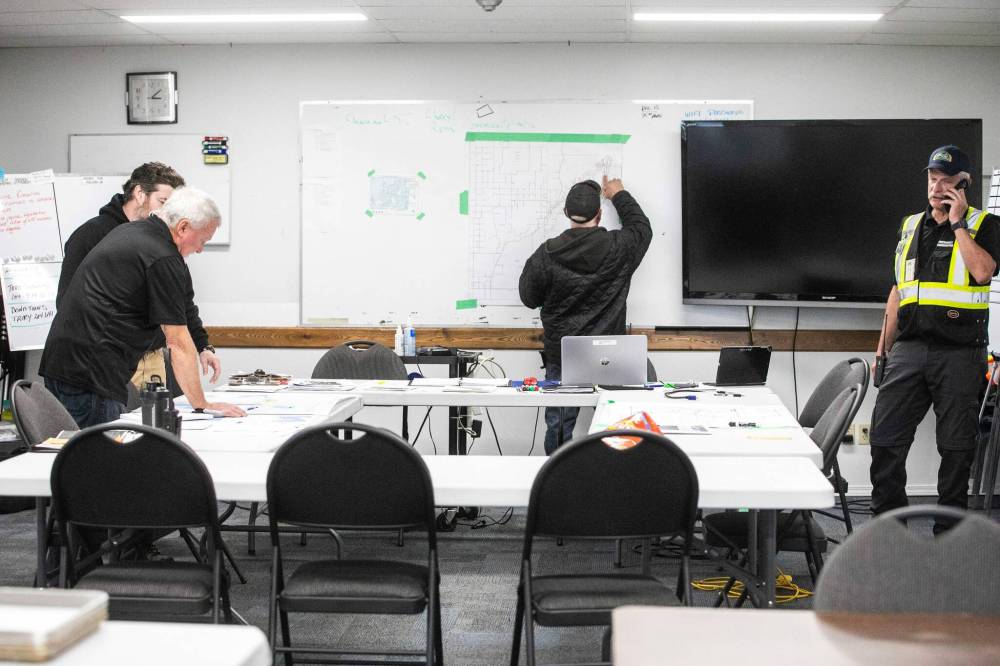
“Tuesday was a ‘no breakfast, no lunch, no dinner’ kind of day,” he said.
On the second floor of the fire hall, the command centre hums with urgent updates and calls for co-ordination. The cluster of folding tables has an array of laptops, maps and potato chips, which stave off hunger.
From dawn until firefighting ends at dusk — when crews can no longer safely battle the flames — Fleming organizes logistics, relays critical updates, and directs a small army of responders.
Lac du Bonnet had 12 of its 32 volunteer firefighters out in the field on Friday.
“These people are all employed by someone else, so it depends on how long your boss will let you be away from your full-time job,” Fleming said.
Evacuation orders were issued within minutes on Tuesday. Alerts were sent out, and crews began going door to door to reach people who hadn’t received notifications. Six zones were cleared by nightfall, and dozens of residents were forced to flee.
Tracy Wasylak, who lives on Webb Lane just off Wendigo Road, was one of those evacuees.
“I heard the waterbomber flying over,” she said on Friday.
MIKAELA MACKENZIE / FREE PRESS Webb Lane resident Tracy Wasylak heads back home near Lac du Bonnet on Friday.
At first, she thought it might be a practice run. Then she looked outside and saw a big cloud of smoke.
“We had just a few minutes and we had to leave,” she said.
Wind gusts up to 70 kilometres per hour helped the fire spread rapidly. Fleming estimated it was moving at four or five miles per hour as it ripped through the countryside moving northward.
Wasylak was in the first of six zones to be evacuated.
“But even before we could get the paperwork done, (the fire) was already by Zone 1, so we had to evacuate Zone 2,” Fleming said.
At the local community centre, an evacuee hub was set up to record people’s information, including where they were coming from and where they were going.
“I want to know you’re out, where you’re going, and I want to be able to contact you later,” he said.
Thirteen rescued by provincial staff, helicopter crew
The Manitoba government confirmed Friday that a chopper crew was instrumental in rescuing people from the Lac du Bonnet fire zone Tuesday. The government issued this statement:
On Tuesday, with fire conditions rapidly deteriorating, provincial staff from the Manitoba Wildfire Service and Conservation Officer Service, with the help of a local helicopter pilot, were able to make a series of dramatic rescues in very dangerous conditions.
The Manitoba government confirmed Friday that a chopper crew was instrumental in rescuing people from the Lac du Bonnet fire zone Tuesday. The government issued this statement:
On Tuesday, with fire conditions rapidly deteriorating, provincial staff from the Manitoba Wildfire Service and Conservation Officer Service, with the help of a local helicopter pilot, were able to make a series of dramatic rescues in very dangerous conditions.
Rescues included six people extracted from an area near Lac du Bonnet, a family of four from Garner Lake, and a trio of stranded boaters from Shoe Lake.
The heroic actions of staff and the helicopter pilot from Provincial Helicopters (Lac du Bonnet) saved 13 people from the rapidly advancing wildfires on Tuesday. The province is grateful for the actions, which exemplify the dedication and commitment of all emergency responders in times of crisis.
Even more volunteers took on that responsibility, he said, including finding accommodations for people who had nowhere to go.
The state of local emergency has granted Fleming sweeping authority to protect the community, including the ability to evacuate and control traffic.
“There’s also the power to go onto the local Co-op and say I need all of your water, send me a bill,” he said. “There’s the power to go to the next grocery store and tell them they can only sell two bottles of water per person per day. We have huge powers, and it’s not a responsibility we take lightly. We do these things to protect our residents.”
They collaborate with the provincial wildfire service.
On Thursday night, residents of about 30 homes on Wendigo Road and nearby cross streets were allowed to return home.
For Wasylak, it was an emotional moment. She is a semi-resident, but her two sisters live permanently on Webb Lane.
Their family has owned property on the quaint road, which looks out onto the Lac du Bonnet Lake, since the 1930s.
“It just brought tears to my eyes,” she said. “I also felt a bit of survivor’s guilt. There are still a lot of people who haven’t been able to get home.”
Fleming said every morning he hears from antsy residents who just want to get their lives back.
The rain and cooler temperatures haven’t sped up the process.
“It’s helping. It’s slowing down some,” Fleming said. “We are still in a high-risk situation. All we need is for the rain and the cool temperatures to stop and the wind to come back up and we could be in trouble again.”
MIKAELA MACKENZIE / FREE PRESS Residents of about 30 homes on Wendigo Road and nearby cross streets were allowed to return home Thursday.
If conditions hold, officials are hopeful some residents evacuated along Cape Coppermine Road could return as early as Saturday night — but Fleming made no promise.
“We can’t move back in until we can ensure people’s safety,” he said, noting that it becomes more difficult to evacuate people a second time, especially if their properties were damaged during the first evacuation.
“We have to be very, very careful. We have to be absolutely, 99.9 per cent sure they’re going to be safe.”
scott.billeck@freepress.mb.ca

Scott Billeck is a general assignment reporter for the Free Press. A Creative Communications graduate from Red River College, Scott has more than a decade’s worth of experience covering hockey, football and global pandemics. He joined the Free Press in 2024. Read more about Scott.
Every piece of reporting Scott produces is reviewed by an editing team before it is posted online or published in print — part of the Free Press‘s tradition, since 1872, of producing reliable independent journalism. Read more about Free Press’s history and mandate, and learn how our newsroom operates.
Our newsroom depends on a growing audience of readers to power our journalism. If you are not a paid reader, please consider becoming a subscriber.
Our newsroom depends on its audience of readers to power our journalism. Thank you for your support.
Related Articles
Community spirit soars amid wildfire fight