Lapping up the local product Province’s sole organic milk producer a true grassroots success story
Read this article for free:
or
Already have an account? Log in here »
To continue reading, please subscribe:

Digital Subscription
One year of digital access for only $205*
- Enjoy unlimited reading on winnipegfreepress.com
- Read the E-Edition, our digital replica newspaper
- Access News Break, our award-winning app
- Play interactive puzzles
*First annual payment billed as $205.00 + GST for one year. This annual subscription will automatically renew at $233.00 + GST every 52 weeks (10% off the regular annual price of $259.35). Offer available to new and qualified returning subscribers only. Cancel any time.
To continue reading, please subscribe:
Add Free Press access to your Brandon Sun subscription for only an additional
$1 for the first 4 weeks*
- Enjoy unlimited reading on winnipegfreepress.com
- Read the E-Edition, our digital replica newspaper
- Access News Break, our award-winning app
- Play interactive puzzles
*Your next Brandon Sun subscription payment will increase by $1.00 and you will be charged $17.95 plus GST for four weeks. After four weeks, your payment will increase to $24.95 plus GST every four weeks.
Read unlimited articles for free today:
or
Already have an account? Log in here »
Hey there, time traveller!
This article was published 12/06/2025 (465 days ago), so information in it may no longer be current.
STEINBACH — It’s Father’s Day weekend and Jim Appleby wants to give credit where credit is due.
Jim and his wife Angela are the founders of Stoney Brook Creamery, a micro-creamery located five kilometres south of Steinbach that is celebrating its 10th anniversary as the province’s lone organic milk producer. The 44-year-old father of four reports that it was his own dad Sam who taught him how to milk a cow, back when he was barely able to walk.
“My dad grew up on a farm in England and bought the land here in 1979, two years after he and my mom arrived in Canada,” Jim says, seated next to Angela in their designated “cheese room,” steps away from a small retail space that sells a variety of non-homogenized commodities including milk, kefir, cottage cheese and cream.
MIKAELA MACKENZIE / FREE PRESS
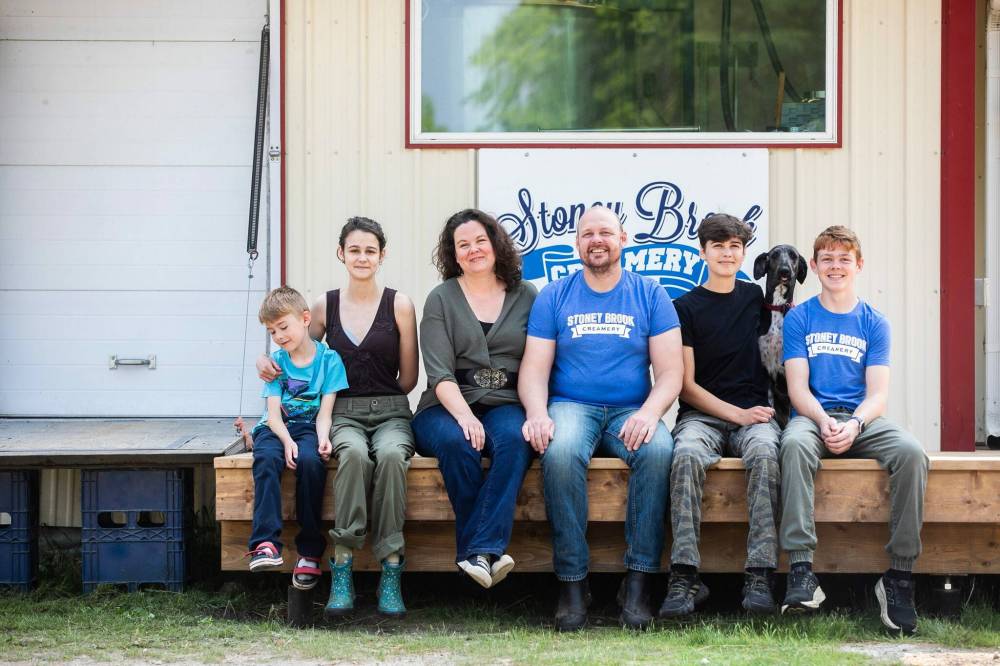
Thomas (seven, left), Julianne (17), Angela, Jim, Alex (18), and Jonah (15) Appleby at Stoney Brook Creamery.
“I came along in ’81 and somewhere there’s a baby picture of me kneeling down next to a cow, being shown the ropes.”
Despite being raised on the 1,500-acre property, home to a herd of 100 red-and-white Holsteins, his dad’s preferred breed of cattle, Jim had zero intention of following in his father’s footsteps. The eldest of three siblings, he left home after graduating from Steinbach Regional Secondary School, to attend Augustana University College in Camrose, Alta. There he met Angela, a native of Cold Lake, Alta., in 2001.
After completing his studies in Camrose, Jim transferred to Saskatoon’s Lutheran Theological Seminary. He was working as a pastor in Armena, Alta., in 2011 when he started to become horribly ill. It turned out he had a chemical sensitivity, where even low-level exposure to substances such as scented deodorant and laundry detergent could result in an immediate reaction.
“He was always in other people’s homes visiting, and being at church was one of the worst places for him. He’d perform a service and be done for two or three days, barely able to get out of bed,” Angela says.
Things became so dire that in 2013 they made the decision to uproot their young family and relocate to Manitoba, to live in a house situated on an acreage near Woodmore also owned by Jim’s parents. Angela came to understand that both her in-laws had previously dealt with a condition similar to their son.
“They were actually one of the first farmers in the area to use chemical sprays, but as soon as they did, Jim’s dad would get the shakes, and his mom, who passed away in 2019, would get really bad asthma and allergies,” she says, noting the six of them now live next door to Jim’s dad, in a recently-built addition.
“So the land’s been chemical-free almost the entire time, and has been certified organic since around 2000.”
It took Jim close to a year until he started to feel more like himself. As soon as he was strong enough, he began lending his dad a hand tending the cows and growing feed, at which point a lightbulb went on in his head.
MIKAELA MACKENZIE / FREE PRESS
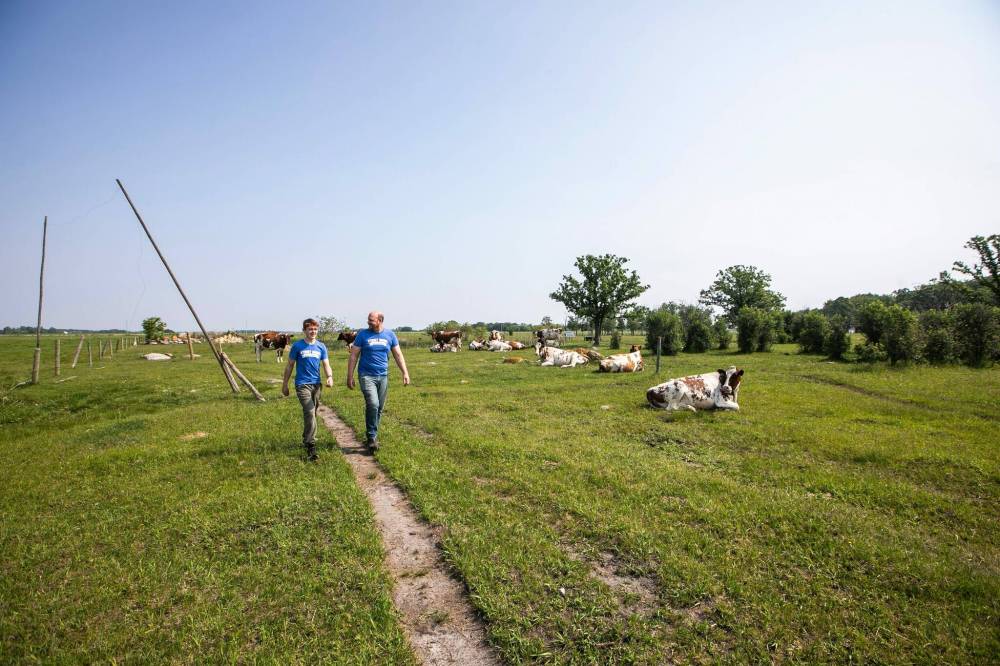
Jonah (left) and Jim Appleby walk through a field with holsteins, which will be calving soon.
At the time, the elder Appleby had a contract with an Ontario firm, Organic Meadow, which was buying a good chunk of the milk he was turning out under the banner Sardius Holsteins. The remainder was being handled by the Dairy Farmers of Manitoba, a non-profit organization responsible for selling milk from Manitoba dairy farms to different processors. Except when Organic Meadow severed the agreement without warning, Jim’s first thought was why not market that share of their milk themselves?
His and Angela’s first order of business after settling on a tag — Steinbach means stony brook in German — was to ferret out a company that manufactured one-litre, reusable milk bottles, the sort that was the norm before plastic jugs became commonplace in the early 1970s.
“That’s something I personally taste as a difference; I find I can definitely taste plastic,” Jim says, agreeing with Angela when she asserts if they hadn’t discovered Stanpac, a packaging plant in Smithville, Ont., that makes precisely what they were looking for, their venture might not have gotten off the ground.
Production was slow in the beginning — often no more than 15 litres of milk a day, twice a week — but things picked up at about the six-month mark, when Hermann Grauer, the owner of Nature’s Farm, a fine-food shop in Steinbach, offered to help the couple out.
Because he also ran a successful egg farm, Grauer had refrigerated trucks at his disposal, which were used to transport his eggs to stores in the southeast part of the province, as well as throughout Winnipeg. What if he was to load the Applebys’ milk on those same vehicles, and drop it off to the same retailers he was dealing with, he proposed?
“Almost overnight, we went from using about a drop of our own milk to numbers we hadn’t dreamed of,” says Angela who, along with her two oldest children, has become a familiar face at the Saturday St. Norbert Farmers’ Market, where they also offer 15-litre containers of milk for local cheese and yogurt makers. “(Sales) are growing all the time and this year already, we’re doing almost double what we did in 2024.”
Ryan Labonte is the operations manager for Vita Health, which has six stores in Winnipeg. Labonte remembers Grauer approaching him and his associates in August 2015, to let them know he’d come across a great local milk, and were they interested in carrying it.
“We were like sure, let’s give it a try, and the relationship’s been history, ever since. Stoney Brook is by far our No. 1-selling milk, outselling the next closest by a margin of six to one,” Labonte says.
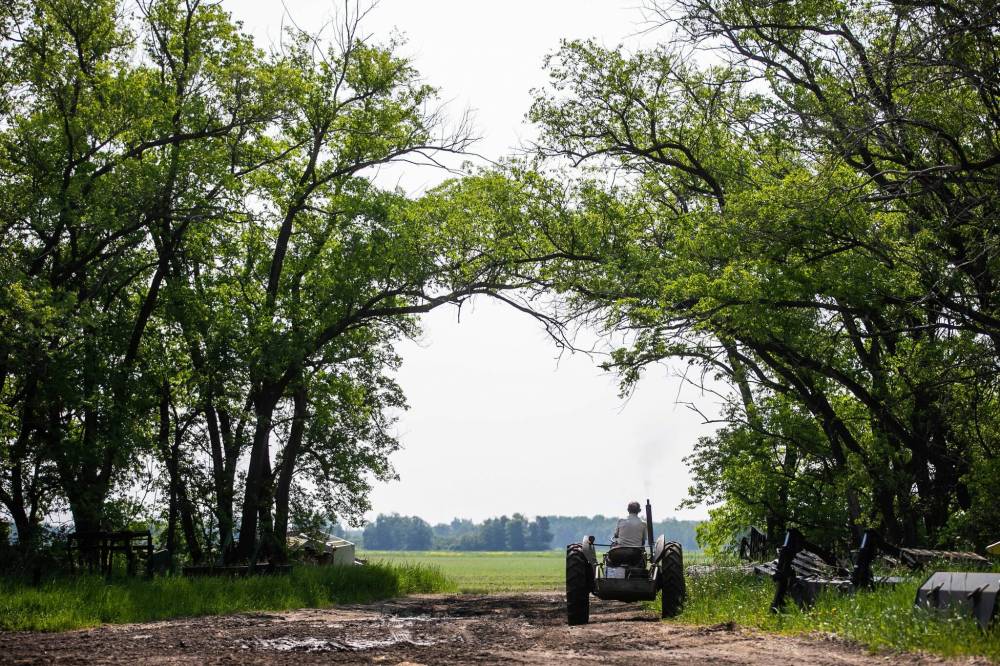
MIKAELA MACKENZIE / FREE PRESS
Sam Appleby rides on a tractor (which is the same model and year as the tractor his parents used on their milk cow farm in England).
The organic aspect is a draw in and of itself, but the fact that the milk is produced in Manitoba is probably its biggest selling point, he says.
“We’ve really seen the switch-over in the last five years to ‘buy local,’ wherever possible. And that’s been our big push, too: local supporting local.”
Labonte notes he doesn’t just stock the Applebys’ milk; he’s a loyal customer, too.
“We have a daughter who’s turning three this year. When they’re that young, you have to have milk with a higher fat content so for us, it’s the go-to milk in our household. I don’t drink that much milk personally but since it’s in the fridge for our daughter, I use it all the time in my smoothies.”
Although the Appelbys aren’t 100 per cent sure what year they expanded their line to include cheddar cheese, cottage cheese, and cheese curds (the latter was recently featured in an Instagram video for the Exchange District’s Ashdown Market, which uses Stoney Brook curds in its breakfast sandwiches), Angela knows for a fact it was seven years ago when what is presently one of their most popular items was added to the mix.
While she was pregnant with their youngest, she developed a strong craving for chocolate milk. Jim was already toying around with the beverage, she recalls, but she let him know in no uncertain terms that there had better be a bottle or three in the fridge, when she went into labour.
“He actually brought it to me my first day at the hospital and we’ve been selling it ever since,” she says with a laugh.
Going forward, the Applebys don’t harbour dreams of landing their milk in “every Sobey’s across Western Canada.” Aside from maintaining the status quo, Angela says they would be more than content to reach a point where they use all of the farm’s milk themselves, versus the 60 per cent or so they continue to supply to the milk board.
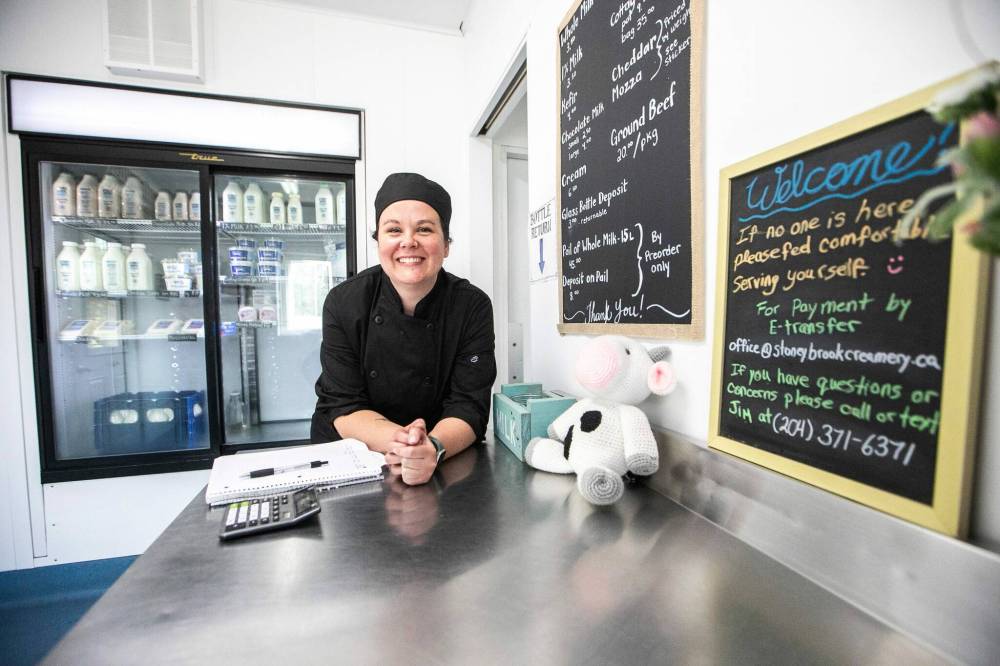
MIKAELA MACKENZIE / WINNIPEG FREE PRESS
Angela Appleby in the farm shop at Stoney Brook Creamery. She has become a familiar face at the Saturday St. Norbert Farmers’ Market, where they also offer 15-litre containers of milk for local cheese and yogurt makers.
“Plus we’d love to see more organic creameries pop up around the province,” Jim pipes in. “I mean, there are so many other cheeses and things people could be making, plus it’s a lot of pressure being the only one.”
For more information, go to stoneybrookcreamery.ca
david.sanderson@freepress.mb.ca

Dave Sanderson was born in Regina but please, don’t hold that against him.
Our newsroom depends on a growing audience of readers to power our journalism. If you are not a paid reader, please consider becoming a subscriber.
Our newsroom depends on its audience of readers to power our journalism. Thank you for your support.