From 2025 to 1851 What does it take to be a historical interpreter?
Read this article for free:
or
Already have an account? Log in here »
To continue reading, please subscribe:

Digital Subscription
One year of digital access for only $205*
- Enjoy unlimited reading on winnipegfreepress.com
- Read the E-Edition, our digital replica newspaper
- Access News Break, our award-winning app
- Play interactive puzzles
*First annual payment billed as $205.00 + GST for one year. This annual subscription will automatically renew at $233.00 + GST every 52 weeks (10% off the regular annual price of $259.35). Offer available to new and qualified returning subscribers only. Cancel any time.
To continue reading, please subscribe:
Add Free Press access to your Brandon Sun subscription for only an additional
$1 for the first 4 weeks*
- Enjoy unlimited reading on winnipegfreepress.com
- Read the E-Edition, our digital replica newspaper
- Access News Break, our award-winning app
- Play interactive puzzles
*Your next Brandon Sun subscription payment will increase by $1.00 and you will be charged $17.95 plus GST for four weeks. After four weeks, your payment will increase to $24.95 plus GST every four weeks.
Read unlimited articles for free today:
or
Already have an account? Log in here »
Hey there, time traveller!
This article was published 10/07/2025 (430 days ago), so information in it may no longer be current.
Welcome to Jen Tries, a semi-regular series in which Free Press columnist Jen Zoratti tries something new and reports back.
In this instalment, Jen Tries… being a Lower Fort Garry historical interpreter/living in the fur trade era.
ST. ANDREWS — People in the past wore too many clothes.
It’s a little after 10 a.m. and I am getting into costume to be a historical interpreter at Lower Fort Garry National Historic Site for the day — which means I’m also getting dressed to go about my day circa the fur-trade era.
MIKE DEAL / FREE PRESS Jen Zoratti was invited to spend the day as an historical interpreter at Lower Fort Garry. 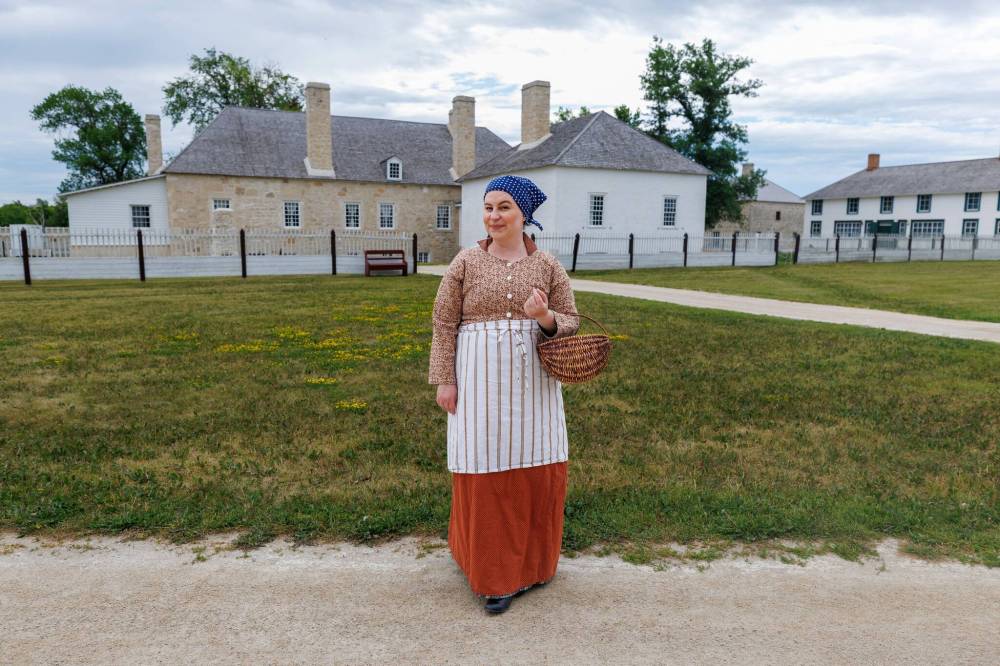
Over my 2025 bike shorts, tank top and sports bra, costumer Amelie Roberts has provided me with a chemise — that was the garment that could best be laundered regularly — a full-length skirt, a long-sleeved shirt called a shortgown, a kerchief for my head, a kerchief for my neck, boots and, of course, a blanket-sized apron.
I also have a basket in which to tuck my phone, smartwatch and anything else that isn’t historically accurate — or, as the “interps” say, “histo acco.”
Did I mention there’s a heat warning in effect?
MIKE DEAL / FREE PRESS Because dresses traditionally didn’t have pockets, Jen is provided with a basket to hold her phone and watch. 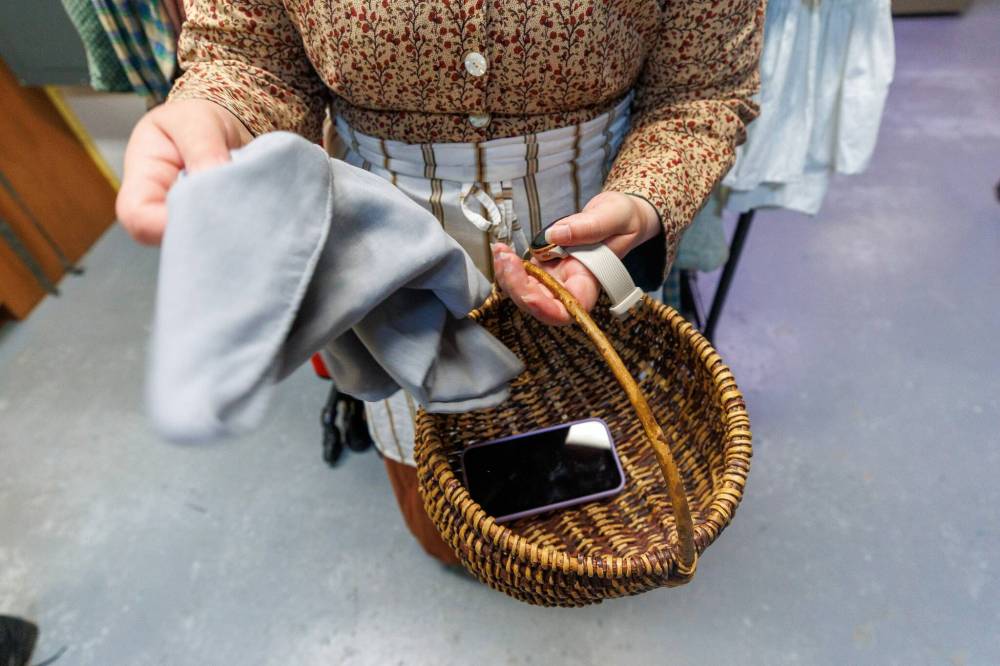
Of course, I wouldn’t know that there’s a heat warning, only that it was “hot as blazes.” I have already crossed the bridge back to 1851. Lower Fort Garry — located just south of Selkirk on Highway 9 — is a Hudson’s Bay Company trading post; in 1871, it will be the place where Treaty 1 was signed.
Here, on the banks of the Red River, is tangible, tactile history, yours for the exploring: a collection of stone buildings dating back to the 1830s; Indigenous dwellings such as wigwams and teepees, constructed out of traditional materials such as birch and buffalo hide, respectively.
But it’s the costumed interpreters who bring this place to life.
MIKE DEAL / FREE PRESS Jen signs a contract similar to what a day labourer would have signed with Laurie MacDonell, Visitor Services Group Supervisor, as a witness. 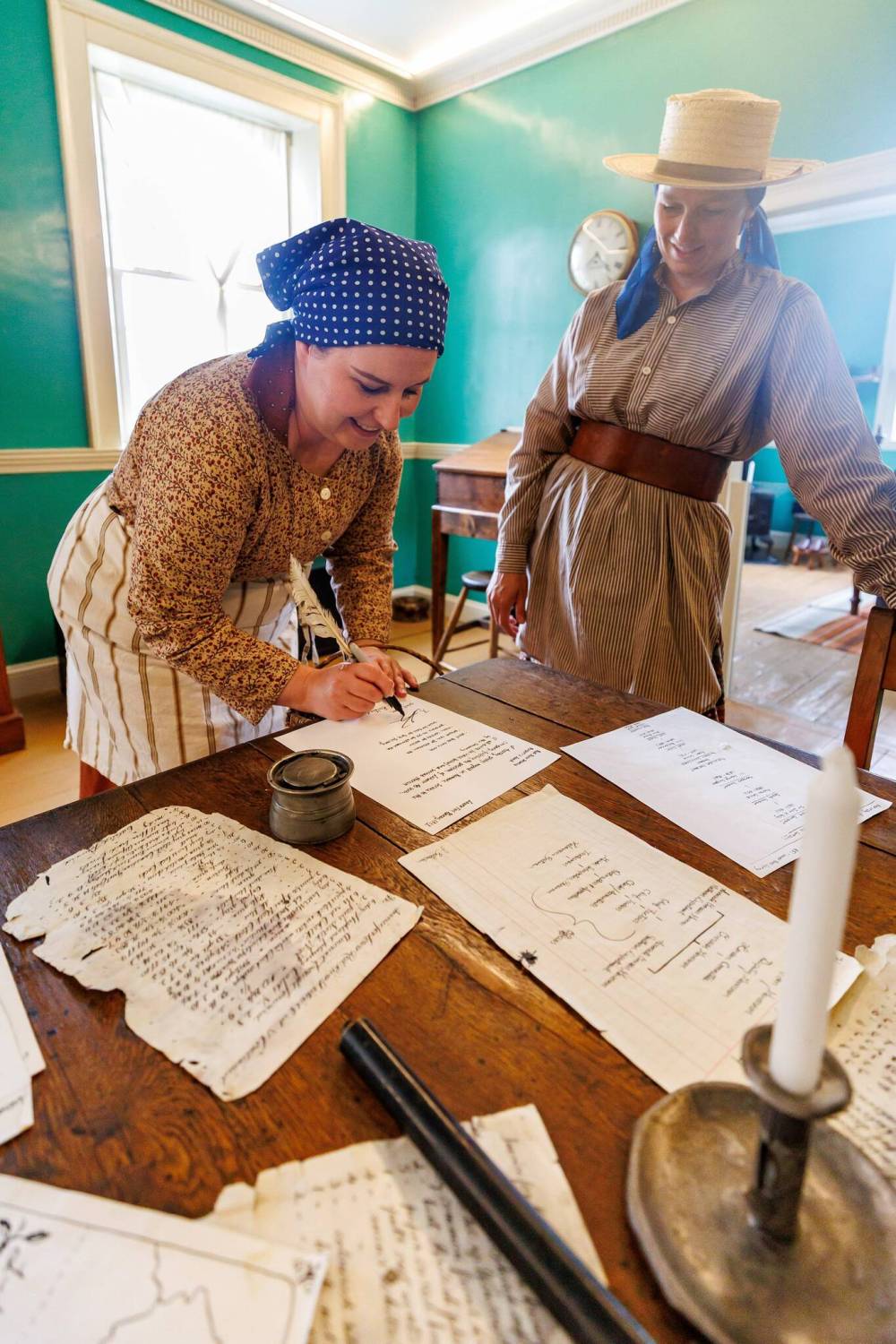
This morning, I am a “lower-class” worker, along with Laurie MacDonell. She is the visitor services group supervisor here at the park, but is dusting off her fur trade-era interpreter persona, Matilda Fox.
“And you can spell that however you want, because Matilda Fox can’t read or write,” she says with a wry laugh.
MacDonell, 32, started working as an interpreter at 19 while studying theatre and film at the University of Manitoba. “My parents were like, ‘I’ve heard of this place where you get to get dressed up in costumes and be paid for it.’ So I was like, right, sounds like the perfect place for me. I like history. I like being outside.
“And then I just couldn’t leave. I mean, I did. I went to Jasper for a little bit. I worked at Festival du Voyageur. But I came back because it’s just so magical here.”
My first task of the day is to light a fire in the bakehouse, so it’s a good thing it’s 32 C out with a humidex making it feel like 40 gazillion.
Sarah Antymis, interpretation co-ordinator, is dressed in her Parks Canada uniform but she knows her way around a 1830s-era oven, showing me how to set up a log cabin-style fire. As interps, we’d be making bannock, since that’s one of the workshops on offer during the summer; today we’re making a cake for a tea party happening this afternoon at the Big House.
MIKE DEAL / FREE PRESS Jen mixes ingredients for a cake. 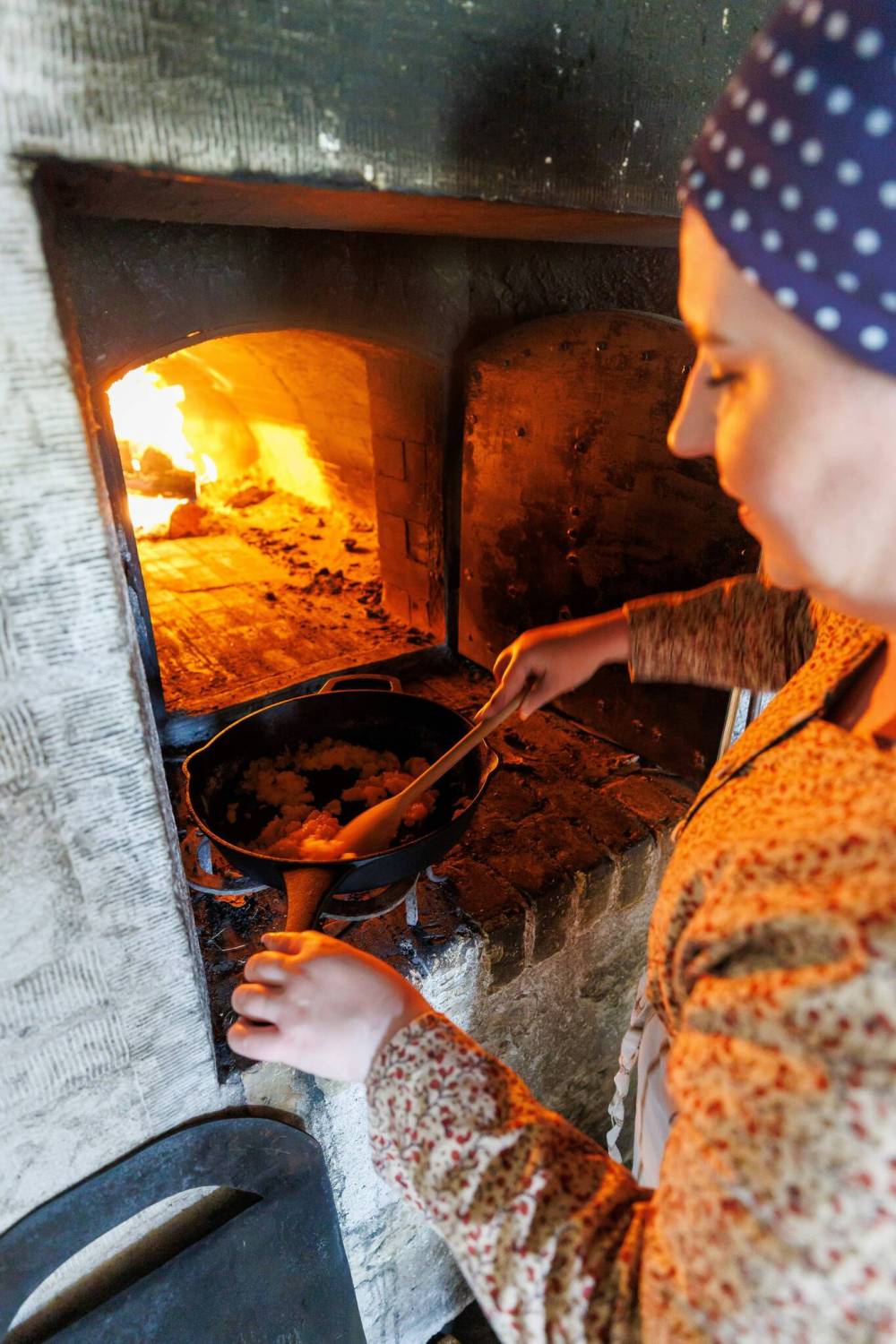
It’s quickly, humblingly evident to me that I was born in the correct era. It’s hot. It’s sooty. My fire isn’t starting. To quote Parker Posey’s character in The White Lotus: “I just don’t think, at this age, I’m meant to live an uncomfortable life.”
Interpreters take different approaches to their roles, Antymis says. Some get fully into character and use the first person; others say they are portraying a figure from the past. But either way, they actually have to learn how to do all the stuff they’re demonstrating. The blacksmiths? Really blacksmithing!
“We’re really doing it, not just miming,” MacDonell says.
“You gain massive amounts of knowledge on things you never thought you’d learn about,” Antymis says.
After we get the cake into the oven (the fire lit! I did it!), our next chore is to make tallow candles which, in 2025, is another workshop the park offers during the summer. In 1851, however, I’d have to make about a thousand candles for winter. The moulded candles would take one year to cure and their burn time is one hour. Let me tell you: I would make it my life’s work to aggressively ration candles if I were alive in this era. My 13 kids and I would be going to bed at 4:30 p.m. in December.
MIKE DEAL / FREE PRESS Jen dips a wick from a bucket of warmed up tallow into a chilled bucket of water, one of the ways that candles could be made.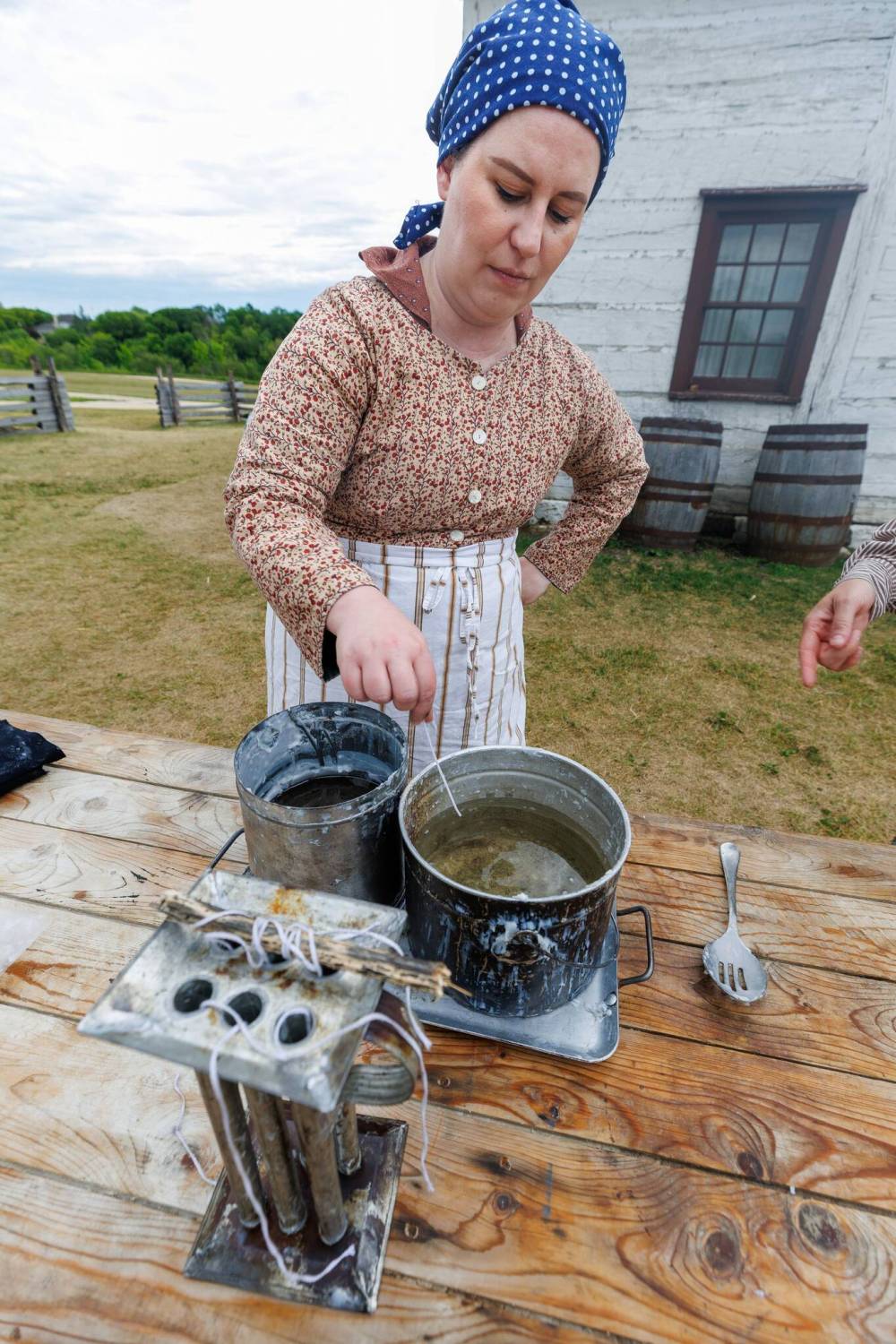
MIKE DEAL / FREE PRESS Jen pours tallow into candle molds. 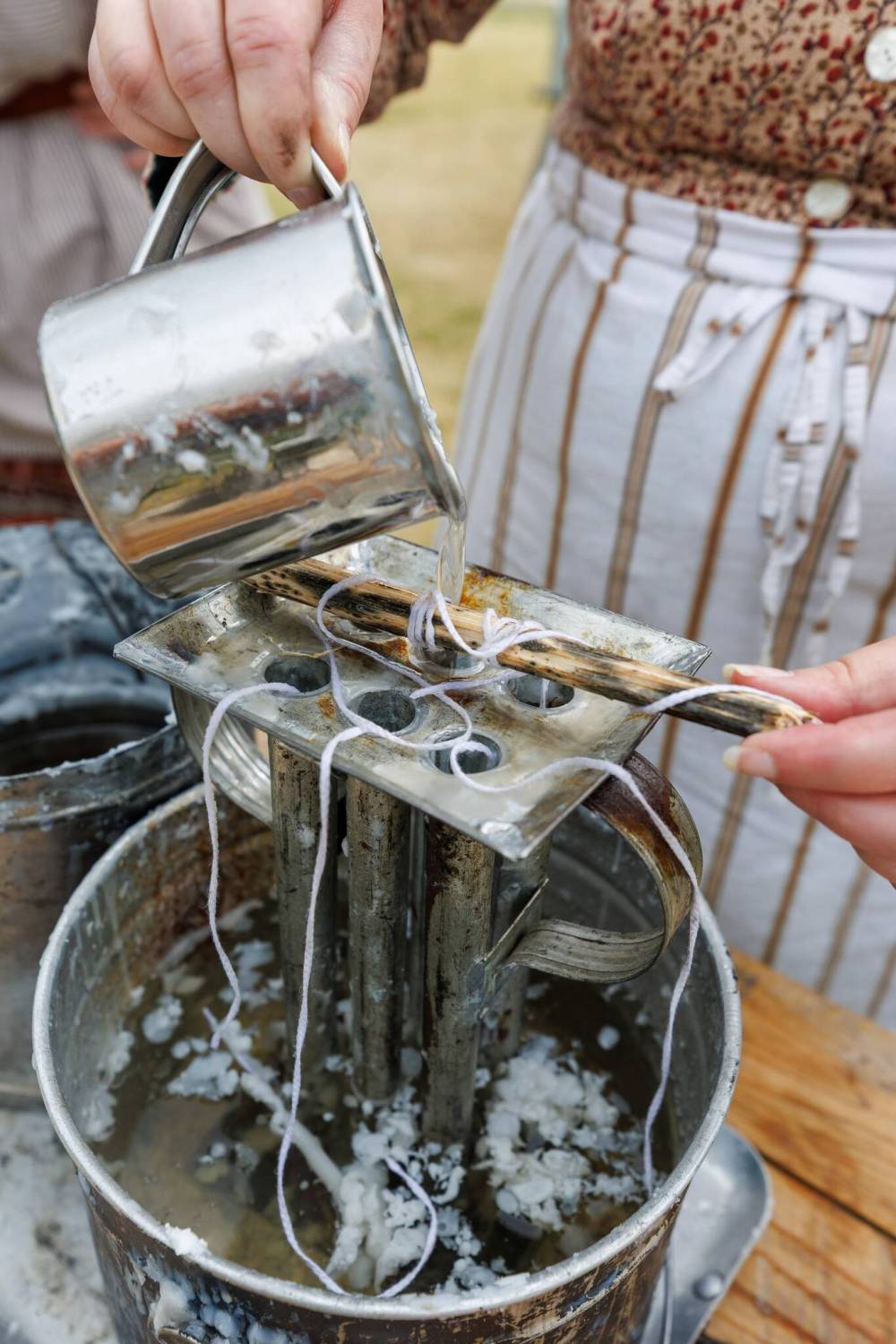
We stop by the Fur Loft so I can try my hand at identifying furs, which I do with surprising accuracy. Beaver, badger, fox, lynx, even a wolverine pelt is up there. Silver fox was in high demand among the high-society women in England at the time; it was the only thing that looked clean in the sooty streets of London during the Industrial Revolution.
And no fashionista would be caught dead wearing an animal with “rat” in its name, so if you ever come across fur labelled “Hudson Seal,” know that it’s muskrat.
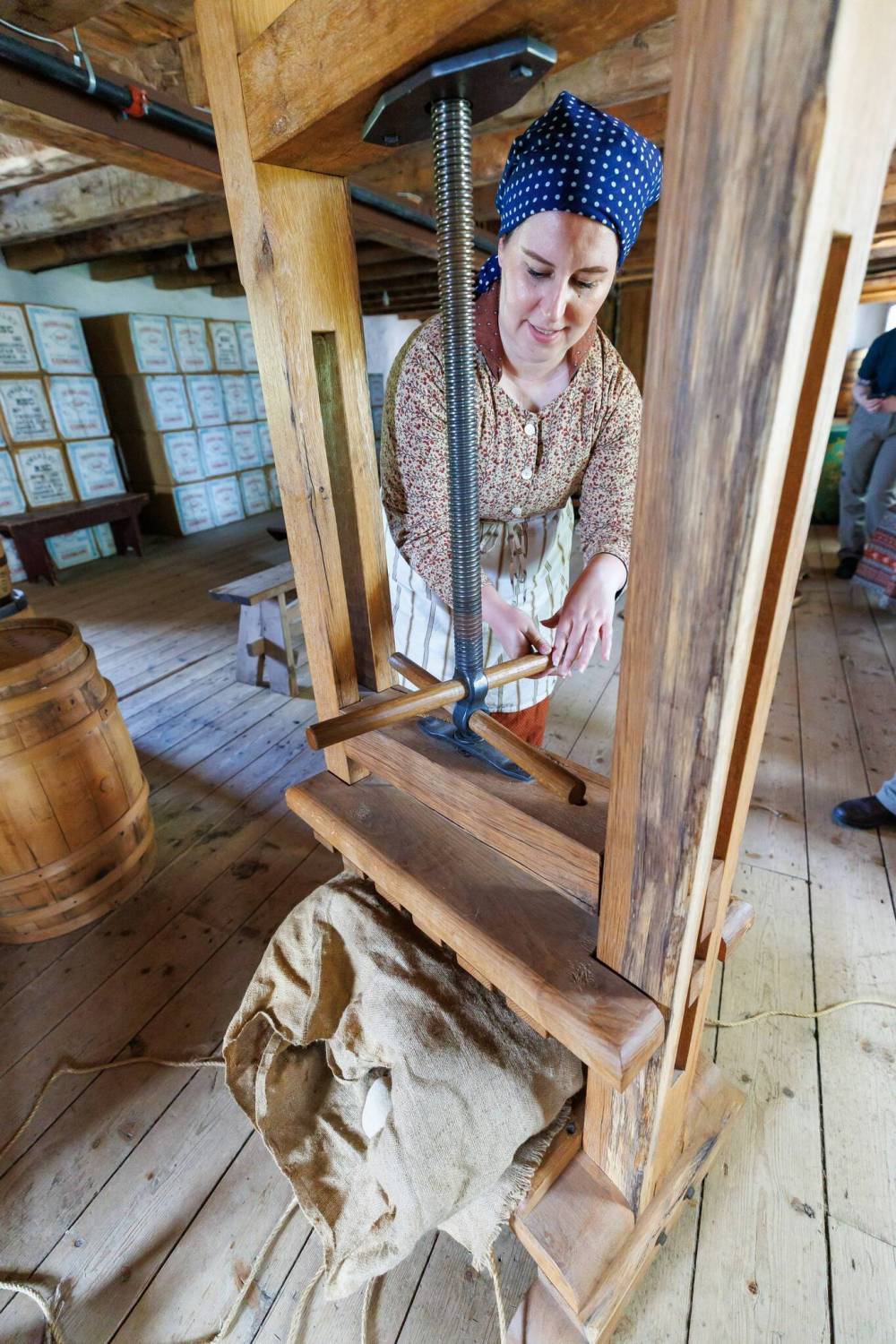
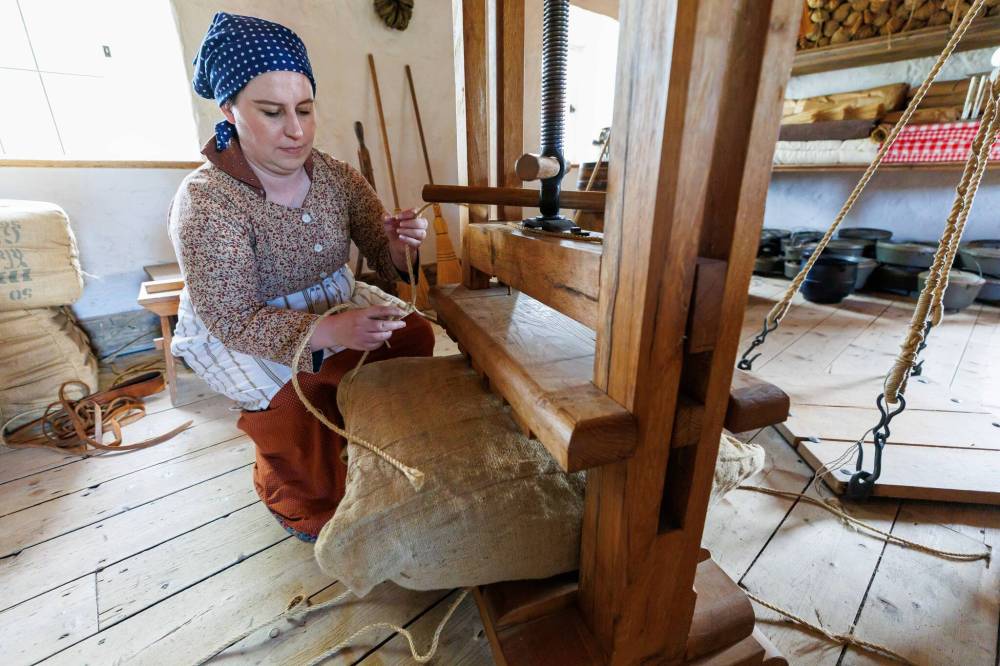
My next task is to help pack fur bales so they could make their weeks-long, 1,100-km journey to Hudson’s Bay. This involves placing the expensive furs in the middle, wrapping them in bison hide to protect them and then pressing them so they are as compact as possible. These 91-kilogram packages need to be able to be portaged on tripmen’s backs when necessary, held in place by a leather strap worn across their foreheads. Unfathomable in our modern era of Amazon and next-day delivery.
MIKE DEAL / FREE PRESS Jen is shown how to package up furs for shipping with Sarah Antymis (centre), Interpretation Coordinator and Laurie MacDonell (right), Visitor Services Group Supervisor. 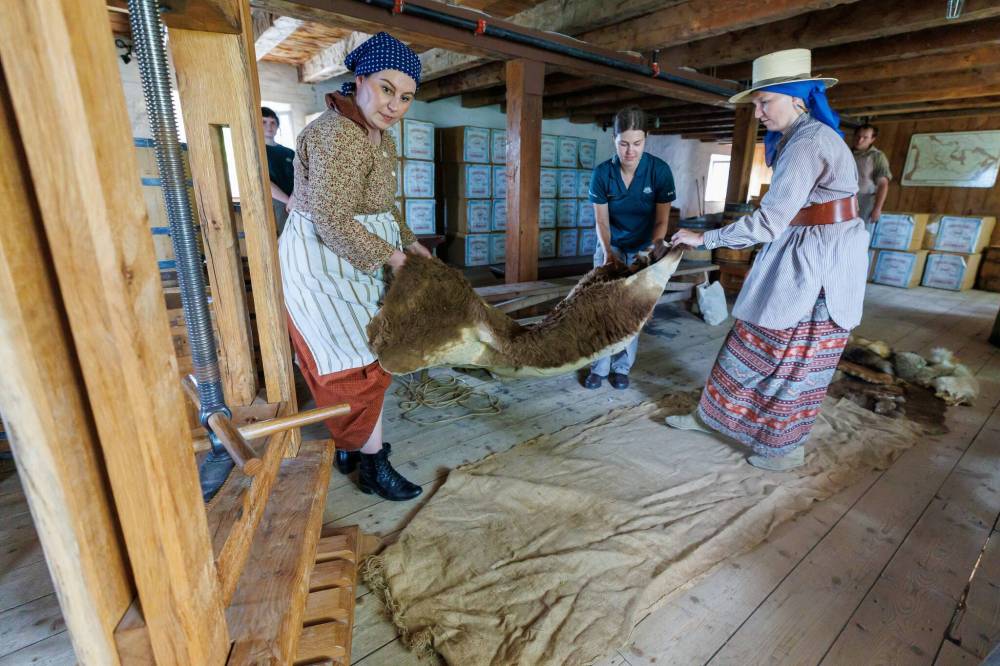
Sure, tripmen had it rough, but packing fur in extreme heat wearing a full skirt is no picnic, either. Luckily, it’s 2025, so we’re only doing a much lighter mock-up of the bundle they’d carry.
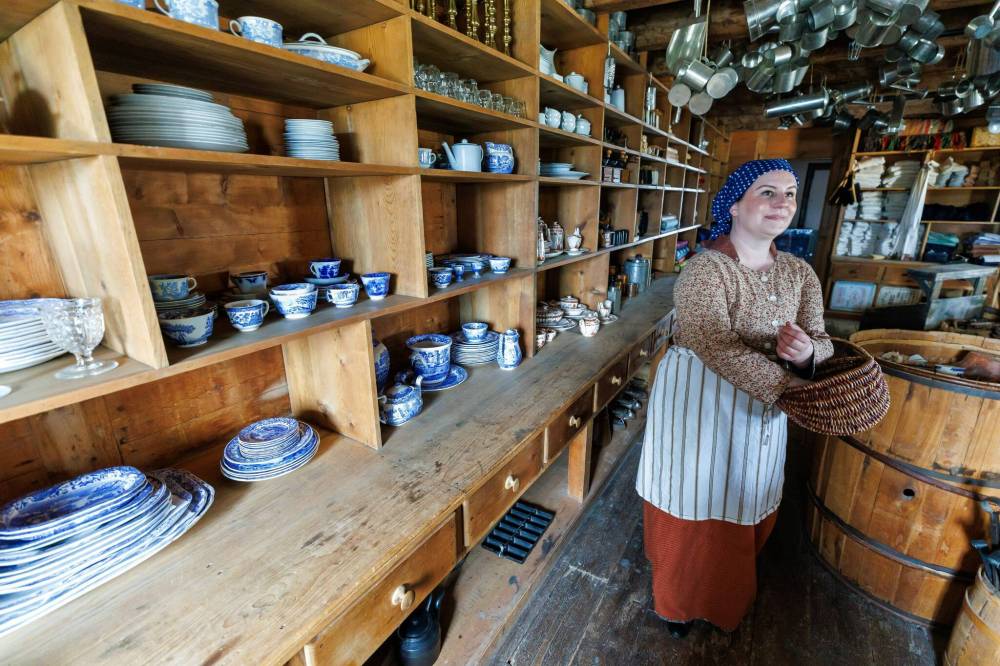
We head downstairs to the shop, since we need to purchase a china tea set for this afternoon. Interpreters there handle both artifacts and reproductions. As such, there’s safety protocol for the artifacts — some brands of tea used to be packaged in lead, for example.
The china we’re purchasing would have been packed in barrels of molasses to keep it from breaking; that molasses could then also be sold.
Antymis points out her favourite product: Perry Davis’ Vegetable Pain-Killer, a “sure cure for all the diseases for which it is recommended, and always perfectly safe in the hands of even the most inexperienced persons,” per the advertising copy.
Perry Davis’s “sure cure” is just herbs, alcohol and opium.
It’s time for a costume change. For the afternoon, I am an upper-class woman and I have been cordially invited for tea at the Big House. (Yes, the very event lower-class me toiled away in the bakehouse for.)
MIKE DEAL / FREE PRESS Jen puts on the many layers that contribute to a lady’s daily outfit. 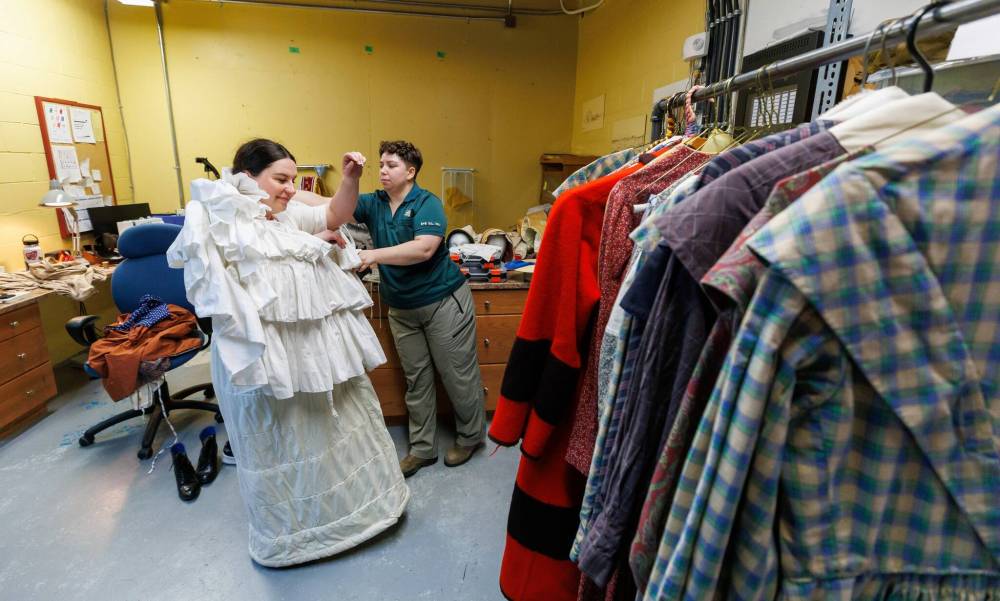
I’ve still got the bike shorts, tank top and sports bra, followed by the chemise — but now I have two petticoats (one full, one ruffled), a full-skirted dress, a collar, a cap and a full-on bonnet. Blessedly, I got to skip the corset. Doing up all those hook-and-eye closures on the dress was enough to make me catch the vapours.
MIKE DEAL / FREE PRESS Jen puts on the many layers that contribute to a lady’s daily outfit. (From left) Sarah Antymis, Interpretation Coordinator, Laurie MacDonell, Visitor Services Group Supervisor, and Amelie Roberts, Costumer. 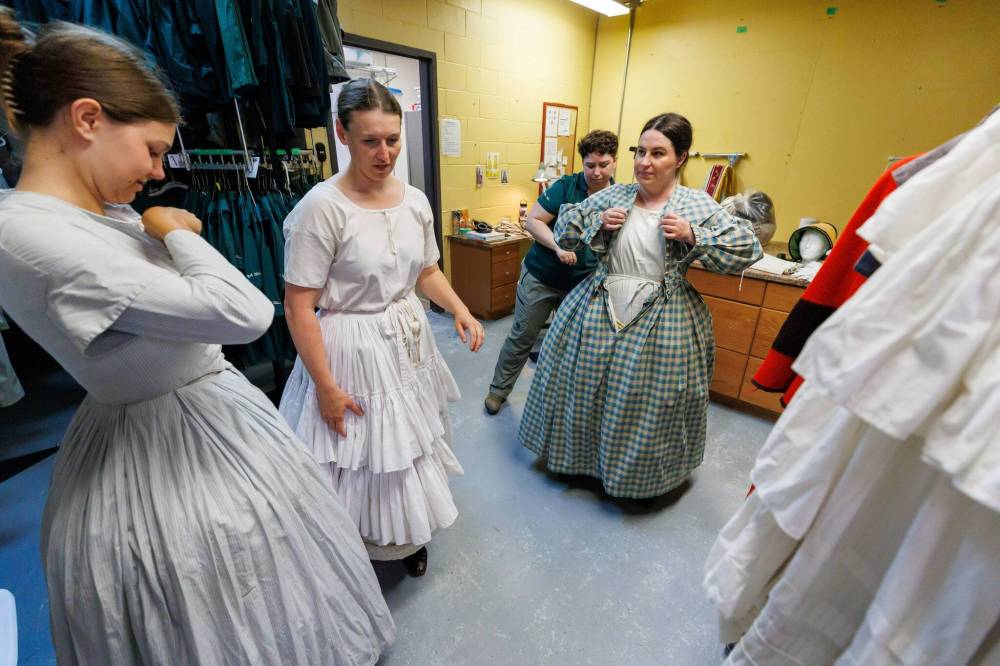
Luckily, as a fancy lady in a huge dress, all I have to do this afternoon is drink Earl Grey and eat cake on a veranda with MacDonell, who has also been classed up, and Antymis, who has gamely changed into a costume.
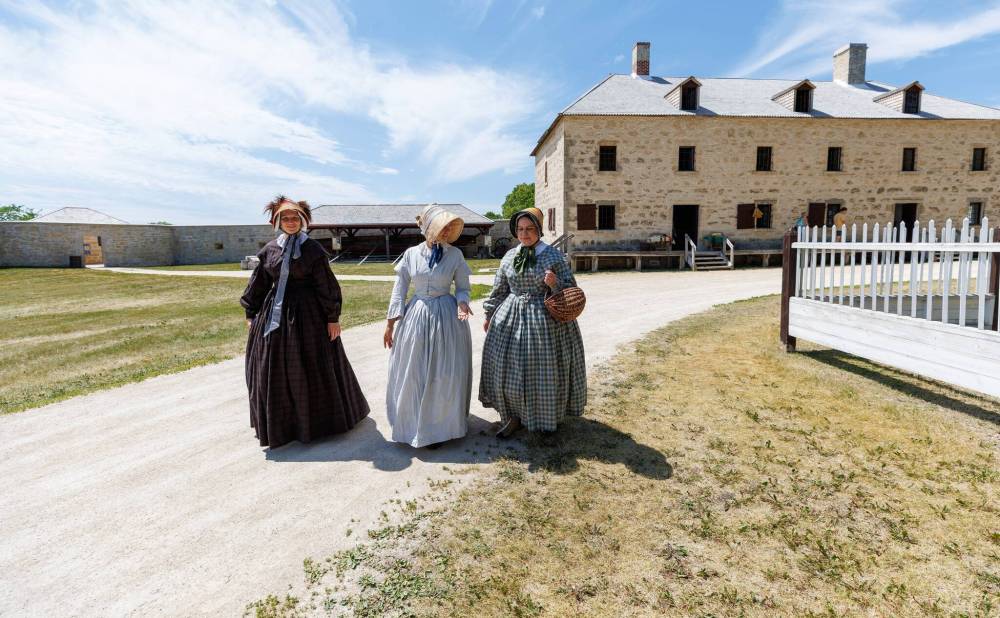
But the first order of business is to not fall down any stairs; the etiquette of the day insists that all skirts must be gathered and lifted with one hand and swept across the body for modesty. (Three ladies walking to tea unaccompanied by a man would also be unheard of.)
MIKE DEAL / FREE PRESS Sarah Antymis (left), Interpretation Coordinator, Laurie MacDonell (centre), Visitor Services Group Supervisor, and Jen have afternoon tea at the Big House inside Lower Fort Garry. 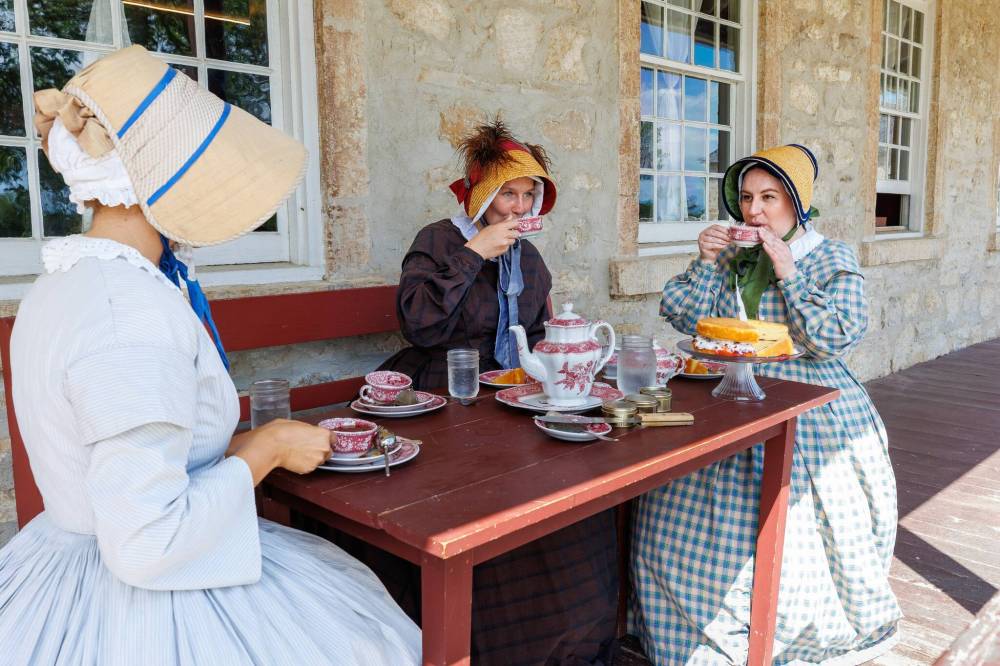
Visitors, charmed, surreptitiously take photos of us having hot tea during, and I cannot stress this enough, a 32 C afternoon. One asks us for a group shot. Antymis and MacDonell are true pros at this; they warmly and knowledgeably answer questions.
And then, my day is done. I leave with newfound respect and appreciation for the women of the past — and what it takes to bring them to life today.
jen.zoratti@freepress.mb.ca
MIKE DEAL / FREE PRESS
Accompanied by Laurie MacDonell (left), Visitor Services Group Supervisor, and Sarah Antymis (centre), Interpretation Coordinator, Jen, now dressed as a higher class lady, makes her way to the Big House where she will have afternoon tea.
MIKE DEAL / FREE PRESS
Jen in the fort’s general store.
MIKE DEAL / FREE PRESS
Jen is shown how to package up furs for shipping.

Jen Zoratti is a columnist and feature writer working in the Arts & Life department, as well as the author of the weekly newsletter NEXT. A National Newspaper Award finalist for arts and entertainment writing, Jen is a graduate of the Creative Communications program at RRC Polytech and was a music writer before joining the Free Press in 2013. Read more about Jen.
Every piece of reporting Jen produces is reviewed by an editing team before it is posted online or published in print – part of the Free Press‘s tradition, since 1872, of producing reliable independent journalism. Read more about Free Press’s history and mandate, and learn how our newsroom operates.
Our newsroom depends on a growing audience of readers to power our journalism. If you are not a paid reader, please consider becoming a subscriber.
Our newsroom depends on its audience of readers to power our journalism. Thank you for your support.