The beauty of fear Métis beadwork artist Vi Houssin captures feeling evoked by increasingly imbalanced world
Read this article for free:
or
Already have an account? Log in here »
To continue reading, please subscribe:

Digital Subscription
One year of digital access for only $205*
- Enjoy unlimited reading on winnipegfreepress.com
- Read the E-Edition, our digital replica newspaper
- Access News Break, our award-winning app
- Play interactive puzzles
*First annual payment billed as $205.00 + GST for one year. This annual subscription will automatically renew at $233.00 + GST every 52 weeks (10% off the regular annual price of $259.35). Offer available to new and qualified returning subscribers only. Cancel any time.
To continue reading, please subscribe:
Add Free Press access to your Brandon Sun subscription for only an additional
$1 for the first 4 weeks*
- Enjoy unlimited reading on winnipegfreepress.com
- Read the E-Edition, our digital replica newspaper
- Access News Break, our award-winning app
- Play interactive puzzles
*Your next Brandon Sun subscription payment will increase by $1.00 and you will be charged $17.95 plus GST for four weeks. After four weeks, your payment will increase to $24.95 plus GST every four weeks.
Read unlimited articles for free today:
or
Already have an account? Log in here »
Hey there, time traveller!
This article was published 27/11/2025 (285 days ago), so information in it may no longer be current.
Often in creative work, the titles of things come later, once one has seen the finished project and the shape it has taken.
For Métis beadwork artist Vi Houssin, the title came first.
Landfear is the evocative name of her first solo exhibition — on view until Dec. 19 at Aceartinc. — which wrestles with the relationship between humans and the Earth.
Before Houssin was naming an art show, she was naming a feeling within herself.
MIKAELA MACKENZIE / FREE PRESS Metis beadwork artist Vi Houssin came up with the name of her first solo exhibition, Landfear, as a way to describe ’the deep-seated fear for both yourself and the world around you.’
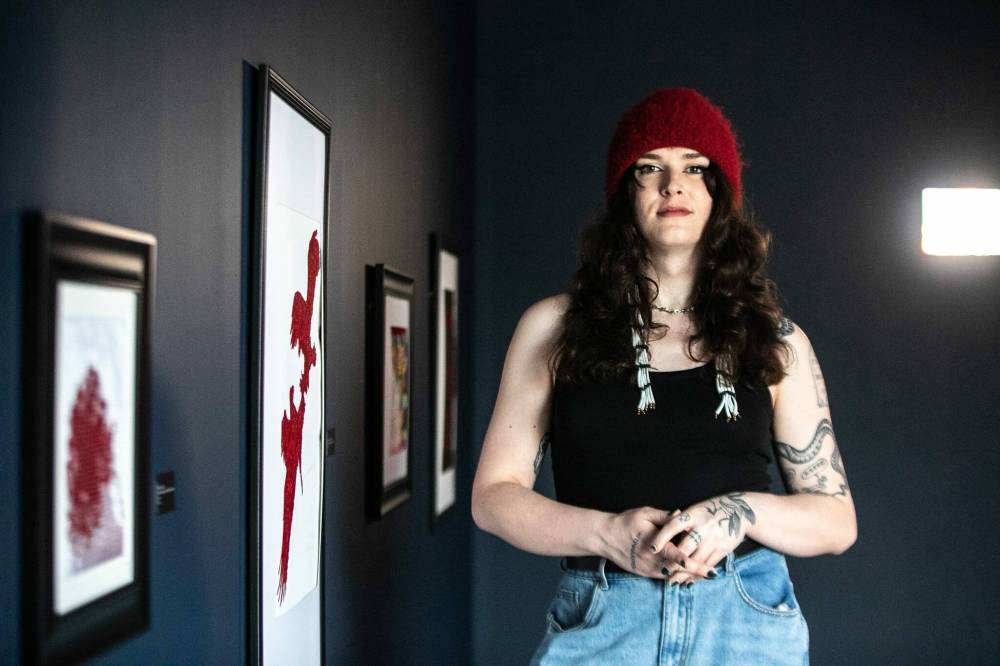
“I was trying to express an emotion that I was feeling of living in an increasingly chaotic, unpredictable and out-of-balance world,” she says. “It’s definitely a terror, it’s definitely a sense of despair, but it’s this fear, not only for yourself, but every other part of the system. In our culture, humans are equilateral to land, sky, water and all the creatures within those domains. It’s this deep-seated fear for both yourself and the world around you.
“‘Landfear’ became the word that I use to express that emotion.”
Curated by Julia Lafreniere with assistance from Michael Miteku, the exhibition is composed of 11 beaded works striking in both their detail and their viscerality.
Many of the pieces challenge human hubris, particularly Silk Swathing, of a spider wrapping its prey; Strange Mercy, of a bloodied polar bear and its kill; and Muzzle Grab, of two wolves (or dogs), teeth bared, bright white against the darkness of their fur, jaws intertwined.
“I was trying to express an emotion that I was feeling of living in an increasingly chaotic, unpredictable and out-of-balance world.”
These scenes may seem brutal to us. They may even be frightening. But they also depict the daily rhythms of nature. And when it comes to nature, humans don’t necessarily understand what they’re looking at.
Take the play on proportions in Silk Swathing; in close-up, the spider looks murderous and massive, an arachnophobe’s nightmare. In reality, she’s probably very tiny, going about her business, nourishing herself.
Muzzle Grab looks like an extraordinarily violent act, but it portrays canines’ means of establishing dominance and teaching other canines the hierarchical structure within their pack.
Supplied Scenes like Muzzle Grab, which portrays two wolves (or dogs) with teeth bared and jaws intertwined, look extraordinarily violent but also depict the daily rhythms of nature.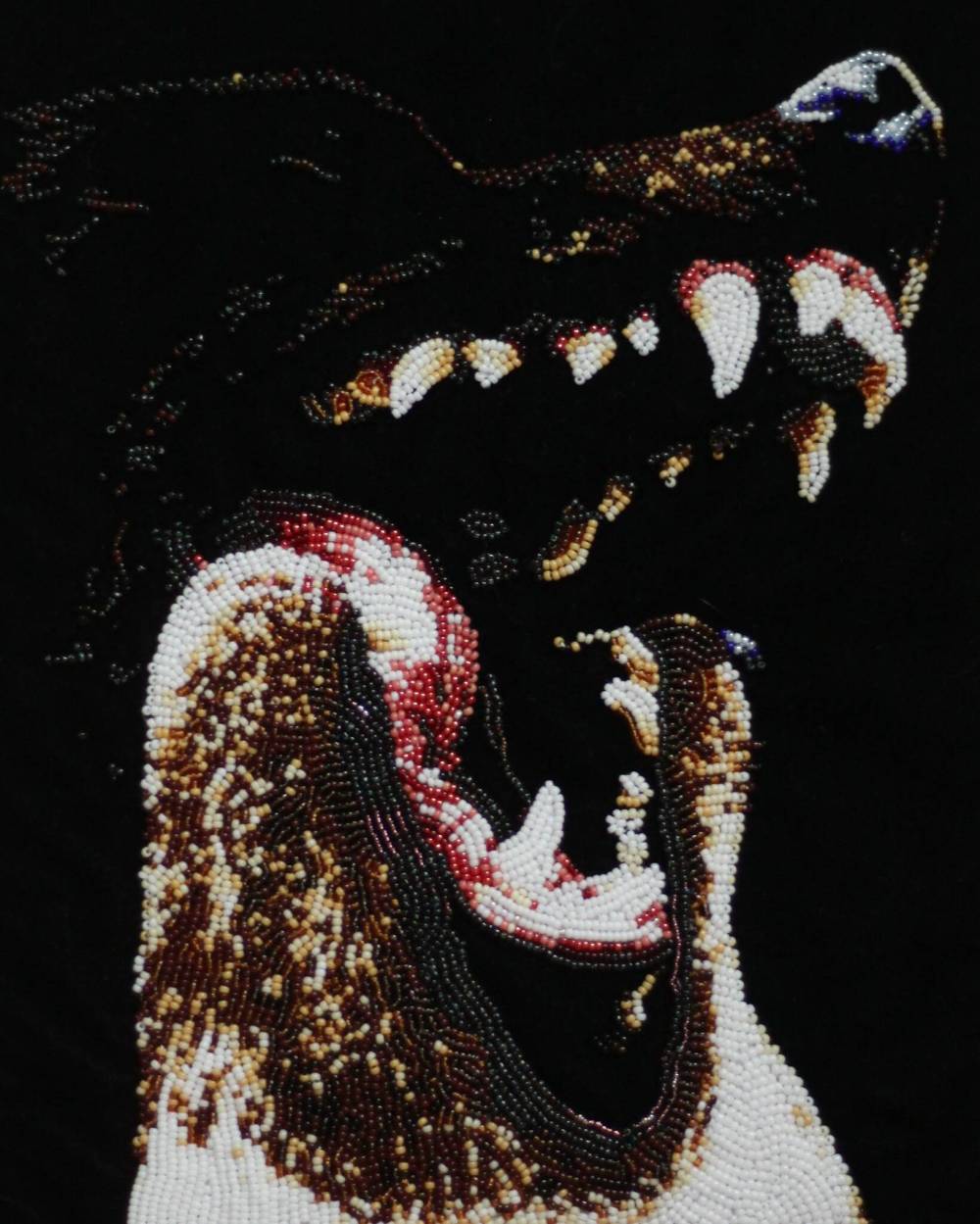
“It’s not necessarily intended to wound, but it is intended to teach one’s place within the world,” Houssin says.
Inspiration also came from elsewhere. In Lot’s Wife — inspired by the Bible story in which a nameless woman is turned into a pillar of salt for looking back as she fled the city of Sodom — a floral motif begins in vivid colour and slowly turns white, giving it the effect of being drained of colour, or turning to salt. Either way, something irrevocable.
“I was not raised religious at all, but both my dad and my grandma are quite religious, and so I interact with Christianity and the Bible with more of an academic or narrative interest rather than a dogmatic one,” Houssin says.
The story of Lot’s wife captured her imagination, specifically the heartbreak of someone having to leave their home and then being punished for looking back.
“As an Indigenous person, I’m quite lucky to be living on my homeland safely. Meanwhile, globally, there are so many Indigenous peoples who are removed from their land because of conflict or famine or disaster.
“While I was working on that piece, I was really thinking specifically about displaced women. I was thinking about the women of Gaza, the women of Sudan, the women of Congo, even the women of northern Manitoba this past summer who had to flee south because of the wildfires, and how difficult that is to leave your home, and how difficult it is to be asked not to look back.”
Supplied Houssin was thinking of displaced women in Gaza, Sudan, Congo, and even those in northern Manitoba displaced by fires this summer, while working on Lot’s Wife. 
It takes about a month for Houssin to create a piece, sometimes more; Lot’s Wife took several. Her art isn’t just time intensive, it’s also finely detailed. She uses glass seed beads, which, as evinced by their name, are teeny tiny.
“Sometimes I enter a flow state and I’m transported somewhere inside of myself, and time just flows past me. And other times I feel every single stitch. Like, there are some works in that show in which I was physically bleeding, pushing the needle through. Anybody who says that craft is easy or dainty doesn’t know what they’re talking about,” she says.
Exhibition preview
Vi Houssin: Landfear
Aceartinc., 206 Princess St.
Wed-Sat, 12-5 p.m., to Dec. 19
Artist talk Dec. 13, 2 p.m., with curator Julia Lafreniere
Houssin, 28, took up beading about five years ago at a workshop offered by the Two-Spirit Michif Local taught by David Heinrichs, a local Métis beadwork artist and Houssin’s first mentor. That was right before COVID hit; during the pandemic, she took the skills she had learned and ran with them.
Part of Houssin’s artistic practice is to challenge the pernicious idea that Indigenous art is ancient artifact to be collected, not art — contemporary art — to be shown.
“Traditional Métis beadwork is some of the most beautiful art found in the world.”
“I believe that traditional Métis beadwork is some of the most beautiful art found in the world, and the only thing to me that separates Métis art and whatever the (expletive) is hanging in the Louvre is simply racism and misogyny. There’s one reason as to why some art pieces are behind glass and seen by thousands of eyes per day and some are anonymous and hidden away on cold shelves in museum back rooms, and it does not have to do with skill,” she says.
Now that Landfear is being shown — and that feeling she was grappling with has been named and transformed into art — Houssin has had an epiphany.
MIKAELA MACKENZIE / FREE PRESS It takes about a month for Houssin to create each finely detailed piece using tiny glass seed beads.
“One thing that I’ve come to realize over the past few weeks as I was finishing up the show is how beautiful an emotion fear can be, and how, just like grief, it’s a real symptom of love. I think that fear wouldn’t exist if we didn’t care about what we had to lose,” she says.
“I think the fact that we are afraid for ourselves, that we’re afraid for the people we love, that we’re afraid for the world around us is a sign that we have a deep love for it. So, I think that appreciating that fear is a way of understanding it.”
jen.zoratti@freepress.mb.ca

Jen Zoratti is a columnist and feature writer working in the Arts & Life department, as well as the author of the weekly newsletter NEXT. A National Newspaper Award finalist for arts and entertainment writing, Jen is a graduate of the Creative Communications program at RRC Polytech and was a music writer before joining the Free Press in 2013. Read more about Jen.
Every piece of reporting Jen produces is reviewed by an editing team before it is posted online or published in print – part of the Free Press‘s tradition, since 1872, of producing reliable independent journalism. Read more about Free Press’s history and mandate, and learn how our newsroom operates.
Our newsroom depends on a growing audience of readers to power our journalism. If you are not a paid reader, please consider becoming a subscriber.
Our newsroom depends on its audience of readers to power our journalism. Thank you for your support.