Friends no more Tumultuous year of Trump sours Manitobans on relationship with U.S., poll finds
Read this article for free:
or
Already have an account? Log in here »
To continue reading, please subscribe:

Digital Subscription
One year of digital access for only $205*
- Enjoy unlimited reading on winnipegfreepress.com
- Read the E-Edition, our digital replica newspaper
- Access News Break, our award-winning app
- Play interactive puzzles
*First annual payment billed as $205.00 + GST for one year. This annual subscription will automatically renew at $233.00 + GST every 52 weeks (10% off the regular annual price of $259.35). Offer available to new and qualified returning subscribers only. Cancel any time.
To continue reading, please subscribe:
Add Free Press access to your Brandon Sun subscription for only an additional
$1 for the first 4 weeks*
- Enjoy unlimited reading on winnipegfreepress.com
- Read the E-Edition, our digital replica newspaper
- Access News Break, our award-winning app
- Play interactive puzzles
*Your next Brandon Sun subscription payment will increase by $1.00 and you will be charged $17.95 plus GST for four weeks. After four weeks, your payment will increase to $24.95 plus GST every four weeks.
Read unlimited articles for free today:
or
Already have an account? Log in here »
Hey there, time traveller!
This article was published 19/12/2025 (240 days ago), so information in it may no longer be current.
After almost a year of trade confusion and crippling tariffs imposed by the U.S., most Manitobans no longer consider that country an ally — and they’re wary of any new trade deal, a survey concludes.
The Probe Research poll found 64 per cent of Manitobans don’t view the United States as Canada’s friend.
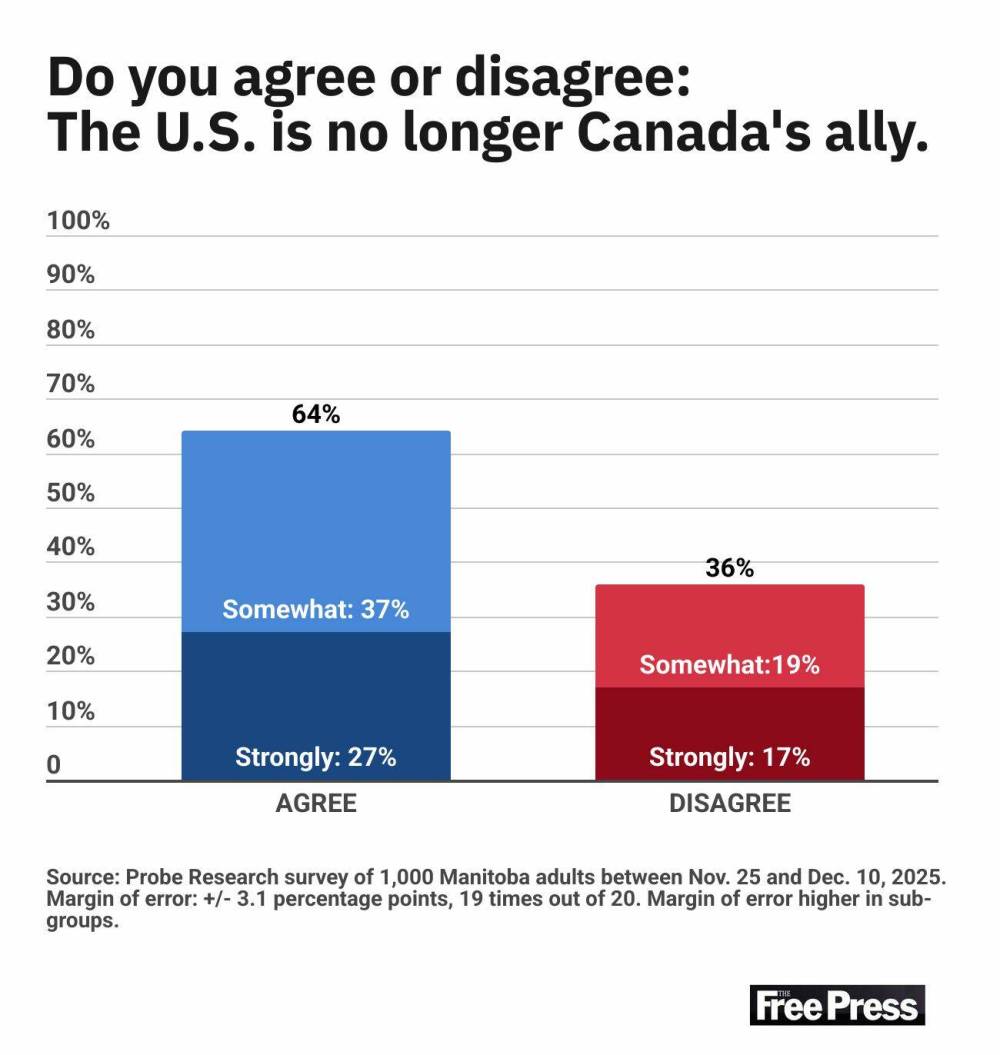
“The tone of things between the two countries means something has really fundamentally changed,” said Curtis Brown, a Probe Research partner.
“Five years ago, 10 years ago, you’d have a very different answer.”
Probe surveyed 1,000 Manitobans between Nov. 25 and Dec. 10, just as public hearings began on the Canada-United States-Mexico Agreement in Washington.
Steve Lambert / The Canadian Press Files Less peaceful than before: Since 1932, the International Peace Garden on the Manitoba-North Dakota border between Boissevain and Dunseith, N.D., has symbolized friendship of two nations. A new poll, however, shows 64 per cent of Manitobans don’t feel so friendly anymore.
The free trade agreement shields about 88 per cent of Canadian exports to the U.S. from tariffs. The review of the trade agreement is slated for July 2026.
For nearly half of poll respondents, no deal with the United States seems better than any deal for Canada. A slight majority of provincial New Democrat voters and adults 55 and older reported aligning with that view.
Twenty-two per cent took the opposite route — any deal with the U.S. is better than none — while one-third remained unsure.
“I think they should take a new deal if things basically stay the same,” said Stephen Kolody, 72, as he shopped for groceries Wednesday.
Kolody called U.S. President Donald Trump “unpredictable” and said he hopes U.S. midterm elections will change the negative headlines coming from Capitol Hill. Congressional elections run from March until November 2026.
Three-quarters of Probe poll respondents believe any deal Canada negotiates with the U.S. will be moot because Trump will change it at his whim.
Probe’s findings are “a measuring stick of just how angry Manitobans are about the relationship we have with our No. 1 trading partner,” said Loren Remillard, president of the Winnipeg Chamber of Commerce.
“When I look at those results, I see more emotion than I do a real dissection of the economics.”
Manitobans are shielded from the full effect of U.S. tariffs because of the CUSMA deal. It’s crucial for Canada to get “the right agreement for Canada,” Remillard said.
On that issue, Manitobans are split on how to get there.
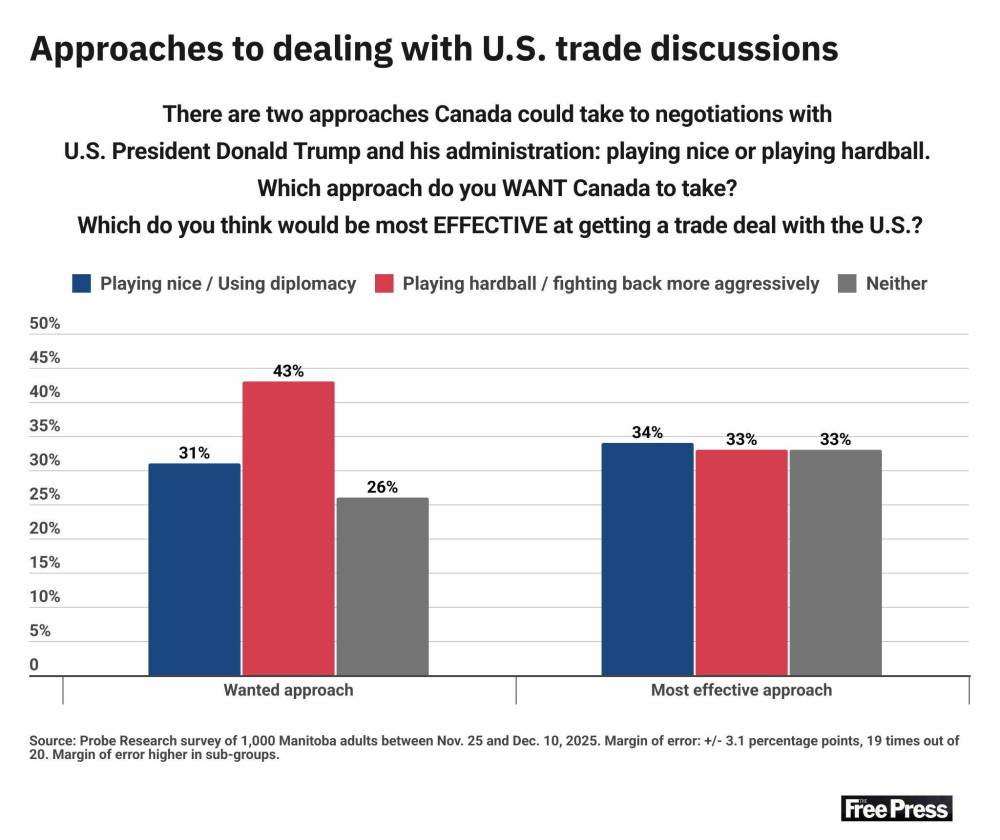
Roughly one-third of respondents each called using diplomacy, being more aggressive or doing neither the most effective approach in trade negotiations.
A slight majority — 43 per cent — said they want to play hardball. Thirty-one per cent would rather play nice.
Respondents who reported being provincial and federal New Democrats were among those most likely to want a tougher stance. Nearly half of respondents ages 18 to 34 also chose that option.
“When you’re younger, you’re maybe more likely to see things as being… more black and white,” Brown said. “You’re wanting to maybe take a bit of a tougher stand or a tougher approach to what you think is right.”
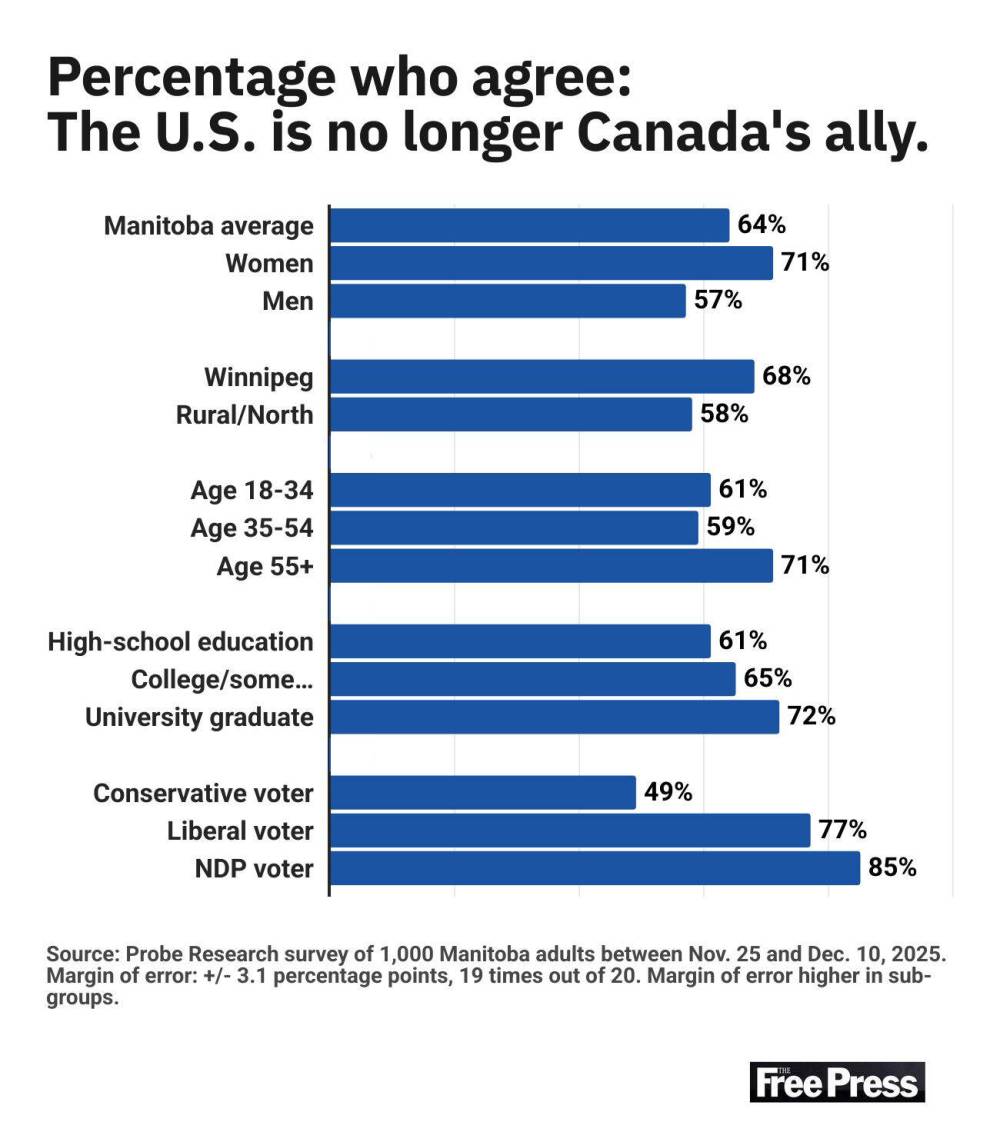
Historically, federal New Democrat voters have been more critical of Canada’s close relationship with the United States. It predates Trump’s election, Brown said.
Older Manitobans and those with Conservative leanings are less likely to believe playing hardball will be effective: 27 per cent of Progressive Conservative respondents and 29 per cent of federal Tory voters agreed.
Kaleb Kleinsasser, 27, joins the 40 per cent of respondents who think Conservative Leader Pierre Poilievre would do a better job in trade talks than Prime Minister Mark Carney.
“It’s not that I have much faith in Poilievre’s ability,” he said, stopping during a grocery run with his family. “It’s more that I have no faith in Carney and his government to get the job done.”
Trump seems to think he can take advantage of the Liberals more, from Kleinsasser’s view. The Carney government aims to deepen ties with China — something Kleinsasser likened to cuddling up “with a snake.”
Trump is putting America first, and Canada should put Canada first, Kleinsasser said, pointing out this country has many resources; a new pipeline to ship Alberta oil abroad is a step “in the right direction,” he said.
Four in 10 Probe respondents rated the Carney government as “excellent” or “good” in relation to its dealings with Trump.
Federal Liberal supporters, and provincial Liberal and NDP voters, most commonly held a positive outlook of the government’s approach.

“There are many Manitobans who don’t support the… federal Liberal party,” said Christopher Adams, a University of Manitoba adjunct professor in political science. “Even if you think that Carney is doing a good job, you still might think that it’s not being handled very well.”
“There are so few successes in terms of these trade negotiations,” he said.
Some of Poilievre’s rhetoric aligns with Trump’s: the Canadian politician campaigned on defunding the CBC; Trump cut National Public Radio’s resources. A segment of Tory supporters would like some of Trump’s actions to be adopted by Canada, Adams said.
Amora Edwards, 24, has shied away from following politics.
“It’s been very frustrating,” she said, pausing in a produce aisle at Superstore. “There’ve just been so many terrible changes.”
She searches for vegetables that aren’t grown in the U.S. Canada shouldn’t sign a new trade agreement with the U.S. unless it sees equal benefits to what the States receives, she said.
“If no, then I feel like we should really start looking elsewhere,” Edwards said.
Almost three-quarters of poll-takers — 72 per cent — figured Canada could replace trade lost in the United States through deals with other countries.
John Woods / The Canadian Press Files Expanding the Port of Churchill to facilitate trade with other markets, such as Europe, has become a top priority for the Manitoba and federal governments.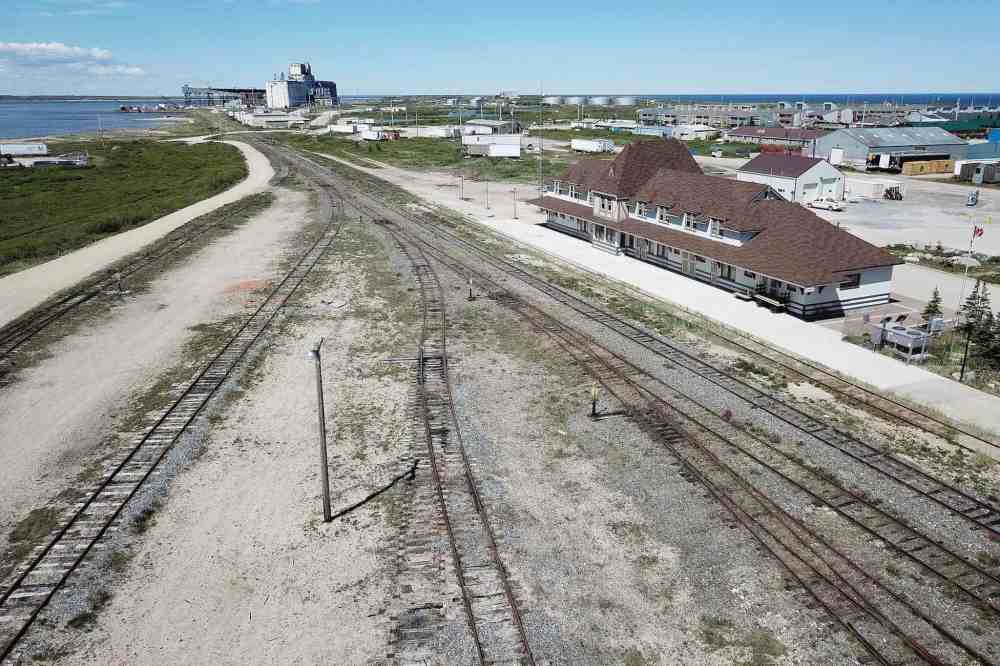
“In the last year, we’ve heard so much about trying to… find other markets, whether it’s in Europe or Asia,” said Brown from Probe. “I don’t know if people would’ve necessarily believed that or thought that was realistic if we would’ve asked that five or 10 years ago.”
Expanding the Port of Churchill to facilitate trade with other markets, such as Europe, has become a top priority for the Manitoba and federal governments. Carney has set a goal of doubling non-U.S. exports over the next decade, accounting for $300 billion in new trade.
Fully replacing U.S. trade with exports to other countries isn’t realistic, said André Brin, chief executive of World Trade Centre Winnipeg.
“We can absolutely become less reliant on the U.S., but (the) U.S. is always, in my opinion — and I think the numbers bear that out — going to be a significant trade partner for Canada,” Brin said.
The United States is close, has a large population and takes in roughly 72 per cent of Manitoba’s exports. Its percentage share of Canadian exports may decrease over time, but it’ll be gradual, Brin said, adding that companies must build relationships, conduct market research and fine tune their products to new customers.
He has noticed more Manitoba businesses are looking to export. Discussions are happening; results should come over the next two to three years, Brin said.

Greater interprovincial trade still consumes “a lot of conversation,” Remillard said. In the meantime, businesses continue to delay investments to see how CUSMA negotiations unroll.
“I would suspect you will see a significant ramping up on provincial movement and international markets if the… relationship with the United States deteriorates,” Remillard said.
Canada would do well to keep tariffs off U.S. imports, even if the other country raises its fees, said Edda Claus, an economics professor at Wilfrid Laurier University in Waterloo, Ont.: “It’s better if we can buy goods and services for less.”
In the U.S., inflation has been climbing since May under Trump’s tariff regime.
Probe Research’s findings have a 95 per cent certainty rate. Results are within plus or minus 3.1 percentage points of what they’d be if Manitoba’s entire population were surveyed.
gabrielle.piche@winnipegfreepress.com

Gabrielle Piché reports on business for the Free Press. She interned at the Free Press and worked for its sister outlet, Canstar Community News, before entering the business beat in 2021. Read more about Gabrielle.
Every piece of reporting Gabrielle produces is reviewed by an editing team before it is posted online or published in print — part of the Free Press‘s tradition, since 1872, of producing reliable independent journalism. Read more about Free Press’s history and mandate, and learn how our newsroom operates.
Our newsroom depends on a growing audience of readers to power our journalism. If you are not a paid reader, please consider becoming a subscriber.
Our newsroom depends on its audience of readers to power our journalism. Thank you for your support.