Let the Games begin Camaraderie and community are everywhere at spread out Olympic sites
Read this article for free:
or
Already have an account? Log in here »
To continue reading, please subscribe:

Digital Subscription
One year of digital access for only $205*
- Enjoy unlimited reading on winnipegfreepress.com
- Read the E-Edition, our digital replica newspaper
- Access News Break, our award-winning app
- Play interactive puzzles
*First annual payment billed as $205.00 + GST for one year. This annual subscription will automatically renew at $233.00 + GST every 52 weeks (10% off the regular annual price of $259.35). Offer available to new and qualified returning subscribers only. Cancel any time.
To continue reading, please subscribe:
Add Free Press access to your Brandon Sun subscription for only an additional
$1 for the first 4 weeks*
- Enjoy unlimited reading on winnipegfreepress.com
- Read the E-Edition, our digital replica newspaper
- Access News Break, our award-winning app
- Play interactive puzzles
*Your next Brandon Sun subscription payment will increase by $1.00 and you will be charged $17.95 plus GST for four weeks. After four weeks, your payment will increase to $24.95 plus GST every four weeks.
Read unlimited articles for free today:
or
Already have an account? Log in here »
Hey there, time traveller!
This article was published 06/02/2026 (232 days ago), so information in it may no longer be current.
MILAN — The deep-voiced, English-speaking PA announcer and his Italian translator repeated it multiple times throughout Friday’s lavish opening ceremonies, reminding the 75,000 spectators inside San Siro Stadium — and the millions watching around the world — exactly what was unfolding.
“Welcome to the first widespread Games,” they kept saying, almost as if it was both a heads-up but also an apology, of sorts.
Yes, Milan Cortina 2026 is going to be a Winter Olympics like no other, spread across four main clusters as much as 400 kilometres apart. Each hosted its own simultaneous celebration to kick things off, which meant dividing the roughly 2,800 athletes instead of gathering them all under one roof to watch the torches be lit.
Ashley Landis / The Associated Press
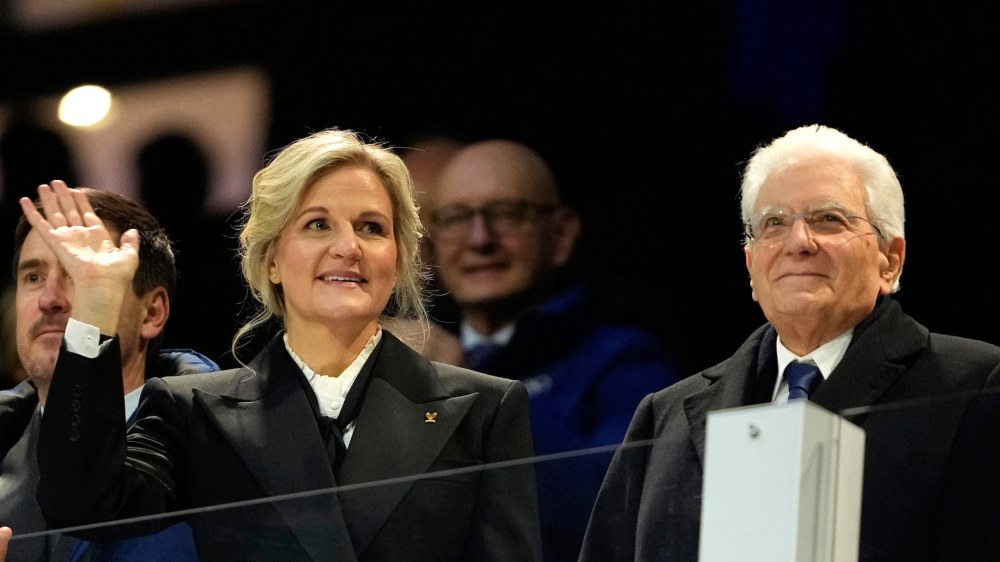
IOC President Kirsty Coventry, left, and Italian President Sergio Mattarella, right, attend the Olympic opening ceremony in Milan, Italy, Friday.
It may have looked slick on television, thanks to quick cutaways and seamless edits, but this was a true case of divide — and (hopefully) conquer.
“I think we can all say very openly and honestly it has added additional complexities — for media, for transport, for the International Olympic Committee,” IOC president Kirsty Coventry told reporters earlier this week. But she said this type of thing may become the new normal in the name of sustainability and cost-efficiency for otherwise reluctant hosts.
Canada, for example, has the largest share of its 207 athletes based in Milan, home to marquee events such as men’s and women’s hockey and speed skating. But plenty of others are stationed in Livigno, Cortina and Predazzo. And that, quite frankly, is a bit of a bummer for all involved.
Spectators, too, may face some tough choices. Want to watch curling and hockey over the next 16 days? You definitely can’t do both on the same day, considering an eight-to-nine-hour round trip would be required — and that’s before factoring in potentially drastic weather changes once you leave the city and get into the mountains.
Given the increasingly fractured state of the world, the setup also carries symbolism. And therein lies the challenge. The Olympic motto is “Citius, Altius, Fortius — Communiter,” which is Latin for “Faster, Higher, Stronger — Together.”
To that end, various dignitaries addressed the audience Friday with repeated calls to remember the humanity, dignity and respect the Games are meant to represent.
Good luck with that.
Although the temperature outside the home of AC Milan and Inter Milan was unusually warm — daytime highs have been in the teens all week, making it feel more like the Spring Olympics — the parade of more than 90 countries got a little frosty at times as politics inevitably crept into sport.
Fans inside the stadium jeered loudly as the Israeli team was introduced, appearing to catch the small contingent of athletes by surprise. It probably shouldn’t have. In this part of the world, public solidarity with Palestinians has been strong, with massive protests held in cities such as Milan and Rome.
Ashley Landis / The Associated Press
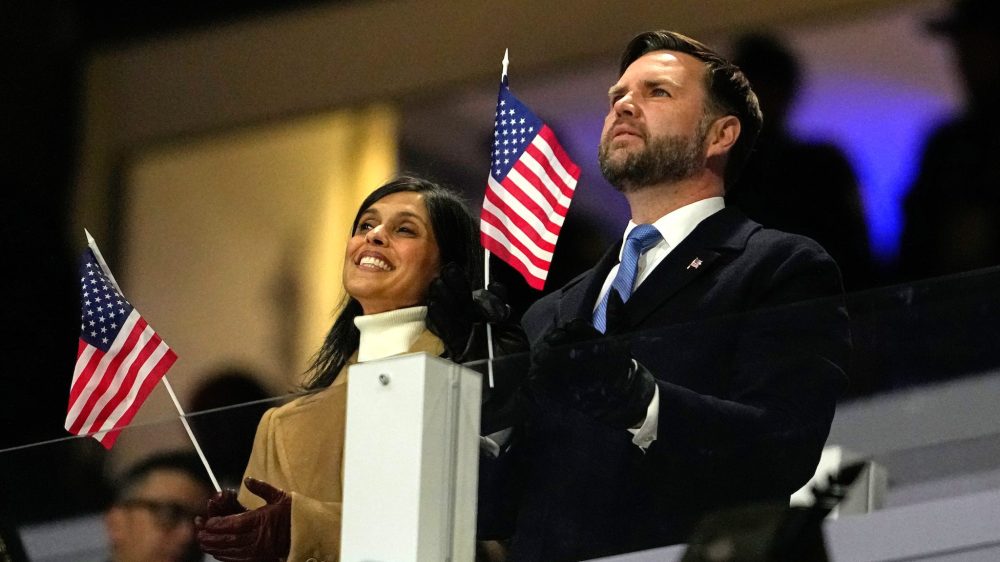
U.S. Vice President JD Vance and his wife Usha Vance during the Olympic opening ceremony in Milan, Friday.
The reaction to the United States was more mixed. There were boos, but they were quickly drowned out by cheers. Things turned sharply when U.S. Vice-President JD Vance and his wife, Usha, were shown standing and applauding in the crowd. An ear-splitting boo-vation followed, and the camera immediately cut away.
On the flip side, Team Ukraine received one of the warmest receptions of the night, rivalled only by the roar reserved for the host Italians, who were saved for last and served as a much-needed palate cleanser. Russia, of course, was nowhere to be found, still facing an indefinite ban from international competition.
The Canadian squad, meanwhile, was greeted with respectful cheers as it eyes a strong showing on the podium.
“Very soon we will show the world what Canadian excellence looks like,” Jennifer Heil, the country’s chef de mission, said Thursday.
Elbows up?
To help combat separation anxiety, the Canadian team is holding video calls every other day so athletes scattered across Italy can gather, at least virtually.
“I totally support having a more sustainable Games, but it’s also going to make it more challenging to feel like a united team out there,” Canadian freestyle skier Brendan Mackay, who is in the mountain region of Livigno for his event, told The Canadian Press recently.
Safety and security remain major concerns, especially in these troubled times, and there is a noticeable presence on seemingly every street corner in Milan.
MIKE MCINTYRE / FREE PRESS
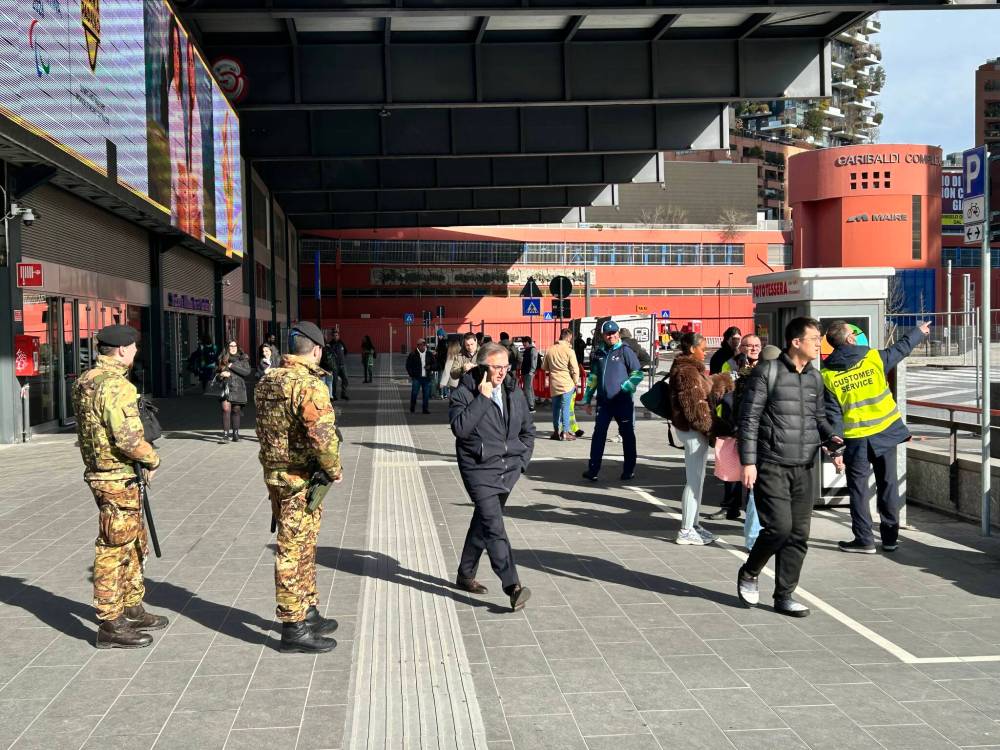
Heavily armed, camouflage-clad police stand guard outside Garibaldi Subway station in Milan, a common sight through the area with stepped up Olympic security.
One example: heavily armed, camouflage-clad police stood guard Friday afternoon outside the Garibaldi subway station. Inside, riders were warned of a rise in pickpocketing while several teenagers jumped the turnstiles to avoid paying fares — their version of the high jump, perhaps.
Of course, this type of petty crime isn’t the primary focus of the stepped-up security. If that’s the worst that happens, everyone will breathe a sigh of relief.
Despite the distance, the politics and the security, signs of camaraderie and community are everywhere.
On Thursday afternoon, in a residential neighbourhood, hundreds of residents turned out as the torch relay passed through, building toward its finale Friday night at San Siro. There was clapping, dancing and unfiltered joy.

On Friday morning, dozens lined up outside a store hosting a pin-trading exhibition. People from all over the world — and, yes, they proudly refer to themselves as “pinheads” — gathered to admire and swap souvenirs, a tradition dating back to Athens in 1896.
Things have evolved. At the Olympic Village in Milan, where athletes are staying and media, including the Free Press, toured this week, pins can even be traded with a robot.
“I have 7,000 pins in my collection. And I bet you I could probably associate a time, a place, a conversation, a name of who I traded with almost all of them,” said Andrew Kollo, a pest control manager from Newmarket, Ont., attending his 14th Olympics.
His first came at age 10 during the 1972 Munich Summer Games, when his family went to watch a cousin compete in rowing. He received five pins that day from an athlete, turned them into 60, and a hobby — or passion — was born.

MIKE MCINTYRE / FREE PRESS
Ontario’s Andrew Kollo and Josh Waller of England have become friends through their Olympic gatherings by trading pins.
“It’s an unofficial sport. You’ll meet people who maybe can’t speak a lick of English, but all you have to do is smile and point at a pin. It’s like a universal language,” he said.
The pins are nice, but it’s really about the people. Kollo said these Games also offer a chance to reconnect after Beijing 2022 was held without fans due to the pandemic, making this the first fan-friendly Winter Olympics since PyeongChang in 2018.
And what would an Olympics be without a little whimsy — and controversy.
On the lighter side, Snoop Dogg has been making the rounds as an NBC special correspondent, including riding a Zamboni at Milan’s main hockey rink and, a day later, hanging out with curlers in Cortina.
On the stranger side, a recent German newspaper report claims some male ski jumpers have been injecting their penises with hyaluronic acid in an attempt to enhance performance. In theory, the procedure temporarily increases size before suit measurements, creating more surface area and, presumably, more lift in the air.
There is no World Anti-Doping Agency investigation at this point, but the story — already dubbed “penis-gate” — may not be going away.
The competition itself, which officially starts Saturday and will include 116 different events, should get the heart pounding and blood pumping, including the return of NHL players for the first time since Sochi in 2014.
Potential clashes between Canada and the U.S. — to be clear, we’re talking strictly hockey here, nothing political — could be on tap for the men and women.

Christophe Ena / THE ASSOCIATED PRESS
U.S. artist Snoop Dogg rode a Zomboni at the figure skating venue on Tuesday.
And here’s a tasty little nugget that might have flown under the radar, given everything else going on: Canada made it clear that, in addition to trying to clean up against the competition, they’d like to get back in the hosting business, perhaps as early as 2038 which remains up for grabs. Vancouver, in 2010, was the last one.
“The importance of hosting the Olympic Games in Canada is not lost on us. We very much want to,” said David Shoemaker, the CEO and secretary general of the Canadian Olympic Committee.
“We see it as helping us with several objectives — boosting infrastructure, creating inspiration for young people to participate in sport, boosting private investment and uniting a country. Hosting a Games, there’s nothing quite like that. If not 2038, then beyond.”
Let the Games begin.
winnipegfreepress.com/mikemcintyre

Mike McIntyre is a sports reporter whose primary role is covering the Winnipeg Jets. After graduating from the Creative Communications program at Red River College in 1995, he spent two years gaining experience at the Winnipeg Sun before joining the Free Press in 1997, where he served on the crime and justice beat until 2016. Read more about Mike.
Every piece of reporting Mike produces is reviewed by an editing team before it is posted online or published in print — part of the Free Press‘s tradition, since 1872, of producing reliable independent journalism. Read more about Free Press’s history and mandate, and learn how our newsroom operates.
Our newsroom depends on a growing audience of readers to power our journalism. If you are not a paid reader, please consider becoming a subscriber.
Our newsroom depends on its audience of readers to power our journalism. Thank you for your support.
Related Articles
Notable quotes from the Milan Cortina Olympics: Feb. 7, 2026