‘Russia will never bring us to our knees’ Battered, bruised Ukrainians mark fourth anniversary of Russian invasion with weary, but unwavering resolve
Read this article for free:
or
Already have an account? Log in here »
To continue reading, please subscribe:

Digital Subscription
One year of digital access for only $205*
- Enjoy unlimited reading on winnipegfreepress.com
- Read the E-Edition, our digital replica newspaper
- Access News Break, our award-winning app
- Play interactive puzzles
*First annual payment billed as $205.00 + GST for one year. This annual subscription will automatically renew at $233.00 + GST every 52 weeks (10% off the regular annual price of $259.35). Offer available to new and qualified returning subscribers only. Cancel any time.
To continue reading, please subscribe:
Add Free Press access to your Brandon Sun subscription for only an additional
$1 for the first 4 weeks*
- Enjoy unlimited reading on winnipegfreepress.com
- Read the E-Edition, our digital replica newspaper
- Access News Break, our award-winning app
- Play interactive puzzles
*Your next Brandon Sun subscription payment will increase by $1.00 and you will be charged $17.95 plus GST for four weeks. After four weeks, your payment will increase to $24.95 plus GST every four weeks.
Read unlimited articles for free today:
or
Already have an account? Log in here »
Hey there, time traveller!
This article was published 23/02/2026 (208 days ago), so information in it may no longer be current.
KYIV — On a grey Sunday afternoon, 75-year-old Vira Kurylenko sits in a warming tent, bundled in layers of thick clothing, clutching a paper cup of hot tea.
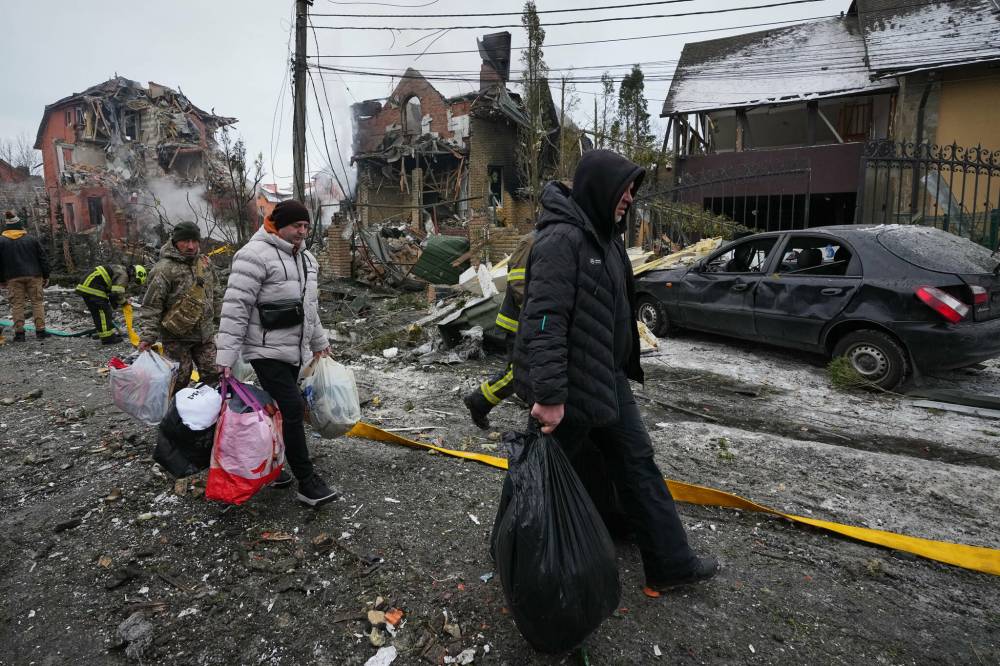
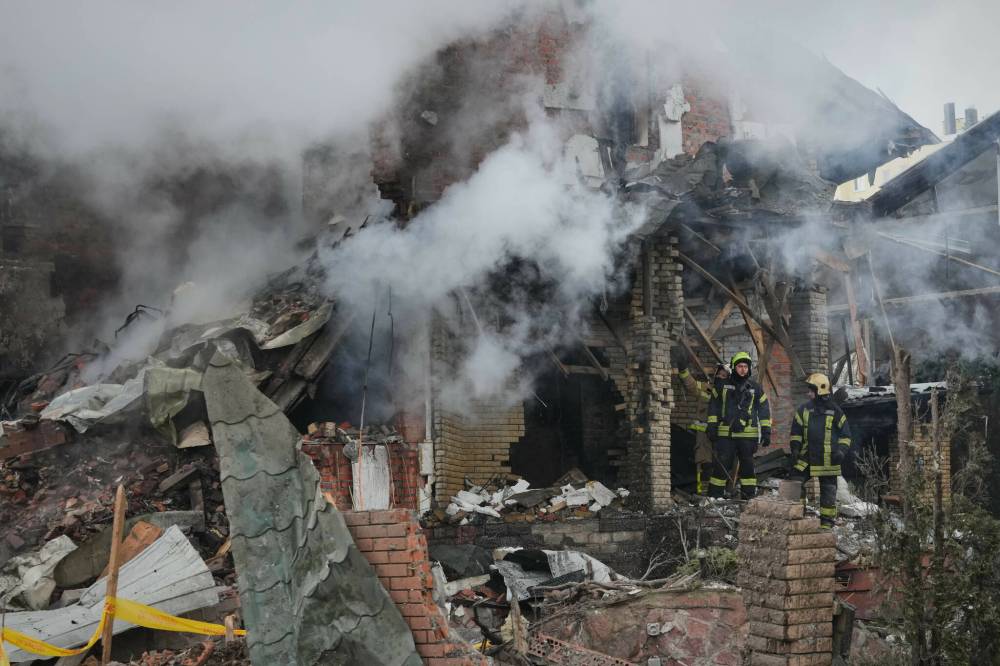
It’s a chilly, bleary-eyed day: just nine hours ago, dozens of ballistic and cruise missiles shrieked into the capital, destroying a swath of warehouses and several homes on the city’s eastern edge.
“This night was very scary,” Kurylenko says, sighing sadly.
MELISSA MARTIN / FREE PRESS Kyiv residents Vira Kurylenko, 75, and Tamila Ivanenko, 70, warm up at emergency warming tents in the capital’s Troieshchyna neighbourhood on Feb. 22. Troieshchyna, which is on the left bank of the Dnipro River, has been among the areas hardest hit by Russian assaults on Ukraine’s civilian electrical and heating infrastructure.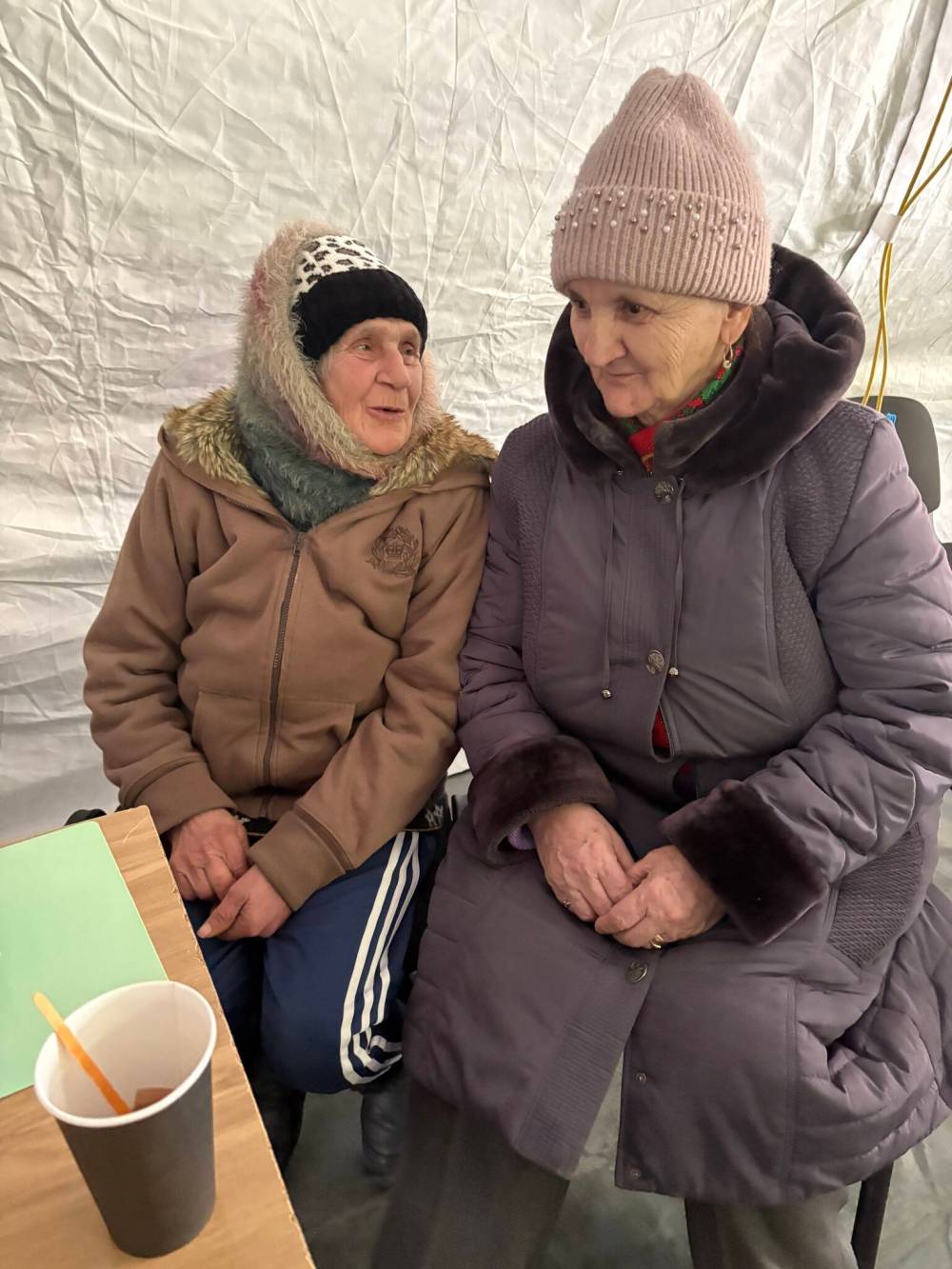
For 36 years, Kurylenko has lived in a ninth-floor apartment in Kyiv’s Troieshchyna neighbourhood. It’s a distinctive place, built mostly in the 1980s, a sweep of striking Soviet residential complexes rising on the left bank of the Dnipro River. Today, nearly 300,000 people live in the high-rises; many were resettled there after the 1986 Chornobyl disaster.
Troieshchyna has a certain gritty reputation. It’s far-flung from the quaint cobblestone streets of the city’s heart, poorly serviced by public transportation and considered, fairly or not, to be plagued by petty crime. The modernist facades of its buildings, bold and eye-catching, loom worn and slowly decaying.
But for Kurylenko, Troieshchyna has simply been a good home, for all these years — until the latest Russian attacks came.
“It’s a good neighbourhood, the best neighbourhood in Kyiv,” she declares, her warm eyes dancing. “And the biggest, and the most beautiful. We like it a lot.”
Sitting beside Kurylenko, her friend Tamila Ivanenko, 70, a lifelong resident of the area, finishes the thought.
“Unfortunately, the war causes all these issues right now, so we have to sit here without water and electricity and heat.”
MELISSA MARTIN / FREE PRESS Emergency warming tents are set up in Kyiv’s Troieshchyna neighbourhood.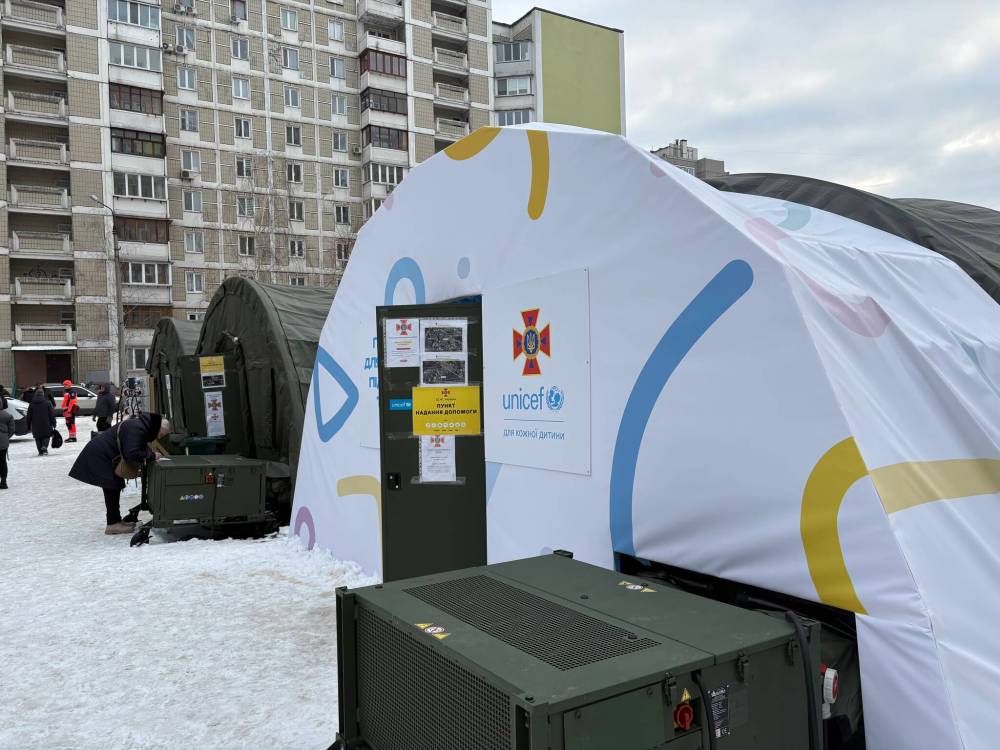
That has been the story of this, Ukraine’s fourth winter of all-out war. It has been several years since Russia launched a long and ongoing campaign to destroy the country’s civilian electrical grid. Last year, that effort intensified, with massive missile attacks striking at Kyiv’s thermal plants and the gas facilities that help drive them.
By late January, the situation in the capital had become dire. All of Kyiv’s central thermal plants — which provide heat and hot water to hundreds of thousands of residents — had been damaged, and as many as 4,500 buildings had no heat. Power came in brief bursts, sometimes just an hour a day — and sometimes, none at all.
While all of Kyiv has been affected by the outages, the communities on the Dnipro’s left bank have borne the brunt.
After a particularly brutal missile strike in mid-January, Kurylenko’s apartment had no heat for two weeks while the temperature plunged below -20 C; she and her neighbours slept swaddled in layers of socks, sweaters, tuques and parkas.
“And also,” Kurylenko adds, “I have a very warm good kitty by my side.”
MELISSA MARTIN / FREE PRESS People line up between warming tents for free portable gas stoves, handed out by a Polish-based chapter of Catholic lay organization Order of Malta, in Kyiv’s Troieshchyna neighbourhood on Feb. 22.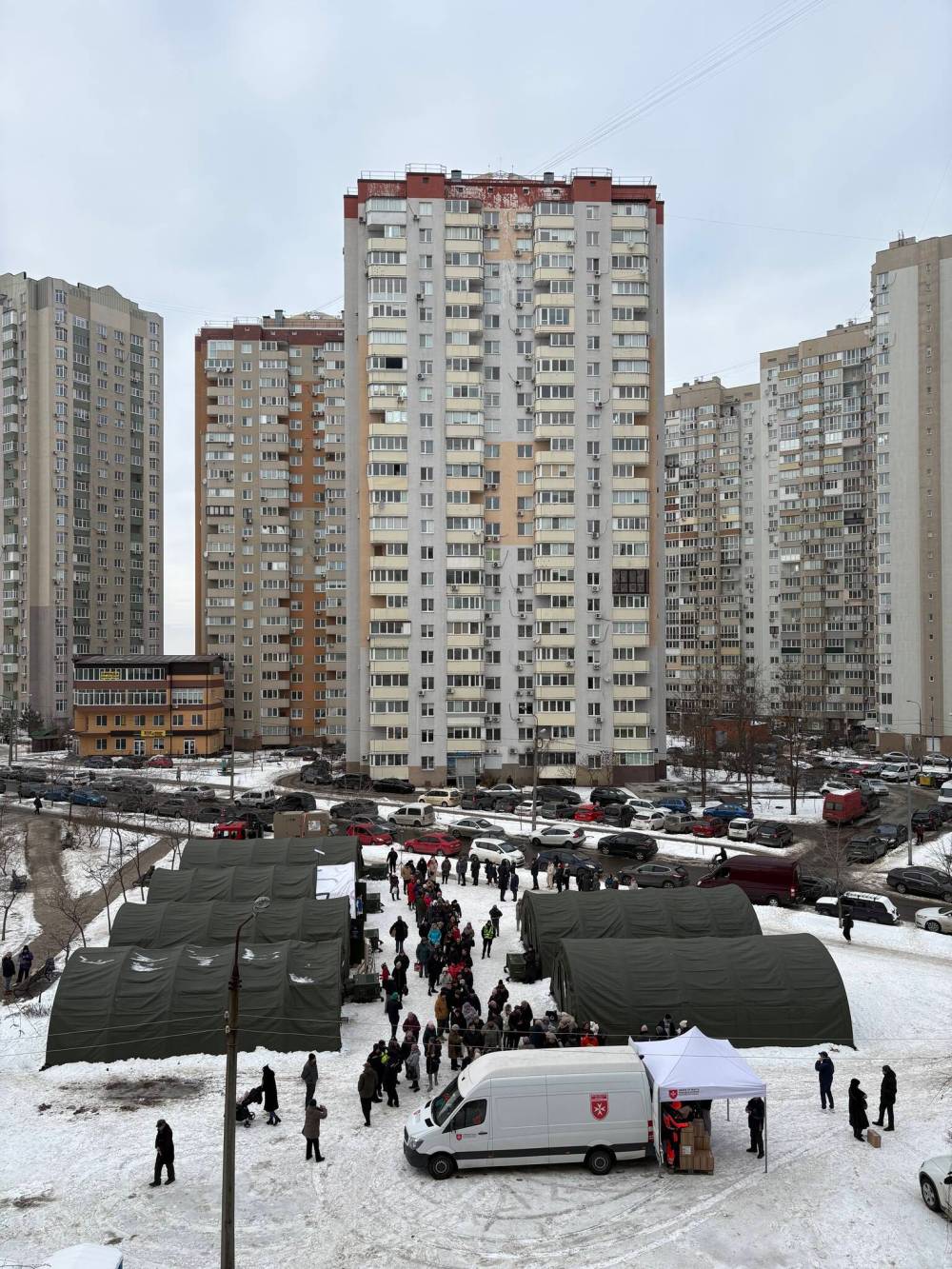
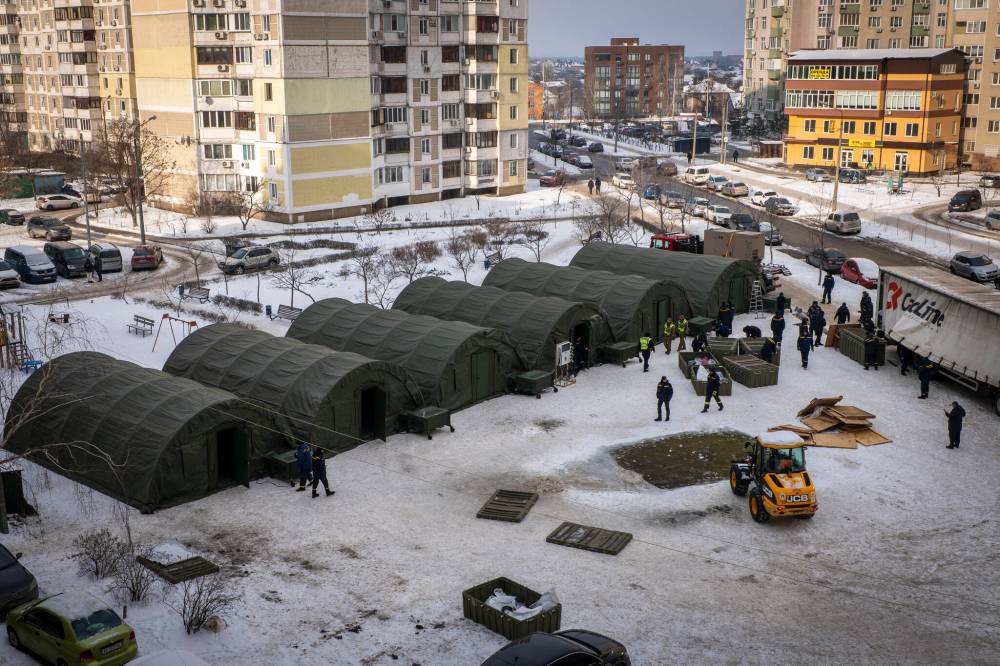
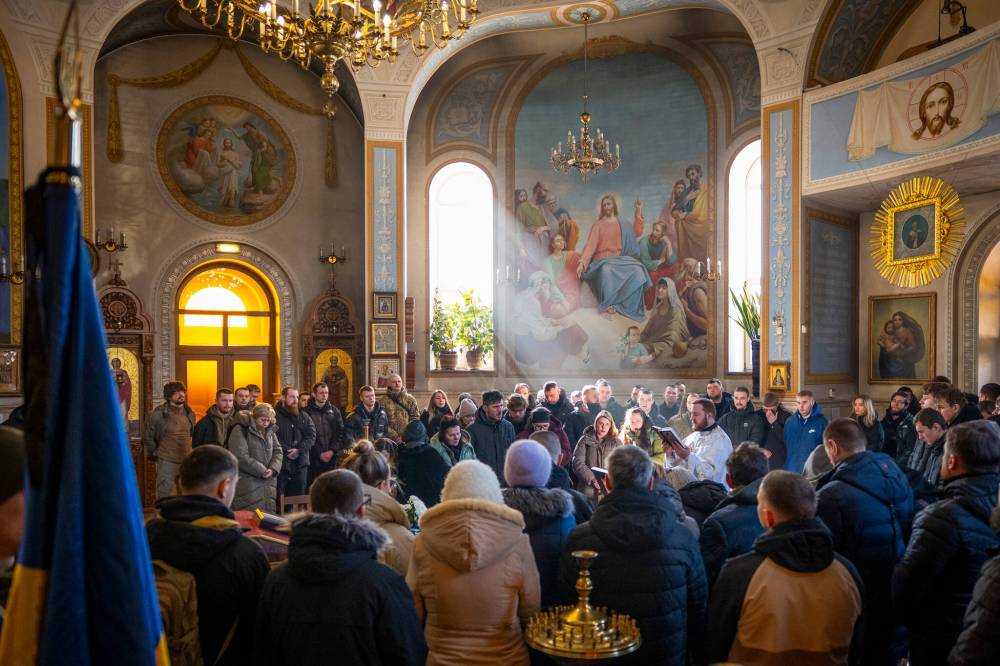
Soon, it became clear the risk to life was imminent; many elderly residents couldn’t leave their homes, unable to navigate 10 or more flights of stairs with the elevators not working. Ukraine’s state emergency service opened a series of warming centres, including a cluster of tents Kurylenko and Ivanenko visit every day.
“Thank God,” Ivanenko says. “Old people and kids are suffering a lot.”
Outside the tent, a large generator operated by Ukraine’s state emergency service growls, sending power to the tangle of cables where Kurylenko’s old-fashioned push-button cellphone is charging. A long line of residents snakes past the tent, waiting to collect portable stoves distributed by a Polish chapter of Catholic lay organization The Order of Malta.
Here, residents find a rare reprieve from the cold. The tents don’t offer much, but they can pour a hot cup of tea, charge their phones and socialize with their neighbours. There’s a kindergarten nearby with a bomb shelter where they take refuge when the sirens wail. When the heat supply was at its worst, Kurylenko even slept here for over a week.
“We’re telling stories to each other. We’re trying to be positive.”
“But most of all, we’re having fun,” she says. “We’re telling stories to each other. We’re trying to be positive.”
She laughs a lot, even as she speaks of their struggles.
“That’s my nature,” she says, with a smile that touches every corner of her face. “This is who I am.”
How do they maintain that spirit, even now, as the war’s degradation tightens around their lives like a fist?
“We just want victory,” Ivanenko says. “So our grandkids are happy. We already had our lives. So we want our kids to live a better life. And we feel sorry for our grandkids.”
Do they think a deal with Russia is possible? Ivanenko waves off the suggestion. “Why should we give our land to them?” she says, frowning.
She recites a passage from seminal Ukrainian poet Taras Shevchenko: “On the renewed land, there will be no enemy, no rival. There will be a son, and there will be a mother. There will be people on the land.”
She pauses, and finishes the thought with a firm nod.
“That’s how it is,” she says, emphatically. “Russia will never bring us to our knees. Never.”
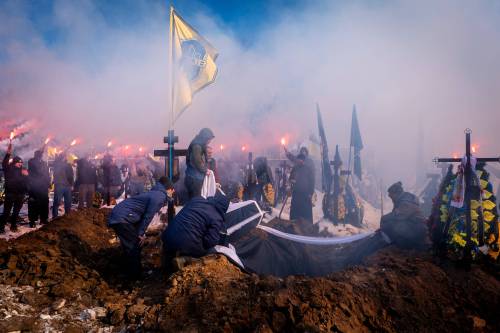
Tuesday marks a grim milestone for Ukraine; it has been exactly four years of this. Four years of all-out war, of terror that routinely rains from the sky, of the need to draw on and perform an extraordinary resilience. Four years of destruction and loss; four years of trudging forward towards an increasingly uncertain future.
Each anniversary has landed with a different feeling. On the first, in 2023, the mood was largely upbeat. The successful defence of Kyiv in early 2022, and the liberation of large chunks of occupied territory in the late summer and fall of that year fuelled a belief that the larger victory was within reach.
“Russia will never bring us to our knees. Never.”
Those hopes sputtered out long ago, dashed on the rocks of escalating missile attacks, military missteps, the wavering and then abandonment by the United States, its largest ally.
Meanwhile, Ukrainians know much of the world has stopped paying as much attention to their plight; those who’ve travelled abroad often report being asked if the war is “still going on.”
It is, and it’s just as devastating now as it was on Feb. 24, 2022. In many ways, it has grown worse. It’s the most high-intensity conventional war since the Second World War and has lasted longer than that conflict’s Eastern Front, when the Soviet Union battled Nazi Germany for 1,418 days. Russia has waged open war on Ukraine for 1,461, and there’s no end in sight.
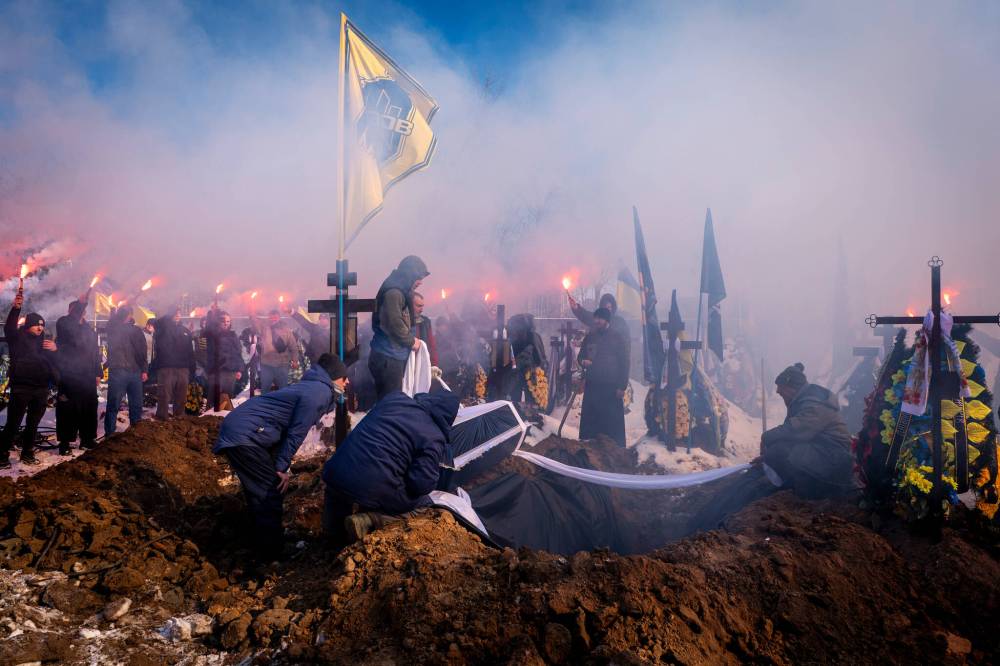
So this fourth anniversary feels the most grim. Yet there is still hope and it radiates from those who help.
There are countless unsung heroes in Ukraine today; the country’s electrical workers are among them. The full story of their heroism is currently a bit shrouded — authorities are understandably skittish to give media too clear a view on the sensitive work of repairing the battered power grid — but it shows every time the lights flick on again.
And there is the patchwork of countless, heroic volunteers — Ukrainian and foreign — who do everything they can to make sure nobody falls through the cracks widened by the deteriorating humanitarian situation.
In a cavernous warehouse in Kyiv’s Dniprovs’kyi district Monday afternoon, Kateryna Pavlova squeezes between maze-like stacks of plywood crates and cardboard boxes, all filled with an array of goods donated to the humanitarian charity she works with, Ukraine 2 Power.
Around her, a team of volunteers — including several Canadians with the Canadian-led NGO Ukrainian Patriot, which also came to help out — works steadily and swiftly, packing items into plastic bags, pausing occasionally to wiggle life back into fingers stiffened by the gnawing cold.
MELISSA MARTIN / FREE PRESS At a warehouse in Kyiv, Kateryna Pavlova, a volunteer with humanitarian charity Ukraine 2 Power, helps fill emergency warming kits bound to be delivered to vulnerable residents in the Kyiv region who are suffering without heat and power, following months of Russian attacks on the city’s civilian infrastructure.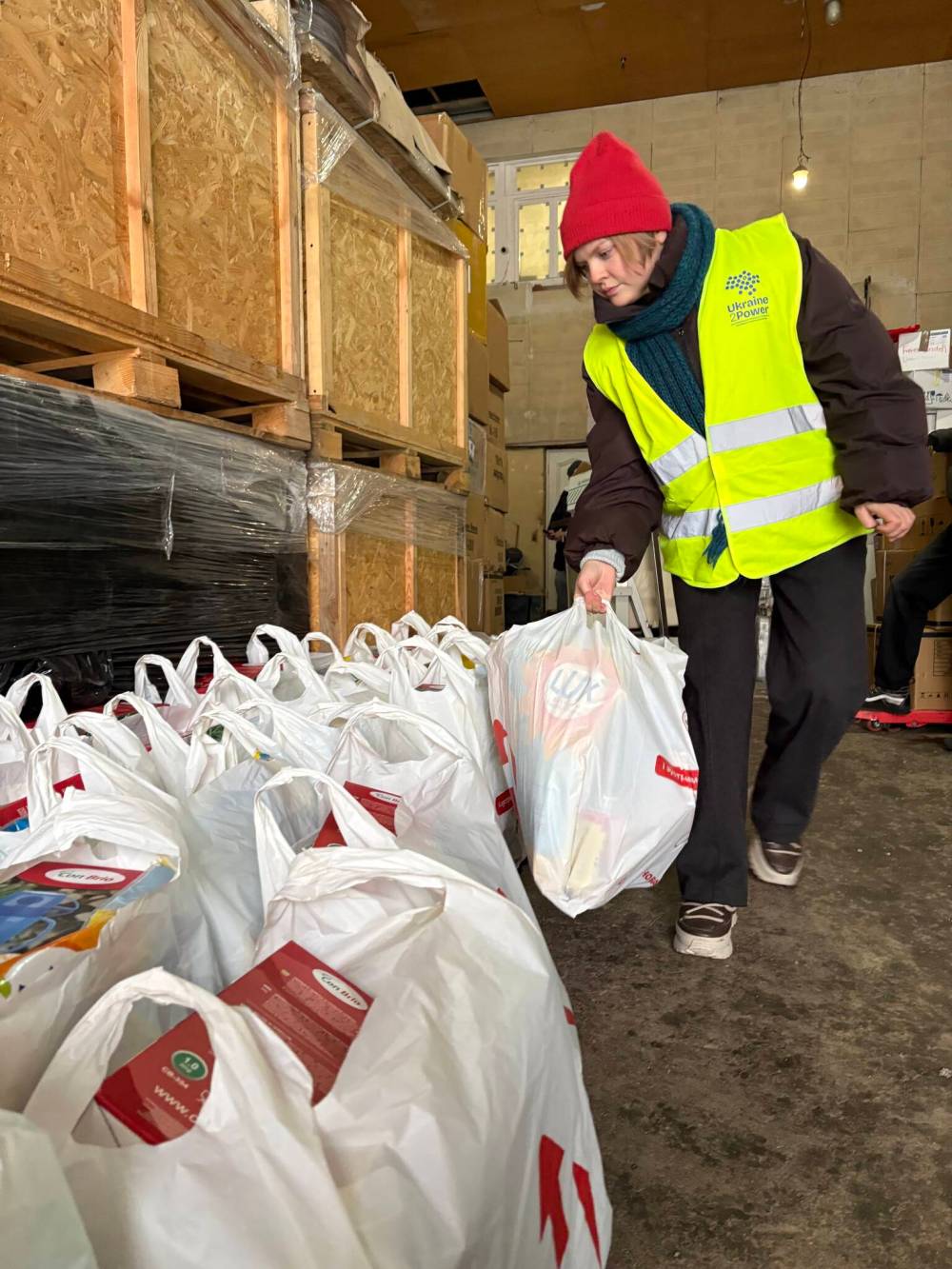
Into each bag goes a power bank, an electric blanket, a thermos, a portable camp stove and a can of propane to fuel it. Each bag, Pavlova says, is worth about $110. In just three weeks, they’ve delivered 1,500 such kits; they hope to distribute 3,000 total, before the spring brings some relief of its own.
That’s a remarkable figure for the nimble NGO, which was launched in 2023 by a Ukrainian woman living in Germany. But it’s only a fraction of the need. Since January, Ukraine 2 Power volunteers have canvassed the hardest-hit parts of Kyiv and developed lists of residents who most urgently need aid. They’ve identified far more than they can serve.
Meanwhile, Pavlova has watched as those they do reach seem to fade, their reserves of strength depleted.
“It’s becoming more and more difficult,” she says. “When we were starting the distributing campaign the mood was still fine. Then, it looked like, ‘OK, we can survive, and we need to hold together.’ Then we see that the mood goes down, because the situation is too complicated. Many people lose energy. Now, they’re just so tired.”
Still, Ukraine 2 Power volunteers keep fighting to reach them, often climbing 10 or more flights of stairs if a resident is not able to come themselves. The work is meaningful but it has also been devastating: in one case, on the morning they set out to deliver a warming kit to an elderly woman on their list, they learned she had frozen to death overnight.
One such case has already been reported in the media, Pavlova says, but that one was not.
“I think there are way more cases than that,” she says. “It’s a hard thing for Ukrainian society to understand and take it in, because we do have this stereotype of ourselves that we hold together. But when cases like that appear in media, it’s kind of against what we think we are.”
“I think that Russia has once again not reached its goal.”
The problem is that it’s almost impossible to reach everyone, especially as key city services grow more frayed. Many elderly eke out lonely lives in the best of times; now many are all but trapped in frozen upper-floor suites, with no power to charge their phones to contact relatives — if they even have any living.
And the resources to reach those most vulnerable citizens are scant. The Ukrainian state, Pavlova says without judgment, is “overloaded.” Large organizations, such as the United Nations, tend to be slower to act. So much of the work falls on civil society and everyday people: a patchwork of small humanitarian aid groups, and neighbours helping neighbours.
They’re doing the best that they can. They do not forget the fundamental injustice, nor should they have to.
“There is also another side of the coin, that we should not let it happen again, and it didn’t need to happen,” Pavlova says. “Now we are dealing with the fire but, in general, we just need to protect the Ukrainian sky. We need to deliver weapons to the Ukrainian army. This is how we prevent a humanitarian crisis like this.”
For four years, Ukrainians have made that plea to the rest of the world; for four years, Russian strikes on the country’s key civilian infrastructure have gone largely unanswered by that global community. So when Pavlova looks at the dire situation in the capital now, as an exhausted country begins its fifth year of all-out war, what does she see?
She considers the question for a moment.
“I think that Russia has once again not reached its goal,” she says. “Their goal this time was to hit critical infrastructure, and by that to break the mood of Ukrainians and their willingness to fight. They are really trying to break the trust of Ukrainians in Ukrainian institutions, and in the Ukrainian army.
“This was not successful,” she continues. “I would say in terms of social cohesion, we are good. Also, now we learn from the soldiers, who keep giving us lessons how to survive in these severe circumstances. But it’s a war against civilians and it’s not getting better.”
melissa.martin@freepress.mb.ca

Melissa Martin
Reporter-at-large
Melissa Martin reports and opines for the Winnipeg Free Press.
Every piece of reporting Melissa produces is reviewed by an editing team before it is posted online or published in print — part of the Free Press‘s tradition, since 1872, of producing reliable independent journalism. Read more about Free Press’s history and mandate, and learn how our newsroom operates.
Our newsroom depends on a growing audience of readers to power our journalism. If you are not a paid reader, please consider becoming a subscriber.
Our newsroom depends on its audience of readers to power our journalism. Thank you for your support.
Related Articles
Slovakia halts emergency electricity supplies to Ukraine amid oil delivery dispute




History
Updated on Monday, February 23, 2026 7:56 PM CST: Clarifies contents of aid bags