Sentinel journey, sentimental memories Wooden elevator reduced to rubble after towering over Austin for 75 years
Read this article for free:
or
Already have an account? Log in here »
To continue reading, please subscribe:
Digital Subscription
One year of digital access for only $1.44 a week*
- Enjoy unlimited reading on winnipegfreepress.com
- Read the E-Edition, our digital replica newspaper
- Access News Break, our award-winning app
- Play interactive puzzles
*Billed as $5.77 plus GST every four weeks. After 52 weeks, price increases to the regular rate of $19.95 plus GST every four weeks. Offer available to new and qualified returning subscribers only. Cancel any time.
To continue reading, please subscribe:
Add Free Press access to your Brandon Sun subscription for only an additional
$1 for the first 4 weeks*
- Enjoy unlimited reading on winnipegfreepress.com
- Read the E-Edition, our digital replica newspaper
- Access News Break, our award-winning app
- Play interactive puzzles
*Your next Brandon Sun subscription payment will increase by $1.00 and you will be charged $17.95 plus GST for four weeks. After four weeks, your payment will increase to $24.95 plus GST every four weeks.
Read unlimited articles for free today:
or
Already have an account? Log in here »
Hey there, time traveller!
This article was published 17/04/2026 (191 days ago), so information in it may no longer be current.
Even in a Prairie town that takes immense pride in preserving agricultural history, what goes up must eventually come down.
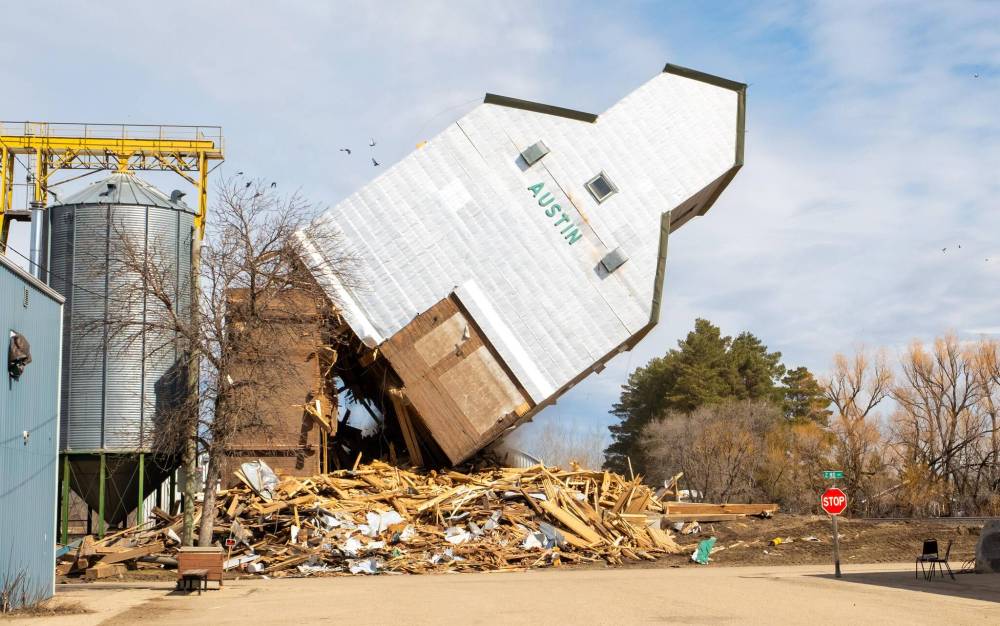
On Wednesday morning, an agricultural landmark in Austin came tumbling to the ground when the former Manitoba Pool Grain Elevator was demolished after 75 years of industrial service.
MIKE THIESSEN / FREE PRESS A group of kids watch the demolition of the elevator on April 15. 
Dozens of residents from town and the surrounding RM of North Norfolk gathered at a safe distance to watch the downfall of the downtrodden prairie sentinel of Second Avenue. The demolition was co-ordinated by local authorities and the Pine Creek Hutterite Colony, which purchased the structure from Agricore in 2003.
Since its construction in 1951 on Canadian Pacific property, the elevator had stood as a roadside icon as much as a symbol of the region’s relationship with the business of farming: across seven decades, a wooden elevator such as Austin’s became as much an agricultural fixture as a symbol of pre-GPS wayfinding, announcing in oversized letters to visitors and passers through that they’d reached their destination: Austin.
MIKE THIESSEN / FREE PRESS The elevator and the excavator are chained together in preparation to pull the building down. 
With the demolition of the wooden grain elevator in Austin, a community about 130 kilometres west of Winnipeg, the Manitoba Historical Society estimates there are only 114 such structures remaining in the province. Of that total, more than 50 per cent are inactive, says executive director Gordon Goldsborough.
Austin’s elevator was in steady use until last year by Pine Creek, but an accumulation of exterior damage – namely, a large hole, a byproduct of rotting wood – had made the structure liable to fall on its own.
The condition of a grain elevator isn’t simply a function of its age, nor is it an inexpensive endeavour, says Goldsborough. “It’s a function of how well you maintain it.”
The community’s reeve, Ed Heppner, has had a clear view. From 1980 to 1996, the longtime member of the local chamber of commerce ran Ed’s Superstore, a grocery market, right across the street.
“This has always been an agricultural community, and the elevator is an important part of that,” Heppner said ahead of the demolition. “It’ll be an emotional loss for sure.”
“This has always been an agricultural community, and the elevator is an important part of that.”
Gerry Currie knows it was better that the emotional outpouring was planned rather than unexpected. During his 30-year tenure as Austin’s fire chief, Currie was frequently alarmed by news of vacant or underused elevators being swallowed up in blazes across the Prairies.
In 2018, the community of Crystal City was devastated when a fire originating in its Paterson grain elevator – built 78 years earlier in the RM of Louise – destroyed that structure, spreading to lay waste to the Cudmore Bros. Hardware store, a business operating a few blocks away. One man was sent to hospital.
The next year, Currie and other local representatives participated in a table-top simulation exercise to examine the potential damage of a similar fire breaking out in Austin. “It didn’t take very long before we realized it would be more than we could handle with our resources,” he says.

Last May, a grain elevator in Waskada — a community about 70 kilometres southwest of Boissevain — burnt to the ground in an early morning fire that drew more than 40 firefighters from local, Deloraine and Melita departments. It was was built in 1961.
“It’s certainly sad to see it gone now,” Currie said of Austin’s elevator. “But there was a risk involved in its standing that needed to be addressed.”
As well, it wasn’t economically feasible to repair the elevator, says Goldsborough, who called the demolition “an illustration of the transformation taking place in Prairie Canada.”
“People who aren’t as connected to agriculture may think (elevators) are all over the landscape, but the reality is they’re disappearing rapidly,” he says. “I predict that within the next 20 years, almost all will be gone.”
MIKE THIESSEN / FREE PRESS A crowd behind the barricade on Bromley St. reacts with glee to the elevator hitting the ground.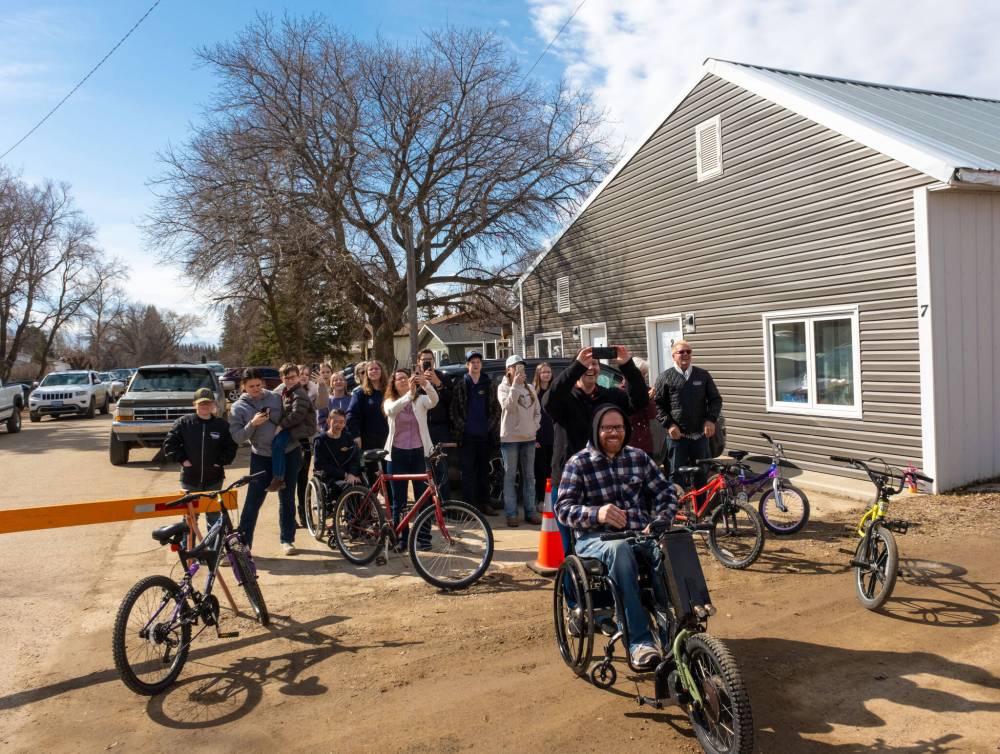
About an hour west of Austin, near Wawanesa, fourth-generation farmer Simon Ellis began operating a licensed elevator in 2024 for his family’s 103-year-old firm, Ellis Seeds. At 40 feet by 40 feet, their elevator doesn’t dominate the skyline like Austin’s did, but the facility, like dozens of other newer builds, continues to operate in order to meet production and consumption demand in the province.
“Certainly, I don’t like seeing those old elevators coming down. They’re landmarks, and I have lots of memories of riding in the grain truck with my dad for dropoffs,” says Ellis. “But the upkeep is very expensive, and at some point, it isn’t a feasible or safe environment to be in anymore.”
Ellis notes that while wooden elevators are dwindling year after year, elevators themselves are not going away, with large-scale investments still being made to meet demand. But those concrete behemoths — now infrequent blips on the Prairie skyline — aren’t likely to ever be featured in nostalgic snapshots on collectible postcards.
MIKE THIESSEN / FREE PRESS The “Austin” sign is quickly salvaged by members of Pine Creek Hutterite Colony. 
“I think the elevators we have left are doing a good job, and hopefully we can see more built,” says Ellis, whose concerns mostly surround equity amidst a wave of corporate consolidation. “But I really hope we don’t have to see too many old ones fall down. I really do like seeing them across the landscape.”
Though their latest elevator has been reduced to rubble, a nostalgic vision of their community’s farming heritage remains at the Manitoba Agricultural Museum, located in town. Since the 1970s, Austin’s original grain elevator – built in 1901 – has been housed on the museum’s 320-acre spread for posterity and reflection.
A few pieces of the community’s safely demolished elevator will be there, too.
MIKE THIESSEN / FREE PRESS Firefighters stand next to the wreckage.
After the dust settled on Wednesday, the best-preserved of the green fiberglass letters were up for grabs. An onlooker offered $1,000 for the signage, Goldsborough says, but the owners from Pine Creek said no, insisting that the letters enjoy their post-script in museum condition.
Currie has since delivered the letters to the museum, where they’ll be affixed to the preserved structure, considered by historians the oldest free-standing wooden grain elevator remaining in Manitoba.
For now, the letters are inside a painstakingly maintained 125-year-old storage building for safekeeping.
MIKE THIESSEN / FREE PRESS The remnants of the elevator are sorted into piles of wood and metal. The bins will remain where they are for the time being. 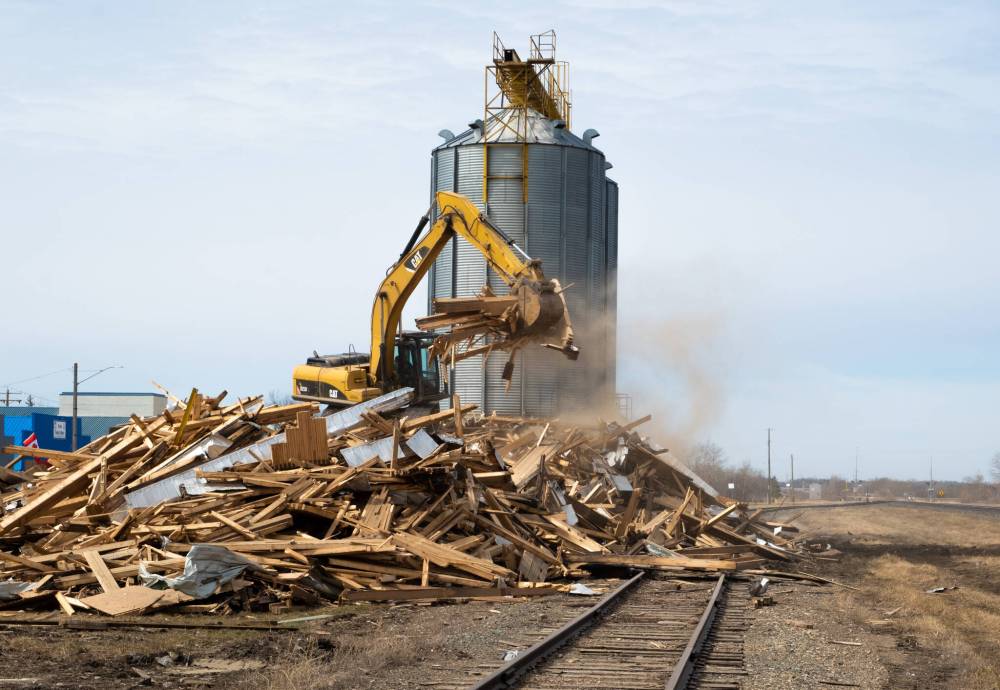
winnipegfreepress.com/benwaldman

Ben Waldman is a National Newspaper Award-nominated reporter on the Arts & Life desk at the Free Press. Born and raised in Winnipeg, Ben completed three internships with the Free Press while earning his degree at Ryerson University’s (now Toronto Metropolitan University’s) School of Journalism before joining the newsroom full-time in 2019. Read more about Ben.
Every piece of reporting Ben produces is reviewed by an editing team before it is posted online or published in print — part of the Free Press‘s tradition, since 1872, of producing reliable independent journalism. Read more about Free Press’s history and mandate, and learn how our newsroom operates.
Our newsroom depends on a growing audience of readers to power our journalism. If you are not a paid reader, please consider becoming a subscriber.
Our newsroom depends on its audience of readers to power our journalism. Thank you for your support.