Poll shows slim majority of Canadians in support of Churchill port expansion
Read this article for free:
or
Already have an account? Log in here »
To continue reading, please subscribe:
Digital Subscription
One year of digital access for only $1.44 a week*
- Enjoy unlimited reading on winnipegfreepress.com
- Read the E-Edition, our digital replica newspaper
- Access News Break, our award-winning app
- Play interactive puzzles
*Billed as $5.77 plus GST every four weeks. After 52 weeks, price increases to the regular rate of $19.95 plus GST every four weeks. Offer available to new and qualified returning subscribers only. Cancel any time.
To continue reading, please subscribe:
Add Free Press access to your Brandon Sun subscription for only an additional
$1 for the first 4 weeks*
- Enjoy unlimited reading on winnipegfreepress.com
- Read the E-Edition, our digital replica newspaper
- Access News Break, our award-winning app
- Play interactive puzzles
*Your next Brandon Sun subscription payment will increase by $1.00 and you will be charged $17.95 plus GST for four weeks. After four weeks, your payment will increase to $24.95 plus GST every four weeks.
Read unlimited articles for free today:
or
Already have an account? Log in here »
More than half of Canadians support expanding the Port of Churchill, although the proposed mega-project faces environmental concerns and a lack of public awareness outside Manitoba, a new poll suggests.
Probe Research said 52 per cent of survey respondents strongly or somewhat support the proposal, 39 per cent are unsure, and nine per cent strongly or somewhat oppose it.

“People broadly are supportive of it in a pretty general sense, and they see the need for it just based on kind of where they country is at right now,” said Curtis Brown, a partner with the Winnipeg-based polling firm.
“The one thing to keep in mind is that can always change, if some of those who are unsure flip into the ‘opposed’ category.”
The proposed expansion of the northern port has greater support in Manitoba, where 77 per cent of respondents are in favour of it. The project, and possibly a pipeline, would be part of a new northern trade corridor to international markets amid the turmoil of U.S. President Donald Trump’s trade wars.
Premier Wab Kinew told reporters last week that Prime Minister Mark Carney presented a “very aggressive timeline” of shipping liquefied natural gas out of the port by 2030.
“People broadly are supportive of it in a pretty general sense, and they see the need for it just based on kind of where they country is at right now.”
Chris Avery, president and CEO of Arctic Gateway Group, which owns the port, said the project is gaining momentum, and awareness is increasing.
“(The poll) reflects a fundamental change in how Canadians think about the change in the way we are conducting ourselves and the partners we trade with, and the need for something like the Port of Churchill,” he said. “A year ago, the Port of Churchill wouldn’t have garnered this national attention.”
In separate online surveys, Probe asked 488 Manitobans and 1,300 other Canadians what they know and think about six potential “nation building” or “transformative” projects that are being eyed by the federal government.
The five other proposals were the Alto high-speed rail corridor between Toronto and Quebec City; a small modular nuclear reactor in southern Ontario; the Ksi Lisims LNG export facility in northern B.C.; the Pathways Plus carbon capture and storage project in Alberta; and the Wind West Atlantic Energy offshore wind farm in Nova Scotia.
The Port of Churchill expansion ranked fourth (at eight per cent), when Canadian respondents chose the proposal they think would most benefit Canada’s economy. It trailed the B.C.’s LNG export facility (24 per cent), the Ontario-Quebec high-speed rail line (16 per cent) and Nova Scotia’s wind farm (nine per cent).
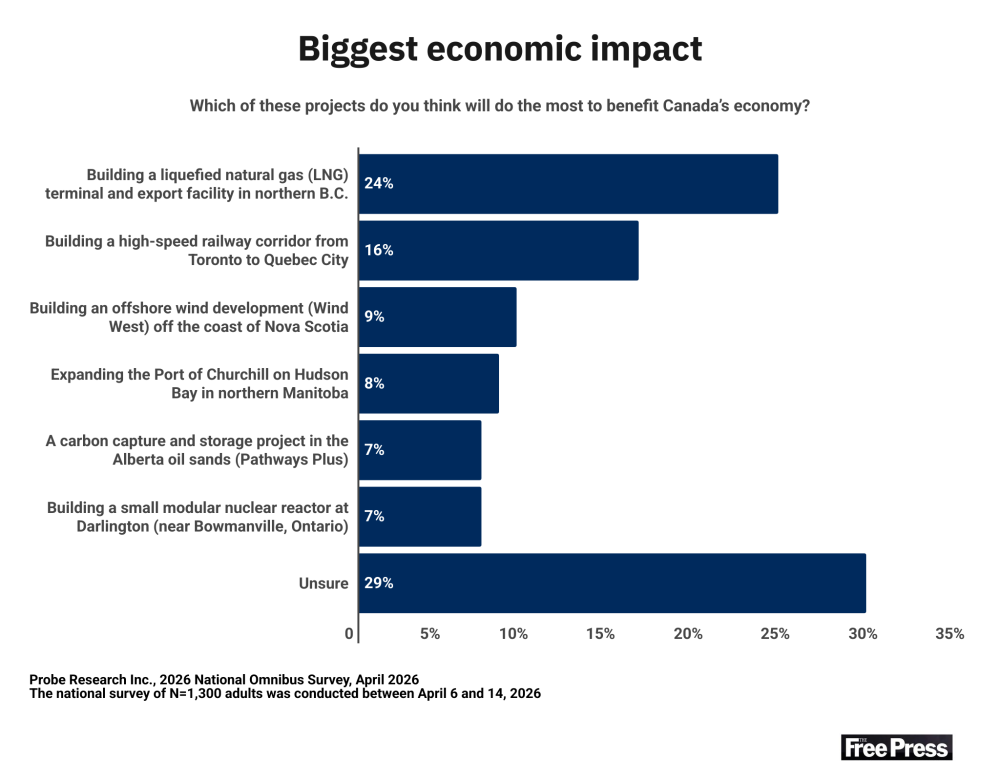
Barry Prentice, a professor of supply chain management and director of the University of Manitoba Transport Institute, said people outside Manitoba aren’t familiar with the port’s potential, and many Canadians don’t have a very good understanding of Western Canada’s economy.
“They don’t recognize there are many things we could move through the port, besides just grain,” he said, citing oil and gas products, potash, minerals and containers as examples.
In terms of respondents’ awareness of the projects, the Churchill proposal ranked second-last (40 per cent of those polled have heard of it). The figure was higher in Manitoba (83 per cent), where there has been more news coverage.
Avery said Arctic Gateway is “working hard” to educate Canadians about the port and the Indigenous- and community-owned Manitoba company that owns and operates it.
“We have a lot more to show Canadians because this investment in trade-enabling infrastructure is going to pay huge dividends for all Canadians for generations to come,” he said.
Almost half of Canadian respondents (46 per cent) said they believe a port expansion will cause environmental damage to an ecologically sensitive area that is home to polar bears, beluga whales and other wildlife (21 per cent disagreed and 33 per cent said they are unsure).
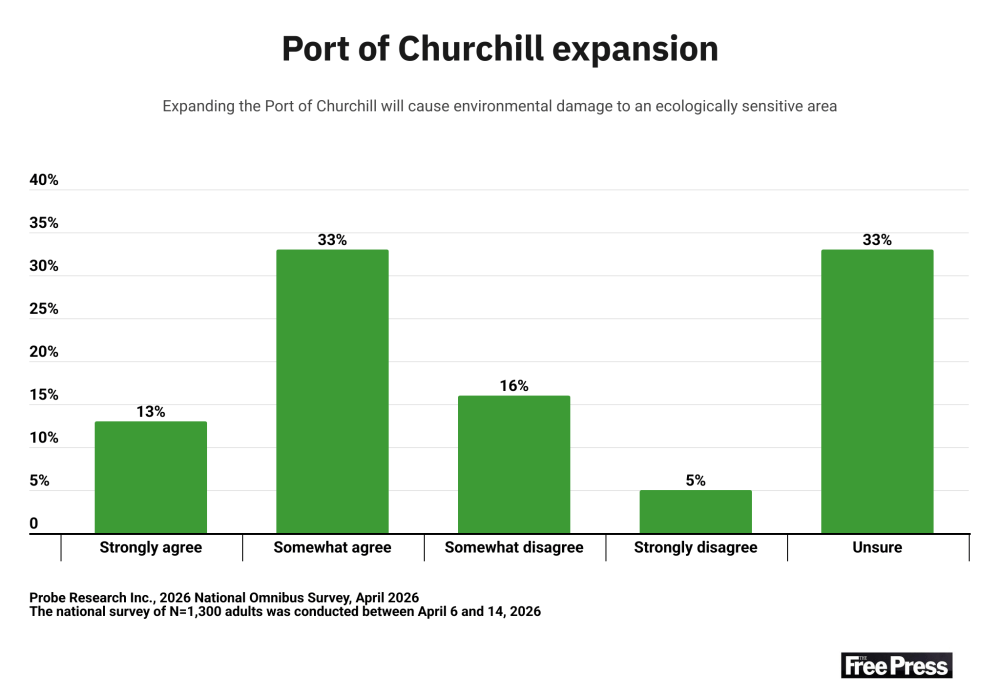
Probe said 48 per cent of respondents from Manitoba believe the expansion will lead to environmental damage.
Avery said the environment is taken into consideration and part of discussions prior to any decision.
“You do need a balance with industry and with the environment,” he said. “We believe you can do both.”
Probe said 42 per cent of Canadian respondents believe the potential economic benefits outweigh the environmental risks (18 per cent disagree and 40 per cent are unsure).
Those most likely to think the benefits are greater include Albertans (51 per cent vs. 39 per cent of respondents from Manitoba and Saskatchewan), and men (55 per cent vs. 29 per cent among women).
Prentice said concerns about potential environmental impacts are legitimate.
“How do we mix a tourist town with a big industrial port? That’s not an easy idea to square,” he said.
Probe conducted the surveys between April 6 and 15. The poll of 1,300 Canadians has a margin of error of plus or minus 2.7 percentage points, 19 times out of 20. The survey of Manitobans has a margin of error of plus or minus 4.4 percentage points.
chris.kitching@freepress.mb.ca

Chris Kitching is a general assignment reporter at the Free Press. He began his newspaper career in 2001, with stops in Winnipeg, Toronto and London, England, along the way. After returning to Winnipeg, he joined the Free Press in 2021, and now covers a little bit of everything for the newspaper. Read more about Chris.
Every piece of reporting Chris produces is reviewed by an editing team before it is posted online or published in print — part of the Free Press‘s tradition, since 1872, of producing reliable independent journalism. Read more about Free Press’s history and mandate, and learn how our newsroom operates.
Our newsroom depends on a growing audience of readers to power our journalism. If you are not a paid reader, please consider becoming a subscriber.
Our newsroom depends on its audience of readers to power our journalism. Thank you for your support.
Related Articles
Federal government puts timeline in place for Port of Churchill project: Kinew