Brewing up community Craft beer landscape is shifting, but it’s not all bottoms up
Read this article for free:
or
Already have an account? Log in here »
To continue reading, please subscribe:

Digital Subscription
One year of digital access for only $205*
- Enjoy unlimited reading on winnipegfreepress.com
- Read the E-Edition, our digital replica newspaper
- Access News Break, our award-winning app
- Play interactive puzzles
*First annual payment billed as $205.00 + GST for one year. This annual subscription will automatically renew at $233.00 + GST every 52 weeks (10% off the regular annual price of $259.35). Offer available to new and qualified returning subscribers only. Cancel any time.
To continue reading, please subscribe:
Add Free Press access to your Brandon Sun subscription for only an additional
$1 for the first 4 weeks*
- Enjoy unlimited reading on winnipegfreepress.com
- Read the E-Edition, our digital replica newspaper
- Access News Break, our award-winning app
- Play interactive puzzles
*Your next Brandon Sun subscription payment will increase by $1.00 and you will be charged $17.95 plus GST for four weeks. After four weeks, your payment will increase to $24.95 plus GST every four weeks.
Read unlimited articles for free today:
or
Already have an account? Log in here »
In the mid-2010s, the Manitoba government reduced many of the prohibitive regulations around opening craft breweries in the province — and in the years that followed, waves of new breweries, brew pubs and contract brewers opened their doors.
In the last few years, those waves have slowed to a trickle, with some outfits scaling back production and others closing their doors.
Today, Manitoba is home to roughly two dozen brick-and-mortar craft breweries, with a handful of brands/virtual breweries making their wares at established breweries. (See this helpful interactive map of Manitoba breweries made by local beer fan Ryan Schreyer.)
With the cost of living, tariffs, changing consumer trends, oil prices and more impacting the craft beer landscape, the state of the industry (both locally and otherwise) is in flux.
With that in mind, the Free Press checked in with some locals in the craft beer industry to get their thoughts on the past, present and future of craft beer in Manitoba.
In mid-July 2016, Barn Hammer Brewing Co.’s Wall Street doors opened to the public for the first time, among the first wave of new Manitoba’s craft beer producers to enter the fray, joining existing locals Fort Garry Brewing Co., Half Pints Brewing Co. and Farmery.
It was in May of that year that Tyler Birch and the Barn Hammer team brewed the first batches of beer at the facility; Barn Hammer’s 10th anniversary festivities will celebrate that feat Saturday at the brewery (595 Wall St.) starting at noon and featuring plenty of new beers.
“We were going to go all out, but figured our whole ethos as a brewery is to be about the beer, as much as we can, and the community, so we pared it down,” Birch says.
Ruth Bonneville / Free Press Barn Hammer Brewing Company is celebrating its 10th anniversary May 23 — a big day for founder Tyler Birch and the Winnipeg craft beer scene.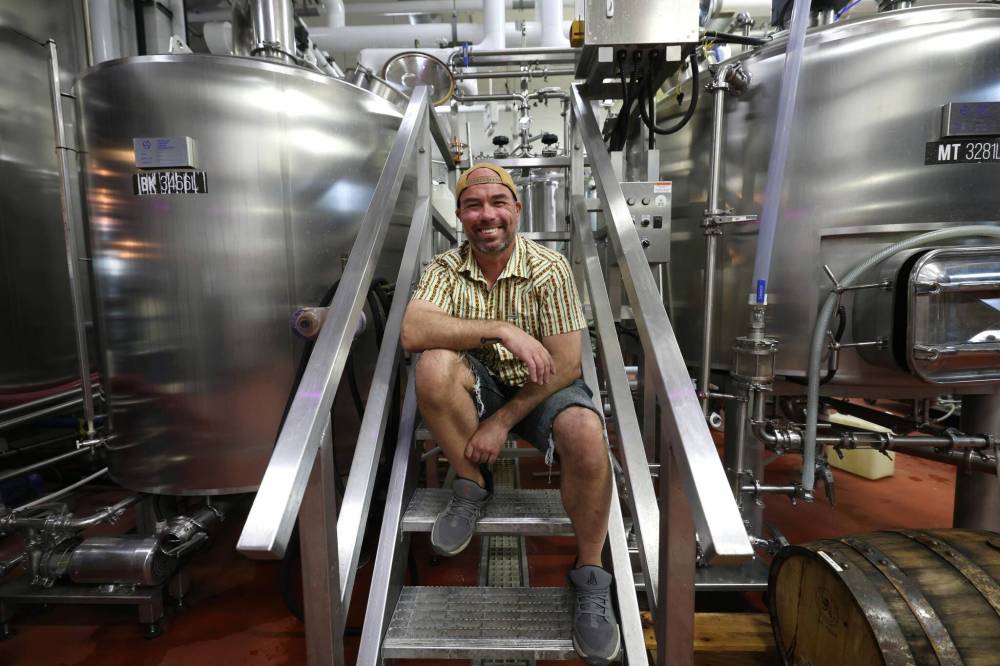
Like many in the industry, Birch, now 41, started out as a home brewer. “You have your friends over, you make beer in your basement, you drink the beer you made last time,” he says. “It’s very social and interactive; I think that’s why a lot of people get into brewing — it’s such a whole experience, kind of like a community unto itself.”
While a sense of community permeates Manitoba’s craft beer scene, the jump to making beer on a larger scale for the public proved an entirely different animal, involving technical know-how, some elbow grease and a whole lot of cleaning.
“Commercial brewing is a lot of very hard work — you’re always wet,” Birch says, laughing. “It’s more stressful because you’re making so much more beer, and tiny mistakes can change the flavour of it. You can miss or skip a thing, and it’s very bad.”
“Commercial brewing is a lot of very hard work… you’re always wet.”
Birch wound down his involvement in a fencing company when starting Barn Hammer. But the birth of his first child, the COVID-19 pandemic and subsequent business speed bumps saw him restart the business three years ago.
While Barn Hammer’s brewing capacity has roughly quadrupled in size since opening, it’s still among the more modest-sized Winnipeg breweries. Picking up the fencing gig again has helped Birch pay the bills and keep Barn Hammer smaller, focusing on quality over quantity.
“I’d rather keep it beer-focused — when you get volume-based, there’s no way it can be about the quality,” he says. “I would never put out beer that we don’t have control over.”
Ruth Bonneville / Free Press Barn Hammer head brewer Danny Grey at work.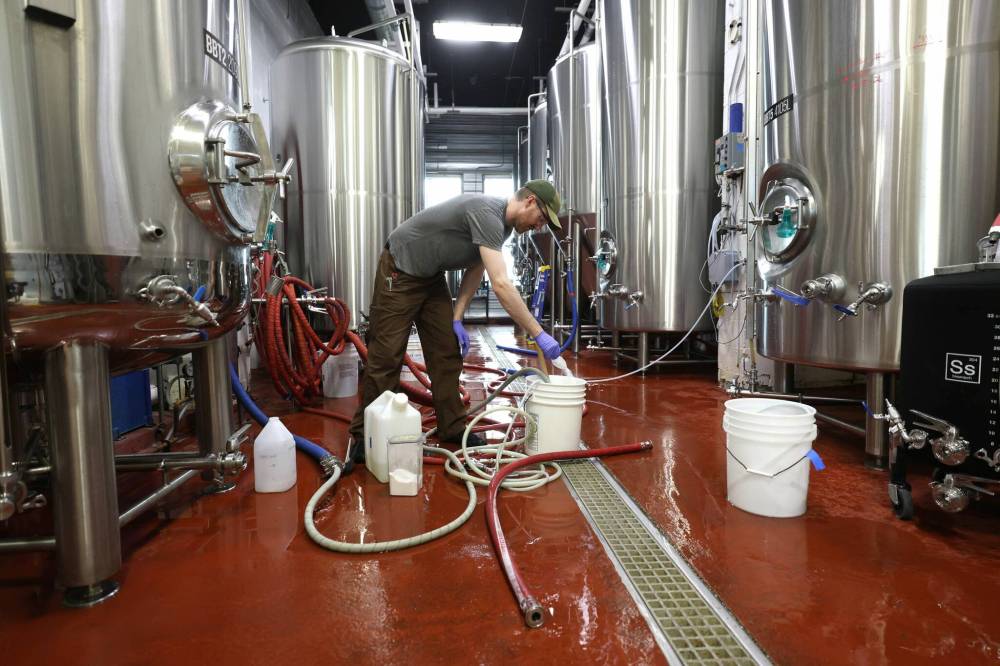
Like most craft breweries, Barn Hammer features a range of core pours as well as a rotating selection of seasonal brews. Over the years, even core beers have been tweaked with new types of hops and yeasts as well as in response to shifting trends in craft beer.
“It’s sometimes hard to know where to go with the beer. Since we’ve opened until now has probably been one of the most turbulent periods for popular beer styles,” he says. “When we opened, nobody had ever heard of a hazy IPA, and now they’re everywhere, along with fruited beers, milkshake IPAs and so on.”
Turning 10 in style
Barn Hammer Brewing Company marks its 10-year anniversary Saturday with a community patio celebration at its 595 Wall St. location. To celebrate the occasion, the brewery will host an anniversary party…
Barn Hammer Brewing Company marks its 10-year anniversary Saturday with a community patio celebration at its 595 Wall St. location.
To celebrate the occasion, the brewery will host an anniversary party beginning at noon, featuring an extended patio, limited-edition bottles, anniversary merchandise, giveaways, games, live music from DJ Princess Die and food from PVG Street Eats.
“When we opened 10 years ago, we hoped to create a space where people could gather, connect, and feel part of the neighbourhood,” Sable Birch, co-owner of Barn Hammer, said in a release. “It’s been amazing to see both the brewery and the West End continue to grow together over the years.”
Gauging how the beer-drinking public will react to a new brew isn’t always easy. “Sometimes we’ll brew something and think ‘People are gonna love this’ and it just falls completely flat, and sometimes we think ‘Let’s try this, I guess’ and people think it’s the best.”
Barn Hammer staples now include the Lumberjack double IPA and Le Sneak Belgique, a wheat beer.
For its 10-year anniversary, Barn Hammer is rolling out 10 different products over the course of the month, including a revamped version of the Still Life Peach Pale Ale, a 10 per cent alcohol triple IPA called 10, as well as a gin made in the small still in the brewery’s back room.
Asked where Birch sees Barn Hammer 10 years from now, he pauses before answering.
“I don’t know — I’d like to be doing basically this, the same,” he says, adding with a laugh, “only our beer will be a little bit better.”
Five years ago, Good Neighbour Brewing Co. co-owners Amber Sarraillon and Morgan Wielgosz were brewing their first beers in Winnipeg (out of Oxus Brewing Co.’s Sanford Street facility).
The pair, who got their start at Toronto’s Amsterdam Brewing Co., have since set up their own brick-and-mortar brewery at 110 Sherbrook St. and co-launched the eatery next door (formerly called One Sixteen and now, fittingly, Next Door).
And their newest venture has seen the pair head south — to a beer shop in South Osborne at 683 Osborne St., located in the old West End Upholstery & Drapery space. The bones of the building made it relatively easy for Good Neighbour to move in and start selling beer.
“We said, ‘Let’s get some fridges and start feeding the neighbourhood some cold beer.’”
“We were able to open a shop really quickly because there used to be a retail licence in here,” says Sarraillon, 43. “So it was a really quick turnaround for us. We said, ‘Let’s get some fridges and start feeding the neighbourhood some cold beer.’”
Behind the fridge wall is a large, unfinished space they hope to incorporate into Phase 2 — a bar, plenty of seating and potentially a kitchen by 2027. (The current beer shop is takeout only.)
INSTAGRAM Good Neighbour co-owners Morgan Wielgosz
and Amber Sarraillon outside their new location.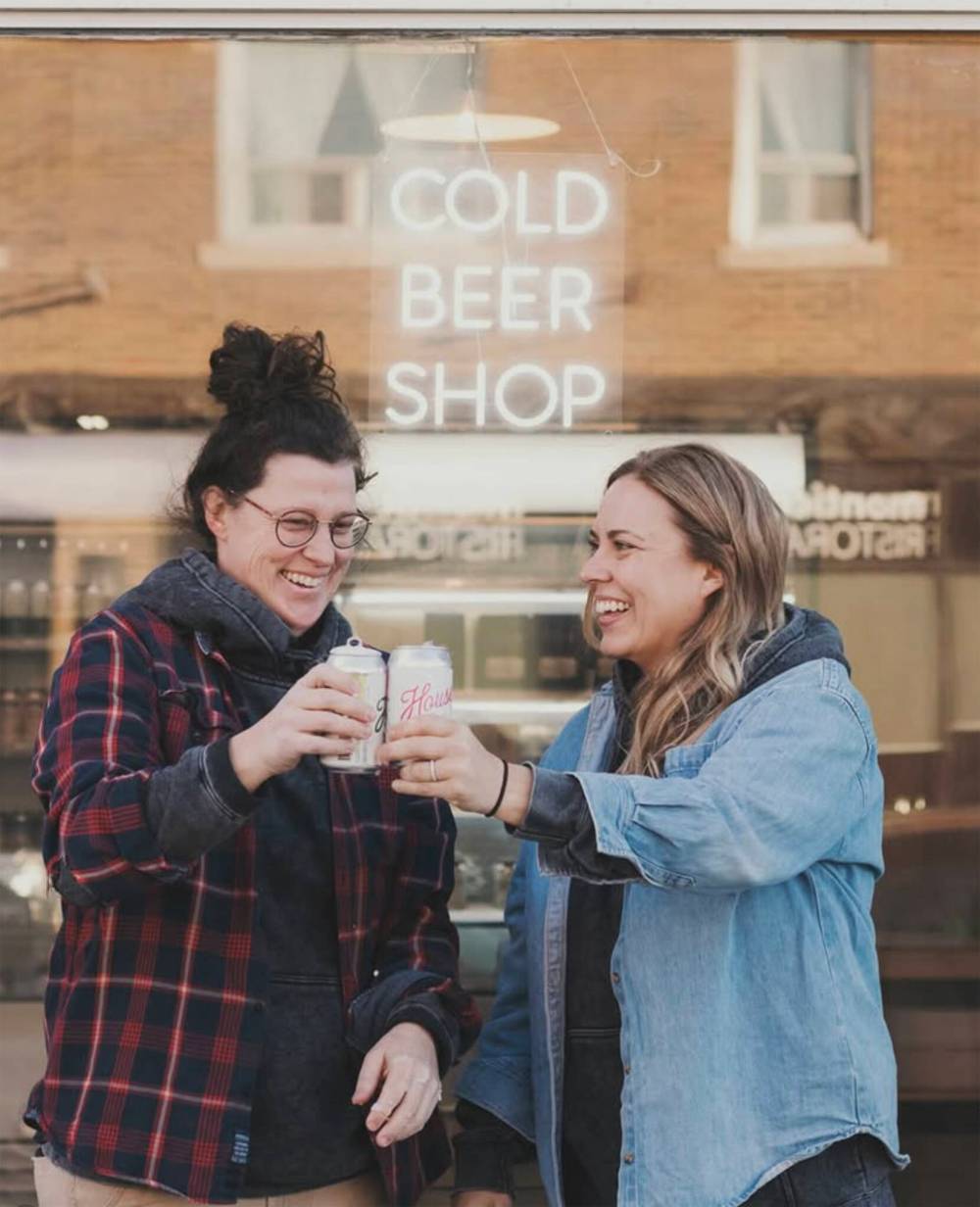
Sarraillon and Wielgosz have been enjoying meeting people in the community.
“We love getting to know our neighbourhoods, the neighbours that come in,” says Sarraillon.
“We’ve become friends with a lot of the regulars. People aren’t necessarily buying in bulk … they’re coming every couple of days to get fresh beer from us.”
Then there are the new (good) business neighbours — across the street are eateries Vera and Monticchio, with nearby watering holes including Leopold’s, Park Alleys and the Park Theatre.
The area will also be home to two more local craft beer purveyors in the near(ish) future.
Scott Tackaberry shut the doors of his Grape and Grain home-brewing business, is contract brewing his Dastardly Villian beers out of Oxus and is planning to open a nanobrewery and tap room open at 726 Osborne St., while Nonsuch Brewing Co., like Good Neighbour, is expanding beyond its current brewery, with a second location slated to open at 551 Osborne St.
In other words, South Osborne is experiencing a mini-craft beer boom.
Good Neighbour’s expansion has been relatively quick but measured — the pair have been careful not to outgrow that inclusive community-mindedness with which they started the brewery, which now plays host to a number of community events.
“We have our vision of the quantity we’d like to produce in a year. We’re on target; once we get to that point, we’re not looking to become a regional, mass-producing brewery,” says Wielgosz, 41.
“We call it taking care of your own backyard — producing enough beer for the neighbourhoods that you’re in,” adds Sarraillon.
“We get questions from other provinces to ship our beer out there, but we’re not interested in that. We want to stay close to the beer, make sure it’s fresh, make sure we get to know a lot of the people consuming it.”
Ruth Bonneville / Free Press Good Neighbour’s Kayla Goossen helps out a customer at the counter at the new location in South Osborne. 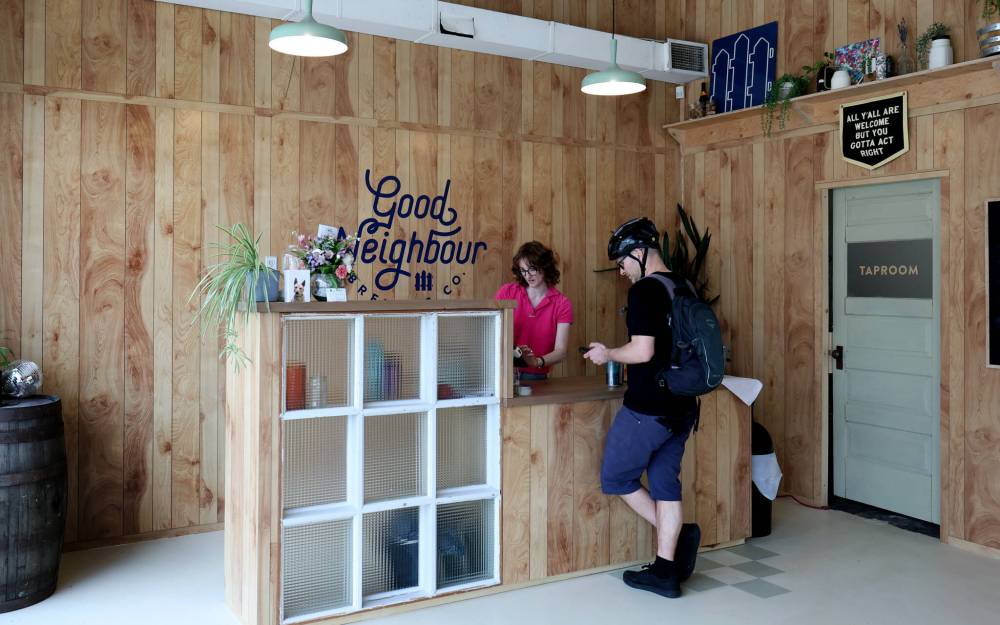
In addition to Good Neighbour’s core pours and seasonal brews — many with fun fruit infusions — the brewery’s growth has seen the addition of the House line of lagers (regular, lite, lime and other smaller-batch seasonals) sold in 355 ml cans — and only from the brewery, helping to keep prices down.
“It’s about our portfolio being inclusive,” says Wielgosz. “In West Broadway, we’ve got a wide demographic of consumers there — how can we make a reasonably priced and good quality beer so we can access all consumers?”
Sarraillon also sees the line as an entry point into local craft beer. “We have these beers in a style you’d be used to drinking growing up, and then you can transfer through and go into some of our sours, our West Coast IPA, and have fun exploring different styles,” she says.
“I really do believe there’s a piece of the pie for everyone.”
With rising oil prices and tariffs on everything from aluminium cans to raw ingredients, keeping prices reasonable has been a challenge.
“We’ve now had an increase on standard CO2 gas for carbonating beer — it’s increasing by cents on the pound, which has pretty significant impacts long term,” Wielgosz says.
While the influx of new craft breweries seems to have stalled, Wielgosz believes there’s room for more.
“I personally think there’s an endless ceiling. I really do believe there’s a piece of the pie for everyone — it just depends on what your niche is, what your craft is, what your goal is,” she says.
“I think the concept Amber and I are striving to really bring to the city works … that neighbourhood, community, inclusive back end.”
Chris Hiebert has a somewhat cooler perspective on Manitoba’s craft beer scene — although not as cold as the Quality Inn Beer Store (685 Weatherdon Ave.), where he’s the manager.
Hiebert’s store stocks the largest selection of local (and Canadian) craft beer in the province, with offerings from practically every Manitoba brewer.
He’s seen an increase in selections from a larger number of local brewers and the ways that has impacted how people buy beer.
“The market has shifted from buying, say, a flat of one beer to buying single cans from a number of breweries,” Hiebert says.
“People are still buying the beer, but they’re not buying in the quantities that help sustain breweries in Manitoba. They’re coming in once or twice a week, but they’re only buying one or two cans from each brewery. It’s good that they’re spreading the love, but at the same time you don’t see that same volume.”
“People are still buying the beer, but they’re not buying in the quantities that help sustain breweries in Manitoba.
Among local producers, Hiebert sees a trend among some larger ones to produce lagers that look and taste more like bigger macro brews, landing on the chilly shelves of the Quality Inn Beer Store in eight-, 12- and 15-packs next to boxes of beer from the big breweries.
“A lot of locals now are bringing out lagers, but most of them don’t really sell that well,” he says, noting big macro breweries are able to offer deep discounts on cases of their lagers and light beers.
“We’re not seeing the customer switch over — you can’t beat $11 off of a two-four, right? No locals would ever make money off of that. But we do see people buying that two-four, and then also buying some singles, which is great.”
MIKE DEAL / FREE PRESS Chris Hiebert, manager of the Quality Inn Beer Store on Weatherdon Avenue, has seen beer customers’ buying habits change.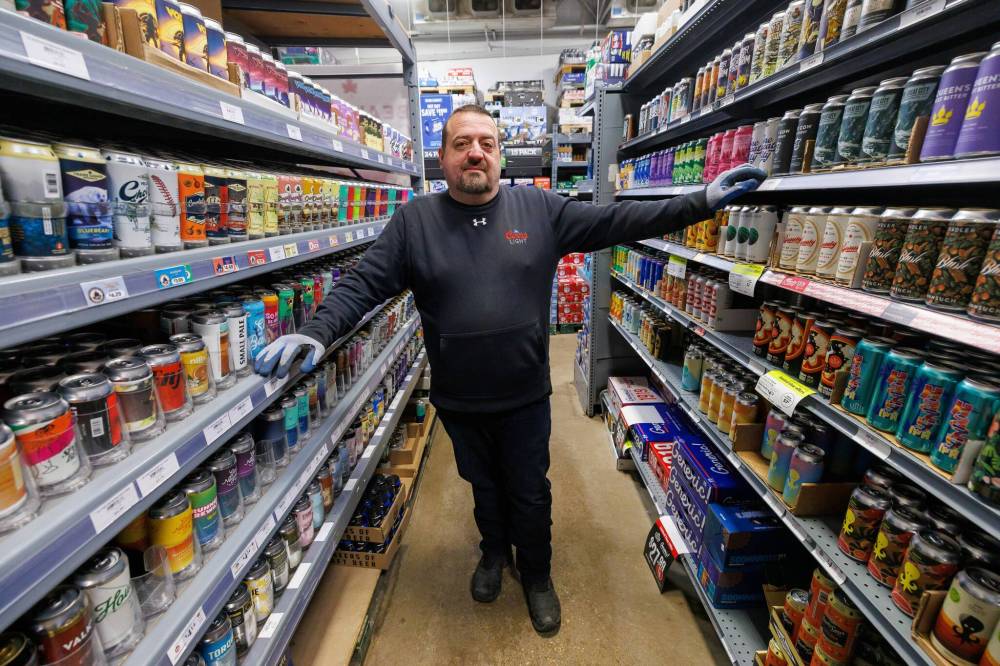
Hiebert says one of the challenges is getting past misconceptions about craft beer held by macro beer drinkers.
“They think local beer is too hoppy — it’s still that mentality,” he says, noting local IPAs still perform very well. “We’ve encouraged breweries to do samplings to break through that thought process and show consumers they do more than IPAs.”
During the COVID-19 pandemic, Hiebert shut down the vendor’s growler bar, reckoning the interest in purchasing beer sold in larger refillable bottles was waning.
He also believes COVID changed the social habits of some craft beer drinkers in the province. “The reason our store has been so successful is that we have everything under one roof — you travel to one location, get your beer, go home and you’re done,” he says. “I think the pandemic turned a lot of people into introverts.”
“We have too many breweries in Manitoba. We’re seeing closures.”
Over the years, Hiebert has enjoyed the community aspect of brewing collaborations with local producers, including Nonsuch, Brazen Hall, Half Pints, Sookram’s and Oxus — the latter partnered with Quality Inn security guard Greg Renton to create the Rumblesport Mutagenetic Smasher Lager, named after Renton’s DIY comic book series and featuring his art on the can.
“We’ve sold over 4,000 cans just out of this location — it’s done well,” Hiebert says.
As for the question of market saturation, Hiebert’s view is less than a pint glass half-full.
“We have too many breweries in Manitoba. We’re seeing closures — like Half Pints, like Stone Angel,” he says. “We were at market saturation years ago, and now we’ve surpassed that. It’s not just here — we’re seeing breweries across Canada close.
“The pie is only so big, and all our pockets are getting tighter every day. So do you spend $6 on an IPA, or do you spend $12 more and get yourself an eight-pack?”
For reviews of some new local seasonal craft beers, see Uncorked in Saturday’s Free Press.
The end of an era
In March 2025, Half Pints posted on its social media pages that the brewery was for sale; in a subsequent Free Press story, founder Dave Rudge said he was looking to retire from brewing and pass the keys to the brewery on to new owners.
Those owners seemingly never materialized; earlier this month a sign from Caplan Debt Solutions was posted in the Roseberry Street brewery’s doors noting that the property was “in the possession of the Licensed Insolvency Trustee.”
Those interviewed for this piece had universal praise for Rudge, who opened the pioneering brewery’s doors in 2006 at a time when regulations and red tape made it prohibitive to do so — it would be another 10 years until Manitoba’s laws were relaxed and the subsequent craft beer boom ensued.
“Dave has got a lot of passion for beer. We’ve all seen it, we’ve all talked to him. He’s a fantastic guy — I’m sorry to see the business go,” said Chris Hiebert of Quality Inn Beer Store. “Maybe he saw the writing on the wall when everybody was launching breweries, thinking ‘I can’t sustain this.’”
Morgan Wielgosz of Good Neighbour Brewing Co. had similar praise for Rudge. “When we were back in Toronto 15 years ago, Half Pints was being distributed out there to some of the top craft beer bars. Dave was producing, has always produced, really high-quality beers,” she said. “He paved the way for the craft beer industry we have here now — he did a lot for the community.”
The Free Press wasn’t able to reach Rudge for comment.

Ben Sigurdson
Literary editor, drinks writer
Ben Sigurdson is the Free Press‘s literary editor and drinks writer. He graduated with a master of arts degree in English from the University of Manitoba in 2005, the same year he began writing Uncorked, the weekly Free Press drinks column. He joined the Free Press full time in 2013 as a copy editor before being appointed literary editor in 2014. Read more about Ben.
In addition to providing opinions and analysis on wine and drinks, Ben oversees a team of freelance book reviewers and produces content for the arts and life section, all of which is reviewed by the Free Press’s editing team before being posted online or published in print. It’s part of the Free Press‘s tradition, since 1872, of producing reliable independent journalism. Read more about Free Press’s history and mandate, and learn how our newsroom operates.
Our newsroom depends on a growing audience of readers to power our journalism. If you are not a paid reader, please consider becoming a subscriber.
Our newsroom depends on its audience of readers to power our journalism. Thank you for your support.
Related Articles
TCB breaks ground on Brandon site