Wanderers centennial transcends the pitch Rugby club’s storied history a tale of Winnipeg’s sports landscape
Read this article for free:
or
Already have an account? Log in here »
To continue reading, please subscribe:

Digital Subscription
One year of digital access for only $205*
- Enjoy unlimited reading on winnipegfreepress.com
- Read the E-Edition, our digital replica newspaper
- Access News Break, our award-winning app
- Play interactive puzzles
*First annual payment billed as $205.00 + GST for one year. This annual subscription will automatically renew at $233.00 + GST every 52 weeks (10% off the regular annual price of $259.35). Offer available to new and qualified returning subscribers only. Cancel any time.
To continue reading, please subscribe:
Add Free Press access to your Brandon Sun subscription for only an additional
$1 for the first 4 weeks*
- Enjoy unlimited reading on winnipegfreepress.com
- Read the E-Edition, our digital replica newspaper
- Access News Break, our award-winning app
- Play interactive puzzles
*Your next Brandon Sun subscription payment will increase by $1.00 and you will be charged $17.95 plus GST for four weeks. After four weeks, your payment will increase to $24.95 plus GST every four weeks.
Read unlimited articles for free today:
or
Already have an account? Log in here »
A local rugby club’s influence on Winnipeg’s sports scene impacts thousands of Winnipeggers every day. Their story is one of the city’s best-kept secrets.
This year marks the 100th anniversary of the Winnipeg Wanderers Rugby Football Club. The Kildonan-based Wanderers’ storied history reflects the core values of a global community, rooted in camaraderie and fuelled by a burning love for the sport.
The Wanderers’ influence on both rugby and football has built stadiums, shaped families, and pioneered the way for Winnipeg’s beloved professional gridiron football team.
Last month, Manitoba’s oldest rugby club celebrated the milestone with the communities it helped build. The club hosted a weekend of festivities at Maple Grove Rugby Park and was honoured on two separate occasions at Princess Auto Stadium.
BROOK JONES / FREE PRESS The Winnipeg Wanderers 100th anniversary was celebrated by Rugby Canada during halftime of the Canada-Zimbabwe match, fitting at the home of the Winnipeg Blue Bombers on July 18. From left: Mayor Scott Gillingham, Wanderers president Brad Hirst, vice-president Dan Fardoe, secretary Turner Green and men’s team head coach Joey Potter.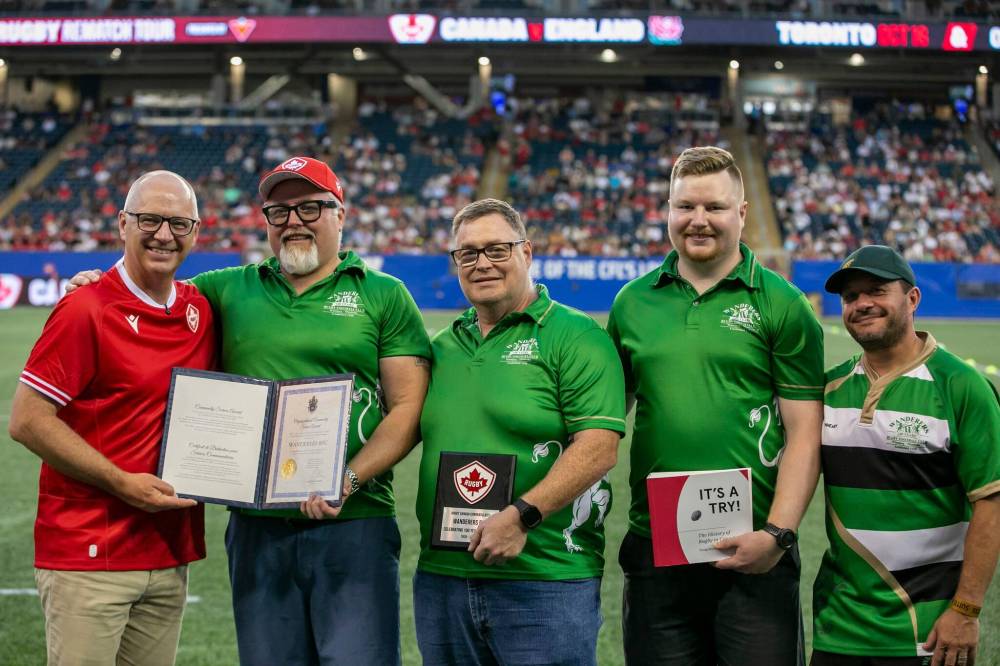
Longtime Wanderer Joey Potter said support away from the pitch was essential to the club’s longevity.
“To keep a nonprofit organization running for that long is a testament in itself,” Potter said. “It’s a testament to so many volunteers, so many people who have a passion for just being around — not just playing the game, but making sure that everything around the team functions.”
Potter grew up playing football, but had never played rugby before joining the club. In 1998, attending a social, Potter found all the motivation he needed to start.
“Good old Gordy Den was talking to some of my huge friends about coming out to rugby. He wasn’t talking to me because I’m five-foot-nothing, right?” Potter joked. “And none of those guys came out. I came out by myself and never left.”
Twenty-eight years later, he’s still playing.
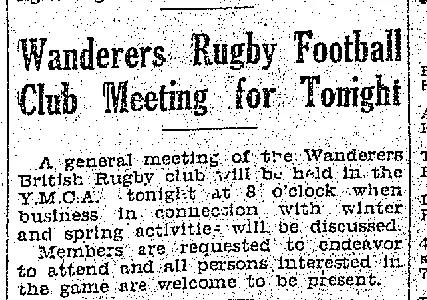
Potter’s unique venture into rugby is one of a million stories that make up the club’s history, immortalized through conversations over a pint after the final whistle.
“Tradition, right? That’s what we’re celebrating,” said Potter, the longest-serving player on the team. “There’s not a lot of things in Canada that make it to 100 years.”
Potter now gets to pass those traditions on to a new generation of Wanderers, serving as a player-coach with the men’s team. On match days, they wear the same green and white colours they wore 100 years ago. After games, they sing the Wanderers song over drinks at the clubhouse, just as their captain John A. Bulloch sang in 1929.
But perhaps the most important Wanderers tradition is their devotion to growing the game. It’s certainly important to the near-33,000 fans at Princess Auto Stadium during Blue Bomber home games, or to the tens of thousands who watch from home — even if they don’t know it.
The Blue Bombers are born
In the late 19th century, a new game emerged in Canada featuring modified British rugby rules. In 1909, Earl Grey donated the Grey Cup, to be awarded to Canada’s best rugby football team. Popularity skyrocketed for the new game, which eventually became Canadian football.
In 1913, the Winnipeg Tammany Tigers were founded to compete for Earl Grey’s trophy. After 16 years, the club folded.
Winnipeg was eager to field a new team, but short on players. That’s when they called on the Wanderers.
The Wanderers answered the call, supplying enough players to roster a team. In 1930, the Winnipeg Football Club was born. Five years later, they became the first team from Western Canada to win the Grey Cup, beating the Hamilton Tigers 18-12 and inheriting the Blue Bombers nickname from journalist Vince Leah.
FREE PRESS FILES The Wanderers filled out the Winnipeg Football Club’s roster that won the first Grey Cup for the city in 1935 and was the first team from Western Canada to win the Cup.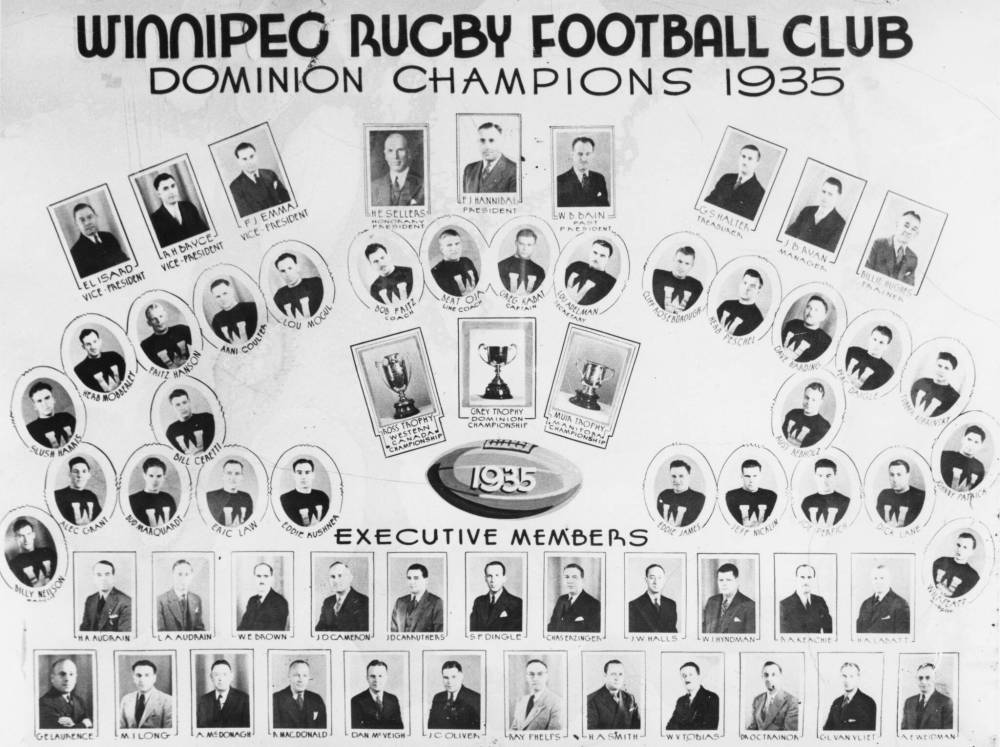
On the July 10 home game, hosting the Toronto Argonauts, the Blue Bombers paid their respects, inviting the Wanderers to carry the Canadian flag onto the field for a pre-game ceremony.
One hundred and thirty Wanderers players and alumni carried out the nine-by-18 metre flag before being honoured by the Bombers organization. The Wanderers were the first group with enough people to carry the flag by themselves.
According to club president Brad Hirst, they were also the first team allowed to wear green.
“Wade Miller gave us that distinction because of — obviously — the resemblance to Saskatchewan,” Hirst said, laughing.
On July 18, the Wanderers returned to Princess Auto Stadium where Canada hosted Zimbabwe in a World Rugby Nations Cup match.
At halftime, in front of 6,712 rugby fans, Mayor Scott Gillingham presented the club with the City of Winnipeg Community Service Award. Rugby Canada also presented an award commemorating the club’s 100th anniversary.
BROOK JONES / FREE PRESS Winnipeg Wanderers president Brad Hirst said the Winnipeg Blue Bombers allowed Wanderers green on the field when the club was honoured during the July 10 home game. Hirst was presented the City of Winnipeg Community Service Award by Mayor Scott Gillingham (left) during the Rugby Canada celebration of the club on July 18.
It was a dream come true for Hirst. The Wanderers had finally received their flowers, and the secret was out.
“It was monumentally historic,” Hirst said. “Knowing that I was able to be a part of that moment in time, that moment in our club’s history… it was just overwhelming to be a part of that.”
The Wanderers have to make room in their trophy case with two more awards to add to a long and decorated history.
“We’ve had a lot of accolades throughout the years,” Hirst said. “There’s been a lot of successes, and we’re here to just continue to grow.”
Finding an identity
Somewhere in that trophy case is the 2004 Men’s Manitoba Rugby Union Division One banner. The Wanderers men’s team went 14-0 that year, becoming just the third team to record a perfect season in Rugby Manitoba’s 128-year history.
You’ll find several Wanderers alumni in the Manitoba Rugby Hall of Fame, like Neville Rhoda and Albert Shepherdson. Others like Stephanie Harland and Robert Turk represented Team Canada in international play.
Many talented ruggers have graced the pitch in Wanderers green, none greater than Mandy Marchak.
REMY DE LA MAUVINIERE / THE ASSOCIATED PRESS FILES Winnipeg’s Mandy Marchak is tacked back in 2014 at the Women’s Rugby World Cup. Marchak is one of the most famous Wanderers. She went on to represent Canada in five World Cups, winning silver in 2013 with the women’s sevens team and in 2014 with the 15s. In 2011, Marchak was named captain of the national rugby sevens team, who went undefeated in four World Tournaments that year.
Marchak represented Canada in five World Cups, winning silver in 2013 with the women’s sevens team and in 2014 with the 15s. In 2011, Marchak was named captain of the national rugby sevens team, who went undefeated in four World Tournaments that year.
Marchak hung up her boots in 2016, finishing her career with 60 international caps. In 2017, she was inducted into the Manitoba Rugby Hall of Fame.
Two years later, she was joined by teammate Shannon Ploegman Smith.
Ploegman Smith is another Wanderers star who enjoyed a decorated career. Growing up, long before she found rugby, she had a different sport on her mind.
“I wanted to play hockey, my parents wouldn’t let me,” she said.
Ploegman Smith played every sport she could in school, planning to play basketball in university. In her first year, she took time off to rest her body.
During that year, Ploegman Smith’s sister convinced her to try rugby.
“I wanted to play hockey, my parents wouldn’t let me.”
“My sister played rugby and said, ‘You’ve got to do this,’ and I joined,” she said. “And then it’s just invigorating, exhilarating.”
It was love at first try for Ploegman Smith. She spent 11 years with the Wanderers, serving as the women’s captain or co-captain every year after her rookie season. She played Provincial Team rugby for nine seasons, also making two international caps with Team Canada.
Ploegman Smith’s longtime Wanderers teammate Joadine Self wanted to play tackle football growing up. Attending Churchill High School in the 1980s, Self approached the school’s head coach and asked to play.
That coach was Brian Dobie.
“He said, ‘No, you cannot play tackle football, but I’ll organize the next best thing,’” Self said.
A 2025 Football Manitoba Hall of Fame inductee, Dobie coached the Manitoba Bisons for 28 years, winning the Vanier Cup in 2007.
When Self asked to play, Dobie helped create one of the first women’s high school rugby teams in the province. Self played a year of field hockey in university before returning to rugby, joining the Wanderers women’s team.
“Girls who were afraid to try something, or who thought that maybe they didn’t fit into an athlete’s type… rugby embraces it all.”
“The game draws you in… it’s the physicality of it,” Self said. “At that time, it was the most aggressive thing that we could have as an outlet. And man, was it fun!”
Self spent 11 seasons as a player and coach with the Wanderers. After her playing career, she started a women’s rugby team at St. Mary’s Academy. When Self stepped down from coaching at St. Mary’s, Ploegman Smith took over.
Both Ploegman Smith and Self grew up in a time when girls couldn’t play certain sports, but rugby changed the narrative. As coaches, they got to pay it forward.
“Girls who were afraid to try something, or who thought that maybe they didn’t fit into an athlete’s type… rugby embraces it all,” said Ploegman Smith.
With more opportunities now for female athletes, Self said she’s proud knowing the next generation’s experience will be different.
“Yeah, girls didn’t play those things,” she said. “Our children’s generation — they go, ‘What do you mean? Why can’t I play?’”
Building for the future
The Wanderers 100th anniversary weekend wrapped up at Maple Grove Rugby Park, featuring men’s and women’s alumni games and a men’s league game, concluding with an evening social.
Taking in the action from the men’s game was Wanderers alumni Jon Siddall, who began with the club in 1977. Looking out at the pitch, he recalled playing in much different conditions.
“We used to play on community club fields that were half gravel,” Siddall said. “We used to walk around the field before the game, picking up the broken beer bottles off the field before we played.”
In the 1980s, Winnipeg’s rugby community imagined a new facility. It didn’t take long before the clubs came together, pooling enough cash to lease a plot of land in St. Vital.
In 1983, Maple Grove Rugby Park was built. With five regulation rugby pitches and a clubhouse, it’s the only rugby park of its kind in the province. The facility also hosts St. Vital Mustangs minor football and the Winnipeg Rifles of the Canadian Junior Football League.
“Rugby is such an incredibly great sport and promotes incredible friendships with people.”
Now 66, Siddall said the project was a testament to the spirit of the game he loves.
“I can remember going out playing the game, bashing heads as hard as we could with the other team, and then going to have a beer with them and laughing and joking,” he said.
Through rugby, Siddall built lifelong friendships with teammates and opponents alike. He said the weekend wasn’t just about celebrating the Wanderers, but the sport as a whole.
“Rugby is such an incredibly great sport and promotes incredible friendships with people,” he said.
As the final whistle sounded on the men’s game, the teams shook hands, iced their wounds, and went inside to cool off — perhaps over a pint. It’s a tradition as old as rugby itself; a testament to a shared love for the game that transcends the pitch.
AVERY PLATT PHOTO The Winnipeg Wanderers clashed against the Winnipeg Assassins during the club’s centennial anniversary weekend this month.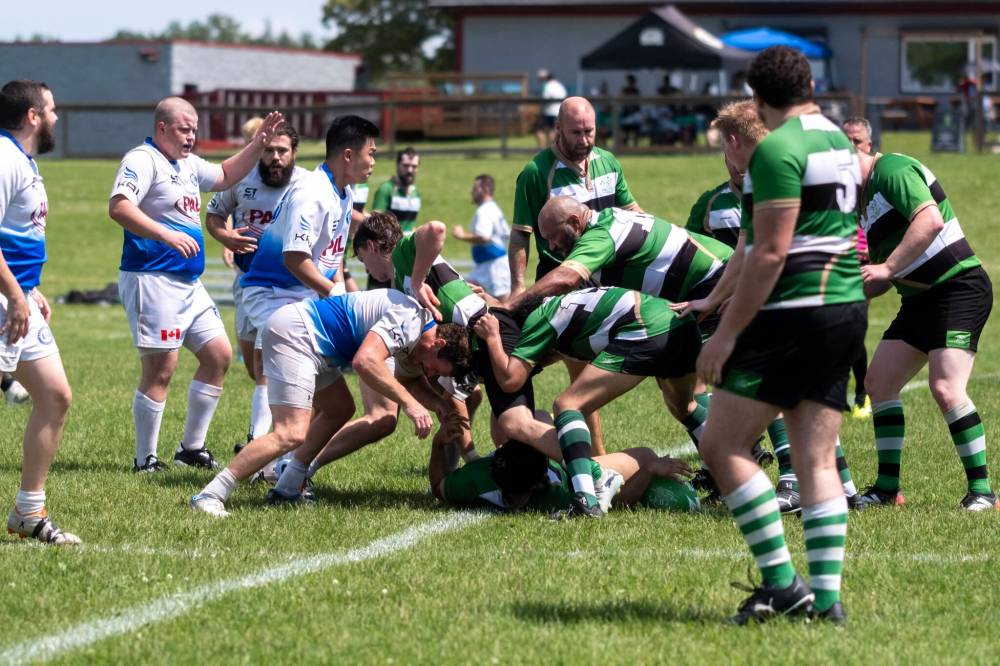
In the centennial celebration, the Wanderers were honoured by a team they helped build, competed on a pitch they helped build, and celebrated with a community they helped build.
With a rock-solid foundation at their feet, Hirst and the Wanderers move forward, with many alumni playing active roles in developing the next generation of rugby players.
“We’re not just celebrating 100 years of rugby,” Hirst said. “We’re also going to celebrate the next 100 years.”
winnipegfreepress.com/benlittle

Our newsroom depends on a growing audience of readers to power our journalism. If you are not a paid reader, please consider becoming a subscriber.
Our newsroom depends on its audience of readers to power our journalism. Thank you for your support.