Crushing it Trailblazing Western Scrap Metals heavy-equipment operator relishes role at massive crane’s control
Read this article for free:
or
Already have an account? Log in here »
To continue reading, please subscribe:

Digital Subscription
One year of digital access for only $205*
- Enjoy unlimited reading on winnipegfreepress.com
- Read the E-Edition, our digital replica newspaper
- Access News Break, our award-winning app
- Play interactive puzzles
*First annual payment billed as $205.00 + GST for one year. This annual subscription will automatically renew at $233.00 + GST every 52 weeks (10% off the regular annual price of $259.35). Offer available to new and qualified returning subscribers only. Cancel any time.
To continue reading, please subscribe:
Add Free Press access to your Brandon Sun subscription for only an additional
$1 for the first 4 weeks*
- Enjoy unlimited reading on winnipegfreepress.com
- Read the E-Edition, our digital replica newspaper
- Access News Break, our award-winning app
- Play interactive puzzles
*Your next Brandon Sun subscription payment will increase by $1.00 and you will be charged $17.95 plus GST for four weeks. After four weeks, your payment will increase to $24.95 plus GST every four weeks.
Read unlimited articles for free today:
or
Already have an account? Log in here »
Less than five per cent of heavy-equipment operators in the country are women but that number is trending upward, according to a study conducted by trade magazine Crane & Hoist Canada.
It was reported that in Ontario roughly eight per cent of jobs in the transport and heavy-equipment field are currently held by women. Furthermore, in 2024 almost 20 per cent of graduates at an Edmonton-based heavy-equipment operator training school were female, the article stated.
Harmony at the controls of one of two cranes she operates at Western Scrap Metals. (Ruth Bonneville / Free Press)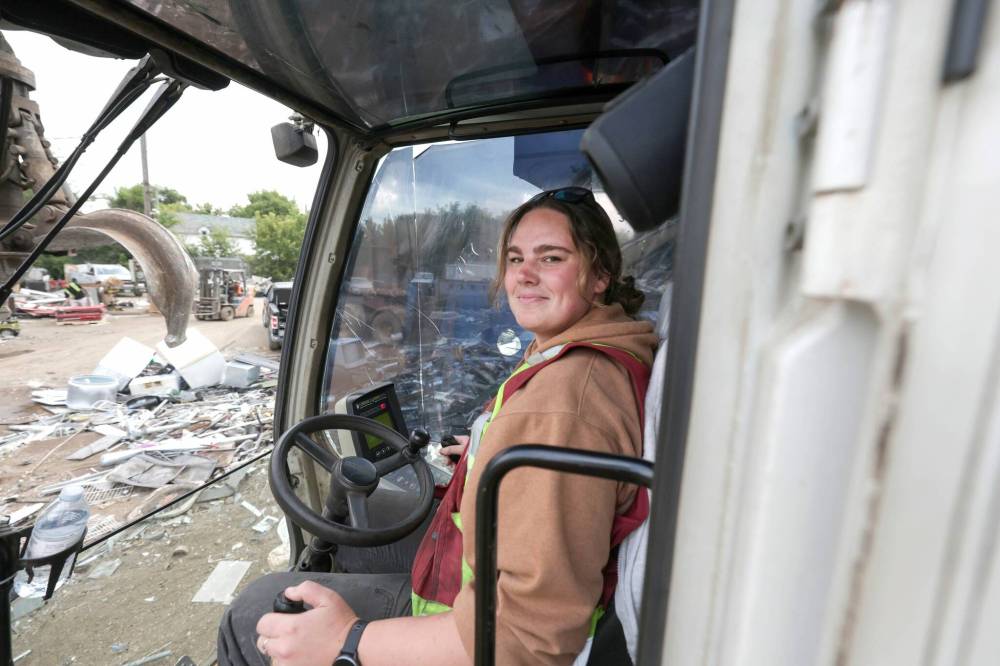
That brings us to Harmony Guspodarchuk, the first female crane operator in the 70-year history of Western Scrap Metals, a family-owned business at 18 Sutherland Ave.
Three years ago, Guspodarchuk literally stepped into the driver’s seat of a 27,500-kilogram, Liebherr C 924 Heavy Lift Litronic crane. The 29-year-old hasn’t looked back much since.
Well, except to ensure that her machine’s 900-kilogram, five-claw grappling hook isn’t releasing a derelict air conditioner or bed frame on top of anything valuable.
“There are seven (metal) scrapyards in the city and unfortunately, I don’t know of any other women doing this,” says Guspodarchuk, dressed in a bright-orange T-shirt, dark pants and scuffed pair of steel-toe boots, her shoulder-length hair tied back in a ponytail.
“That’s a shame because if you’re asking me, scrapyards could definitely use a woman’s touch. I like to think I’m very organized and one of my goals has been to clean up the yard to make things more efficient, which a lot of people tell me is now the case.”
“If you’re asking me, scrapyards could definitely use a woman’s touch.”
Guspodarchuk, who lives in Ste. Anne with her husband Bren, grew up in Transcona. The Transcona Collegiate Institute alumnus was working as a bartender at the LaSalle Hotel on Nairn Avenue when COVID-19 struck six-and-a-half years ago, a set of circumstances that threw a wrench into her lifestyle.
She loved it at the LaSalle — that’s where she met her husband, whose mother and grandmother own the property — but because the bulk of her shifts dried up owing to the bar having to shutter, she was forced to go job-hunting to make ends meet, she says, during a scheduled break.
Crane operator Harmony Guspodarchuk during a recent shift at Western Scrap Metal. (Ruth Bonneville / Free Press)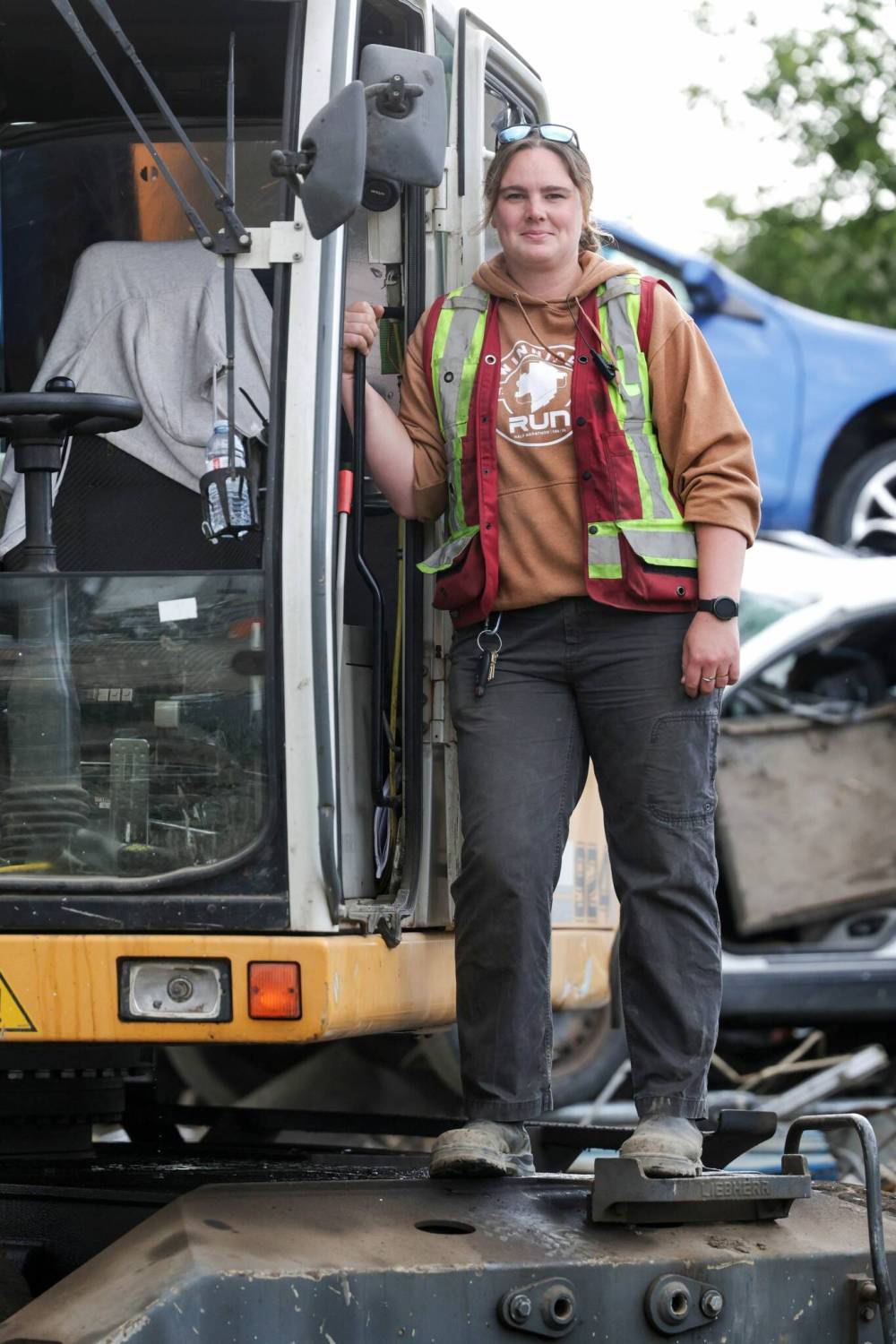
An acquaintance who worked at Western Scrap let her know there was an opening at the Point Douglas institution. Mentioning that she’s always been mechanically inclined, she says she did her homework and applied for what she thought would be an outdoor position sorting goods destined for a steel mill in Selkirk.
(Guspodarchuk, a hockey player, marathoner and Festival du Voyageur Games champion, winks, saying she’s never been one to balk at physical labour.)
“Only when I got here they told me they wanted me to be the receptionist, on account of my computer skills,” she continues, pausing to say hello to Adam Kaplan, whose 93-year-old grandfather, Al Linder, founded Western Scrap in 1956 together with his father-in-law, Izzy Silverman.
Although Guspodarchuk initially didn’t know the first thing about the scrap-metal biz, that changed in a hurry. So much so that while driving to work, she would spot abandoned appliances or barbecues parked next to dumpsters and immediately think to herself, “Hey, that’s $20… that’s $30…”
In the spring of 2023, Greg Babisky, a crane operator at Western Scrap for close to 40 years, announced his pending retirement. One morning he told Guspodarchuk, who by then was slipping away from her station at every opportunity to assist customers with unloading their vehicles, that he wanted her to be his replacement.
“I think I blurted out something like, ‘OK, sure,’ but in my head I was probably more like, ‘Uh, that sounds a bit scary,’” she says.
Harmony at the controls of one of two cranes she operates (one with a grapple, the other with a ginormous magnet) (Ruth Bonneville / Free Press)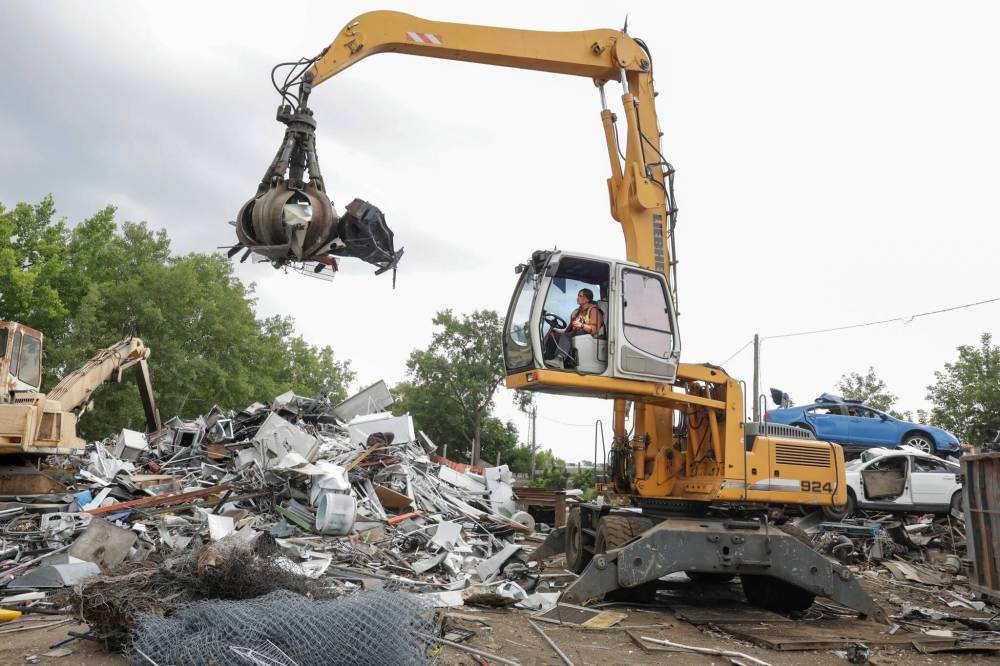
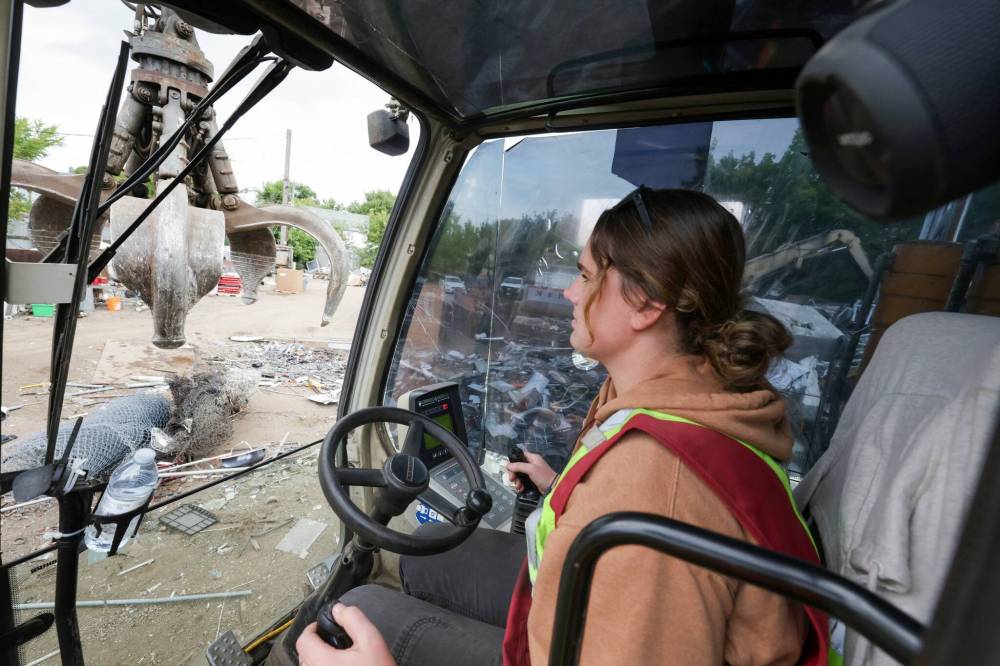
Guspodarchuk discussed the idea with her bosses. They agreed to let her come in on Saturdays — her regular day off — to get the hang of things. With Babisky as her personal instructor, she learned the ropes by figuring out how to manoeuvre a pair of joysticks that separately cause the crane’s boom and grappling hook to move up, down and around in all directions.
By the time Babisky called it a career, she felt comfortable enough to hoist material directly out of clients’ truck beds — as large as stoves and propane heaters, and as slight as hubcaps and rebar.
“If you’re a jerky-type person, cranes are probably not for you,” Guspodarchuk explains, admitting in the beginning she received her share of double-takes from regular customers who had grown used to spotting her behind a desk.
“It’s a very stressful/relaxing experience, all in one. You have to be very delicate with the movements and you have to be spatially aware. That being said, it’s just you inside the cab, with nobody bugging you. I wouldn’t trade it for my old office job, no way, no how.”
Her break over, Guspodarchuk first helps an elderly gent dump out what she laughingly refers to as a “scrap salad” — a mix of barbecue grates, room fans and patio chairs stored in the back of his minivan.
She adds the lot to a five-metre-high mountain of detritus she hopes to have sorted and reallocated by the end of her shift, then climbs back into her air-conditioned operator’s cab.
After getting an all-clear signal from a co-worker, she lowers the crane’s hook into the pile, closing it slowly in an attempt to scoop up as many shreds as possible. If it’s a larger item, say a barbecue or fridge, she’ll pull it out individually, with a quick flick of her wrist.
Confident her load is secured, she raises the grapple before swinging it and the boom around to her left, where she deposits the stack in a train-car sized storage container. Finally, she raises the grapple and closes the hooks completely before pounding down what she just let fall, to make room for the next stack.
Rinse and repeat every 30 seconds or so for eight hours, Monday to Friday.
“It doesn’t matter how old people are, everybody loves seeing things get crushed,” she yells out through an open door. “I never need to go to a rage room because I spend 40 hours a week breaking things.”
Back on the ground 30 minutes later, Guspodarchuk says while there have been a few mishaps, mostly involving automobile rims that “shoot out like a bullet” when they get pinched too tightly between the grapple’s claws, luckily those have been few and far between.
She chuckles, saying there have been occasions when she’s been shredding a chest freezer, only to discover that its previous owner neglected to remove food from it, ahead of leaving it at the yard.
“On an average day, I probably move between 60,000 and 80,000 pounds of metal,” she says, recalling an especially busy four-day period in June when the yard tallied 400,000 pounds of steel.
“Things do slow down a bit in the winter but because of our industrial accounts, there’s always something to do, which is probably what I like most about the job. I can honestly say I’m never bored.”
By the way, if you’re wondering whether Guspodarchuk is adept at those arcade-style claw machines — the ones that challenge you to win plush animals or plastic toys — the answer is a resounding yes.
“I never played those games before this, but now that my nieces and nephews know what I do for a living, they’re always enlisting Aunt Harmony to win them prizes,” she says with a smile. “Nine times out of 10, I’m successful.”
david.sanderson@freepress.mb.ca
Dave Sanderson was born in Regina but please, don’t hold that against him.
Our newsroom depends on a growing audience of readers to power our journalism. If you are not a paid reader, please consider becoming a subscriber.
Our newsroom depends on its audience of readers to power our journalism. Thank you for your support.