A resplendent homecoming Artist’s inspired work brings Red River Métis story back to Portage and Main
Read this article for free:
or
Already have an account? Log in here »
To continue reading, please subscribe:

Digital Subscription
One year of digital access for only $205*
- Enjoy unlimited reading on winnipegfreepress.com
- Read the E-Edition, our digital replica newspaper
- Access News Break, our award-winning app
- Play interactive puzzles
*First annual payment billed as $205.00 + GST for one year. This annual subscription will automatically renew at $233.00 + GST every 52 weeks (10% off the regular annual price of $259.35). Offer available to new and qualified returning subscribers only. Cancel any time.
To continue reading, please subscribe:
Add Free Press access to your Brandon Sun subscription for only an additional
$1 for the first 4 weeks*
- Enjoy unlimited reading on winnipegfreepress.com
- Read the E-Edition, our digital replica newspaper
- Access News Break, our award-winning app
- Play interactive puzzles
*Your next Brandon Sun subscription payment will increase by $1.00 and you will be charged $17.95 plus GST for four weeks. After four weeks, your payment will increase to $24.95 plus GST every four weeks.
Read unlimited articles for free today:
or
Already have an account? Log in here »
Jennine Krauchi calls them the “grandmothers.”
“They speak to you very silently. You never hear a word, but they speak,” Krauchi says, referring to the antique pieces of Métis needlework she’s carefully studied for years — a craft passed down across generations, with the pieces themselves sometimes serving as the instructive elders.
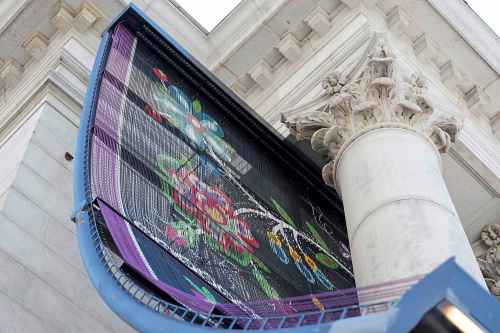
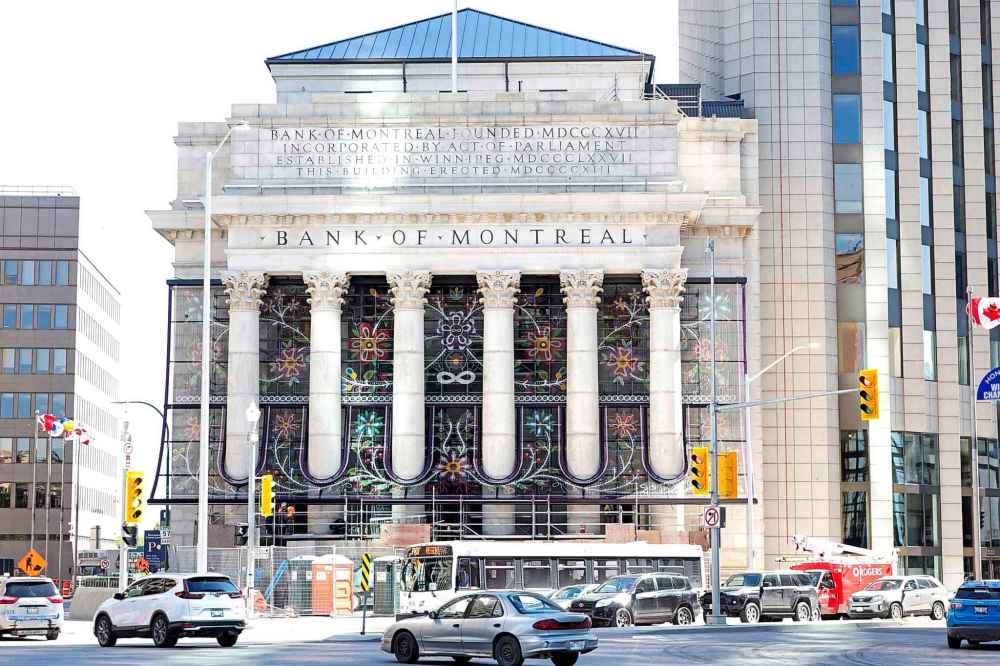
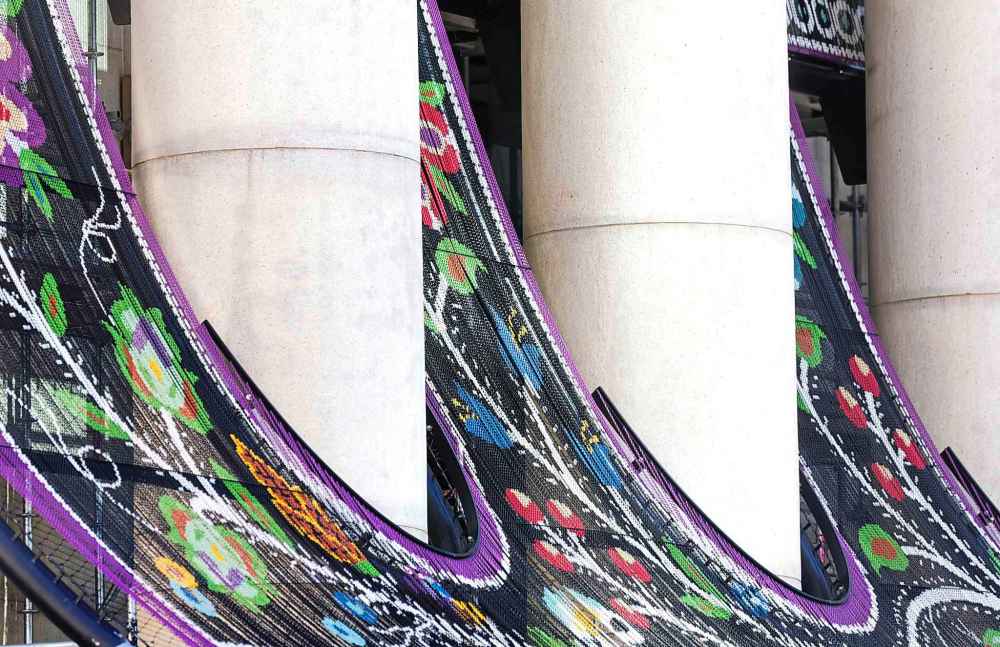
But there are few precedents for her latest art project: a 85-foot-wide by 32-foot-high chain curtain of Métis needlework — teeming with wild flowers, infinity symbols, berries and other motifs paying tribute to Red River Métis heritage and renewal — that drapes over the historic Bank of Montreal’s neoclassical facade.
Métis beadwork artist Jennine Krauchi with her large-scale, chain-link Métis public artwork that now graces the outside of MMF’s Bank of Montreal building at Portage and Main.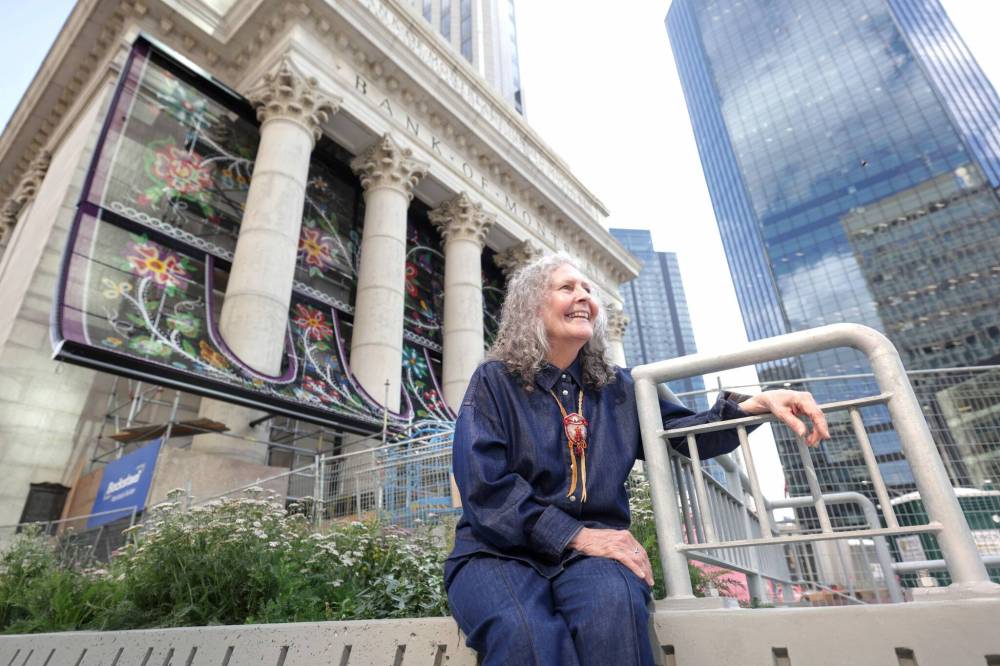
That building, at 335 Main St., will soon bear another title: Red River Métis National Heritage Centre or La Plas Taanshi kaa-Ishipamachihoyaahk, its Michif name.
The chain curtain appears as a laser-cut metal layer, “pinned on” and not damaging the original century-old engraved lintel; all part of Number TEN Architectural Group’s redesign of the 113-year-old former bank at Portage and Main.
Scheduled to open next year in late summer or early fall, the Manitoba Métis Federation’s new heritage centre will prioritize heritage exhibits, education and contemporary art.
A foundational part of the collection is called “Our Grandmothers.” The body of 142 items — including horse blankets, silk embroidery, firebags, beadwork and more, some dating back to 1830 — transports viewers back to the Red River settlement of yore.
Number TEN Architectural Group Krauchi’s design for the 85 x 32 ft. chain curtain expression of Métis needlework is rich with wild flowers, berries and other traditional motifs.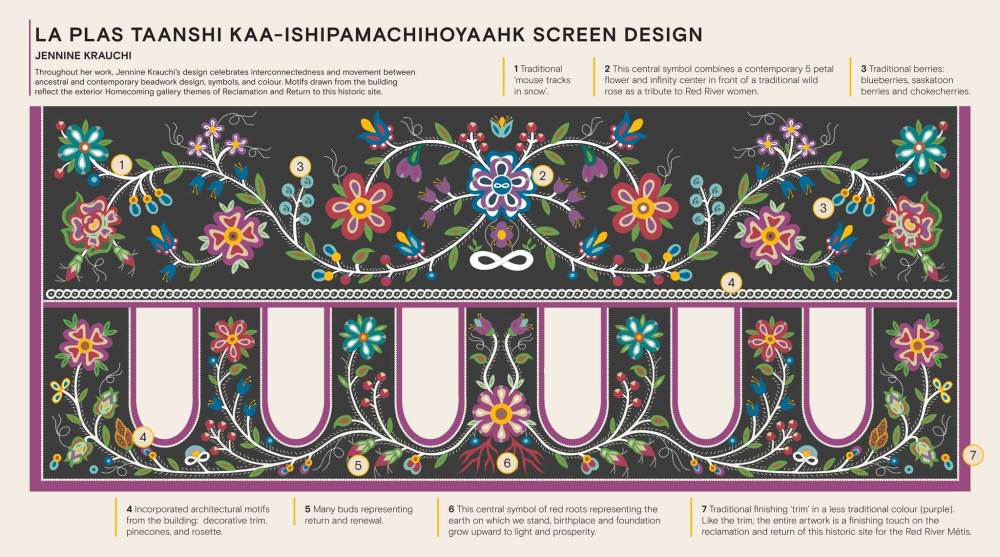
Portage and Main was but a scrubby intersection of ox cart paths, surrounded by swamp, when it was purchased by Henry McKenney in 1862.
While now considered Canada’s most famous — and windiest — intersection, at the time it was dwarfed by a more significant intersection: the Forks, which for thousands of years offered a Y-marks-the-spot gathering point for traders and travellers using the continent’s river highway systems.
Minister Barbara Fleury, the Minister of Culture, Heritage, and Michif Language for the
Manitoba Métis Federation (MMF), inside the foyer of 333 Main Street.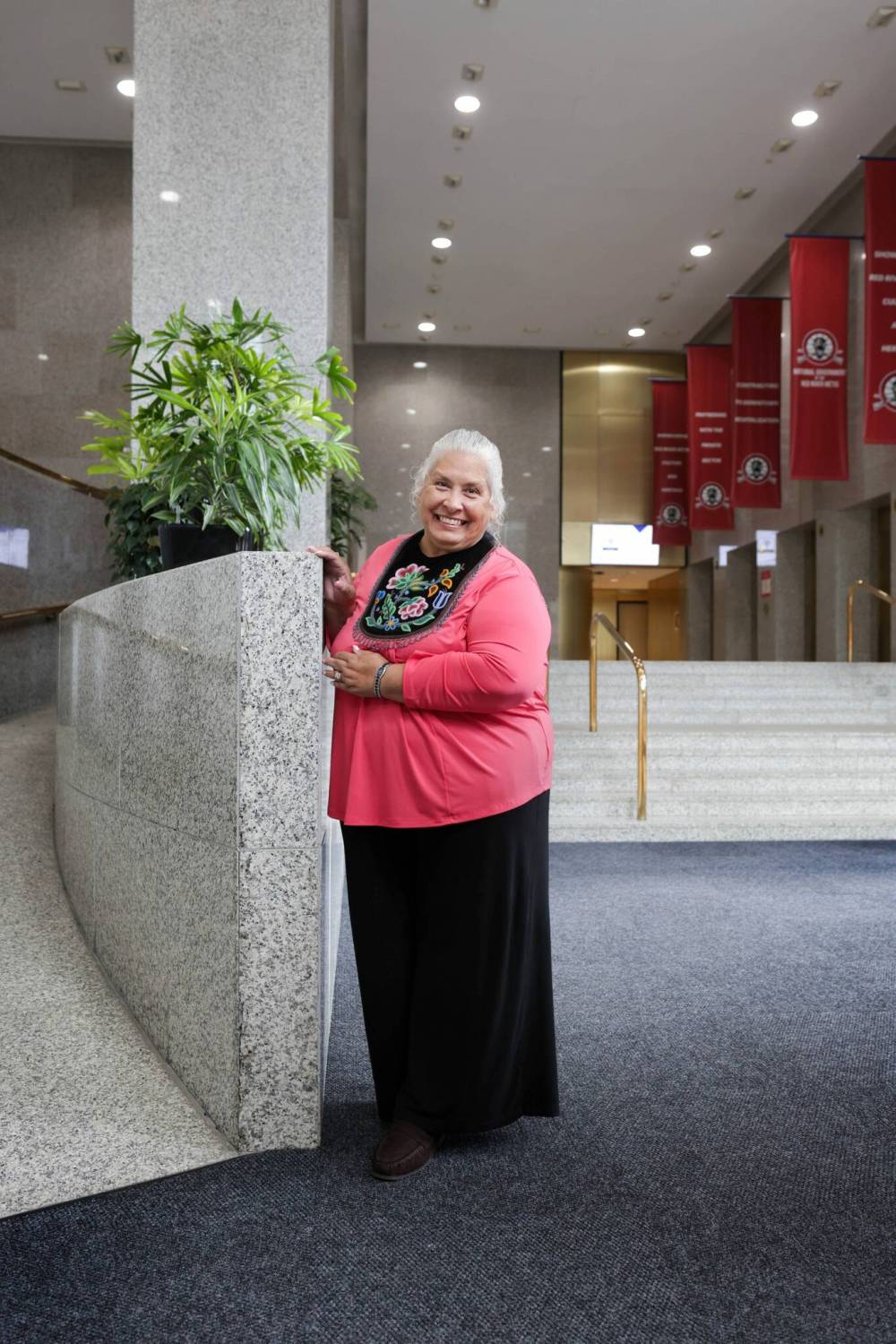
The Forks served as the fur trade’s hub, drawing the Hudson’s Bay Company and North West Company to establish rival strongholds such as Fort Garry and Fort Gibraltar, with the Red River Métis forming a basis of these trading posts’ workforces.
The heritage centre will help to preserve and illuminate this history, while creating an active space for contemporary Red River Métis culture and art.
“This is where the birth of the Red River Métis started and we want to continue because now our baby has grown into adulthood and she’s beautiful,” says Barbara Fleury, the MMF’s minister of Culture, Heritage, and Michif Language.
“We want to bring our people back to being at home and (thriving) like we once did, because that was taken away from us.”
The MMF is the federally recognized national government of the Red River Métis and has more than 60,000 citizens.
MMF’s head office will remain at 150 Henry Ave. while its space at 333 Main St. will serve as an expansion, with the main and mezzanine levels hosting the new heritage centre and the building’s two upper levels serving as offices for various MMF departments.
The renovations include extensive HVAC and electrical upgrades and energy-efficient glazing, and is buoyed by a $33.1-million investment from the federal and provincial government made in 2022.
And, in case anyone’s wondering, the building’s famous vaults will be kept intact.
“We respect the heritage of the building … The bank vaults will remain in place, fully a part of our vision for the restoration of the space,” says Fleury.
It was considered the world’s most impenetrable vault at the time of its making, with the entrance doors together weighing about 450 tonnes, or the equivalent of 90 elephants.
Number TEN associate architect Aaron Pollock and partner/practice leader Greg Hasiuk highlight designing, building and installing the chain curtain as one of the project’s most interesting challenges, both logistically and in service of a larger problem: how to reimagine a “colonial edifice” like the Bank of Montreal as an Indigenous milieu while doing justice to the building’s significant heritage?
“We respect the heritage of the building … The bank vaults will remain in place, fully a part of our vision for the restoration of the space.”
When McKenney purchased the plot at Portage and Main to build a store, many settlers considered the move ill-advised — it seemed too far from the river, which at the time was the only nearby source of water. But the arrival of the railways and the Prairie grain boom quickly transformed the swampy area into the city’s modern business district.
The Exchange served as its commodity shipping hub while Bankers Row — a two-block strip on Main from Portage to Bannatyne that hosted as many 20 financial institutions in the late 1800s — anchored the city’s financial world. The Bank of Montreal loomed as the district’s most important bank, drawing eastern capital to grease the wheels of westward expansion.
Yet this expansion dispossessed many Red River Métis and other Indigenous communities of their land, coming to a head with the Red River Resistance (1869–70) and North-West Resistance in 1885.
Social pressures and government policies — such as 1890’s Official Language Act, which made English the province’s sole official language and strictly restricted education in other languages, despite initial protections for French — pushed Red River Métis people toward assimilation.
“The first thing that would identify (the Métis) is their beadwork. So they hid their beadwork because of racism,” Krauchi says. “Some of it was actually taken away from them and burnt.”
The massive metal chain screen featuring a traditional floral Métis beadwork design is being
installed on the facade of Winnipeg’s historic Bank of Montreal building at Portage and Main.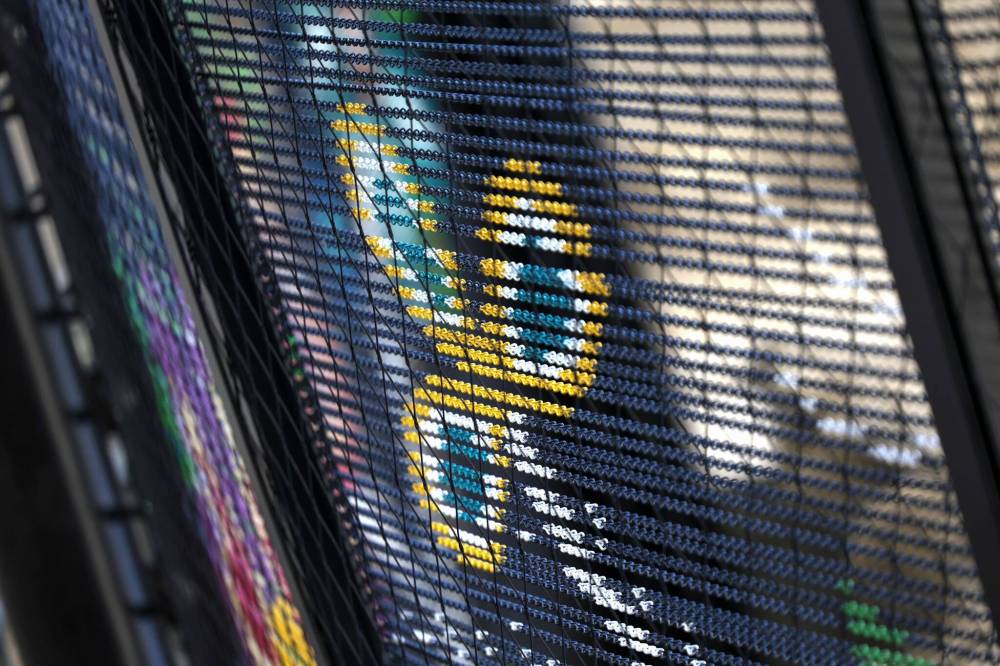
Whatever its colonial trappings, the building at 335 Main St., which was built between 1911-13 and vacated in 2020, still stands out as the city’s richest example of neoclassical architecture. The renovations are meant to preserve the historic site, not just by upgrading its mechanical and electric infrastructure, by giving it new life and ensuring it doesn’t fall into neglect and disrepair.
“You’ve got these huge columns. It’s all stone. It feels very cold and stoic, but it’s meant to give this sense of permanence. But how do you infuse a new Métis layer onto that that feels more welcoming, that feels more vibrant?” Pollock says.
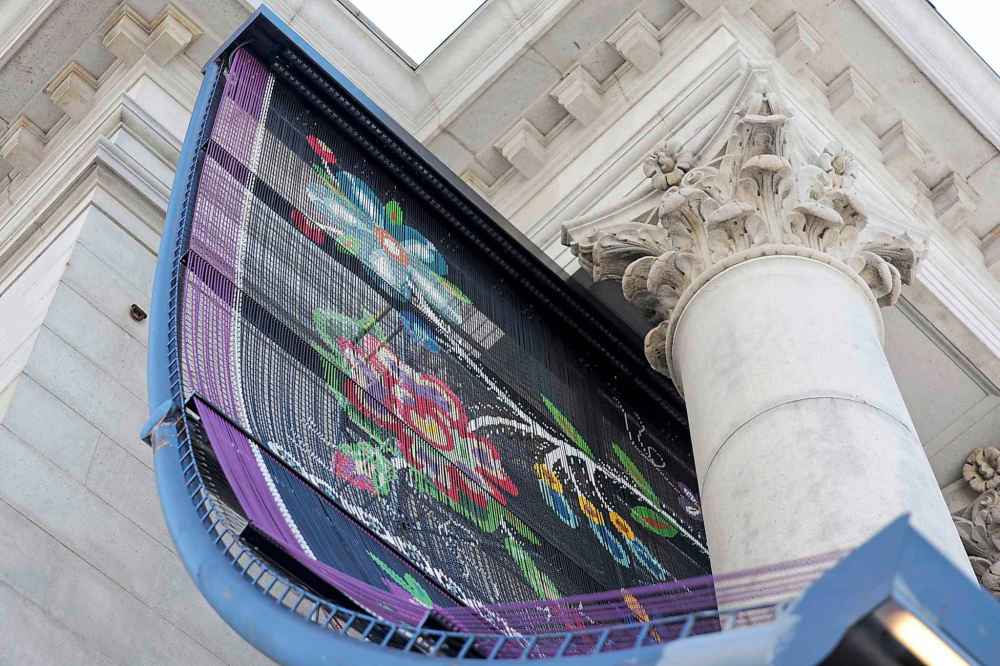
The layer they created to solve this problem isn’t just metaphorical, but a quasi-translucent tapestry of 750,000 individual links. Hasiuk says that if all of the pieces of chain were laid out end to end, they would stretch 14 kilometres.
“I never dreamed I would do anything on this scale,” adds Krauchi, though a four-by-26-foot fire bag she made for the Canadian Museum for Human Rights in 2014 gave her a taste of what it takes to build work on such a large scale.
Krauchi’s meticulously drawn mock-up for the curtain, which included holes for the Bank of Montreal’s six Ionic columns, was used as a blueprint by Kriskadecor, a 100-year-old design company based in Spain that creates customized projects with aluminum chains.
Number TEN Architectural Group The interior stage as envisioned by Number TEN Architectural Group.
The curtain was then transported to Winnipeg in panels and assembled here.
“At times, it’s completely invisible, like at 5 o’clock when the sun is shining in the evening down Portage Avenue and hits the building, it almost disappears and it’s amazing. And at other times, like in the morning, it’s quite solid looking,” Hasiuk says.
The heritage centre is poised to take on a palette of hues, thanks to its colour-changing lighting.
“When the Jets win the Stanley Cup, it’s gonna be red and blue,” says Hasiuk, adding that the 2025 opening of Portage and Main to pedestrians could not have been better timed.
Like the architects, Fleury positions the centre as part of a broader downtown renewal.
“(MMF) president (David) Chartrand once said that without a downtown, there’s no city,” she says. “It’s our bringing home of our Red River Métis people that’s going to help enlighten downtown.”
conrad.sweatman@winnipegfreepress.com


Conrad Sweatman is an arts reporter and feature writer. Before joining the Free Press full-time in 2024, he worked in the U.K. and Canadian cultural sectors and freelanced for outlets including The Walrus, VICE and Prairie Fire. Read more about Conrad.
Our newsroom depends on a growing audience of readers to power our journalism. If you are not a paid reader, please consider becoming a subscriber.
Our newsroom depends on its audience of readers to power our journalism. Thank you for your support.
Related Articles
Owners, agents reviewing bids to purchase Fort Garry Hotel




History
Updated on Friday, September 11, 2026 10:42 AM CDT: Adds photos, changes tile photo
Updated on Friday, September 11, 2026 2:47 PM CDT: Updates infographic, references to Red River Métis