Slop-py campaigning AI usage prominent in municipal race and likely here to stay
Read this article for free:
or
Already have an account? Log in here »
To continue reading, please subscribe:
Digital Subscription
One year of digital access for only $1.44 a week*
- Enjoy unlimited reading on winnipegfreepress.com
- Read the E-Edition, our digital replica newspaper
- Access News Break, our award-winning app
- Play interactive puzzles
*Billed as $5.77 plus GST every four weeks. After 52 weeks, price increases to the regular rate of $19.95 plus GST every four weeks. Offer available to new and qualified returning subscribers only. Cancel any time.
To continue reading, please subscribe:
Add Free Press access to your Brandon Sun subscription for only an additional
$1 for the first 4 weeks*
- Enjoy unlimited reading on winnipegfreepress.com
- Read the E-Edition, our digital replica newspaper
- Access News Break, our award-winning app
- Play interactive puzzles
*Your next Brandon Sun subscription payment will increase by $1.00 and you will be charged $17.95 plus GST for four weeks. After four weeks, your payment will increase to $24.95 plus GST every four weeks.
Read unlimited articles for free today:
or
Already have an account? Log in here »
Winnipeg voters may have noticed an uncanny sheen to aspects of certain mayoral campaigns this year.
Social media images and text a little too synthetically smooth — or, in some cases, downright surreal.
(Andrej Ivanov / Free Press files) McGill University Prof. Aengus Bridgman warns rampant AI-use is the new political reality.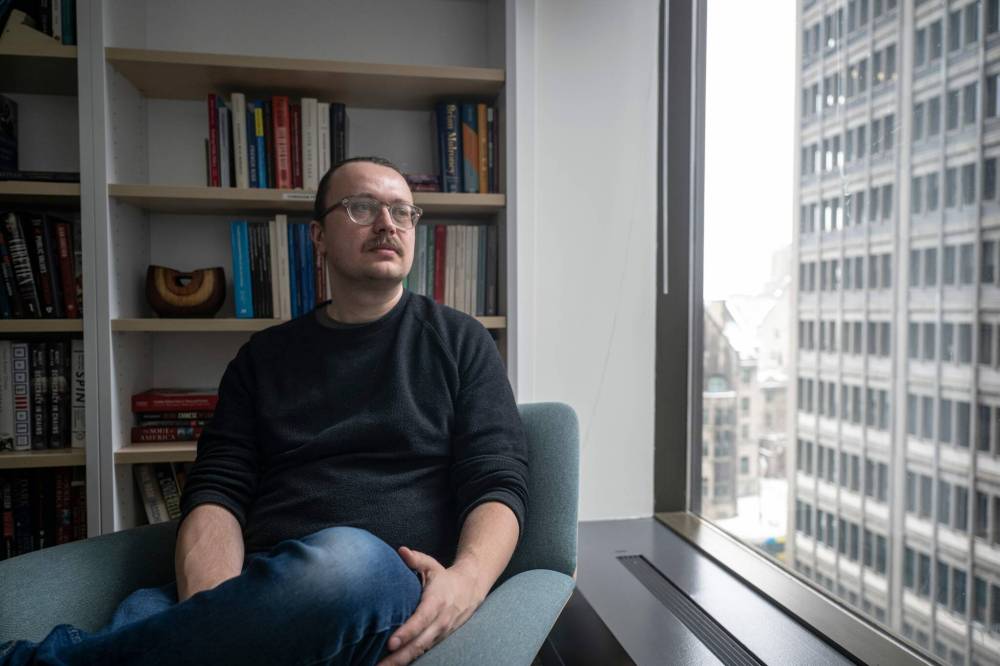
“This is the new normal. Everyone needs to accept that there is going to be rampant AI use by political parties … it’s the speed of adoption that’s been so disorienting,” says Aengus Bridgman, a former Winnipegger and assistant professor at McGill University whose research addresses the intersection of artificial intelligence and democracy.
“(Generative-AI use in elections) ranges from innocent fun to augmenting an under-resourced campaign to pretty clear examples of misleading.”
That range is reflected in the run-up to Winnipeg’s Oct. 28 municipal election. While incumbent Mayor Scott Gillingham and mayoral candidate Noah Redden have disavowed its use, campaign materials by some other candidates have more subtle inflections of generative AI, which is artificially produced images, text or audio through applications such as ChatGPT, Google Gemini and Claude.
On the more light-hearted side, Don Woodstock has marked his third consecutive mayoral run with an AI-generated musical album featuring titles like More Sports, Less Crime and Put Your Trust in the Bus Man.
But in other cases, the line between reality and AI fabrication is less distinguishable.
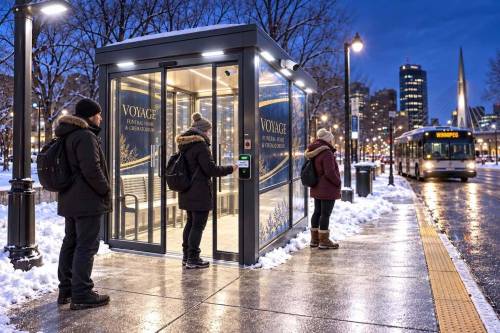
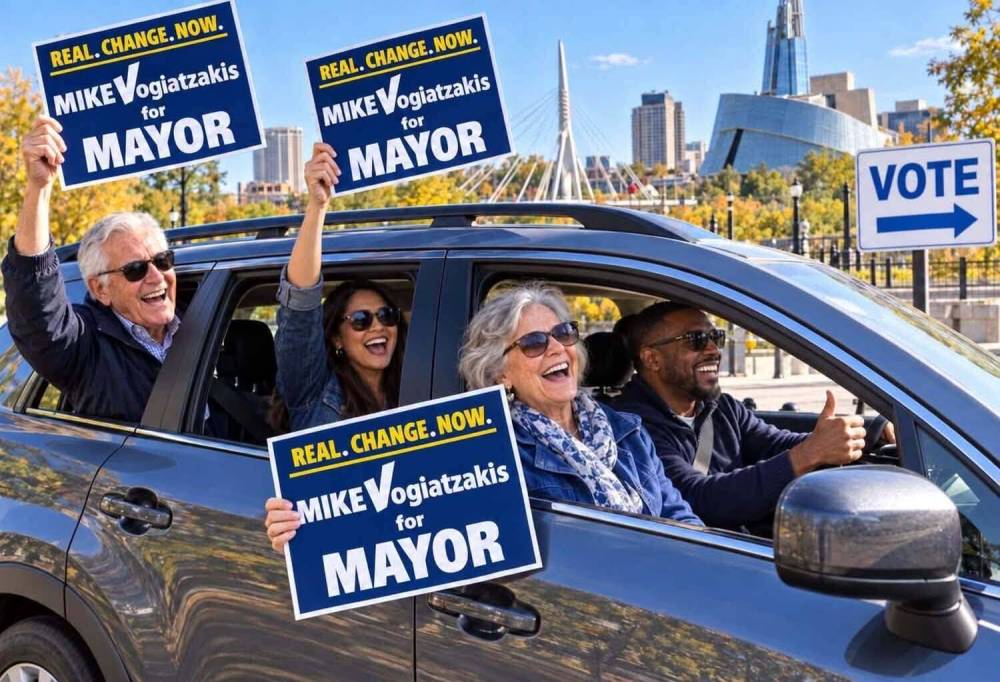
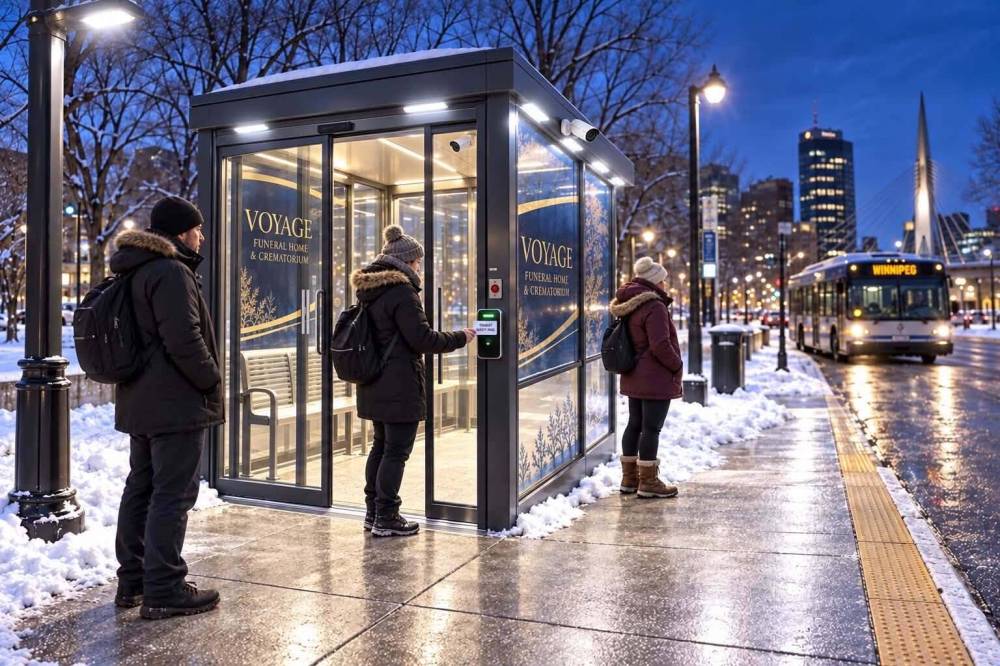
Among the examples is a poster from Mike Vogiatzakis’s mayoral campaign that highlights his proposed upgrades to the Winnipeg Transit system. It also includes an ad for his funeral home business superimposed on the bus stop.
Vogiatzakis is unapologetic about using AI, saying it helps to reduce costs and aids in balancing the scale between non-established candidates and heavily financed campaigns.
“These tools can lower the cost of producing campaign materials and help candidates with limited resources take part in public life,” he said in an email. “I’ve used AI-assisted tools to develop some campaign visuals.”
While AI artifice may seem harmless, there is a much deeper threat to the electorate. AI is known for hallucination (generating confident sounding, but incorrect information), malicious manipulation through deepfakes (fabricated audio or video showing people doing things they did not), automated bot networks (fake accounts that work to promote a certain viewpoint) and AI-driven microtargeting (tailored propaganda designed to encourage voters’ fears or biases).
The demographic most susceptible to online distortion is also the one that most reliably turns up to vote — older adults. Studies have shown they struggle the most to recognize false information online as well as generative AI imagery.
The Free Press sat down with two seniors to see if they could identify AI-generated material that has cropped up during the current election campaign.
Joanne, 78, who worked in information services before retiring and asked that her last name not be used, examines an image of a mayoral poll posted on Sept. 23 by candidate Brad Gross to his more than 5,000 Facebook followers.
It shows him in fourth place with 17 per cent support of decided voters, with Gillingham in first place with 26 per cent. Days earlier, a Sept. 18 poll by Abacas Data (formerly Probe Research, an established Manitoba polling firm), put Gross’s support of decided voters at one per cent, while Gillingham was at 55 per cent.
“Where does it say who did the poll and everything? Are people swayed by percentages if they look at this?” asks Joanne, before noticing a note at the bottom of the image that reads: “Figures supplied by campaign. Not a scientific poll.”
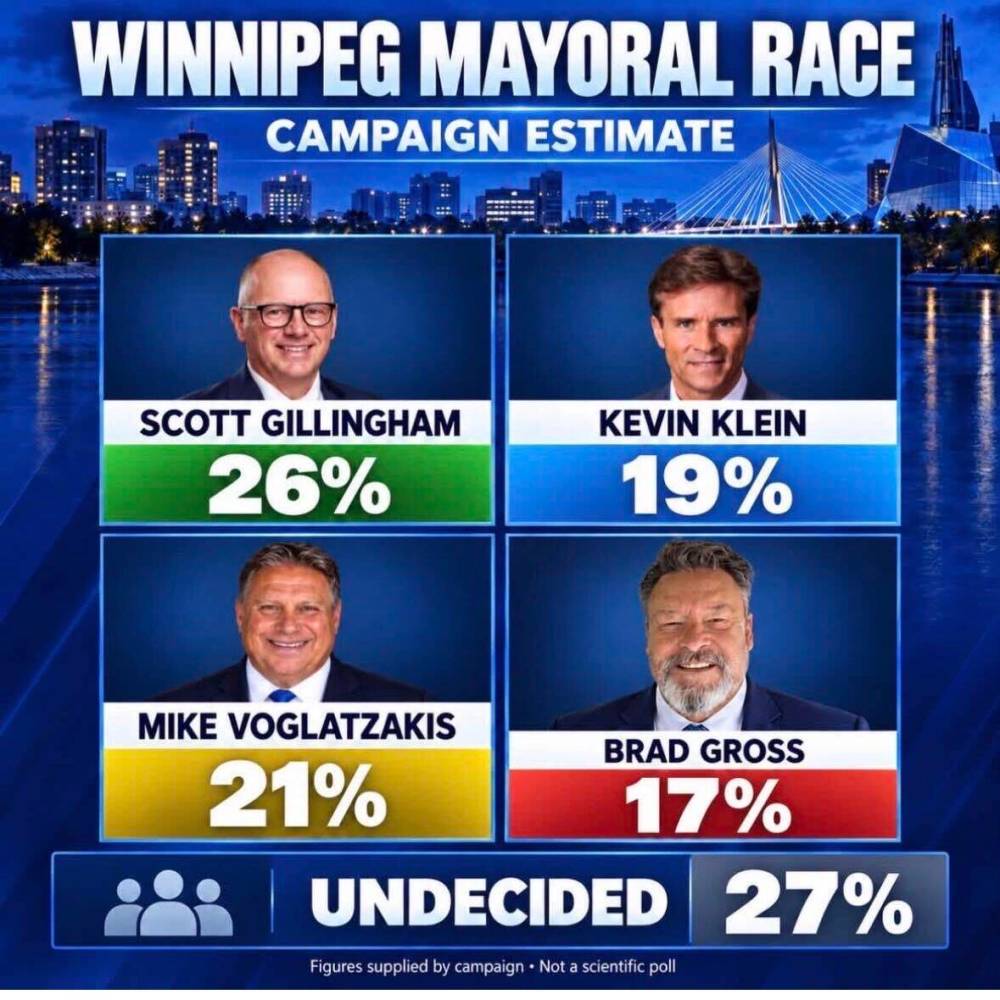
Gross told the Free Press that he finds ChatGPT a “very useful tool for conceptual drawings for illustration purposes only.” He did not respond to a question about how he sourced the figures that placed him in fourth in the Facebook image.
Joanne moves on to an image shared by Vogiatzakis, who frequently posts AI-generated campaign imagery to his social media channels. The image was of people standing at a bus stop below a post that proposes a series of reforms to Winnipeg’s bus system.
“It’s an awfully pretty scene for winter,” she says. “Icy streets. It could be real, but it looks … I don’t know.”
She’s not surprised to learn that the image is AI-generated after she notices posters on the bus stop advertising Vogiatzakis’s business, Voyage Funeral Homes.
(Mike Deal / Free Press) Sig Laser says AI-generated information has a place, but must be verified by other sources.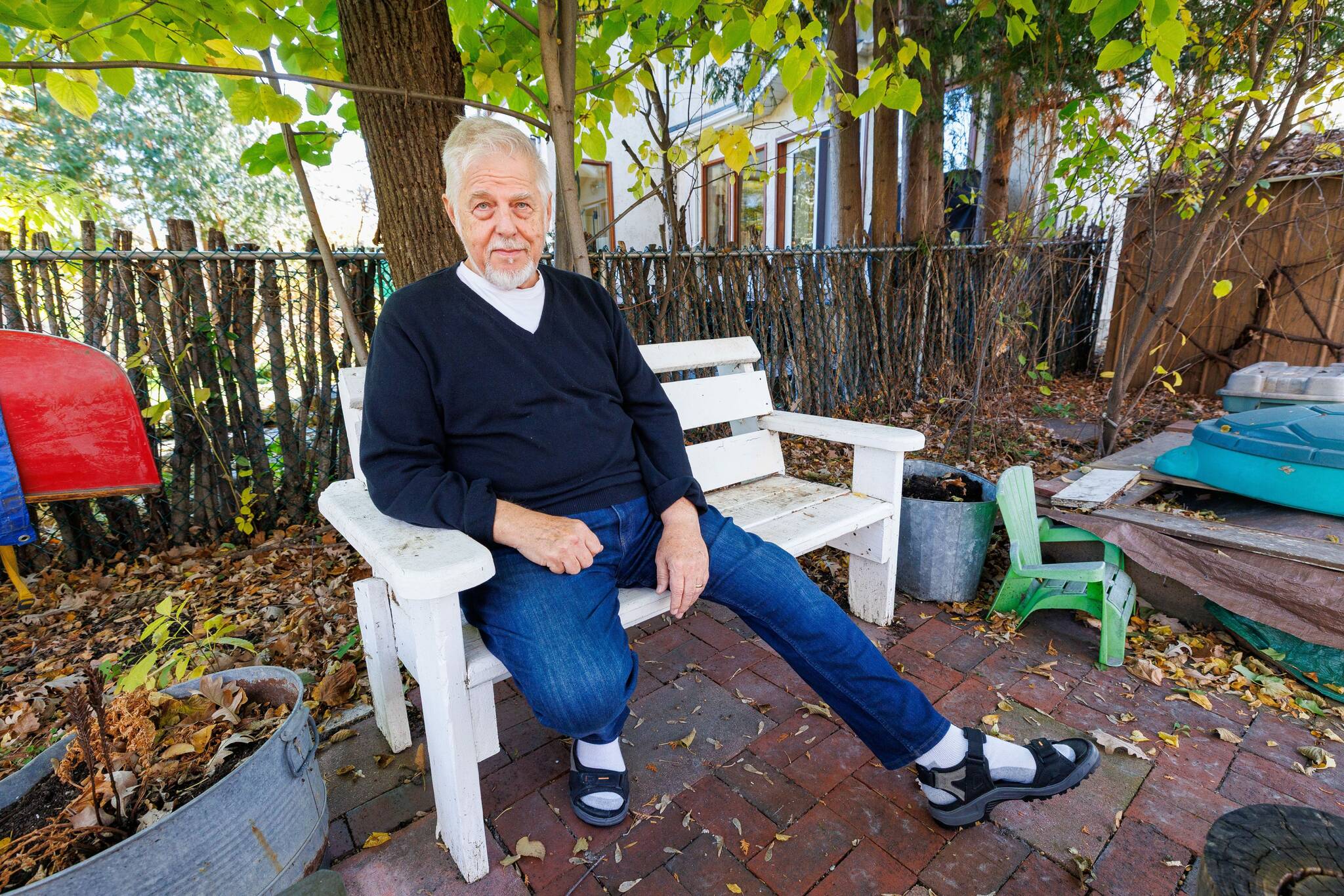
Sig Laser, a 77-year-old retired policy analyst, detects the image’s artifice quickly.
“Everything’s too glitzy … It’s AI-generated, but I don’t necessarily mind that. Otherwise, you got to pay Getty Images (a news and stock photo agency) for the use of it.”
Like Joanne, Laser’s not especially offended by this instance of generative AI and sees the use of AI in politics as a mixed bag.
He suggests the speed of AI responses and summaries offer informational advantages to voters but worries that too many users treat this as a “magic bullet” without checking them against their sources or alongside traditional media.
Joanne says that as a general rule she’s learned to always be skeptical of things she encounters online, but she feels AI adds a new dynamic of uncertainty.
“Technology can always be used for the common good … (but) the presentation of falsehoods is the scariest thing about AI, and getting the truth out is getting more and more difficult,” she says.
For Bridgman, the issue of AI in politics runs deeper than the potential spread of undetected falsehoods. He says it’s also about the loss of politicians’ and voters’ willingness to do the hard work of researching the issues through original and divergent sources, thinking critically about them and arriving at conclusions through their own reasoning.
“There is a cognitive offloading of what should fundamentally be a human endeavour — the collection and aggregation of public opinion and public preferences through democracy into governance — onto AI,” he says.
Beyond errors and deliberate manipulation, there’s also the matter of how AI frames political issues.
While traditional news platforms are sometimes accused of editorial bias, Bridgman observes a similar but more seamless dynamic with AI, only reflecting the biases of users themselves.
“The concern for a long time was around hallucination, and there’s still some hallucination. But actually, the much bigger problem is agreeability,” he says.
“It feels like you’re talking to something that has the potential to push back, but it very rarely does because fundamentally it is required to be compliant or obedient.”
For Bridgman this all-too-human undertone to AI also has a silver lining, a reminder that AI is still far from genuinely autonomous with all the dystopian dangers that could entail.
“AI, as a tool, is not entirely neutral. But, right now, we’re not in the AI-upper-tier world yet. We’re in a ‘humans are directing AI to help them in their campaigns,’” he says. “The worst has not come to pass.”
conrad.sweatman@winnipegfreepress.com

Conrad Sweatman is an arts reporter and feature writer. Before joining the Free Press full-time in 2024, he worked in the U.K. and Canadian cultural sectors and freelanced for outlets including The Walrus, VICE and Prairie Fire. Read more about Conrad.
Our newsroom depends on a growing audience of readers to power our journalism. If you are not a paid reader, please consider becoming a subscriber.
Our newsroom depends on its audience of readers to power our journalism. Thank you for your support.
Related Articles
News and views on upcoming elections for mayor, city councillor and school trustee