No small parts Hidden details fill artist’s miniature scenes
Read this article for free:
or
Already have an account? Log in here »
To continue reading, please subscribe:

Digital Subscription
One year of digital access for only $205*
- Enjoy unlimited reading on winnipegfreepress.com
- Read the E-Edition, our digital replica newspaper
- Access News Break, our award-winning app
- Play interactive puzzles
*First annual payment billed as $205.00 + GST for one year. This annual subscription will automatically renew at $233.00 + GST every 52 weeks (10% off the regular annual price of $259.35). Offer available to new and qualified returning subscribers only. Cancel any time.
To continue reading, please subscribe:
Add Free Press access to your Brandon Sun subscription for only an additional
$1 for the first 4 weeks*
- Enjoy unlimited reading on winnipegfreepress.com
- Read the E-Edition, our digital replica newspaper
- Access News Break, our award-winning app
- Play interactive puzzles
*Your next Brandon Sun subscription payment will increase by $1.00 and you will be charged $17.95 plus GST for four weeks. After four weeks, your payment will increase to $24.95 plus GST every four weeks.
Read unlimited articles for free today:
or
Already have an account? Log in here »
Hey there, time traveller!
This article was published 11/01/2024 (978 days ago), so information in it may no longer be current.
Canadian artist Kim Adams began building worlds with his miniature models as a kid in his mother’s vegetable garden.
“I had a typical boy period, building tanks and stuff,” says Adams, now 72. “I brought them outside and found that the carrot tops were about the right scale, looking like trees. I started interplaying these tanks, hiding in the trees.
“And then I got my brother’s lighter fluid and set the trees on fire.”

That sense of imagination and play — and flirtation with disaster — is evident in the assemblage artist’s work, particularly Earth Wagons, which is on view now at WAG-Qaumajuq.
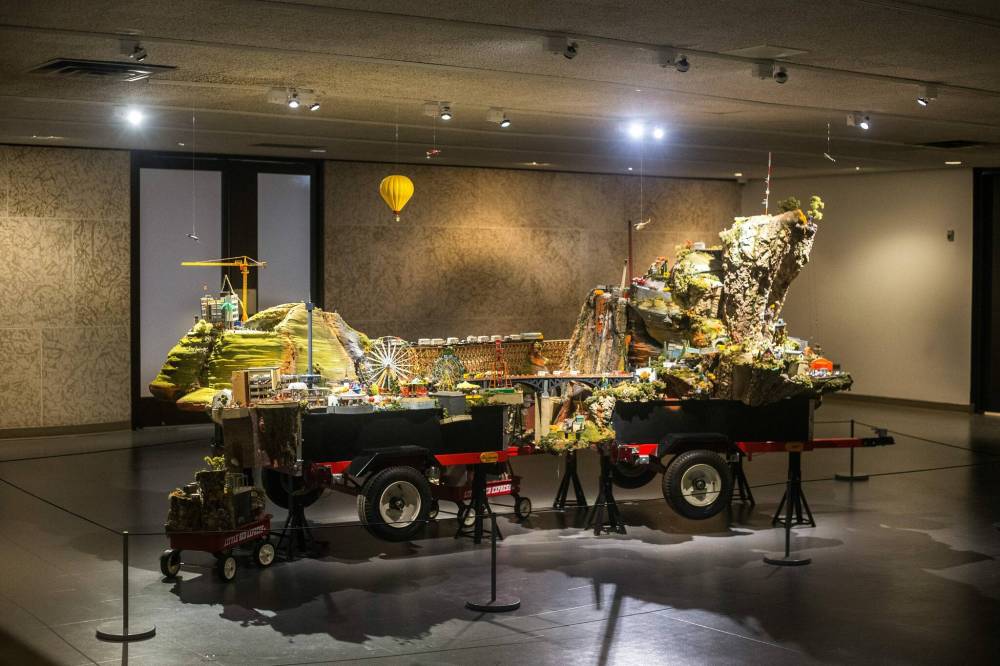
The sculpture, which was created over a period from 1989 to 1991 and is part of the Winnipeg Art Gallery’s collection, uses HO-scale (toy-train size) models to construct a world built on trailers and little red wagons.
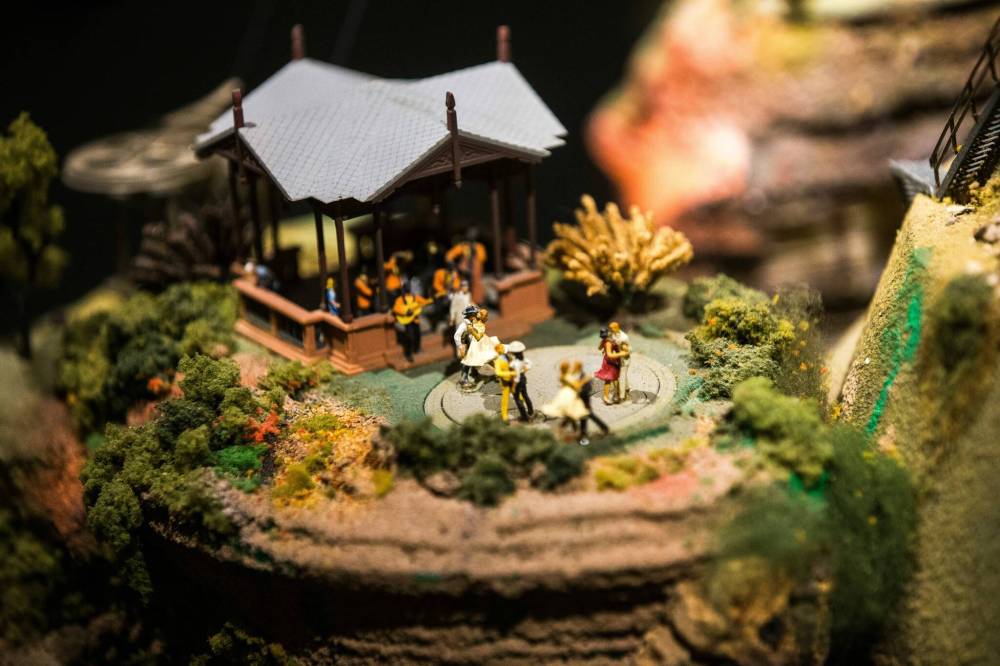
His miniature vignettes — carnivals, a square dance, a caravan of motorcyclists and endless construction — reveal a society humming along, teetering on the edge of oblivion. Just everyday people, living out their little lives, working and playing amid larger existential threats of their own creation. (Sound familiar?)
“I want everything to be on the edge,” Adams says over the phone from Toronto, where he’s based. “I didn’t want to get into that next step where everything becomes destroyed. Earth Wagons is somewhat positive, I would say. There’s one person jogging and there’s a truck going by and it’s got this clown on the back because it’s part of a circus. Everything’s a close call.”
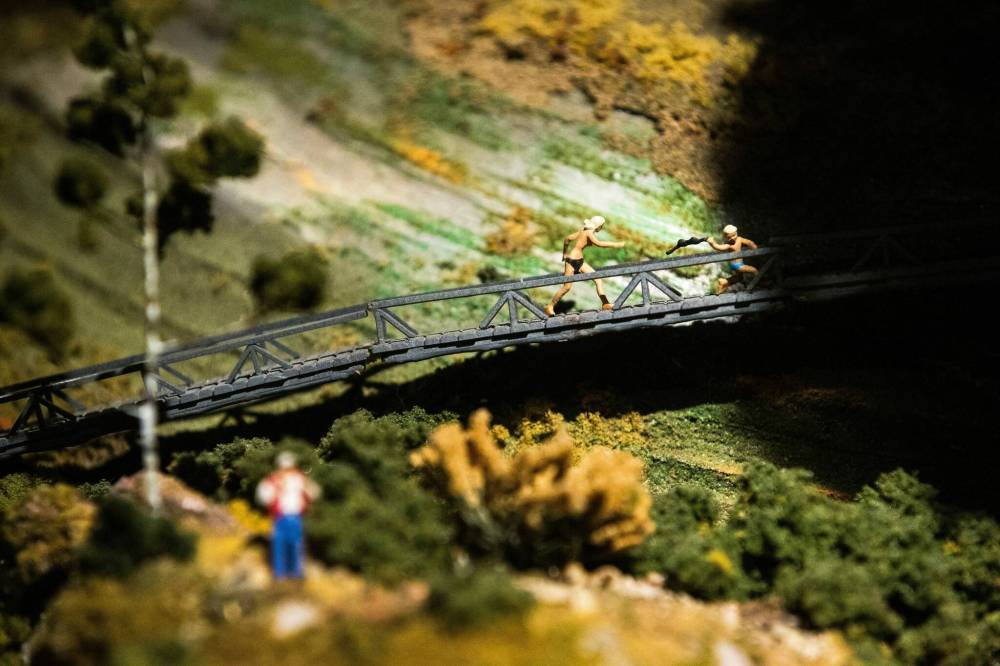
Humour also plays a big role in Adams’ work. In Earth Wagons, a teensy boy runs away with a woman’s black bikini top waving like a flag behind him with a teensy topless woman in hot pursuit.
Look closely, and you’ll find dozens of these tiny stories. The miniatures, particularly the people, were not placed at random. Adams’ figures must relate to each other — or to the viewer.
“There are people with binoculars and they’re looking out of Earth Wagons at you. I was trying to play with that space between the actual viewer and the fake viewer,” he says.
Adams also drew inspiration from other types of scale models, such as the maquettes used in architectural projects or film and theatre design, or engineering models such as the U.S. Army Corps of Engineers Bay Model, a working hydraulic scale model constructed in 1957 of the San Francisco Bay and Sacramento-San Joaquin River Delta System.
These types of scale models weren’t really considered “art” per se, more like tools, prototypes or first drafts. But Adams saw the art in them.
He was also inspired by the work of Winnipeg artist Eleanor Bond, whose own work explored urban landscapes and the impact of humans on the natural world.
Her 1989 oil painting Rock Climbers Meet with Naturalists on the Residential Parkade, for example, is an aerial view of a parkade carved into a mountain, spiraling into the sky.
Adams met her around that time, and was telling her how she should make models of her worlds.
“And she said, ‘Well, that’s you — you should do it,’” he recalls with a laugh. “It was right in front of my nose, but she’s the one that poked the nose and said, ‘This is what you should do.’
“On the top of the piece, there’s a higher part of the mountain. In kitty litter I spelled out Mount Bond. So it’s somewhat dedicated to her, too.”
Earth Wagons was the precursor of Adams’ most well-known — and ambitious — work: the Bruegel-Bosch Bus, a permanent and ongoing installation at the Art Gallery of Hamilton.
Adams has been working on the bus since 1996, visiting AGH twice a year to add to his intensely detailed apocalyptic megalopolis that spills out of a 1959 Volkswagen bus.
“It’ll never be done,” he says.
The bus is named for Netherlandish Renaissance artists Pieter Bruegel and Hieronymus Bosch, who painted elaborate scenes — or, in Bosch’s case, nightmarish hellscapes — densely populated by people going about their day-to-day lives, and indulging in all that makes them human, the horror and the sublime around them.
Those influences can be seen in Adams’ work. His towering skyscrapers — complete with a menacing Godzilla — echo Bruegel’s The Tower of Babel. The miniature vignettes — an in-progress funeral, an ice cream cart, animals making their grand escape from train cars — are tiny, self-contained stories about people oblivious (or perhaps resigned) to the fact their society is built, say, on overflowing wagons, or a bus being driven by a skeleton.
Adams relishes talking to people when he’s at the AGH, tinkering away on the bus, which is one of the gallery’s most-visited works.
“I’m meeting people who grew up on it now,” Adams says. “It’s so unexpected, but the whole situation is very special.”
Earth Wagons can be found on the mezzanine level of the WAG building.
jen.zoratti@winnipegfreepress.com

Jen Zoratti is a columnist and feature writer working in the Arts & Life department, as well as the author of the weekly newsletter NEXT. A National Newspaper Award finalist for arts and entertainment writing, Jen is a graduate of the Creative Communications program at RRC Polytech and was a music writer before joining the Free Press in 2013. Read more about Jen.
Every piece of reporting Jen produces is reviewed by an editing team before it is posted online or published in print – part of the Free Press‘s tradition, since 1872, of producing reliable independent journalism. Read more about Free Press’s history and mandate, and learn how our newsroom operates.
Our newsroom depends on a growing audience of readers to power our journalism. If you are not a paid reader, please consider becoming a subscriber.
Our newsroom depends on its audience of readers to power our journalism. Thank you for your support.