Many lenses on West Broadway Exhibition of Art City photos and art chronicles 25 years of artists, residents and community portraits
Read this article for free:
or
Already have an account? Log in here »
To continue reading, please subscribe:

Digital Subscription
One year of digital access for only $205*
- Enjoy unlimited reading on winnipegfreepress.com
- Read the E-Edition, our digital replica newspaper
- Access News Break, our award-winning app
- Play interactive puzzles
*First annual payment billed as $205.00 + GST for one year. This annual subscription will automatically renew at $233.00 + GST every 52 weeks (10% off the regular annual price of $259.35). Offer available to new and qualified returning subscribers only. Cancel any time.
To continue reading, please subscribe:
Add Free Press access to your Brandon Sun subscription for only an additional
$1 for the first 4 weeks*
- Enjoy unlimited reading on winnipegfreepress.com
- Read the E-Edition, our digital replica newspaper
- Access News Break, our award-winning app
- Play interactive puzzles
*Your next Brandon Sun subscription payment will increase by $1.00 and you will be charged $17.95 plus GST for four weeks. After four weeks, your payment will increase to $24.95 plus GST every four weeks.
Read unlimited articles for free today:
or
Already have an account? Log in here »
Hey there, time traveller!
This article was published 17/05/2024 (823 days ago), so information in it may no longer be current.
Each Monday afternoon in West Broadway, a collection of shutterbugs — some as young as six, others older than the film cameras in their hands — flutters out the doors of Art City to capture a photographic survey of themselves and the neighbourhood around them.
They march out the front door of the non-profit arts centre and tilt their lenses in all directions, finding views that define the visual identity of an often misunderstood and misrepresented slice of Winnipeg, a neighbourhood as tight-knit and vital as any in the city.
Over the course of 25 years, hundreds of participants have taken the same weekly excursion as part of Art City’s free photography program, venturing out of the neon box at 616 Broadway before returning with unrealized visions — of trees, of streetlights, of apartment blocks, of butcher-shop signage — to the pools of the dark room.
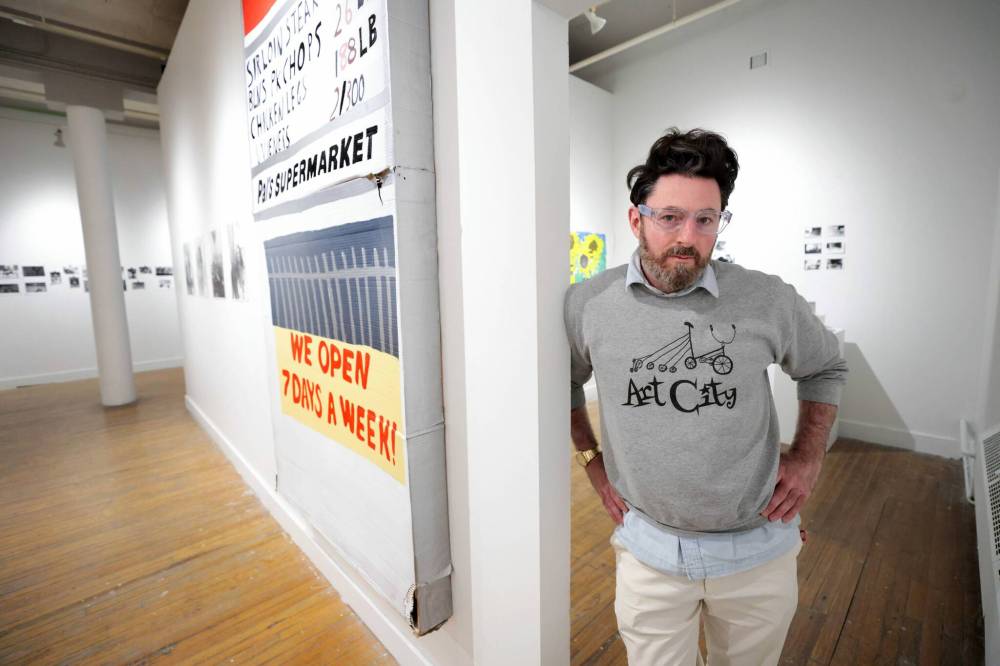
Artistic director Eddie Ayoub says Art City’s aim of providing an artistic outlet for West Broadway residents also achieved a chronicle of the neighbourhood from 1998 to present.
“One of the byproducts of having this photography program is that we have created a chronicle of West Broadway from 1998 to present,” says artistic director Eddie Ayoub, who started volunteering with the organization in 2003.
Outside at Young and Broadway, a new exhibit on view until June 1 at the Platform Centre (121-100 Arthur St.), tells three stories — of a neighbourhood, of an organization and of a generation — all at once.
Shortly after it was founded in 1998 by artist and organizer Wanda Koop, who became a member of the Order of Canada in 2006, Art City — formerly the location of an LGBTTQ+ nightclub and a short-lived bike-repair shop — became a nucleus of creativity in the neighbourhood, drawing visitors in search of a safe place to explore their artistic identities.
Around that time, a 23-year-old industrial arts grad named Monique Lysak set up a tiny darkroom in a closet in Art City’s basement with the help of Photo Central’s then-owner, Dick Toews.
With donated supplies, Lysak started showing Art City participants how to make photograms, which are prints made by laying objects onto photo paper and exposing them to light.
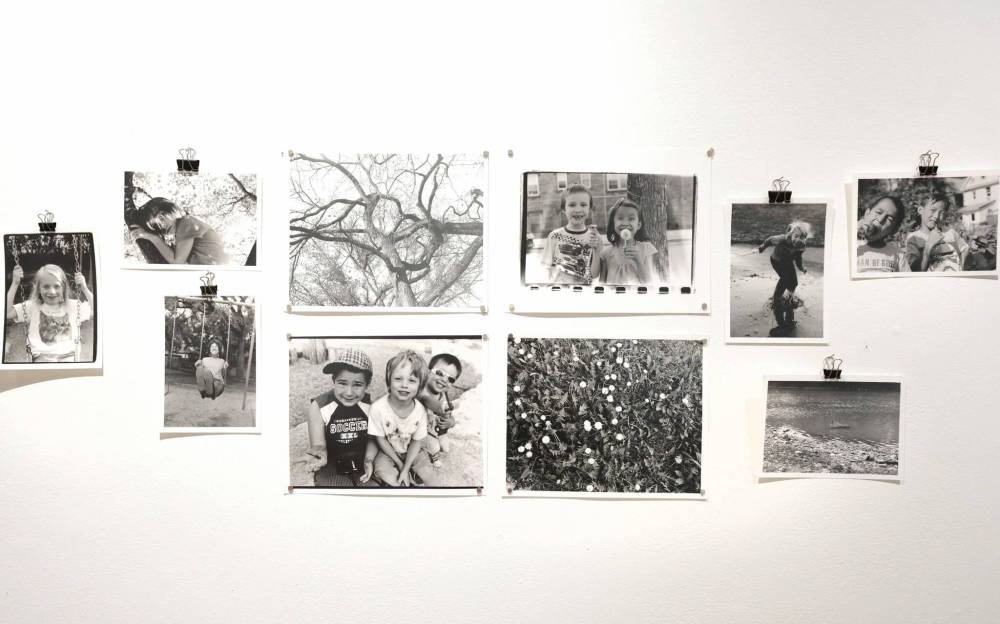
Harking back to John Paskievich’s celebrated North End photography, Outside at Young and Broadway’s collection of Art City photos chronicles West Broadway.
“It’s sort of like painting with light,” says Lysak, who now teaches graphic arts in the Louis Riel School Division.
At that time, Lysak says, it was cheaper to develop black-and-white film than it was to develop colour film, a market that was cornered by big-box stores anyhow.
Expenses and availability led the photography program to lean into the noir style, which even then might have felt like a throwback to an earlier era.
When the participants started to shoot photographs of their own, the results were impressive and meaningful, Lysak says.
“It’s always an awe-inspiring moment to see the image come to life on paper,” she says.
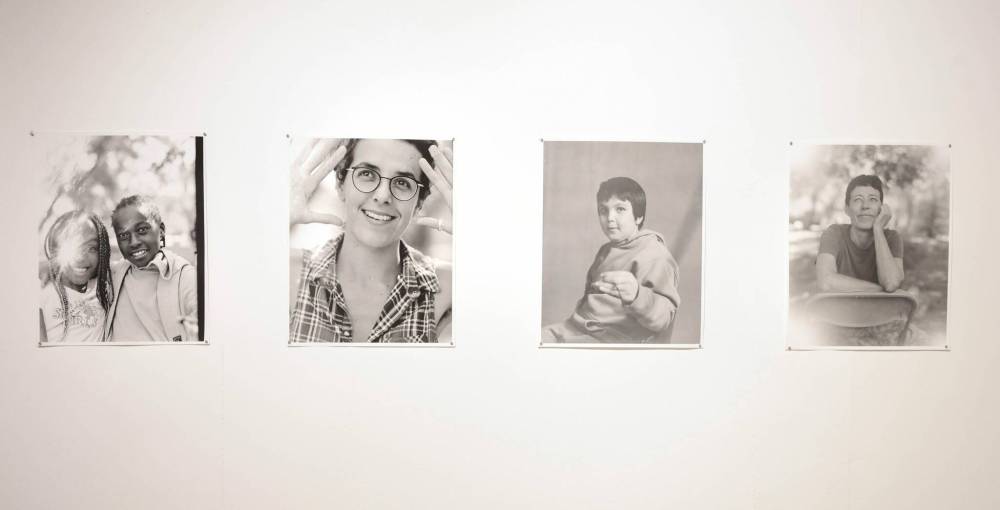
Art City’s film and photography program dates back to cash-strapped black-and-white days, but evolved to include colour.
“Everyone felt very honoured to have the (cameras) and be able to use them. It was really eye-opening for them. They felt trusted and worthy.”
Over the ensuing quarter-century, several instructors and volunteers continued to keep the program alive, Ayoub says.
Before current instructor Natalie Baird took over in 2016, instructors included Lindsey Bond, Mandy Malazdrewich, Antoinette Dyksman, Alix Reynolds and David Wityk, while volunteers such as Robert Wilson, Duncan McNairnay and Alexis L. Grise were among those who lent the program their time, expertise and equipment.
The photo exhibit itself begins outside the gallery space, where visitors are greeted by a towering model of the streetlight, pedestrian signals and street signs at the corner of Broadway and Young Street, built by Art City participants mostly out of wood, cardboard and duct tape. The glowing green light is an invitation to come inside.
In the gallery, the soft quality of the photographs — selected by co-curators Ayoub and Baird, along with the participants — is a welcoming force, asking visitors to look up and about while exploring two faces at work and at play: the literal faces of program participants and neighbourhood denizens, but also the face of the neighbourhood itself, detailed subtly through changing fashions, streetside vehicles and commercial typography.
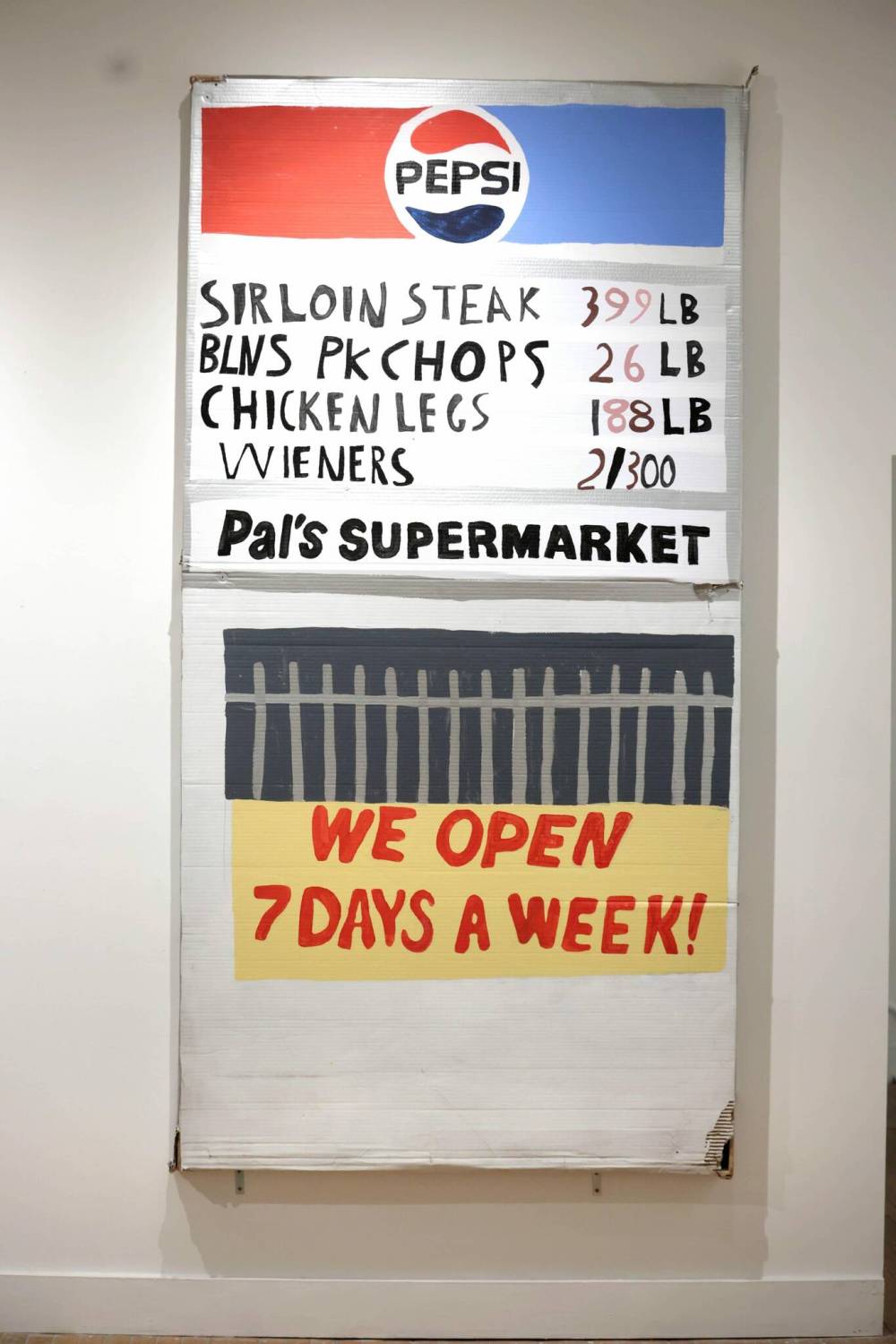
A hand-painted, cardboard re-creation of the Pal’s Supermarket sign.
This type of lived-in, documentarian quality calls to mind John Paskievich’s celebrated photographic chronicle of the North End, except this collection is told through multiple perspectives, often with a retention of “imperfections,” which keeps the exhibit feeling as loose, accepting and freewheeling as the program itself must be.
One highlight is a series of self-portraits shot by young participants, including a diptych of two smiling girls embracing. In the photo on the left, neither is looking at the camera, and the image came out crystal clear. In the photo on the right, both girls make direct eye contact with the camera, but their faces are distorted by a burst of light. Neither picture is “better,” but both are lovely representations independent of each other, reflecting the nostalgic joy of flipping through an old family album and being grateful Baba Molly decided to hang on to the outtakes.
In a room tucked to the side of the back wall, a series of eerie prints are organized above canisters, but the centrepiece is a touching, hand-painted — with brushes and sponges — reproduction of the sunflower mural on the west side of the Manitoba Housing apartment complex at Broadway and Young. One section is obscured by a blur of green, where Ayoub says a participant was “furiously” painting the tree that covered the paint underneath.
Another highlight is the participants’ hand-painted, cardboard re-creation of the east-facing sign at Pal’s Supermarket, which looked onto Young Street for years but was removed during a recent renovation.
Made with cardboard, paint and duct tape, it’s a pitch-perfect piece of urban folk art, retaining the charm of the original Pepsi-coloured signage right down to time-faded numbers and permanently ingrained grammatical oddities, such as “BLNS PK CHOPS” or “WE OPEN 7 DAYS A WEEK!”
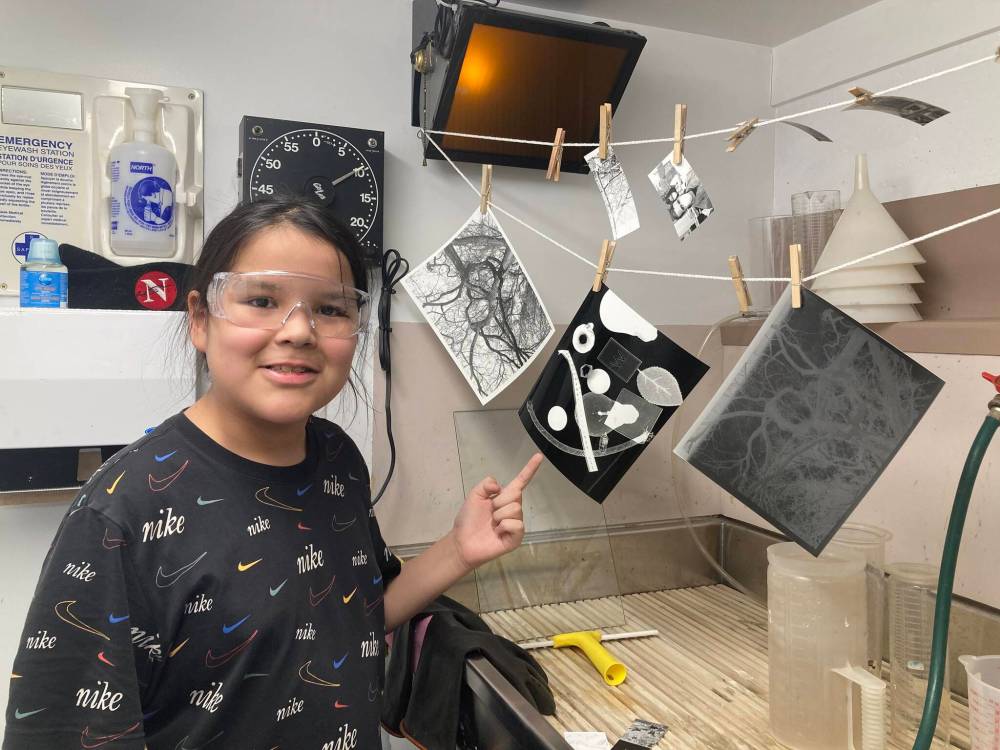
A young Art City participant
Walking through the exhibit feels just like walking through West Broadway, which is a testament to both Art City’s influence and to the neighbourhood’s beautifully anti-picturesque sensibilities.
ben.waldman@winnipegfreepress.com

Ben Waldman is a National Newspaper Award-nominated reporter on the Arts & Life desk at the Free Press. Born and raised in Winnipeg, Ben completed three internships with the Free Press while earning his degree at Ryerson University’s (now Toronto Metropolitan University’s) School of Journalism before joining the newsroom full-time in 2019. Read more about Ben.
Every piece of reporting Ben produces is reviewed by an editing team before it is posted online or published in print — part of the Free Press‘s tradition, since 1872, of producing reliable independent journalism. Read more about Free Press’s history and mandate, and learn how our newsroom operates.
Our newsroom depends on a growing audience of readers to power our journalism. If you are not a paid reader, please consider becoming a subscriber.
Our newsroom depends on its audience of readers to power our journalism. Thank you for your support.