Meta-theatrical comedy Iago Speaks gives voice to Bard’s bit player Post-Othello action handled wisely and well in terrific two-hander
Read this article for free:
or
Already have an account? Log in here »
To continue reading, please subscribe:

Digital Subscription
One year of digital access for only $205*
- Enjoy unlimited reading on winnipegfreepress.com
- Read the E-Edition, our digital replica newspaper
- Access News Break, our award-winning app
- Play interactive puzzles
*First annual payment billed as $205.00 + GST for one year. This annual subscription will automatically renew at $233.00 + GST every 52 weeks (10% off the regular annual price of $259.35). Offer available to new and qualified returning subscribers only. Cancel any time.
To continue reading, please subscribe:
Add Free Press access to your Brandon Sun subscription for only an additional
$1 for the first 4 weeks*
- Enjoy unlimited reading on winnipegfreepress.com
- Read the E-Edition, our digital replica newspaper
- Access News Break, our award-winning app
- Play interactive puzzles
*Your next Brandon Sun subscription payment will increase by $1.00 and you will be charged $17.95 plus GST for four weeks. After four weeks, your payment will increase to $24.95 plus GST every four weeks.
Read unlimited articles for free today:
or
Already have an account? Log in here »
Hey there, time traveller!
This article was published 15/06/2024 (844 days ago), so information in it may no longer be current.
Comedy walks a rapier’s edge with human pathos in Daniel Macdonald’s cleverly conceived, often brilliant play Iago Speaks.
The two-hander directed by Rodrigo Beilfuss, Shakespeare in the Ruins’ artistic director, opened Friday night as second offering of the company’s 2024 season, performed al fresco within the crumbling walls of the burned-out monastery with an apropos pre-show medieval chant.
Theatre review
Iago Speaks
Shakespeare in the Ruins
Trappist Monastery Provincial Heritage Park
To July 7
★★★★ 1/2 out of five
Named for the Bard’s heinous villain from Othello, the 90-minute play (sans intermission) references the quintessentially Machiavellian antagonist’s pledge to stony silence before being whisked off to prison by the Jailor: “From this time forth I never will speak word.”
Well, nearly a full 30 minutes into the narrative, he finally does burst into poetic verse. However, the show — given its première by Shakespeare on the Saskatchewan in August 2022 — is essentially an ode to the Elizabethan playwright’s more shadowy bit characters, literally giving voice to those generic swordsmen, guards and functional roles simply dismissed as “others” in the canon.
NIC ADAM / FREE PRESS Joshua Beaudry plays the Jailor, a minor character in Othello but a leading man in Iago Speaks.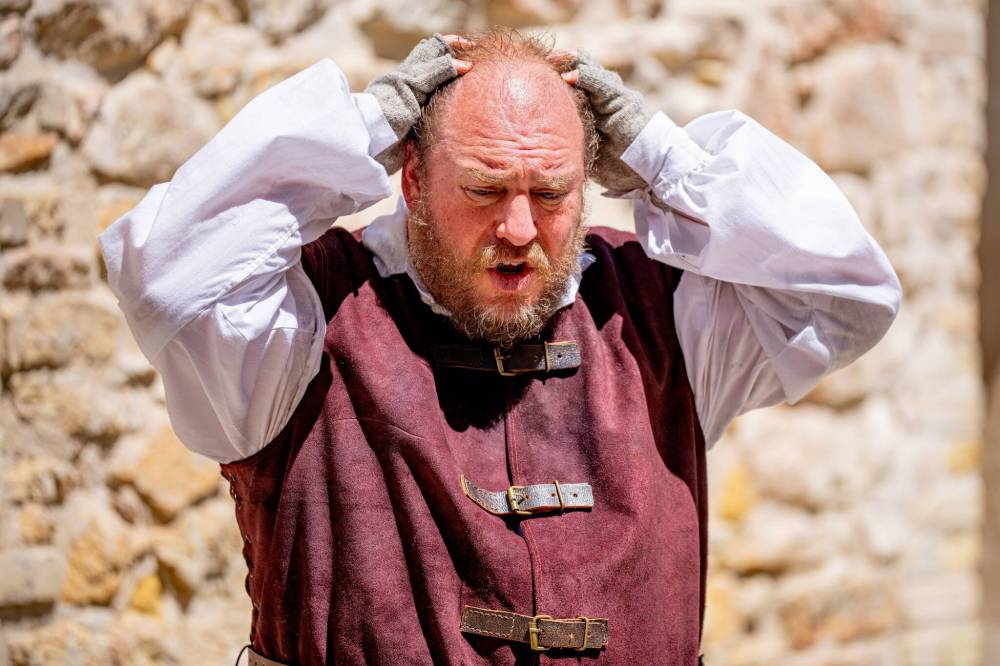
There could be no finer cast to bring this original story to life than the riveting Saskatchewan-based actor Joshua Beaudry, who reprises his role as the Jailor (beginning with a half-hour monologue delivered flawlessly) and Winnipeg’s own Arne MacPherson, who crafts a brooding, sulking Iago as a powder keg ready to blow, caged behind his prison bars, compelling even in his initially silent, “less-is-more” portrayal.
The fact that both artists currently play Bottom the Weaver/Egeus and Oberon/Peter Quince, respectively, in SiR’s alternating production, A Midsummer Night’s Dream — performed in repertory throughout early July — is a testament to their acting chops, not to mention sheer stamina and nerves of steel.
NIC ADAM / FREE PRESS 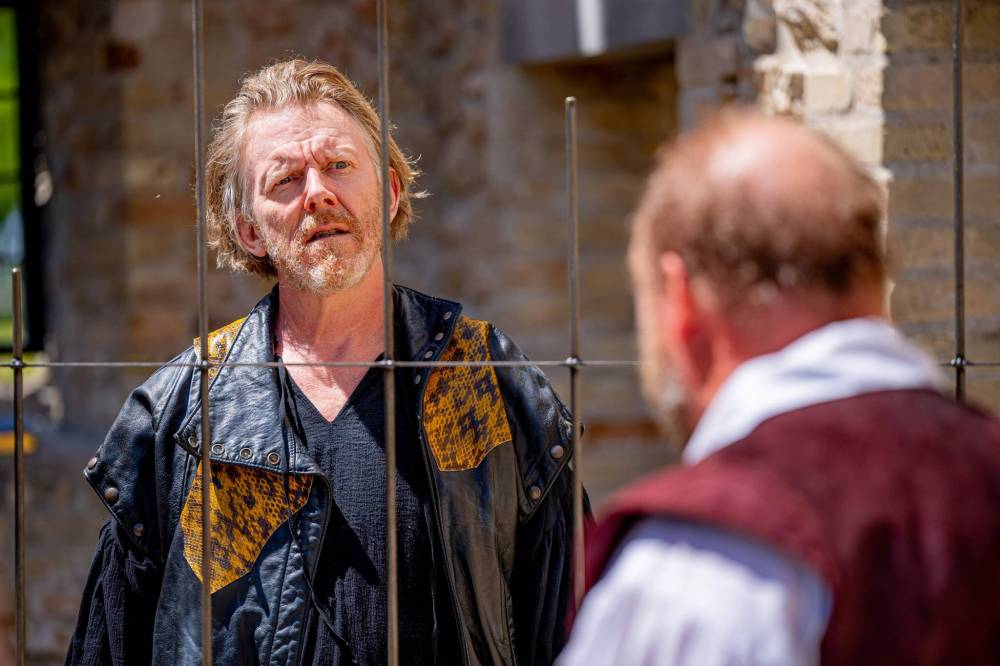
Saskatchewan playwright Macdonald’s script, evoking the existential timelessness of Samuel Beckett’s Waiting for Godot, morphs between an imagined sequel to Othello and a thoughtful discourse on the art of theatre, including the nature of live performance itself.
It’s most potent when the Jailor seeks his purpose in life, ruing that he “always misses the good stuff” in “those things,” including the “Othello story,” as a self-identified “afterthought, an appendage.”
One-line zingers abound, such as Beaudry’s “I’m no actor, I’m just the Jailor,” paralleling real-life, such as when his character, played as a clownish Everyman, takes ownership over his own life and metaphorically realizes “perhaps it’s up to me to start the drama,” before concocting a play-within-a-play, à la Dream’s Pyramus and Thisbe with his prisoner.
NIC ADAM / FREE PRESS 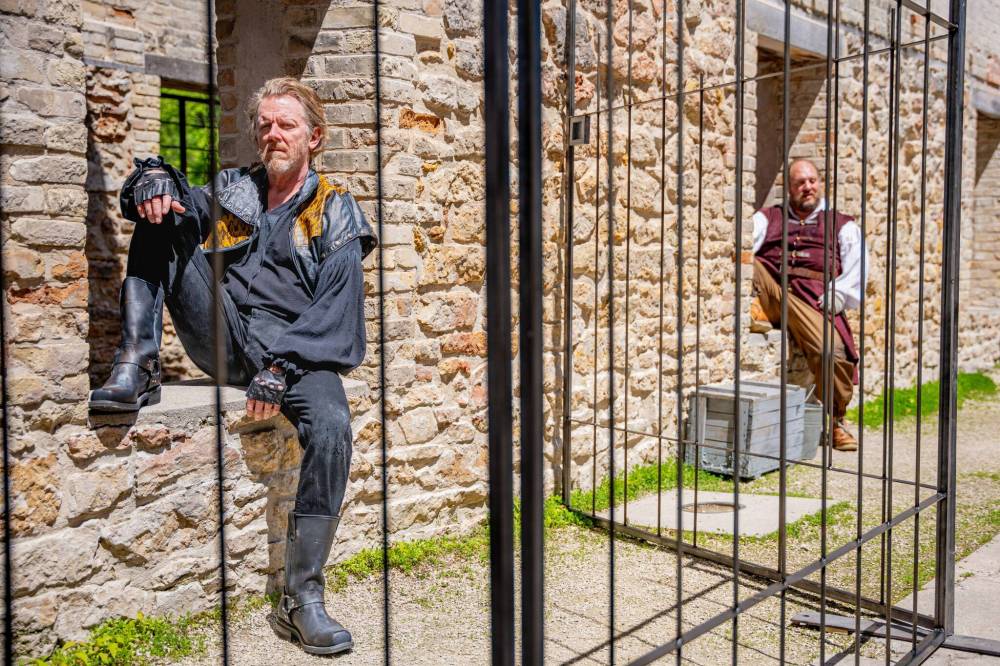
It’s also poignant when the Jailor gives himself a name — Bruce, in this case — speaking to perennial quests for self-identity and actualization whether one is a thespian or not.
Admittedly, some of the briskly paced play’s finer points are glossed over. It’s not entirely clear why Iago suddenly “sees” the audience touted by the Jailor, which suddenly thrusts him into his captor’s conjured world of make-believe while propelling the narrative forward.
The Jailor, a rebel against the status quo, frequently breaks the fourth wall, bringing the viewers into the action as witnesses or co-conspirators who affirm his very existence.
Leif Norman photo Joshua Beaudry (left) and Arne MacPherson are stuck in a Shakespearean slammer in Iago Speaks.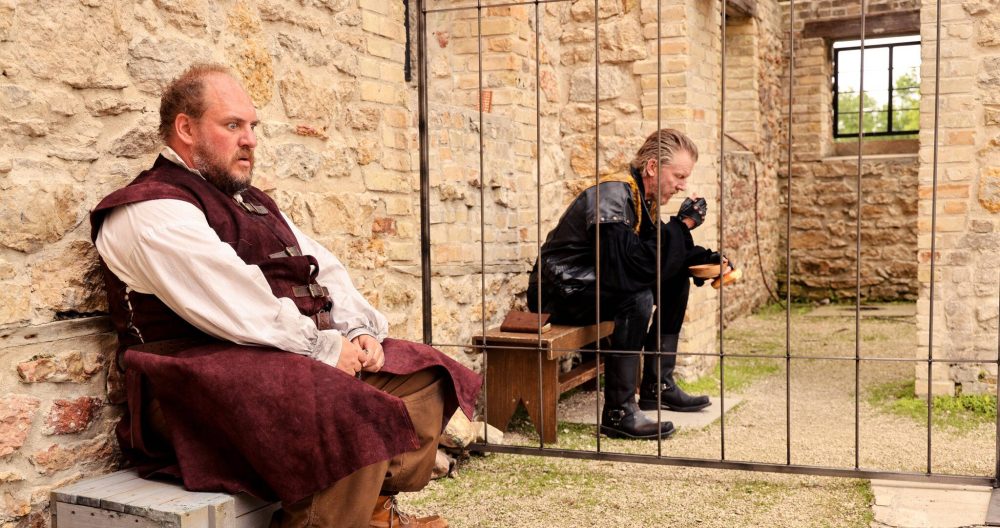
Other scenes lag and drag at times, including a recap of the plot/ending of Hamlet, although the exchange — in which the more prosaically inclined Jailor challenges Iago for his flowery, quintessentially Shakespearean speech (kudos to Macdonald for pulling off its idioms and idiosyncrasies) — shines a light on the power of language and communication, and the way words themselves can become weapons.
Beaudry’s “You take 18 words to say three,” whined to MacPherson, is one of the funniest lines.
Broad-stroke comedic flourishes — including plenty of sight gags, re-enactments of various bodily functions and actors’ warm-up rituals, delivered with a wink and a nudge — colour the action with visceral authenticity and elicited loud guffaws from opening night’s capacity audience.
Leif Norman photo Joshua Beaudry (left) as the Jailor and Arne MacPherson as Iago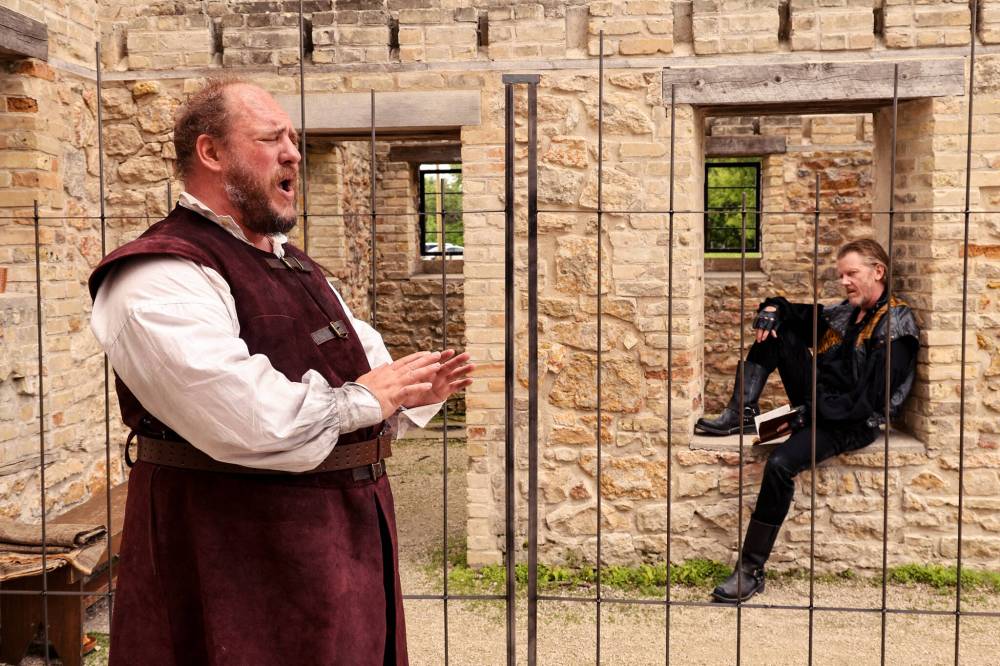
So does Beaudry’s freewheeling interactions with individual audience members, adding an element of “danger” to sitting close to the stage area that should be noted.
The production also boasts effective sets and props designed by Kate George, period costumes by Brenda McLean, with fight direction by Jacquie Loewen.
Pundits have mused for generations about why Iago, in the Bard’s original tragedy, chooses at the end to opt for power in silence. Some have surmised it’s the ultimate feat, the character leaping to life while holding fast to the secret regarding his murderous motivations in killing Desdemona and Emilia.
He’s alive and well in Iago Speaks, with the notorious bad guy ultimately calling the shots, just as he has in the four centuries since Shakespeare penned Othello in 1603. Macdonald’s clever trick ending adds a postmark to this love letter to those — either real or living solely in playwrights’ imagined worlds — still searching for their own voice, “speaking word” as their own self-determination that never grows old.
holly.harris@shaw.ca
Holly Harris writes about music for the Free Press Arts & Life department.
Our newsroom depends on a growing audience of readers to power our journalism. If you are not a paid reader, please consider becoming a subscriber.
Our newsroom depends on its audience of readers to power our journalism. Thank you for your support.