Delivering on a vision Departing head of Winnipeg Arts Council a fierce supporter of city’s cultural community
Read this article for free:
or
Already have an account? Log in here »
To continue reading, please subscribe:

Digital Subscription
One year of digital access for only $205*
- Enjoy unlimited reading on winnipegfreepress.com
- Read the E-Edition, our digital replica newspaper
- Access News Break, our award-winning app
- Play interactive puzzles
*First annual payment billed as $205.00 + GST for one year. This annual subscription will automatically renew at $233.00 + GST every 52 weeks (10% off the regular annual price of $259.35). Offer available to new and qualified returning subscribers only. Cancel any time.
To continue reading, please subscribe:
Add Free Press access to your Brandon Sun subscription for only an additional
$1 for the first 4 weeks*
- Enjoy unlimited reading on winnipegfreepress.com
- Read the E-Edition, our digital replica newspaper
- Access News Break, our award-winning app
- Play interactive puzzles
*Your next Brandon Sun subscription payment will increase by $1.00 and you will be charged $17.95 plus GST for four weeks. After four weeks, your payment will increase to $24.95 plus GST every four weeks.
Read unlimited articles for free today:
or
Already have an account? Log in here »
Hey there, time traveller!
This article was published 18/11/2024 (640 days ago), so information in it may no longer be current.
For a gal from Regina, Carol A. Phillips sure champions this city’s arts community like a Winnipegger.
For the past 18 years, Phillips has been the executive director of the Winnipeg Arts Council, the arm’s-length agency of the City of Winnipeg tasked with managing the city’s public art policy and distributing funding to artists and organizations.
She would probably tell you her job is to make sure the arts in this city are properly funded and that artists are properly paid, but through that work, she has shaped the cultural identity of this city.
“Her care for art and artists is unparalleled.”–Shawna Dempsey
In the spring, Phillips, 79, announced that she would be retiring this fall. She’s characteristically matter-of-fact about it.
“I’ve worked in the arts for many, many decades,” she says over the phone from her new home in Alberta.
“And, I mean, it’s time. You have to move on sooner or later, so I just thought that I would bite the bullet and do it.”
MIKAELA MACKENZIE / FREE PRESS Carol Phillips first moved to the city in 1985 to be the director of the Winnipeg Art Gallery. She's been executive director of the Winnipeg Arts Council for 18 years. 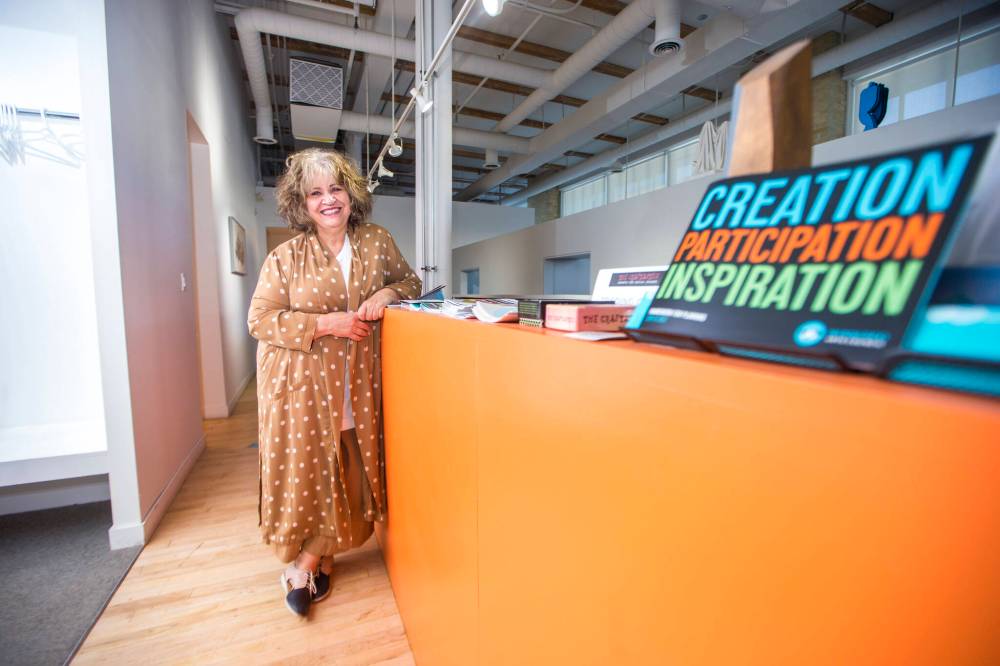
Phillips’ legacy is long, and her influence can be seen and keenly felt all over the city — in placemaking public art, yes, but also in the existence of an arts community.
“I think that Winnipeg’s vibrant arts community is a result of individuals and small organizations forming connections with each other — supporting each other and being each other’s audience,” says Ian August, the Métis artist behind the public artwork Rooster Town Kettle and a WAC board member.
“That type of thing takes time, requires that small venues and organizations can keep the doors open, and that individual artists have the space to create. I think it has been vibrant for so long, in part, thanks to Carol’s influence and her strong advocacy for stable arts funding.”
Another big piece of her legacy is the establishment of the annual Mayor’s Luncheon for the Arts and Winnipeg Arts Council Awards, which, since 2007, has recognized excellence and creativity in the Winnipeg arts scene.
In 2024, each award came with a $5,000 prize.
“I don’t want to take credit,” she demurs. There are other events like it, she says, and the premise is simple.
But the Mayor’s Luncheon for the Arts is a chance, every year, for artists from across disciplines to get together in the same room and acknowledge and celebrate each other — even if the actual mayor is a no-show.
“You know, that only happened twice,” she says with a laugh.
The event also serves as a striking reminder to the city of all the people that contribute to the arts in Winnipeg, of all they do to shape its identity.
“Winnipeg rides the coattails of the arts, really, without making the investment and commitment that is necessary,” Phillips says.
Phillips worked tirelessly to make those kinds of investments and commitments happen because she herself was committed. She rolled up her sleeves and did the work.
“Carol has been an inspiration of commitment and professionalism in the arts in Winnipeg for decades. Her care for art and artists is unparalleled, as is her rigour in making sure art is appropriately valued. Her vision is responsible for having made so much happen here. She has been a titan, setting the bar high, demanding that we all do better and create a more creative city,” says Shawna Dempsey, visual artist and the co-executive director of MAWA.
“I could go on and on…”
Carol Phillips — then Carol Alecxe — grew up in Regina’s East End, which she describes as being like Winnipeg’s North End, as the eldest of three. She’s loved art in all of its forms for as long as she can remember.
“It’s not that culture wasn’t constant in my family, but it wasn’t the ‘Oh, you know, now we must go to the museum or the art gallery or the concerts or the theatre’ sort of thing. But there was always music,” she says.
She also loved to draw. Her medium was mostly crayon on paper back then — “and occasionally, if it was a very special time of year, we got to paint,” she says — and she was good at it.
“I was one of those insufferable children who was always winning the prizes. I loved it.”
Phillips went on to study graphic arts at her technical high school in Regina and would return to the province to earn a bachelor’s degree in art history from the University of Saskatchewan.
But it was when she went to study visual arts at the Ontario College of Art (now OCAD) that her world cracked open. Toronto, with all of its museums and galleries, animated her.
“You know, going to the old Royal Ontario Museum — we had a weekly class there, down in the depths, and I was just entranced. And then it just kind of built from there, until it was the world that I thought was made for me,” she says.
Phillips’ first major gig in the arts was as the director of the MacKenzie Art Gallery in Regina, where she co-curated the groundbreaking 1982 exhibition New Work by a New Generation with Saulteaux First Nations artist Robert Houle and Métis painter Bob Boyer. It was the first major exhibition of contemporary Indigenous art from North America.
“I’m tremendously proud of that,” she says.
RUTH BONNEVILLE / FREE PRESS FILES Local artist Ian August finishes installing his sculpture Rooster Town Kettle, an example of the public art championed by Carol Phillips.
Championing Indigenous art has always been at the forefront for Phillips. For her, it’s a no-brainer.
“It’s always been one of the easiest acknowledgements to make because the art is there, the art is good, and it has to be seen.”
Phillips came to Winnipeg in 1985 to be the director of the Winnipeg Art Gallery.
“And I was six months pregnant,” she says with a laugh.
“Coming from Regina, Winnipeg seemed that much more cosmopolitan. The Winnipeg Art Gallery was a great attraction, one of the best in Western Canada with a fabulous permanent collection and, of course, the great modernist statement of a building. So it was a real opportunity for me.”
And then, in the early 1990s, another opportunity came knocking: a position as vice-president and director of the Banff Centre for the Arts. Phillips had been there as a participant and loved the very idea of it. Directing it, then, was a dream.
Banff was also a fresh start. Phillips’ husband, Ian Phillips — whom she met in university — had passed away, and her children were young.
“It seemed like a real opportunity for all of us as a family — and it was,” she says.
Living in the national park was a privilege, she says.
But Winnipeg was calling again. In 2001, she managed Canada’s award-winning representation by Plug In ICA at the Venice Biennale and stayed on a few more years to work on the gallery’s transition from artist-run centre to an Institute of Contemporary Art.
And then, in 2006, she took the helm of the Winnipeg Arts Council.
It’s clear, when she talks about her time at WAC, that Phillips is proud of her “small but mighty” team and all it has been able to do.
“We were not only able to funnel dollars into the system, but also work on creative projects in partnership with organizations and individual artists, always, to come up with new ways of public engagement. So that, I think, distinguishes Winnipeg Arts Council from other like bodies,” she says.
Winnipeg’s designation as the Cultural Capital of Canada in 2010 is also an accomplishment of which she’s very proud.
April Carandang photo Artists Lorri Millan (left) and Shawna Dempsey (right) accept their Career Achievement award at the 2023 Mayor’s Luncheon for the Arts, an initiative spearheaded by Carol Phillips (centre).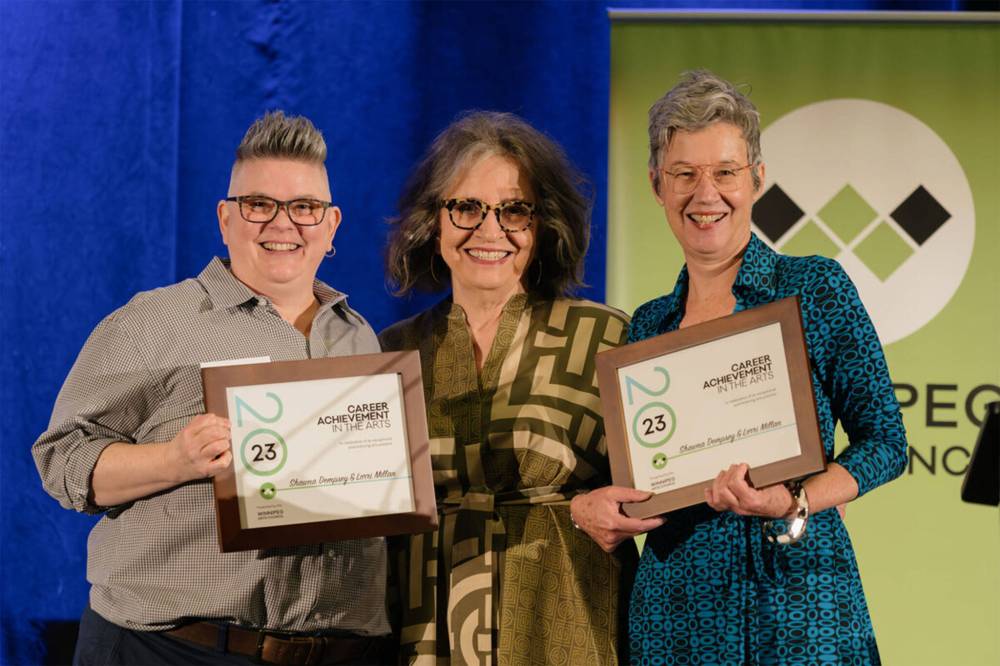
“We were able to bring several million dollars into the arts community and it was a couple of years of some pretty sensational programming that benefited all of the arts community and everyone who lived in Winnipeg and chose to take part.”
Phillips recently moved to Cochrane, Alta., just outside of Calgary, to be close to her daughter and her young family. She has three adult children — a daughter and two sons — and four grandchildren: three in Alberta and one in Minneapolis-St. Paul.
But she still thinks about Winnipeg. There are things that still concern her. The abandonment of the Pantages Playhouse Theatre, for one. The state of public art funding in general, for another.
“The arts in Winnipeg have always, to use an overused term, reached beyond their means with so little, but is that a good thing, really? Because now the expectation is, well, you don’t really need that much. Look how good you are with the little investment that takes place,” she says.
Phillips says survival in the arts sector is a constant process of education and promotion and marketing and development. People often describe her as tireless; it’s because she’s had to be.
“And I’m only speaking with decision makers in government who have the authority on how or why to fund the arts. There’s short memory syndrome in that sector, so it has to be constant. If you are going to be an arts administrator, you are responsible for making sure the whole sector survives.”
In October, Phillips was feted with the 2024 Cultural Leadership Award from the Creative City Network of Canada, a national award that “recognizes individuals who have made significant contributions to local cultural planning, programs and services, demonstrating inspired leadership and a deep dedication to advancing the vision of creative cities.”

It’s a huge, well-deserved honour, says Winnipeg actor, singer, director, and educator Donna Fletcher, who also serves as vice-chair of WAC’s Board of Directors.
“Honestly, she should have the Order of Canada. She should have everything as far as I’m concerned. We have so many unsung heroes that really are the quiet visionaries behind policy, behind funding, behind support and advocacy — and Carol, I think, is one of those people, Fletcher says.
“She’s done her work so beautifully that she’s almost invisible, which is another thing I love about her leadership style. She’s not someone who stands in the front, saying, ‘Look at me. Look at me.’ It’s always about her staff, or the artists, or the art, or the city.
“She’s an amazing, amazing person.”
jen.zoratti@winnipegfreepress.com

Jen Zoratti is a columnist and feature writer working in the Arts & Life department, as well as the author of the weekly newsletter NEXT. A National Newspaper Award finalist for arts and entertainment writing, Jen is a graduate of the Creative Communications program at RRC Polytech and was a music writer before joining the Free Press in 2013. Read more about Jen.
Every piece of reporting Jen produces is reviewed by an editing team before it is posted online or published in print – part of the Free Press‘s tradition, since 1872, of producing reliable independent journalism. Read more about Free Press’s history and mandate, and learn how our newsroom operates.
Our newsroom depends on a growing audience of readers to power our journalism. If you are not a paid reader, please consider becoming a subscriber.
Our newsroom depends on its audience of readers to power our journalism. Thank you for your support.