Wildfire smoke felt acutely by some, has longer-term health impacts
Read this article for free:
or
Already have an account? Log in here »
To continue reading, please subscribe:
Digital Subscription
One year of digital access for only $1.44 a week*
- Enjoy unlimited reading on winnipegfreepress.com
- Read the E-Edition, our digital replica newspaper
- Access News Break, our award-winning app
- Play interactive puzzles
*Billed as $5.77 plus GST every four weeks. After 52 weeks, price increases to the regular rate of $19.95 plus GST every four weeks. Offer available to new and qualified returning subscribers only. Cancel any time.
To continue reading, please subscribe:
Add Free Press access to your Brandon Sun subscription for only an additional
$1 for the first 4 weeks*
- Enjoy unlimited reading on winnipegfreepress.com
- Read the E-Edition, our digital replica newspaper
- Access News Break, our award-winning app
- Play interactive puzzles
*Your next Brandon Sun subscription payment will increase by $1.00 and you will be charged $17.95 plus GST for four weeks. After four weeks, your payment will increase to $24.95 plus GST every four weeks.
Read unlimited articles for free today:
or
Already have an account? Log in here »
Hey there, time traveller!
This article was published 09/06/2025 (502 days ago), so information in it may no longer be current.
For Carol Lobb, 50, even a short walk outside can be dangerous.
Born with a congenital heart defect and only one functioning lung, she navigates daily life with a range of heart, lung and breathing challenges — conditions that often go unseen and misunderstood.
With wildfire smoke drifting into Winnipeg and nearby areas from Alberta, Saskatchewan and Manitoba, the air has become even more hazardous, raising health concerns for those with vulnerable conditions like hers.
“It’s hard sometimes living with these invisible illnesses,” Lobb says. “Especially when they don’t fall neatly under the usual labels like asthma or COPD.”
When the smoke rolls in, so do the symptoms: headaches, fatigue, a burning feeling in the chest, a mild cough and throat irritation.
MIKAELA MACKENZIE / FREE PRESS For Carol Lobb, who was born with a congenital heart defect, the influx of wildfire smoke can shut down her daily routine.
“I’ve been in touch with my primary caregiver about coming into the clinic if I notice any signs of pulmonary distress, and I’ve looked into oxygen therapy as a precaution,” she says.
In early June, Winnipeg’s Air Quality Health Index (AQHI) reached 10+, a level classified as a very high health risk by Environment Canada. At this threshold, children, seniors and those with pre-existing conditions are advised to avoid strenuous outdoor activity. Even healthy people may experience throat irritation or breathing difficulties after prolonged exposure.
For Lobb, when the AQHI hits 10 or 11, daily life comes to a halt. Instead, she stays indoors, carefully monitors her symptoms and listens closely to her body. “That’s all I can do,” she says.
Across the region, nearly 30,000 people in Alberta, Saskatchewan and Manitoba have been evacuated as wildfires continue to burn. Environment and Climate Change Canada reports that the heaviest smoke plumes are concentrated over central Manitoba and northwestern Ontario but have drifted south into the U.S. and even as far as Europe.
“It’s hard sometimes living with these invisible illnesses … Especially when they don’t fall neatly under the usual labels like asthma or COPD.”–Carol Lobb
While wildfire smoke can affect anyone’s health, even brief exposure poses greater risks to vulnerable groups such as older adults, young children, pregnant individuals and those with chronic illnesses.
Wildfire smoke is a complex blend of gases, water vapour and particles of different sizes. While larger particles can irritate the eyes, nose and throat, the most concerning lies with fine particles known as PM2.5. These microscopic particles measure less than 2.5 micrometres in diameter — roughly 1/70 the width of a human hair — making them invisible to the naked eye.
Dr. Scott Weichenthal, associate director of the McGill Centre for Climate Change and Health and professor in McGill’s department of epidemiology, biostatistics and occupational health, says the most common early symptoms of wildfire smoke exposure include irritation of the eyes, nose and throat. Some people may also experience coughing, wheezing or overall respiratory discomfort.
Supplied Dr. Scott Weichenthal, of McGill University, warns the smallest particles from wildfire smoke can even enter the bloodstream.
But PM2.5 particles, generated during combustion, are especially concerning because they can travel through your lungs and even enter the bloodstream, potentially contributing to a range of health issues.
“Once inhaled, PM2.5 particles can reach deep within our lungs as well as our systemic circulation,” Weichenthal says. “These particles increase inflammation and oxidative stress in the body, impact our autonomic nervous system, blood coagulation, vascular function and other mechanisms broadly relevant to our overall health.”
A recent study in Environmental Science & Technology, a journal published by the American Chemical Society, analyzed wildfire seasons in B.C. from 2016 to 2019. Researchers found that infants whose mothers were exposed to wildfire smoke during pregnancy had a higher likelihood of developing ear infections and lower respiratory infections, such as bronchitis or pneumonia, within their first year of life.
While many symptoms may appear mild at first, Weichenthal stresses that the health risks of wildfire smoke extend beyond short-term respiratory issues, potentially leading to long-term health consequences, including cancer.
“Wildfire smoke contains many known human carcinogens, including polycyclic aromatic hydrocarbons and toxic metals. The exact composition depends on what’s burning — whether it’s forests, buildings, or other materials,” he says. “Either way, it’s a toxic mix of harmful components that poses significant risks to public health. We have much to learn about the long-term health risks of fires.”
“The key strategy is to reduce exposure. The more we can reduce population exposures, the more we can mitigate potential health risks.”–Dr. Scott Weichenthal
Given these serious public health implications, Weichenthal has been vocal about the need for greater awareness and action.
In the April 2025 issue of Nature Reviews Cancer, Weichenthal published an article titled “We cannot ignore the cancer risks of wildfires.” In it, he highlights the increased cancer risk linked to repeated wildfire exposure in regions affected annually and advocates for practical, science-backed measures — such as using indoor air filtration — to help reduce harmful exposures.
“Unfortunately, we will be dealing with this issue for the rest of our lives,” he says. “The key strategy is to reduce exposure. The more we can reduce population exposures, the more we can mitigate potential health risks.”
Weichenthal’s warning underscores the lasting impact wildfire smoke can have on people’s health, especially those with pre-existing respiratory conditions.
For Julia Frankfurt, 43, who lives with asthma and chronic seasonal allergies triggered by environmental factors, wildfire smoke adds another layer of difficulty to managing her symptoms.
“I have to be very fluid,” she says. “Fortunately, I have the kind of job where I can work from home, and I have an air purifier here.”
MIKAELA MACKENZIE / FREE PRESS Julia Frankfurt feels the effects of wildfire smoke acutely enough, it can lead to a trip to an emergency room.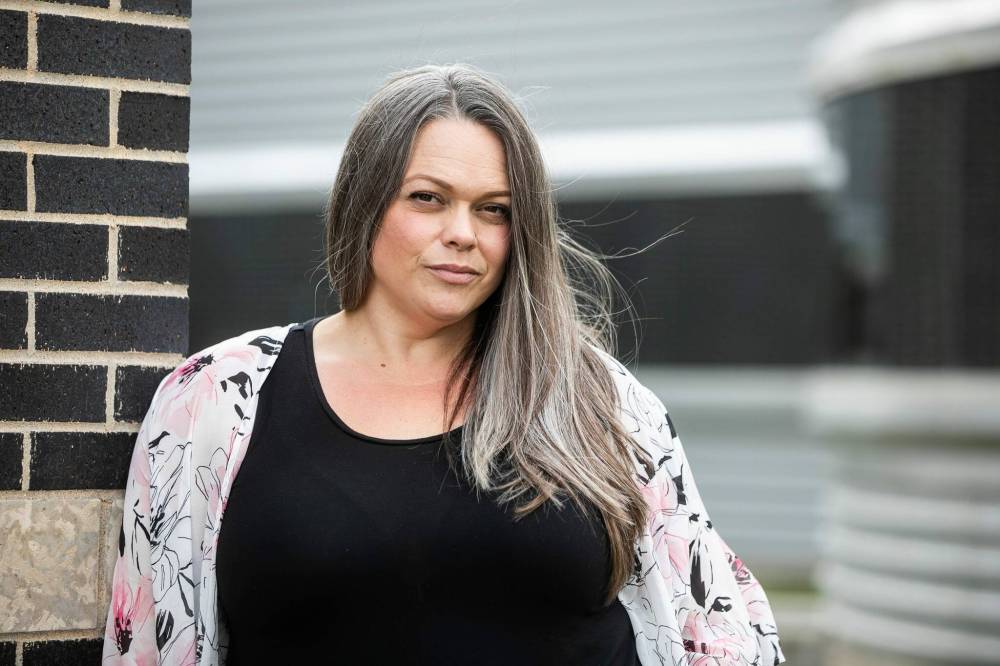
But when she’s at the office, things are more complicated. “We can only reduce it to about 10 per cent outside air, because there still has to be some external air coming in. I can’t restrict the doors from opening, so you can smell the smoke inside the building.”
The smoky air has made breathing more difficult, pushing her to rely more on her medication.
“I’m breathing heavily through my lungs pretty much every day,” she says. “I’ve had to increase how often I use my inhalers to offset some of the symptoms. If it gets bad and my chest gets really tight, I’ll have to go to the ER for a nebulizer treatment.”
Even before the smoke smells strong, she feels its effects.
“When the smoke is on its way, I’ll lose my voice within five to 10 minutes. I can feel it deep in my lungs. And then I start getting wheezy and my chest gets heavy.”
“Leading with kindness and understanding is so important. It might not seem like much from the outside, but it means everything to those who are struggling.”–Julia Frankfurt
And it’s not just her lungs. “My eyeballs feel like they’ve got sand in them pretty much every day since fire season started. I buy eye drops and have to keep hydrating because they’re so itchy.”
When air quality drops, the most important thing Manitobans can do is stay informed and reduce their exposure as much as possible.
“The first step is to be aware of the air quality in your area. Tools like the AQHI developed by Health Canada and Environment Canada are an excellent resource,” Weichenthal says.
When the AQHI shows a high risk, people are advised to stay indoors, keep windows closed and use a high-efficiency (HEPA) air purifier to filter out harmful particles. For those who need to be outside — such as construction or delivery workers — a properly fitted N95 mask can offer added protection against fine particles.
There are also do-it-yourself solutions available: “You can find instructions online to build your own air purifier (using a box fan and a furnace filter) with materials found at hardware stores,” Weichenthal adds.
For Frankfurt, wildfire smoke isn’t just a health concern — it also takes an emotional toll.
“I don’t know if it counts as anxiety or stress, but I just feel disappointed,” she says. “We don’t have a long summer, and I want to be outside. I love being in my garden. It’s really frustrating not being able to do what I love.”
That frustration can also feel isolating, especially when others don’t fully grasp the impact.
“There are always people who say, ‘Oh, it’s not that bad.’ I’m glad it’s not that bad for them, but for some of us, it’s much harder,” she explains. “You can’t always see conditions like asthma unless someone’s using an inhaler or wearing a mask. For me, people only notice when my voice changes. Otherwise, I look like any average person.”
What helps, she says, is simple compassion.
“Leading with kindness and understanding is so important. It might not seem like much from the outside, but it means everything to those who are struggling.”
sabrinacarnevale@gmail.com
arts@freepress.mb.ca

Sabrina Carnevale is a freelance writer and communications specialist, and former reporter and broadcaster who is a health enthusiast. She writes a twice-monthly column focusing on wellness and fitness.
Our newsroom depends on a growing audience of readers to power our journalism. If you are not a paid reader, please consider becoming a subscriber.
Our newsroom depends on its audience of readers to power our journalism. Thank you for your support.
Related Articles
Take care of your eyes amid wildfires and smoke, ophthalmologists urge





History
Updated on Tuesday, June 10, 2025 9:25 AM CDT: Adds email address