From jeers to cheers City projects that overcame early derision to become iconic urban locations
Read this article for free:
or
Already have an account? Log in here »
To continue reading, please subscribe:

Digital Subscription
One year of digital access for only $205*
- Enjoy unlimited reading on winnipegfreepress.com
- Read the E-Edition, our digital replica newspaper
- Access News Break, our award-winning app
- Play interactive puzzles
*First annual payment billed as $205.00 + GST for one year. This annual subscription will automatically renew at $233.00 + GST every 52 weeks (10% off the regular annual price of $259.35). Offer available to new and qualified returning subscribers only. Cancel any time.
To continue reading, please subscribe:
Add Free Press access to your Brandon Sun subscription for only an additional
$1 for the first 4 weeks*
- Enjoy unlimited reading on winnipegfreepress.com
- Read the E-Edition, our digital replica newspaper
- Access News Break, our award-winning app
- Play interactive puzzles
*Your next Brandon Sun subscription payment will increase by $1.00 and you will be charged $17.95 plus GST for four weeks. After four weeks, your payment will increase to $24.95 plus GST every four weeks.
Read unlimited articles for free today:
or
Already have an account? Log in here »
Hey there, time traveller!
This article was published 15/07/2025 (434 days ago), so information in it may no longer be current.
As Michael Scott from TV sitcom The Office says: “New ideas are fine. But they are also illegal.”
For a city that has such a chip on its shoulder about being looked down on by the rest of the country, Winnipeg can sometimes seem pretty defeatist about efforts to transform the city.
We envy Toronto, Montreal and Vancouver for their subways, metros, rapid public services and walkable, bustling downtowns. But do anything to steer Winnipeggers away from their cars and they come close to barricading themselves at Portage and Main in protest.
To be sure, grandiose architectural and planning projects — even those shaped by extensive public consultation — can go off the rails in grand style, as have several projects that we’ll avoid naming here.
And whether the city’s recent transformations — from the pedestrian pivot at the intersection of Portage and Main and Graham Avenue mall, to the adoption of a spine-and-feeder transit model — will come close to delivering on their lofty promises remains to be seen.
Winnipeg is the capital of what’s bluntly called a “have-not” province, and its downtown often stands out as a stark reminder of this. Could urban planning efforts in prioritizing pedestrian traffic put the cart before the horse when so many deeper socioeconomic issues affect the city’s core?
Even if the answer is at least partially yes, this isn’t really an excuse to take refuge in our suburban enclaves, avoiding the downtown except as commuters. And it’s too easy to forget how many of our most iconic, essential pieces of civic infrastructure were once met with skepticism, even scorn.
In this spirit, let’s consider a few examples, focusing (this being the arts section) mostly on arts and cultural projects without which it’s now nearly impossible to imagine the city core.
Downtown arena
WAYNE GLOWACKI/FREE PRESS FILES There was no shortage of cynics when the MTS Centre, now the Canada Life Centre, was erected downtown.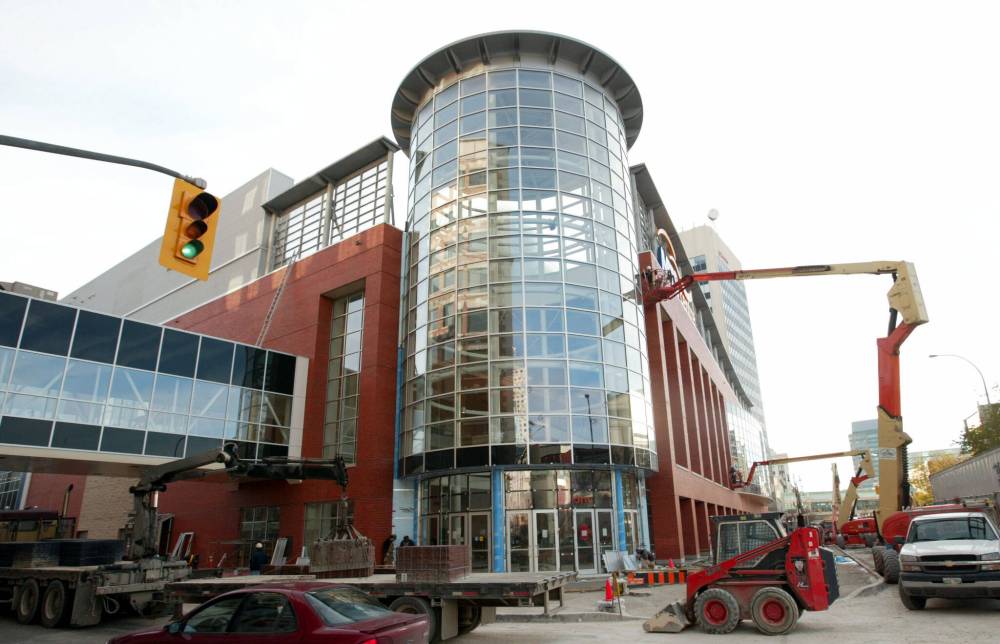
“Demolition is one of our city’s few growth industries,” intones Guy Maddin in his 2007 film My Winnipeg, after nostalgic odes to the Eaton’s Centre, the old Winnipeg Arena and the Jets.
“Overnight, a construction of a new arena on the old Eaton’s site was announced … city council suddenly rushed out this new architectural lie to Winnipeggers. The result: a sterile new thrift-rink for minor league hockey… with the name the Emp-ty Centre!” he goes on while the camera lingers on the then-MTS Centre’s sign, where the S flickers in and out.
Fast forward almost 20 years, and the resurrected Winnipeg Jets have just finished one of their most successful and memorable, if underattended, seasons at the Empty Centre.
But even if you’re not a Jets fan, at some point you’ve probably ended up in the middle of a White Out Party, shoulder to shoulder with thousands of people chanting G-J-G. It takes a special kind of civic-cynic to stand there mute and arms crossed. Ultimately, there’s no denying the power of this rather funny arena to light up Winnipeg’s underused downtown, however fleetingly.
The Winnipeg Art Gallery
Ken Gigliotti /Free Press files The Winnipeg Art Gallery is a monumental example of prairie modernism.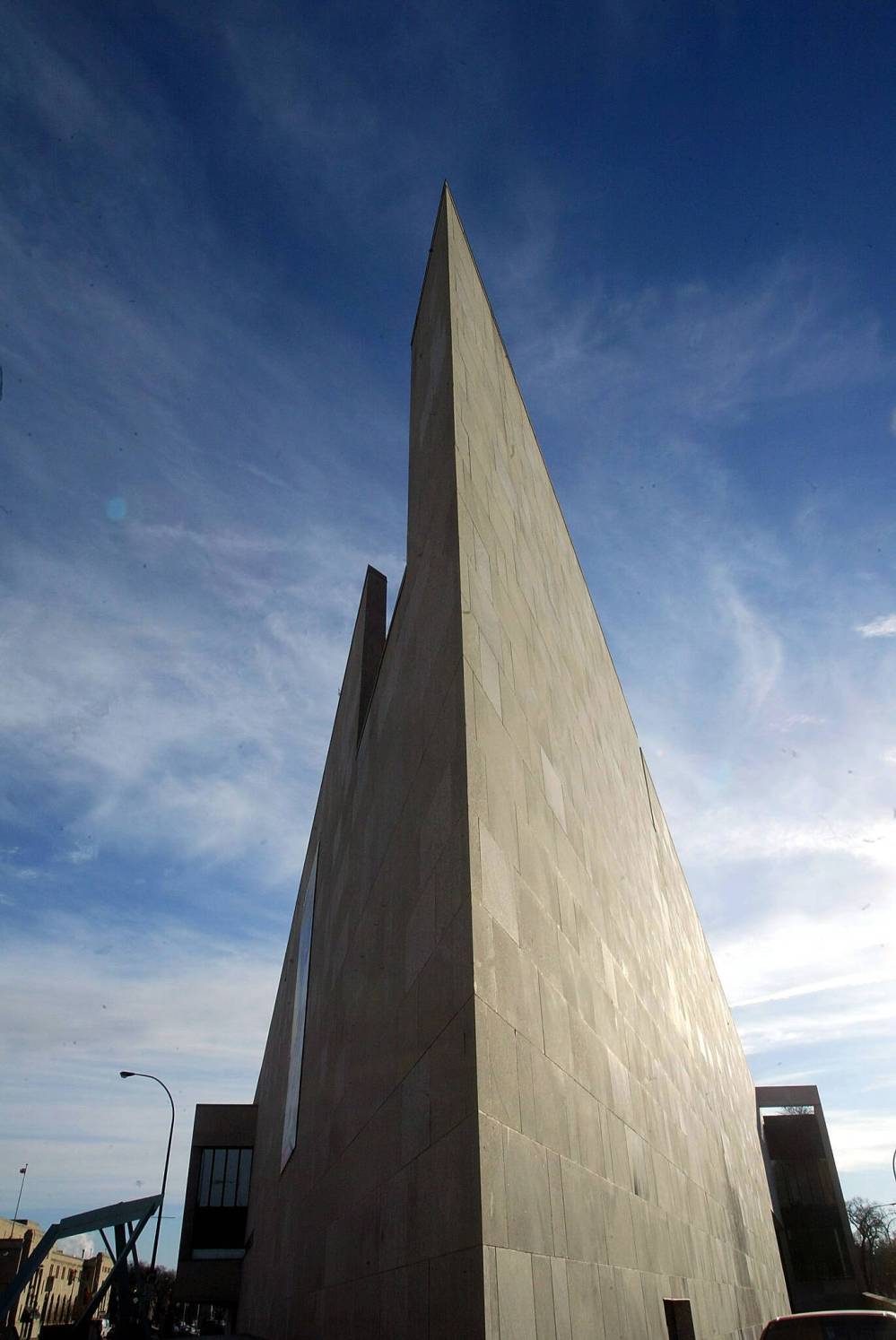
The term “brutalism” tends to invite the most negative connotations surrounding modernist design: top-down, remote, austere. And there’s definitely a monolithic quality to architect Gustavo da Roza’s triangular, brutalist-adjacent design for the WAG, which started construction in 1969,
Former WAG director Ferdinand Eckhardt, who played a vital role in spearheading the gallery’s new building near the end of his tenure, once colourfully called it “the prow of an icebreaker cutting through the cultural apathy of the masses.”
But the WAG is also one of Winnipeg’s most beautiful buildings.
Its almost lush Tyndall stone facade is an organic substitute for concrete and further distances it from brutalism. Stand at its northern point, and you can literally hold the building between your fingers.
For such a monumental example of Prairie modernism, the WAG is also a relatable, humanizing example of the same. It’s complemented strikingly by the Qaumajuq addition, with programming that likewise strikes a balance between the urbane and the accessible.
The Forks
MIKE APORIUS/FREE PRESS FILES An aerial view of the The Forks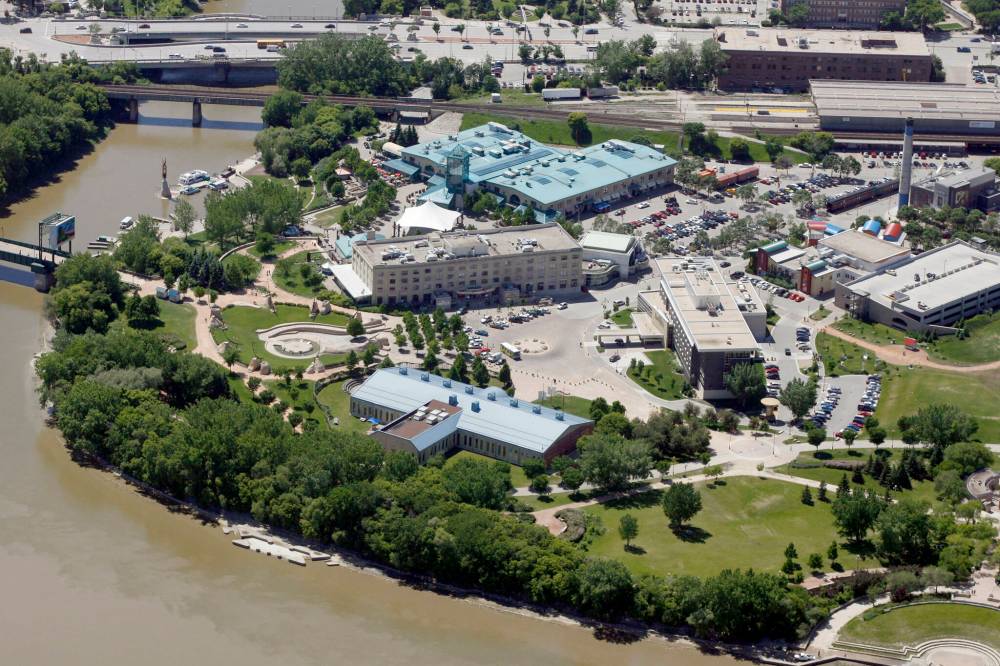
It stands out as one of Winnipeg’s most famous and, arguably, effective urban developments.
When it was first getting going, back in the 1980s, many considered it a disaster in the making. Winnipeggers looked out at the contaminated, abandoned railyard and industrial ruins at the meeting of the two rivers and saw another white elephant.
It’s likely many weren’t even thinking about the site’s deep historical importance for Indigenous Peoples and the relative lack of consultation with Indigenous communities in development efforts.
The Forks continues to wrestle with colonialist legacies, supporting ceremonies and powwows, National Indigenous Peoples Day and other relevant cultural programming, while facing criticisms for, among other things, its security practices.
There’s no easy way to square these inconvenient realities with The Forks’ reputation as one of the core’s most vibrant social hubs, but that reputation is deserved.
While some early critics could envision nothing more ambitious for The Forks than a public park, its momentum owes a lot to its ambitious avoidance of the “single purpose” trap.
Its always-evolving offerings blend not just park-like amenities such as skating trails, green space and walking trails, but market stalls, restaurants, beer gardens, art and growing residential developments, giving Winnipeggers reason to return all year around and live in the area.
The Cube
Janek Lowe/ Free Press Files Architects Sasa Radulovic (left) and Johanna Hurme in 2010 at the Cube; the stage was initially criticized and underwent years of repairs.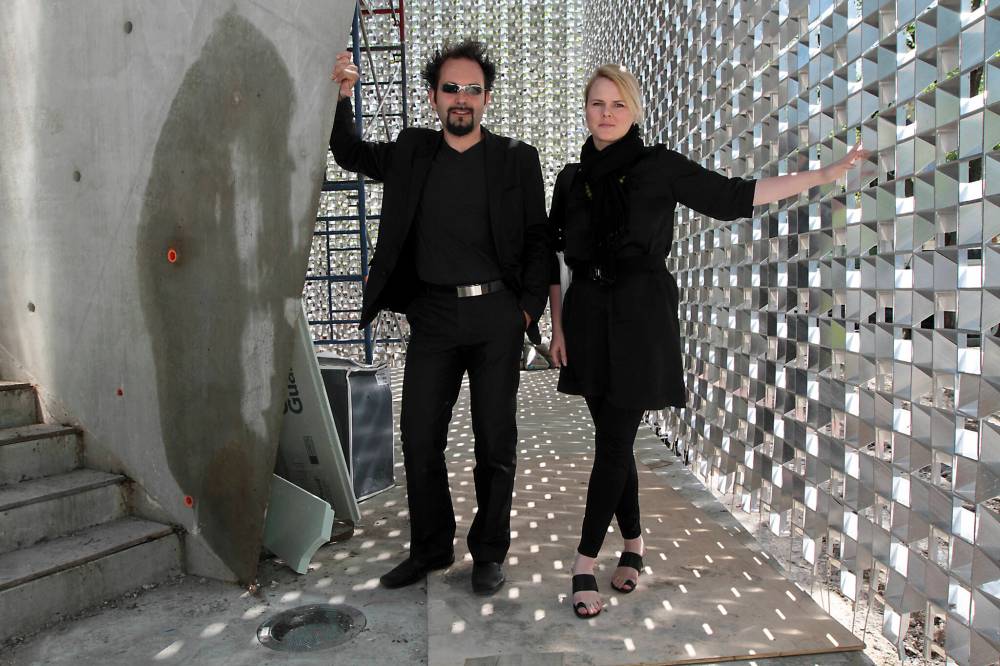
The complaints against the cheese grater-like stage at Old Market’s Square are familiar. The Cube’s knockers say that, with its perforated metal mesh and modernist symmetry, it’s mismatched with the Exchange District’s turn-of-the-century Chicago School architecture.
Also: the thing just didn’t seem to work at first.
The motors on its retractable panels broke down easily in Winnipeg’s harsh climate, and musicians and performers complained that its acoustics sucked. (Surprise, surprise: surfaces with as many holes as Swiss cheese don’t encourage reverberation.)
The Cube, designed by 5468796 Architecture and erected in 2010, was and is criticized as a stage prioritizing appearance over function, and an appearance that isn’t to everyone’s tastes.
That appearance is to this writer’s taste. There’s something so satisfying about seeing the surfaces of this metallic cube fold inward to create a stage and then fold back out, like a Transformer, to its original shape.
The Cube also just seems to work better today; the panels have been fixed and the structure is more reliable, while concert organizers have learned to adapt to the stage’s acoustic limitations with directional speakers and other tricks.
The Burton Cummings Theatre
MIKAELA MACKENZIE / FREE PRESS files The Burton Cummings Theatre.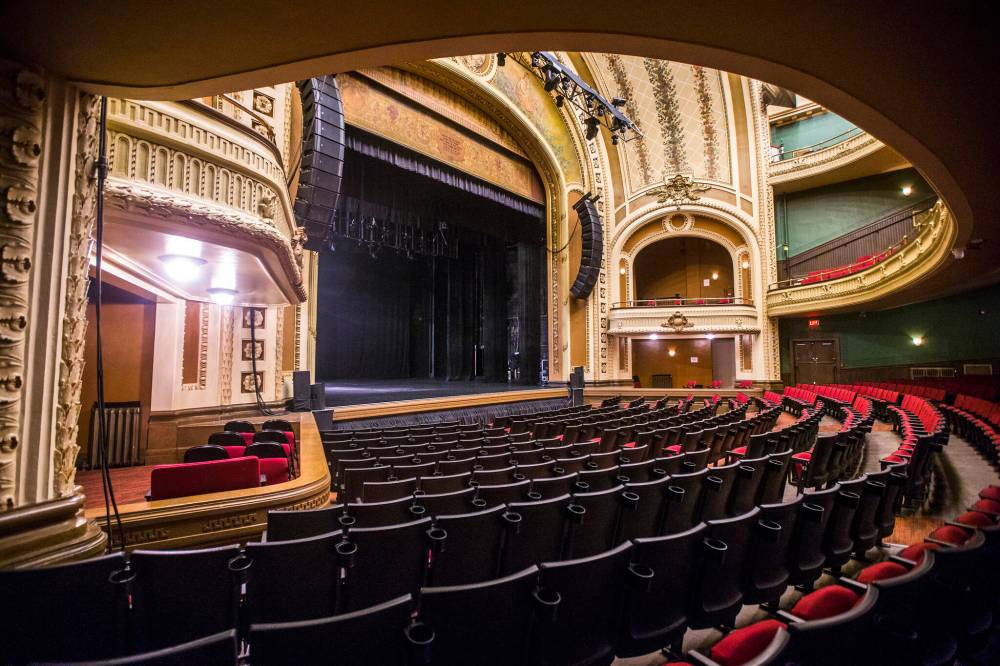
Some people snickered at renaming the theatre — built in 1906 as the Walker Theatre and converted to a movie house in 1945 — after a local star whose lingering Winnipeg connection involved a few performances here and there and a stake in Salisbury House. Others questioned whether its restoration in 1992 would boost commercial interests and mainstream acts at the expense of local music and community.
But today it seems fair to describe this former vaudeville theatre as a widely cherished cultural landmark.
Sure, the seats still aren’t super comfortable and it would be nice to have more space to dance.
But overall, the upgrades — more of which were undertaken when True North took ownership in 2016 — have wisely preserved the Burt’s charming heritage and built on its natural virtues. Its high ceilings and horseshoe shape aren’t just eye-pleasing, but acoustic strong points — enhanced by additional acoustic panels and sound-diffusing elements. It usually sounds great.
With its 1,579 seats, it’s well positioned to serve as a conduit to the crème of Canada’s music scene. Seemingly all of Winnipeg’s music royalty — from Neil Young and the Guess Who to the Crash Test Dummies, Begonia, Winnipeg’s Most and the Weakerthans — have played there.
The Burt’s centrality to local music is further highlighted today, as it hosts a celebration of life at 7 p.m. for Brendan Berg and Olivia Michalczuk, vital forces in the Winnipeg music scene whose lives were tragically cut short by a fatal car accident a couple of weeks ago.
conrad.sweatman@freepress.mb.ca


Conrad Sweatman is an arts reporter and feature writer. Before joining the Free Press full-time in 2024, he worked in the U.K. and Canadian cultural sectors and freelanced for outlets including The Walrus, VICE and Prairie Fire. Read more about Conrad.
Our newsroom depends on a growing audience of readers to power our journalism. If you are not a paid reader, please consider becoming a subscriber.
Our newsroom depends on its audience of readers to power our journalism. Thank you for your support.