Fast-moving staging of classic whodunit a thrilling ride
Read this article for free:
or
Already have an account? Log in here »
To continue reading, please subscribe:

Digital Subscription
One year of digital access for only $205*
- Enjoy unlimited reading on winnipegfreepress.com
- Read the E-Edition, our digital replica newspaper
- Access News Break, our award-winning app
- Play interactive puzzles
*First annual payment billed as $205.00 + GST for one year. This annual subscription will automatically renew at $233.00 + GST every 52 weeks (10% off the regular annual price of $259.35). Offer available to new and qualified returning subscribers only. Cancel any time.
To continue reading, please subscribe:
Add Free Press access to your Brandon Sun subscription for only an additional
$1 for the first 4 weeks*
- Enjoy unlimited reading on winnipegfreepress.com
- Read the E-Edition, our digital replica newspaper
- Access News Break, our award-winning app
- Play interactive puzzles
*Your next Brandon Sun subscription payment will increase by $1.00 and you will be charged $17.95 plus GST for four weeks. After four weeks, your payment will increase to $24.95 plus GST every four weeks.
Read unlimited articles for free today:
or
Already have an account? Log in here »
Hey there, time traveller!
This article was published 16/01/2026 (215 days ago), so information in it may no longer be current.
Everyone loves a good whodunit and the Royal Manitoba Theatre opened its own killer stage adaptation of Agatha Christie’s Murder on the Orient Express Thursday; its murderous web of intrigue still luring fans since it was first penned in 1934 by the fabled English author.
Theatre Review
Murder on the Orient Express
● Royal Manitoba Theatre Centre, 174 Market Ave.
● To Feb. 7
★★★★ out of five
The 130-minute (including intermission) production is packed with a tightly knit 12-member cast directed by RMTC artistic director Kelly Thornton, with a particularly strong design team keeping the show on track.
World-renowned Belgian detective, Hercule Poirot (Alex Poch Goldin as Christie’s best-known character), embarks with fellow passengers on the real-life and now defunct Orient Express en route from Istanbul to London.
After the luxury train becomes grounded by a raging snowstorm, shady American businessman Samuel Ratchett (Ian Leung making every moment of his brief stage time count) is brutally murdered that same night, leaving the heavily moustachioed sleuth, who peppers his musings with pithy “bons mots,” to ultimately crack the case (no spoiler alerts here).
Dylan Hewlett photo RMTC has produced a killer stage adaptation of Agatha Christie’s railroad murder-mystery.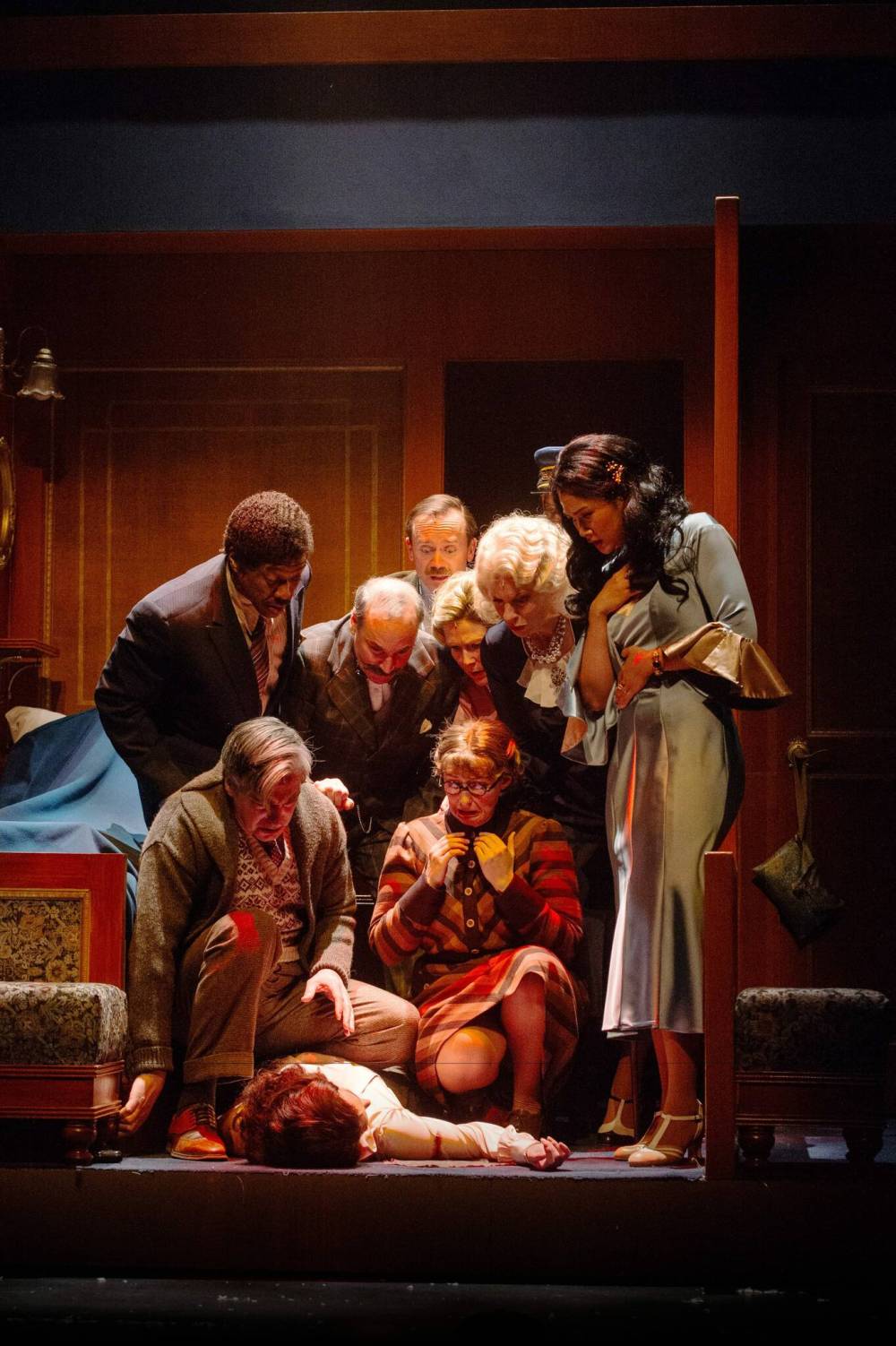
In this version of Christie’s fictional tale, playwright Ken Ludwig frames the overall narrative as Poirot’s flashback via monologues bookending each act, in which the former police officer shares inner turmoil regarding the choices he’s made in solving the case.
These individual scenes are among the most compelling, resonating deeply about personal integrity and the consequences of taking paths of least resistance.
Each character in this United Nations in a railcar is fleshed out with distinct mannerisms and vocal inflections.
Kudos to Thornton for her keen directing skills, which keep the brisk narrative chugging along while cast members navigate complex blocking demands. Another nod goes to dialect coach Jane Gooderham for conjuring a melting pot of convincing accents.
Local thespian Poch Goldin, tasked with the pressures of bringing an iconic character to life, nails his lead role and is as studied and meticulous as the fastidious Poirot’s assembling of clues (albeit more flecks of the gumshoe’s trademark humour would have been welcome).
Dylan Hewlett photo Alex Poch Goldin (left) nails his lead role as the heavily moustachioed sleuth, Hercule Poirot. 
Another standout performance belongs to Donna Fletcher’s bold and brash American actress Helen Hubbard, whose final, impassioned petition of Poirot during the denouement poses real, salient questions about relativism and the nature of justice itself (particularly resonant during our own “unusual” times).
Rodrigo Beilfuss provides gravitas as train conductor Michel (doubling as Head Waiter), whose frantic phone calls for help denote the passing of time as winds howl and the murderer runs loose.
The train’s upper crust, Countess Andrenyi (Dutchess Cayetano) with her near-hysterical assistant Greta Ohlsson (RobYn Slade), and haughty Russian Princess Dragomiroff (Davina Stewart), play foil to prim ’n’ proper Mary Debenham (Jill Agopsowicz) and her military lover, Col. Arbuthnot (Daniel Briere), with the now deceased Ratchett’s trusty aide Hector MacQueen (Tom Keenan) suitably clipped.
However, the undeniable star is the Orient Express itself.
Winnipeg-based Brian Perchaluk has worked magic re-creating different parts of the train set on a large revolve. Each of its initial rotations drew spontaneous applause and gasps of delight from the opening night crowd, making us feel we were right there riding the rails.
RUTH BONNEVILLE / FREE PRESS Murder on the Orient Express set designer Brian Perchaluk compares the production to the precision of a Swiss watch.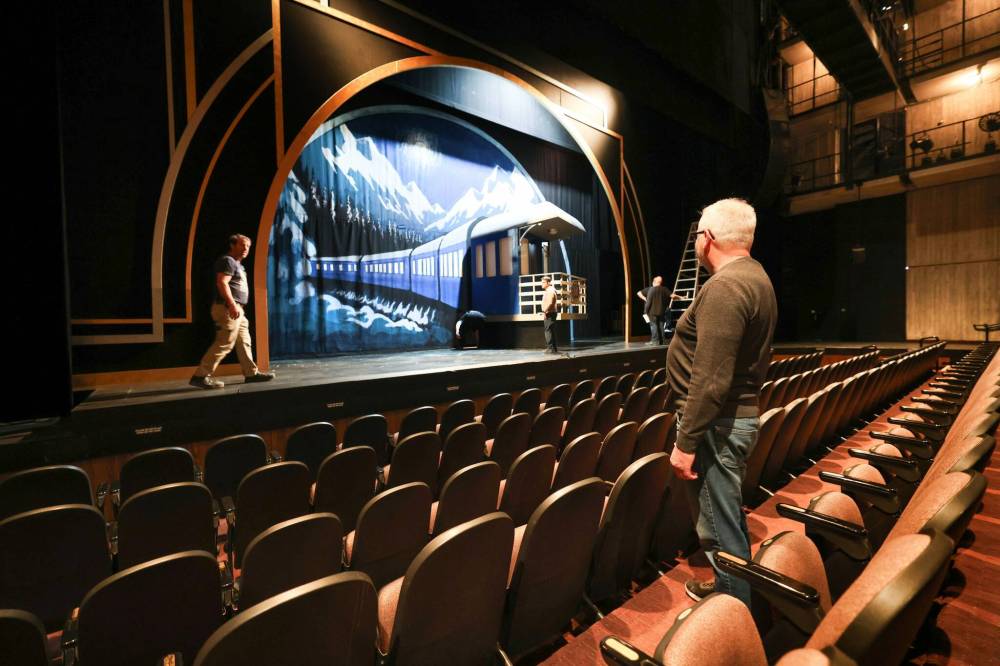
Lighting designer Hugh Conacher’s shadows and light evoking film-noir pump further drama into the show. A powerful opening montage in which the train’s blinding headlights shine through a painted scrim underscored by a thunderous roar struck fear into many audience members’ hearts — including this one — as foreshadowing of the brutality yet to fall.
The production is rounded out with sumptuous period costumes by Joseph Abetria, including sartorial suiting for Poirot, and sound designer Dave Clarke’s pastiche score, including excerpts from Mahler and Bach, along with edgier drones, adding further moodiness.
Yes, a murder has just taken place, and one might assume the emotional temperature is running sky high. However, all too often the actors appeared to be shouting at each other at fevered pitch, with several cast members, including Ray Strachan’s Constantine Bouc’s rapid-fire dialogue at times difficult to distinguish — not aided by their respective brogues.
Relief came during the (all too few) monologues, and one wishes more of these might have been built into the script to provide greater contrast, balance and clues to the detective’s own inner machinations — theatre in all its glorious multi-dimensionality has the power to do that.
Dylan Hewlett photo The 130-minute production is packed with a tightly knit 12-member cast. 
An admittedly weird, overly campy later scene, in which most of the company takes its place downstage a la a police lineup and briefly re-enacts key narrative moments, felt out of place.
Yet, one that did chill to the bone is the play’s prologue depicting the kidnapping and murder of five-year old Daisy Armstrong as its inciting incident, with the young girl’s heavily reverbed voiceover (Isla Verot) breaking into shrieks of terror.
For those still unfamiliar — and there will be some — with Christie’s exotic tale, this writer’s lips remain sealed as to whodunit. Best to just climb aboard this joyride into the heart of darkness that has puzzled and perplexed generations of fans for nearly 100 years since first bolting out of the station.
fparts@freepress.mb.ca
Holly Harris writes about music for the Free Press Arts & Life department.
Our newsroom depends on a growing audience of readers to power our journalism. If you are not a paid reader, please consider becoming a subscriber.
Our newsroom depends on its audience of readers to power our journalism. Thank you for your support.