Stacking the shellac For antique record aficionado, life sounds best at 78 r.p.m.
Read this article for free:
or
Already have an account? Log in here »
To continue reading, please subscribe:
Digital Subscription
One year of digital access for only $1.44 a week*
- Enjoy unlimited reading on winnipegfreepress.com
- Read the E-Edition, our digital replica newspaper
- Access News Break, our award-winning app
- Play interactive puzzles
*Billed as $5.77 plus GST every four weeks. After 52 weeks, price increases to the regular rate of $19.95 plus GST every four weeks. Offer available to new and qualified returning subscribers only. Cancel any time.
To continue reading, please subscribe:
Add Free Press access to your Brandon Sun subscription for only an additional
$1 for the first 4 weeks*
- Enjoy unlimited reading on winnipegfreepress.com
- Read the E-Edition, our digital replica newspaper
- Access News Break, our award-winning app
- Play interactive puzzles
*Your next Brandon Sun subscription payment will increase by $1.00 and you will be charged $17.95 plus GST for four weeks. After four weeks, your payment will increase to $24.95 plus GST every four weeks.
Read unlimited articles for free today:
or
Already have an account? Log in here »
A while back, a contributor to Seventeen magazine revealed she had recently learned why the Grammy Awards are so-named, and how the news had left her “shaken to the core.”
“You probably thought this whole time that the Grammys was just another random award-show name like the Oscars (who’s Oscar?) or the Emmys (who tf is Emmy?),” she wrote in regards to the annual music awards ceremony, the 68th edition of which takes place Sunday in Los Angeles.
“But the reasoning behind the name has literally been in front of your face the entire time… it’s a gramophone. You know, like an old-fashioned record player. How did I not realize this sooner?”
MIKAELA MACKENZIE / FREE PRESS
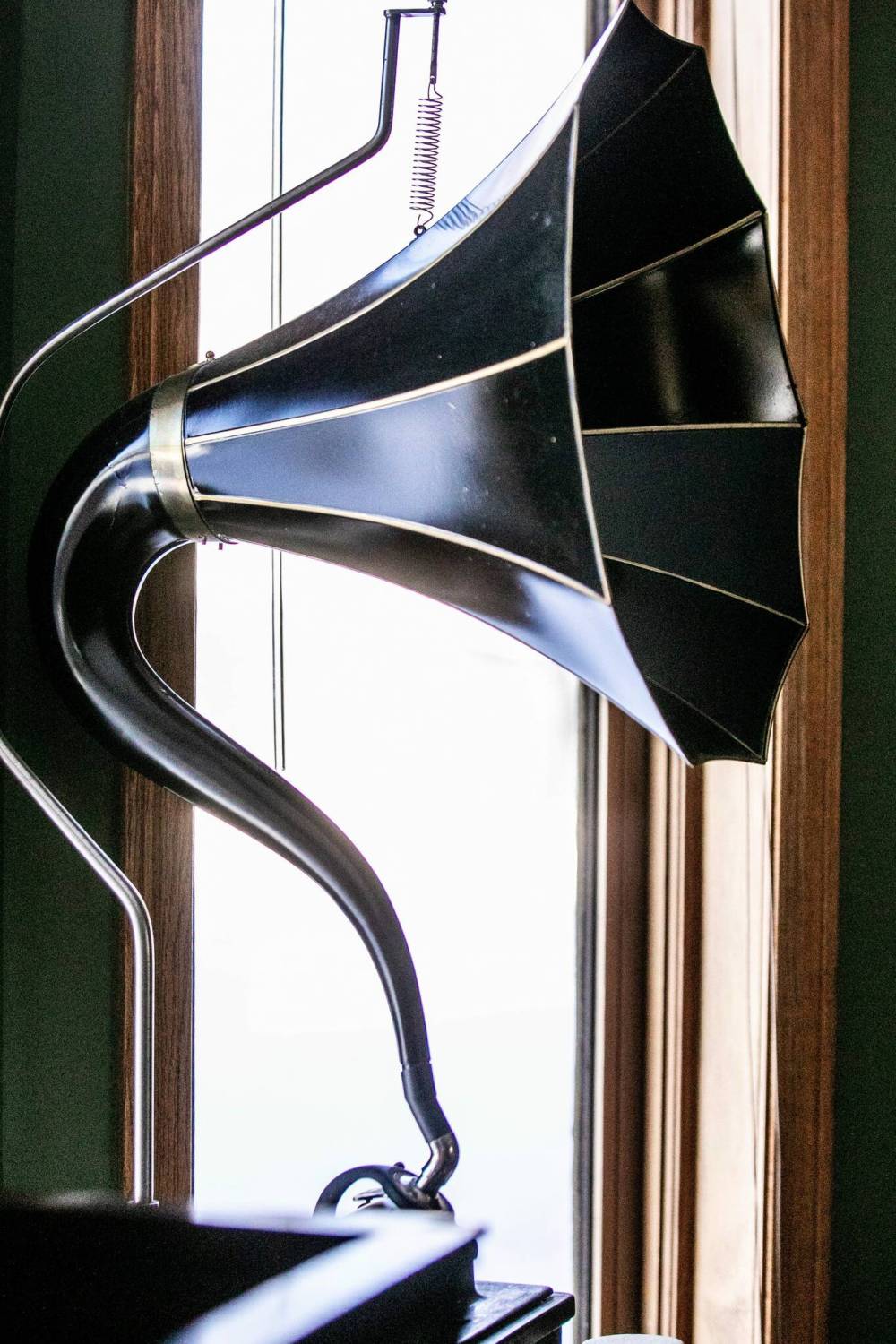
A cygnet horn cylinder phonograph from 1909 in Paul Horchճ collection on Tuesday, Jan. 27, 2026. For Dave Sanderson story. Free Press 2026
Paul Horch can’t say for certain how old he was when he first twigged into the Grammys/gramophone connection. But since the West Kildonan resident has spent the majority of his life collecting and preserving gramophones, he presumes he put two and two together shortly after the inaugural Grammy Awards were doled out in 1959.
(Know how a champagne birthday occurs when the age you’re turning matches the day of the month you were born on? A few months ago, Horch celebrated a champagne birthday of a different sort when he turned 78, duplicating his preferred record playback speed — 78 r.p.m.)
“I had an inkling about the name as soon as I first heard about the Grammys and saw the wonderful trophy,” Horch says, referring to a gold-plated statuette meant to mimic a 1903 Victor III gramophone, instantly recognizable for its attached horn-as-speaker.
“Grammys is a good name but it would have funnier if they’d been named after the phonograph. Then they could have been the ‘Phonies.’”
Horch, the second-eldest of three siblings, was nine years old in the summer of 1957 when his parents rented a cottage at Victoria Beach for a two-week getaway. As much as he enjoyed frolicking in the waves with his sisters, he probably spent more time with a wind-up gramophone that sat on a desk in one corner of the cabin.
“The cottage’s owners kept a bunch of 78s next to it — mostly stuff from the 1920s — and I fell in love with both the music on the records and the machinery associated with the gramophone,” Horch says, seated in the living room of his century-old, two-storey home overlooking the Red River.
MIKAELA MACKENZIE / FREE PRESS
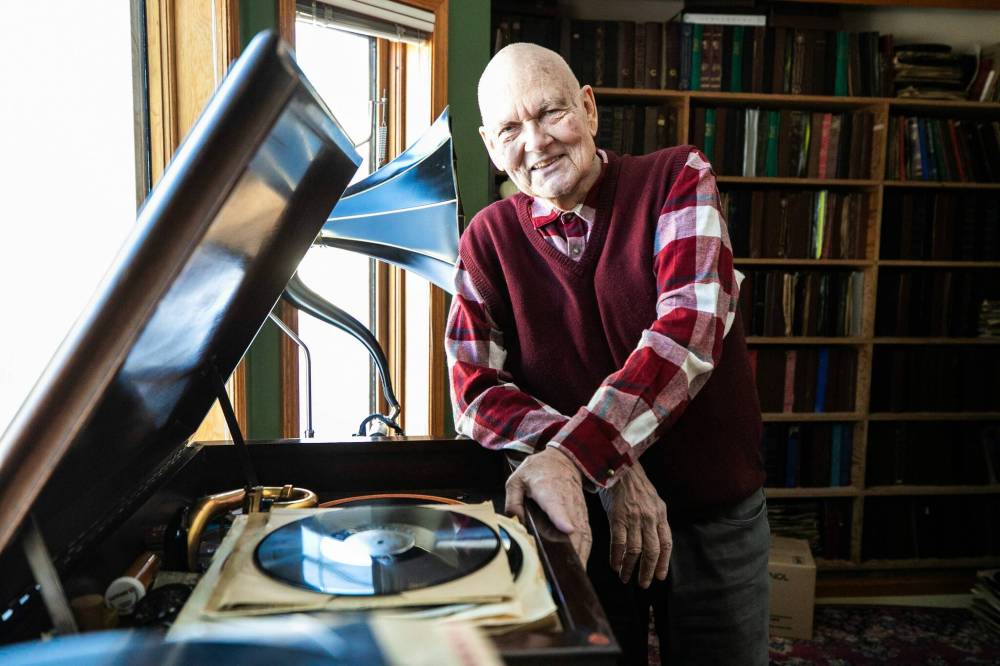
Paul Horch has spent the majority of his life collecting and preserving gramophones.
“No word of a lie, when I wasn’t swimming, I was in the front room with my head stuck in the gramophone.”
That fall, Horch and his family were visiting his aunt, who lived a few blocks away from their place in East Kildonan. His aunt worked as a housekeeper for a husband and wife in River Heights, and that afternoon her employers had also popped by to say hello. At some point during the ensuing conversation, Horch brought up the gramophone from the lake, remarking how much he was coveting one of his own. That’s when the River Heights couple announced they had a 1918 McLagan player — a cabinet model built in Stratford, Ont. — gathering dust in their attic. If the youth wanted it, it was his for the taking, they told him.
“My dad drove me there the following week in his ’53 Plymouth and between the two of us, we managed to haul it downstairs, even though it weighed well over 100 pounds,” he says, mentioning that his late father Albert was a professional flutist who performed with the Winnipeg Symphony Orchestra from 1948 — the year the ensemble was founded — until the late ’70s.
By 1972, the year Horch moved from his parents’ home into his present-day abode, he had amassed in the neighbourhood of a thousand 78s, most of them scooped up for a song at second-hand stores and estate sales across the city. Now that he had ample space at his disposal — previously, his hoard was confined to his bedroom — the life-long bachelor’s cache of shellac rapidly grew by leaps and bounds. Not only records but gramophones, to boot.
Mainly produced from around the turn of the 20th century up to the late-1940s, 78-r.p.m. records are composed of a brittle mix of shellac resin, mineral fillers and colourants like carbon black. Prone to shattering and susceptible to wear and tear, the format gave way to 33⅓-r.p.m. long-playing vinyl records in the post-Second World War era. Vinyl proved a more flexible and forgiving material, and early LPs could hold up to 22 minutes of recorded sound, per side.
He has never taken the time to fully count, he says, but he guesses he currently has somewhere in the neighbourhood of 40,000 78s, the majority meticulously filed according to record label — Paramount, Columbia, Brunswick — on built-in shelves lining the entirety of two living-room walls. As for gramophones, the former Videon cable installer has “40 or so,” spread about the house. Those include a 1910 Victor Talking Machine, the company’s all-time best seller, a 1925 Victor Orthophonic he had shipped here from New Jersey and a 1926 Victrola Credenza that originally retailed for $400 in its day — the equivalent of a budget-busting $7,300 in today’s currency.
MIKAELA MACKENZIE / FREE PRESS
Horch hosts a radio show with friend Bill Perlmutter dedicated to 78-r.p.m. LPs.
Here, allow him to demonstrate how perfectly the Credenza sounds to this day, he says, fetching a 78-r.p.m. copy of Highways are Happy Ways, a jazz number recorded in 1927 by Ted Weems and His Orchestra.
After giving the machine’s hand-crank a few turns to get it up and running, he drops the needle on the shellac disc, warning a visitor to step back as “this thing gets plenty loud.” Suddenly the room is alive with music, the same as it is most days owing to a weekly radio show called the Wonderful World of 78s that Horch and his pal Bill Perlmutter, a fellow 78-r.p.m. aficionado, host for 93.7 CJNU Nostalgia Radio.
“We’ve been doing the show since 2021 and it’s a great excuse to go combing through the shelves, looking for things we haven’t played yet,” Horch says, raising his voice to be heard above the din. “I have a separate turntable hooked up to my computer that I use to digitize songs in order to play them on-air. I also have a program that allows me to clean records up by removing a lot of the hisses and pops, not that the sounds bother me too much.”
CJNU station manager Adam Glynn says he is “consistently impressed” by Horch’s depth of musical expertise, as well as the breadth of his collection.
“Also the fact he has it so well-catalogued and readily available. What a feat,” Glynn says when reached at his office.
Glynn says it was a no-brainer in 2021 when Horch and Perlmutter floated the idea for the hour-long show, which they pre-record at Horch’s place on Friday mornings.
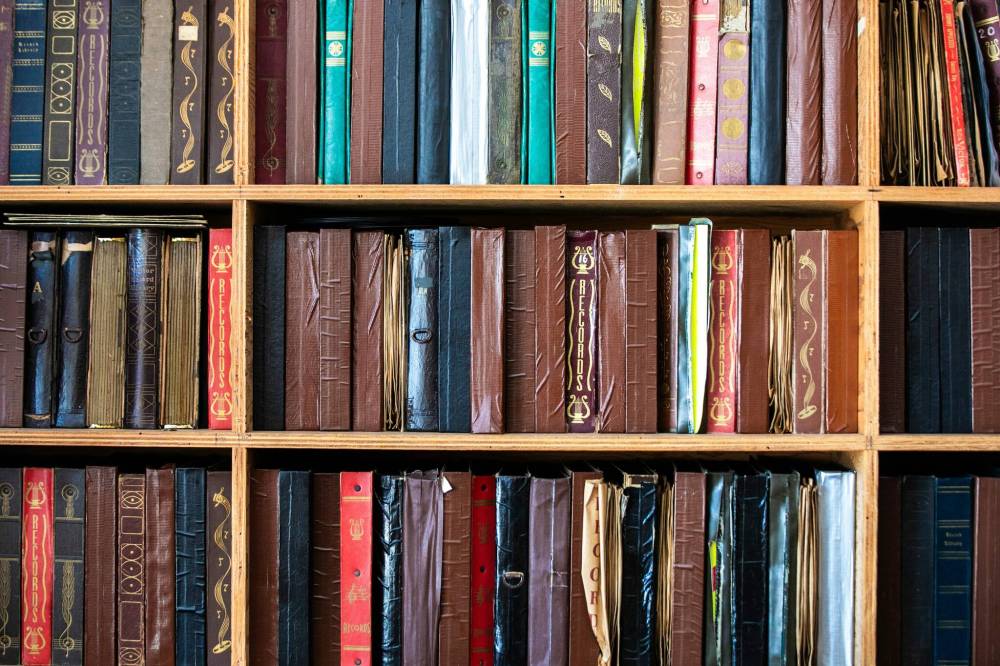
MIKAELA MACKENZIE / FREE PRESS
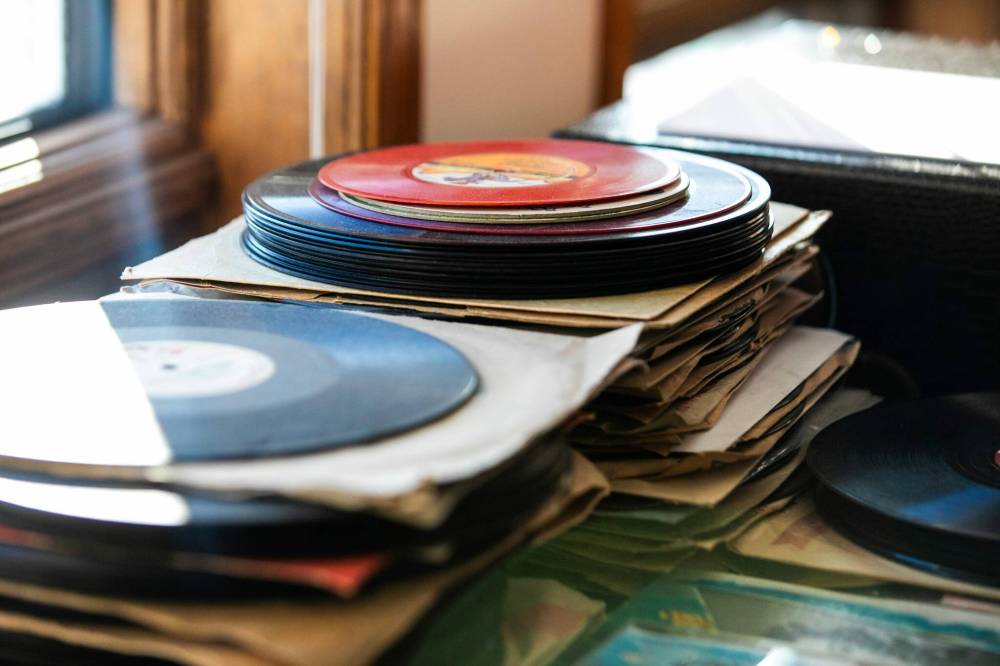
While he’s never fully counted, Horch estimates he has about 40,000 78 r.p.m. records in his collection, meticulously filed according to record label.
“For me personally, I love the eclectic nature of the music that Paul and Bill play — particularly because one might assume focusing on 78s would mean solely playing music of the jazz and big-band era,” Glynn says. “But those amazing recordings sit shoulder-to-shoulder with unexpected artists such as the Beatles, whose music was still released on 78 so that folks who had an older turntable could enjoy the hits of the day. And the fact that these two incredibly knowledgeable chaps choose to share it with us on the radio? That’s the most wonderful thing of all.”
Horch, who drove to Matlock a couple of weeks ago to pick up yet another gramophone, says he still feels like a kid in a candy store when he arrives home with a fresh pile of records. Often he’ll stay up all night sorting and listening to his new discoveries, one by one. (Unlike conventional vinyl LPs, a 78-r.p.m. record typically contains one song per side, about five minutes of music, tops.)
“Almost all the records I get nowadays are from people whose loved one has passed and they’re looking for a good home for their treasures, which is definitely something I can provide,” he says. “It’s not like there’s anything I need, but I do have some that are in rough shape, that I don’t mind getting a better copy of.”
As for his own collection, as he isn’t getting any younger, and because he’s been dealing with his share of health issues lately, he already has a plan in place for when the inevitable occurs.
“I’m a man of faith and I know I’m not going to be here forever,” he states ahead of throwing on another selection.
“There’s a musician friend of mine who’s going to get all this — the records, the players — so I don’t spend a second thinking about it. It was drilled into me by my dad, who lived to 93, to make the most of every single day and that’s what I try to do, a lot of that thanks to my music.”
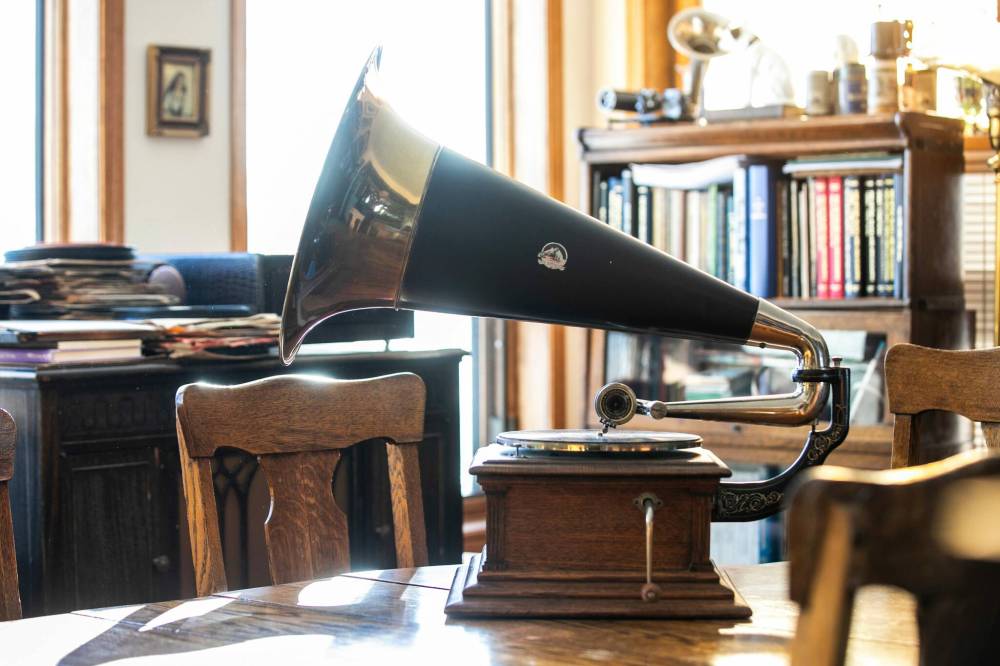
MIKAELA MACKENZIE / FREE PRESS
Horch’s collection contains a Victor III gramophone from 1910. The 1903 Victor III gramophone serves as the inspiration for the Grammy Awards’ gold-plated trophies.
winnipegfreepress.com/davidsanderson

Best of the bunch
We asked Paul Horch to list his 10 favourite 78-r.p.m. records from his personal collection of over 40,000 discs. Here’s what he settled on, in no particular order.
The Man From the South — Rube Bloom and His Bayou Boys (1930)
When Bhudda Smiles — Benny Goodman and His Orchestra (1935)
St. Louis Blues — Bing Crosby with Duke Ellington and His Famous Orchestra (1932)
Playmates — Mitchell Ayres and His Fashions in Music (1940)
Bye Bye Blackbird — George Olsen and His Music (1926)
St. James Infirmary (various artists)
Dancing in the Dark — Waring’s Pennsylvanians (1932)
Bluebird Boogie Woogie — Teddy Powell and His Orchestra (1941)
All the Things You Are — Artie Shaw and His Orchestra (1939)
Creole Love Call — Duke Ellington and His Orchestra (1928)
Dave Sanderson was born in Regina but please, don’t hold that against him.
Our newsroom depends on a growing audience of readers to power our journalism. If you are not a paid reader, please consider becoming a subscriber.
Our newsroom depends on its audience of readers to power our journalism. Thank you for your support.