Game for wordplay Rhyme repository recognizes razed Métis enclave Rooster Town
Read this article for free:
or
Already have an account? Log in here »
To continue reading, please subscribe:

Digital Subscription
One year of digital access for only $205*
- Enjoy unlimited reading on winnipegfreepress.com
- Read the E-Edition, our digital replica newspaper
- Access News Break, our award-winning app
- Play interactive puzzles
*First annual payment billed as $205.00 + GST for one year. This annual subscription will automatically renew at $233.00 + GST every 52 weeks (10% off the regular annual price of $259.35). Offer available to new and qualified returning subscribers only. Cancel any time.
To continue reading, please subscribe:
Add Free Press access to your Brandon Sun subscription for only an additional
$1 for the first 4 weeks*
- Enjoy unlimited reading on winnipegfreepress.com
- Read the E-Edition, our digital replica newspaper
- Access News Break, our award-winning app
- Play interactive puzzles
*Your next Brandon Sun subscription payment will increase by $1.00 and you will be charged $17.95 plus GST for four weeks. After four weeks, your payment will increase to $24.95 plus GST every four weeks.
Read unlimited articles for free today:
or
Already have an account? Log in here »
April was National Poetry Month and despite the fact the annual celebration has come and gone for another year, the literary art form continues to enjoy an everyday presence on Dudley Avenue, near Harrow Street.
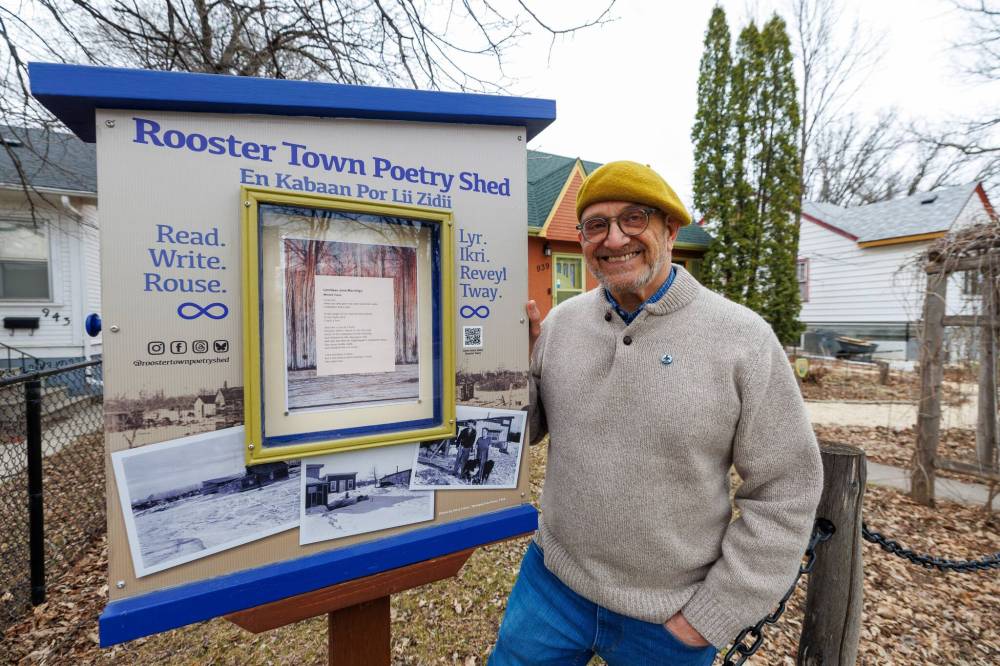
Bernie Kruchak is the founder and curator of the Rooster Town Poetry Shed, named for Rooster Town, a Métis settlement that existed close to his and his wife’s present-day home for six decades until residents’ shanties were razed by the city in the late 1950s to pave the way for the Grant Park Shopping Centre and neighbouring Grant Park High School.
The installation, which rests in the Kruchaks’ front yard at 939 Dudley Ave., resembles a little free library. Only, instead of being stocked with books, it is wholly devoted to poetry.
MIKE DEAL / FREE PRESS
Bernie Kruchak erected the Rooster Town Poetry Shed, a structure that resembles a free little library but is instead devoted to poetry, as a reconciliation project.
Kruchak, 74, erected the two-metre-tall structure in July 2025. However, its roots date back to 1963, when Kruchak, who is of Ukrainian descent, was a grade-school student in Sioux Lookout, Ont.
“I was 11 years old when our public school — which was full of white kids for the most part — became integrated,” says the father of two adult children, explaining in 1954, his late father, a Canadian National Railways employee, was transferred from Winnipeg to the northwestern Ontario town for his job.
Kids from the Pelican Lake Indian Residential School — approximately 20 kilometres away — were being bused over first thing in the morning, then bused back to the residential school at the end of the day to eat and sleep.
At the time, Kruchak knew next to nothing about Canada’s residential school system. That being said, he was intuitive enough to realize something was “off.”
“I still have the picture in my head of the first time they entered our classroom. They were all dressed identically, which was a contrast in and of itself. The boys seemed angry; the girls were very shy. All eyes were on them and I can only presume it was very shocking for them to have been thrust into that situation.”
Kruchak and his family returned to Winnipeg in 1966, but not before he had gained some insight into the lives of his new classmates, particularly a pair named Johnny and Kenny, with whom he became good friends.
“Today we talk about the hardships they likely would have been enduring — the sexual and physical abuse. Was I aware of that 60 years ago? No. I was never told that outright. But from talking to them and getting to know them a bit better, I could definitely tell it was far from an ideal situation.”
Fast-forward to 2021. For a while, Kruchak, who fell in love with poetry as a teenager after being introduced to the works of Leonard Cohen, had been thinking about introducing a so-called poetry box to his property. The self-contained units, also called poetry poles, were springing up in pockets of the United States, especially Portland, Ore., where one homeowner’s poetry box paid tribute to Edgar Allan Poe, and was adorned with faux skulls and ravens.
Kruchak wanted his undertaking to have a central theme, as well. Knowing his one-and-a-half-storey abode sat roughly a block away from what would have been Rooster Town’s eastern-most border, he chose to title it for those who called the community home.
“I was totally honoured to be asked to contribute, partly because some of the work I do with poetry isn’t just text-based.”
Then, after reading in May of that year about 215 unmarked graves being discovered on the grounds of a residential school in Kamloops, B.C., he vowed to make his poetry box a personal reconciliation project that would also honour residential school survivors, including his former classmates.
Kruchak was still working, so he waited until 2023, the year he retired from a decades-long career as a professional writer, to give the poetry shed his full attention. One of the first things he did was contact Paul Tétrault, a leader in the local Métis community, to run the idea past him.
“If you’re going to do something that appropriates anything Indigenous, you should never do it without asking,” Kruchak states.
“I knew right away that before I got too far ahead of myself, I’d need to speak with somebody who was in a position to say that what I was doing was right. That yes, I could incorporate the Métis symbol and colour blue from the Métis flag into my plans.”
Tétrault subsequently put Kruchak in touch with his son Julien, who helped Kruchak with Michif translations for the sayings “Lyr. Ikri. Reveyl tway.” (“Read. Write. Rouse.”) and “En Kabaan Por Lii Zidii” (cabin of ideas) that grace the front of the shed.
Kruchak would never classify himself as a handyman — the reason he enlisted his son, Aaron, to assist with the design and construction of the shed itself. They agreed it should have a single-sloped roof similar to the majority of homes in Rooster Town. They also used recycled materials exclusively, the same as what Rooster Town inhabitants would have relied upon to build their premises.
Jennifer Still, the 2025-26 Winnipeg Poet Laureate, recalls how excited she became when Kruchak reached out to her last July, wondering if he could officially launch the Rooster Town Poetry Shed with one of her poems.
“Bernie told me he had a poetry shed and that he was going to be putting poems in the window of it in the hope people passing by would stop to read,” says Still, who is Métis.
“Of course, I’m totally on board with anything that makes poetry more accessible to the general public.”
“I was totally honoured to be asked to contribute, partly because some of the work I do with poetry isn’t just text-based. There can be some dimension to it and Bernie’s shed sounded like it would lend itself to that perfectly.”
For her entry, Still went with a poem from her latest collection A Little Bit of Light. It’s a visual piece that requires illumination, she says, and she was grateful Kruchak permitted her to install mini-lights inside the shed, letting the poem “speak in its fullest sense.”
“Most people probably think of poems in the conventional, roses-are-red-violets-are-blue sense,” Still goes on, noting that in October 2025 she and Kruchak were invited to Grant Park High School to discuss poetry and to help students with a visual poetry project, portions of which were ultimately showcased in the Rooster Town Poetry Shed.
“Of course, I’m totally on board with anything that makes poetry more accessible to the general public. Last summer, I got a call from my husband’s cousin living on Vancouver Island who told me he learned about my poem being in Bernie’s poetry shed from an online post originating in Paris. Obviously, word is getting out.”
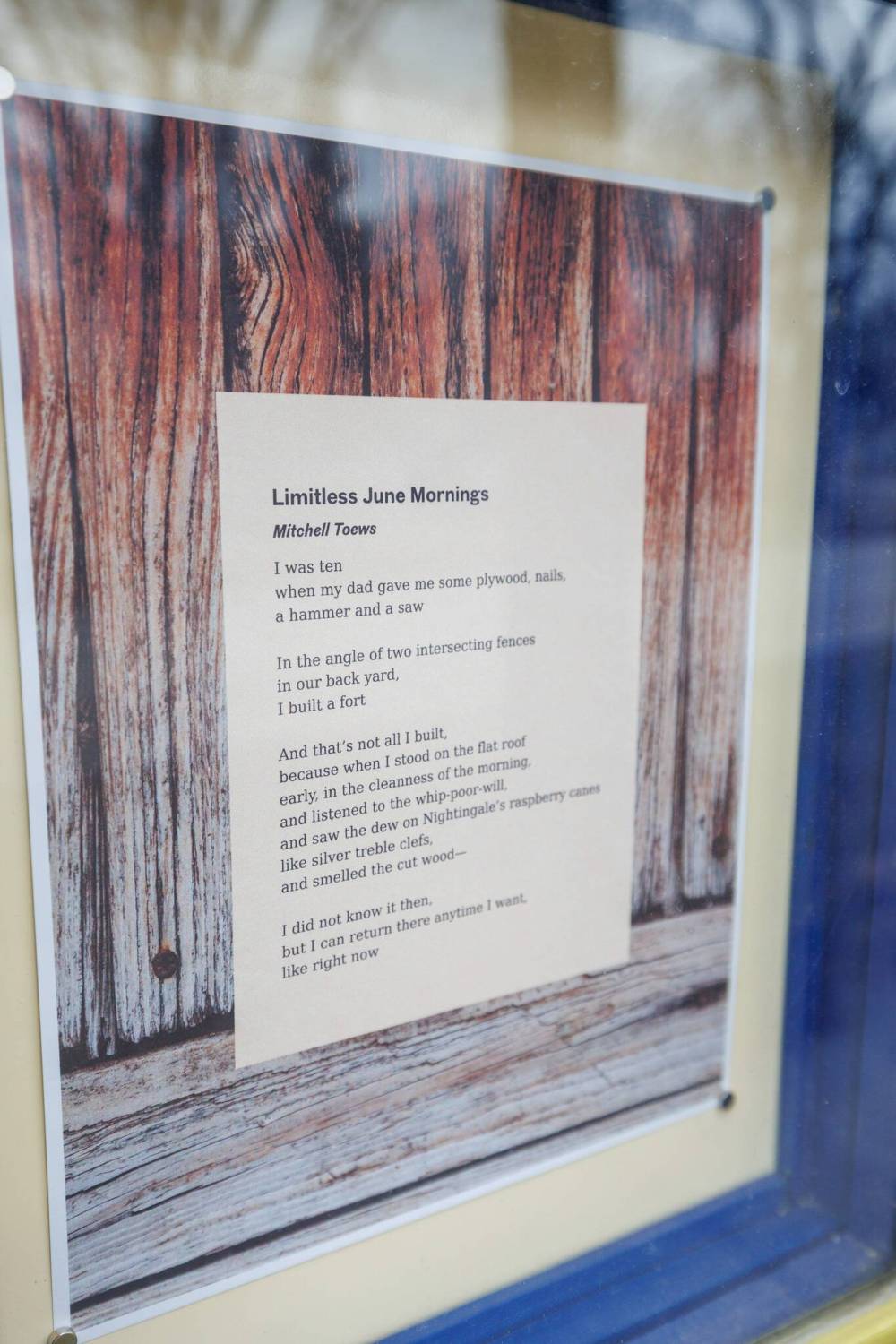
Kruchak generally keeps a poem on display for two weeks before moving on to the next. He always seeks permission from the writer ahead of showing off something they’ve penned.
To date, everyone he’s reached out to has been thrilled to take part. Among those whose poems have been exhibited are Melanie Dennis Unrau, the author of Happiness Threads: The Unborn Poems (2013), Cendrine Marrouat, the founding editor of The Haiku Shack Magazine, and, during the buildup to last September’s National Day for Truth and Reconciliation, Cree-Métis poet Duncan Mercredi.
“They’re not always Indigenous poets, but I definitely want to have more,” says Kruchak, who has also mounted a couple of his own compositions inside the shed.
“And although nobody has reached out to me yet about submitting a poem of theirs for consideration, I do encourage people to do just that.”
Now, because he isn’t in his yard day and night, Kruchak can’t say for certain how many visitors the Rooster Town Poetry Shed gets on a regular basis.
MIKE DEAL / FREE PRESS
Kruchak keeps a poem on display for two weeks.
“I wouldn’t say it’s drawing throngs but there is one fellow who informed me he comes all the way from Osborne Village to see what’s new, and how the shed is now a destination point for his walks. So I guess if nothing else, it’s become a good way for at least one person to get some exercise.”
For more information, go to roostertownpoetryshed.ca.
winnipegfreepress.com/davidsanderson

Dave Sanderson was born in Regina but please, don’t hold that against him.
Our newsroom depends on a growing audience of readers to power our journalism. If you are not a paid reader, please consider becoming a subscriber.
Our newsroom depends on its audience of readers to power our journalism. Thank you for your support.