Stay on the line In a smart-device world, some families keep phone jacked into the wall
Read this article for free:
or
Already have an account? Log in here »
To continue reading, please subscribe:

Digital Subscription
One year of digital access for only $205*
- Enjoy unlimited reading on winnipegfreepress.com
- Read the E-Edition, our digital replica newspaper
- Access News Break, our award-winning app
- Play interactive puzzles
*First annual payment billed as $205.00 + GST for one year. This annual subscription will automatically renew at $233.00 + GST every 52 weeks (10% off the regular annual price of $259.35). Offer available to new and qualified returning subscribers only. Cancel any time.
To continue reading, please subscribe:
Add Free Press access to your Brandon Sun subscription for only an additional
$1 for the first 4 weeks*
- Enjoy unlimited reading on winnipegfreepress.com
- Read the E-Edition, our digital replica newspaper
- Access News Break, our award-winning app
- Play interactive puzzles
*Your next Brandon Sun subscription payment will increase by $1.00 and you will be charged $17.95 plus GST for four weeks. After four weeks, your payment will increase to $24.95 plus GST every four weeks.
Read unlimited articles for free today:
or
Already have an account? Log in here »
When the phone rings in Kristin Shiach and Jordan Sobkowicz’s Riverview home, their three daughters race to see who can be the first to answer.
“It depends who is closest,” says 13-year-old Emily. “If I’m sitting in my room, I can get to it quickest.”
“That’s because it’s always in your room,” Anna, 10, replies. “You never put it back!”
Emily (13, left) and Julie (eight) Sobkowicz with their family landline phone.
“Usually, when the phone rings,” explains Sobkowicz, “someone yells really loudly —”
“I got it!” Julie, 8, hollers with a grin.
“Then it’s a sprint to find it,” Sobkowicz says.
When Shiach and Sobkowicz moved into the home 18 years ago, their landline came with it.
“It was part of our package and we never changed it,” Shiach says. “I always have tried not to be tied to my cellphone, purposefully. I was one of the last people I knew to get a cellphone.”
Shiach says having their children grow up seeing her and her husband use the home phone regularly made for a smooth transition to using it themselves — which was a deliberate choice on the family’s part.
“From a young age, they knew how to answer a phone, because people would call our house,” she says. “It really teaches them communication skills. We practise, like how to ask for their friend or other things.”
The family held on to its landline as many households ditched theirs. According to Statistics Canada, the use of traditional, hardwired landlines has been on the decline across Canada for some time, with just over 47 per cent of households reporting having one in 2021, while more than 93 per cent of households had at least one cellphone.
However, many families with young children are opting to bring landlines back in their homes as a means for the kids in the house to communicate, screen-free, with friends and family. Voice-over internet protocol (VOIP) phones are an increasingly popular choice for young families, mostly owing to the low cost.
A basic landline from BellMTS starts at $40.56, while a basic VOIP subscription via Ooma, one of the more popular VOIP services, is free after paying the $109 one-time installation fee, provided you already have high-speed internet in your home. A premier service with Ooma, which includes call blocking and voicemail features, costs $9.99 per month. Many other VOIP services are in that price range, or even cheaper.
Traditional landlines, while more costly, aren’t tied to internet service. If the power goes out, a landline offers a means of communication that a VOIP phone does not.
“It really teaches them communication skills. We practise, like how to ask for their friend or other things.”
Lucy Sommerfeld is the founder of the Springfield chapter of Unplugged Canada, a parent-led advocacy group that encourages members and the public to keep children off social media and smartphones until they are teenagers. (Manitoba Premier Wab Kinew has pledged to ban youth in the province aged 15 and younger from accessing social media and AI chatbots, though how that ban will be enforced has yet to be determined.)
Meanwhile, Sommerfeld and her husband have signed Unplugged’s pledge to keep their son, who is currently eight and in Grade 3, from having a smartphone until he is at least 14.
“We’ve always been very conscious of the type of media he consumes and screentime and all those things,” she said. “It wasn’t much of a problem in his younger years. But as he gets older, it’s something we need to talk about more.”
Sommerfeld was inspired by the bestselling books The Anxious Generation and The Amazing Generation by American author Jonathan Haidt — both of which detail the negative impacts social media and excess screentime can have on children — to get involved with Unplugged Canada. She and her husband decided to get a landline so that their son would be able to stay in touch with friends and family in a meaningful way.
“He can call his grandparents, his cousins, and he has one friend with a landline,” she says. “They can call each other and set up playdates. The hope is he’ll influence some more kids to do so, too.”
Some families are bringing back landlines and using
them to teach children how to communicate screen-free.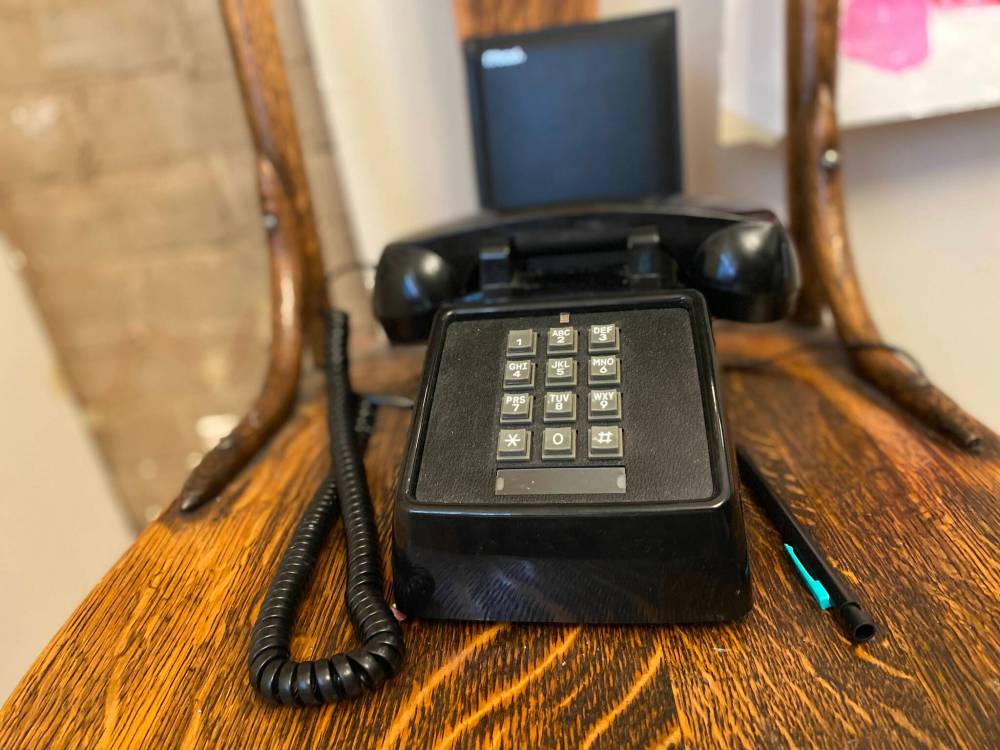
Dr. Jo Ann Unger, a clinical psychologist working with the University of Manitoba, agrees that providing children with alternative screen-free communication methods is a positive thing for their development.
“I love this idea,” Unger says.
With smartphones and tablets designed to encourage prolonged and passive use, both of which are connected to negative developmental outcomes, Unger says having an alternative that is used solely for its intended purpose is a step in the right direction.
“One thing we know about some of the positive effects of being on digital media has to do with social connection and communication,” she says. “This allows us to pull out the benefits from those devices and put it into a device that doesn’t have the temptation for prolonged use or passive use.”
A high school teacher, Shiach says she sees first-hand the effects smartphones can have on kids at that age.
“I see how addicting they are and how easily you can be distracted by them,” she says.
“And when our kids are home alone, they have the house phone. If kids get home before we do, they can call us. That’s a huge safety net as well.”
Developing social skills that aren’t a part of screen devices is an added benefit to using a landline.
“This is all around social-emotional development,” Unger says. “For kids to grow up into the lovely humans we’d like to raise, giving them practise on how to talk to each other, have that back-and-forth communication and the empathy skills that come with that, the speaking and pauses that come with that. They do that on the playground, but this is another opportunity to do so, which is great.”
Like the Sommerfelds, Mike and Melissa Thiessen recently got a VOIP phone in their South Osborne home so their seven-year-old daughter Madeline could stay in touch without a smartphone.
“We thought it would be great for Madeline to have the experience of chatting with friends and family on the phone,” Mike Thiessen says. “(But) we were a hard no on her getting a cellphone.”
Watching their children learn telephone etiquette and build relationships in a way that seems familiar, even nostalgic, has been a positive experience for many families.

“It’s been interesting,” says Thiessen, adding he has installed enhanced safety features on their VOIP line, so that incoming or outgoing calls are limited to pre-approved numbers. “She’ll pick up the phone and not say anything. Or call someone and say hello and assume they know who it is. She loves organizing playdates through the phone.”
“When (my daughters’) friends come over, they don’t need my cellphone to call their parents,” Shiach adds. “And when our kids are home alone, they have the house phone. If kids get home before we do, they can call us. That’s a huge safety net as well.”
Shiach believes that the close-knit nature of her neighbourhood in South Osborne has made it easier to get other families on board with both limiting smartphone use and adopting landlines.
“It’s kind of like a small town in the big city,” she says. “Some of us made a pact not to get kids cellphones until later. So many families in our neighbourhood have them now. It’s awesome.”
While his daughter Madeline currently only calls a couple of friends, Thiessen feels that number could grow as the school year progresses.
“Talking with neighbours, there’s a lot of interest,” he says.
“I honestly use the phone more than I use the iPad. It might even be easier.”
To date, Sommerfeld says not many of their peers in Springfield have jumped on the landline bandwagon, but she hopes to see that change.
“All it takes is a few other like-minded families to start the conversation,” she said. “If it means he can go to school with a few other friends who also don’t have smartphones, it would be really powerful to have some peer support in that way.”
Shiach and Sobkowicz’s daughters have found this to be true. The three girls keep a running list of their friends’ phone numbers near the primary phone in their home, so they can easily call someone up to play or quickly identify an incoming caller.
“I call and ask questions — like if it’s Spirit Week or something, I’ll call a friend and ask what day it is,” says Anna, who is in Grade 6, and counts more than a half-dozen of her friends who regularly use landlines to talk or plan neighbourhood hangouts.
Now in Grade 8, Emily has started to connect with friends over text using an iPad, but still makes good use of the landline to talk to her friends.
“My friends all have cellphones and iPads,” she says. “I honestly use the phone more than I use the iPad. It might even be easier.”
sheldon.birnie@winnipegfreepress.com