The power of principle Work at Manitoba Theatre for Young People aims to share Jordan River Anderson’s heroic legacy with young audiences
Read this article for free:
or
Already have an account? Log in here »
To continue reading, please subscribe:

Digital Subscription
One year of digital access for only $205*
- Enjoy unlimited reading on winnipegfreepress.com
- Read the E-Edition, our digital replica newspaper
- Access News Break, our award-winning app
- Play interactive puzzles
*First annual payment billed as $205.00 + GST for one year. This annual subscription will automatically renew at $233.00 + GST every 52 weeks (10% off the regular annual price of $259.35). Offer available to new and qualified returning subscribers only. Cancel any time.
To continue reading, please subscribe:
Add Free Press access to your Brandon Sun subscription for only an additional
$1 for the first 4 weeks*
- Enjoy unlimited reading on winnipegfreepress.com
- Read the E-Edition, our digital replica newspaper
- Access News Break, our award-winning app
- Play interactive puzzles
*Your next Brandon Sun subscription payment will increase by $1.00 and you will be charged $17.95 plus GST for four weeks. After four weeks, your payment will increase to $24.95 plus GST every four weeks.
Read unlimited articles for free today:
or
Already have an account? Log in here »
It isn’t often that Yvette Nolan is brought to tears by her own work.
But at the Montreal premiere of Jordan, the playwright found herself weeping in the aisles.
Theatre preview
Jordan
Manitoba Theatre for Young People
• Opens Friday, runs to Oct. 11
• Recommended audience: ages 6 through 12
• Approximate runtime: 55 minutes
• Tickets: $26 to $29 at mtyp.ca
“I was a mess,” she recalls.
But all around her, the audience of children at Montreal’s Geordie Theatre were cheering at the conclusion of Nolan’s latest work, a fable centred on the heroic influence of Jordan River Anderson, a Norway House boy who spent two years living in hospital because the federal and provincial governments couldn’t agree on which level of elected office should pay for his at-home care.
Jordan’s death in 2005 at the age of six “ignited a movement to uphold human rights for all First Nations children through the creation of the child-first principle called ‘Jordan’s Principle,’” the First Nations Child and Family Caring Society says.
Born in Prince Albert, Sask., but raised in Winnipeg, with familial roots in Norway House, Nolan — who served as director of Native Earth Performing Arts from 2003 to 2011 — always felt a deep connection to Jordan’s story, but drew fresh inspiration from his profound impact on Canadian society after watching Alanis Obomsawin’s 2019 documentary portrait. (Jordan River Anderson, The Messenger is available to stream on CBC Gem.)
She didn’t plan on writing about Anderson, however, until she gave Jimmy Blais a congratulatory call upon his appointment as artistic director of Geordie, a Montreal company that presents English-language work for young audiences in Quebec and abroad.
Blais, who directed Rhonda Apetagon’s In the Shadow Beyond the Pines last season for the Royal Manitoba Theatre Centre, told Nolan that he was interested in telling Anderson’s story to a generation of audiences who probably didn’t know it yet.
Emelia Hellman / Geordie Theatre The heroic underpinnings of the work reinforce the belief held by playwright Yvette Nolan that theatre can still save the world through empathy.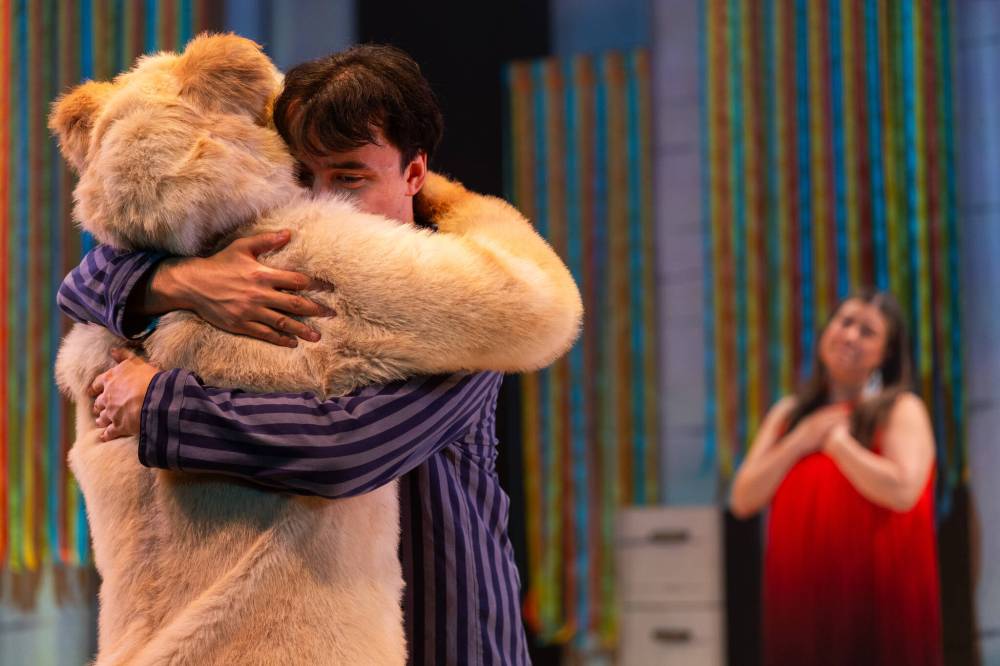
To Blais, it seemed an opportunity to keep his memory alive while also following through on the 83rd call to action of the Truth and Reconciliation Commission, which calls on the Canada Council for the Arts to prioritize funding for collaborative works by Indigenous and non-Indigenous artists that advance reconciliation.
For Nolan, the idea, though intimidating, rang true when reflecting on her 2015 book Medicine Shows, in which she wrote, “Indigenous theatre artists make medicine by reconnecting through ceremony, through the act of remembering, through building community and by negotiating solidarities between communities.”
In the book, she cites works by playwrights such as Tomson Highway, Ian Ross and Maria Campbell as exemplars of that complex path to healing.
In 2026, Nolan understood that those conversations started in the 1980s and ’90s were as prevalent as ever. The question was how to open the discussion when the primary intended audience was between six and 12 years old.
Emelia Hellman / Geordie Theatre The play aims to tell Jordan’s story to a generation of audiences who may not be familiar with it yet. 
Through conversations and workshops, Nolan and Blais set out to imagine an alternate reality where Anderson, who was non-verbal during his life, awakens in his hospital bed with the newfound ability to move and to speak in both English and his ancestral language.
Accompanied by a spirit bear named Maskwa, Jordan gets to see through his own eyes the enormous impact he continues to have on the world.
“I think that’s helpful for kids to internalize,” says Nolan.
But the work, she says, speaks to many generations at once, and its heroic underpinnings reinforce the playwright’s unflagging belief that theatre can still save the world.
“Because we have to sit together, and we have to meet each other there, we have to experience a story together,” Nolan says. “It may be that the person next to me is receiving it differently than I am, but we’re still seeing the same story.
“The theatre, I think, is one of the last places where we create empathy, and I think that we need a lot more empathy.”
ben.waldman@winnipegfreepress.com

Ben Waldman is a National Newspaper Award-nominated reporter on the Arts & Life desk at the Free Press. Born and raised in Winnipeg, Ben completed three internships with the Free Press while earning his degree at Ryerson University’s (now Toronto Metropolitan University’s) School of Journalism before joining the newsroom full-time in 2019. Read more about Ben.
Every piece of reporting Ben produces is reviewed by an editing team before it is posted online or published in print — part of the Free Press‘s tradition, since 1872, of producing reliable independent journalism. Read more about Free Press’s history and mandate, and learn how our newsroom operates.
Our newsroom depends on a growing audience of readers to power our journalism. If you are not a paid reader, please consider becoming a subscriber.
Our newsroom depends on its audience of readers to power our journalism. Thank you for your support.