Beautiful beak RMTC finds charm behind Cyrano’s prominent proboscis
Read this article for free:
or
Already have an account? Log in here »
To continue reading, please subscribe:

Digital Subscription
One year of digital access for only $205*
- Enjoy unlimited reading on winnipegfreepress.com
- Read the E-Edition, our digital replica newspaper
- Access News Break, our award-winning app
- Play interactive puzzles
*First annual payment billed as $205.00 + GST for one year. This annual subscription will automatically renew at $233.00 + GST every 52 weeks (10% off the regular annual price of $259.35). Offer available to new and qualified returning subscribers only. Cancel any time.
To continue reading, please subscribe:
Add Free Press access to your Brandon Sun subscription for only an additional
$1 for the first 4 weeks*
- Enjoy unlimited reading on winnipegfreepress.com
- Read the E-Edition, our digital replica newspaper
- Access News Break, our award-winning app
- Play interactive puzzles
*Your next Brandon Sun subscription payment will increase by $1.00 and you will be charged $17.95 plus GST for four weeks. After four weeks, your payment will increase to $24.95 plus GST every four weeks.
Read unlimited articles for free today:
or
Already have an account? Log in here »
There are more flattering places to have your body described than in a book called Les Grotesques, but it was in that 1844 work that French readers such as playwright Edmond Rostand were reintroduced to a 17th-century firebrand named Cyrano de Bergerac, the subject of Royal Manitoba Theatre Centre’s season-opening production.
Theatre preview
Cyrano de Bergerac
• John Hirsch Mainstage, Royal Manitoba Theatre Centre
• Opens Thursday, runs to Nov. 1
• Tickets $30 to $112 at royalmtc.ca
Yes, he was real.
And yes, his nose was apparently spectacular.
“Less doughy, less fleshy in its contours, it shows more bone and cartilage, more flat planes and highlights — it is most heroic,” wrote French poet Théophile Gautier, sparing no detail in his facial analysis.
“As for the rest of his face — insofar as that triumpant nose allows one to see it — it strikes me as graceful and well-proportioned. His eyes are almond-shaped and very dark, lending them a surprising blend of fire and gentleness. His eyebrows are slender yet very distinct. His moustache, somewhat thin and sparse, fades into the shadows at the corners of his mouth. His hair falls gracefully on either side of his face.
“Were it not for the nose, he would truly be a handsome fellow. That unfortunate nose, however, gave Cyrano de Bergerac the occasion to display his valour in duels that recurred almost daily.”
But there’s more to the swashbuckling romantic than his hopeless protuberance, says actor Jack Davidson, a Toronto-raised performer with a notably unremarkable nose.
“Cyrano offers so much,” says Davidson, who plays the title role in the RMTC production, a rhyme-time adaptation of Rostand’s 1897 work written by Winnipeg’s Jessy Ardern, who wrote Theatre Projects Manitoba’s recent R+J: Closing Night.
“Cyrano’s so witty, he’s so smart and he’s so capable of all of these things, but because of this one thing, he believes he’s not deserving, and he’s angry.”
Dylan Hewlett photo Jack Davidson as Cyrano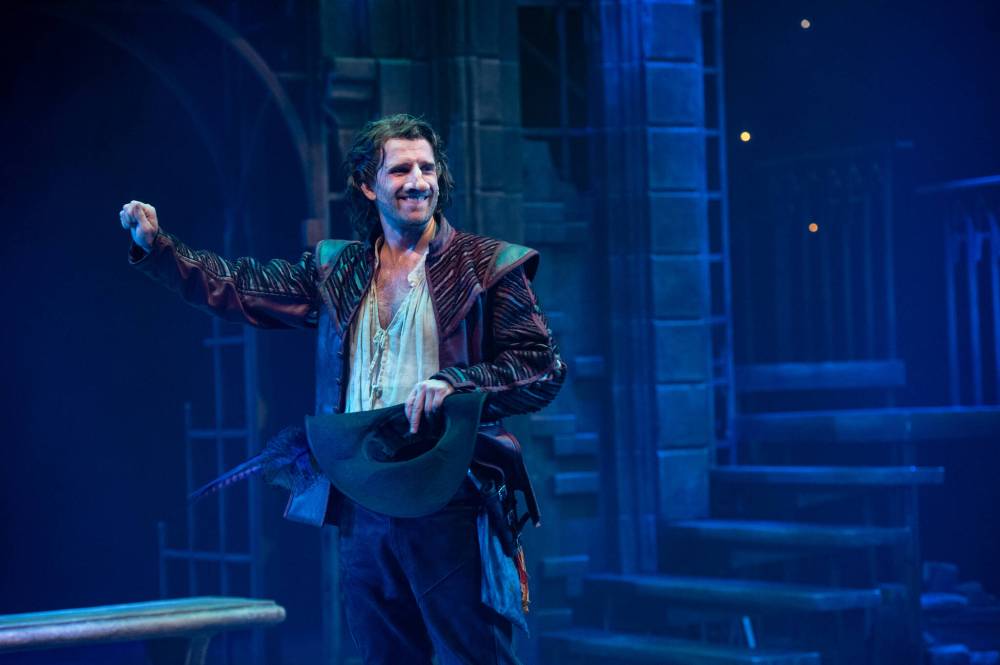
Cyrano is enamoured with the brilliant Roxane (Stephanie Sy) — who is his cousin, at least in Rostand’s work — but feels hopelessly crushed when comparing himself to the upstart Christian (Darren Martens), who’s described as having “a beautiful head.”
What ensues is a tale of negative self-regard, with Cyrano using his literary gifts to help Christian, who describes himself as “too stupid to write,” to woo Roxane through daily letters.
“It’s kind of one of the earliest examples I can think of for what we would now call catfishing, where someone is being deceived in some way about who the person they’re communicating with is,” Davidson says.
“As much as we don’t want that to happen, it does because people don’t feel that their self-worth is very high, and for whatever reason, they’ve gotten to a place where they think the best idea is to be someone else and mislead someone else in hopes that it might still lead to a connection.”
The Nose
Cyrano de Bergerac star Jack Davidson says that the process to plaster on his prosthesis isn’t too arduous, averaging about 10 minutes per usage. “Chris, my nose guy, has been timing it for his own purposes,” Davidson says. “It’s complicated to get a thing to stick to your head as you run around and sweat for (two hours and 45 minutes).”
Cyrano de Bergerac star Jack Davidson says that the process to plaster on his prosthesis isn’t too arduous, averaging about 10 minutes per usage. “Chris, my nose guy, has been timing it for his own purposes,” Davidson says. “It’s complicated to get a thing to stick to your head as you run around and sweat for (two hours and 45 minutes).”
But Goldberg, the director, spent far longer than a coffee break thinking about the play’s most famous piece of makeup.
“I would say there were months of conversation with my costume designer (Deanna Finnman) about what the nose needed to look like and all the things I didn’t want it to look like,” she says. “I didn’t want it to look like the hooked witch or the Pinocchio nose. I wanted it to have a naturalistic element to it. I wanted it to not have the perfect curvature. I was just sending pictures of real noses of real people.
“There’s lots of pictures of Owen Wilson’s nose in my photo gallery,” she adds. “What I think is important is that it’s not so comically large that it’s distracting, but that it has to be there so we understand. Cyrano’s insecurities are far deeper than just his nose. It may be the catalyst, but his wounds are so deep from what he’s told himself for all these years — that he cannot be loved.”
Cyrano, in Davidson’s reading, is largely about what poor judges each of us can be when it comes to assessing our own self-worth.
When she studied Cyrano in university, director Amanda Goldberg hardly thought the play was worth a sniff. So when her mentor, Citadel Theatre’s artistic director Daryl Cloran, suggested to Goldberg and Ardern — frequent collaborators on indie adaptations — to adapt Rostand, the Montreal-raised Goldberg was hesitant to sign up for the nose job.
“I kind of went, ‘I don’t know if this is the show for me.’ I didn’t really know if I understood what this play was or what the story could be,” says Goldberg, whose left nostril is pierced twice.
“And then Jessy handed me her adaptation, and I just feel like I understood it for the first time. The way she tackled the poetry and the language and the emotional arcs of these characters, all while keeping it in 1640, I felt was such an amazing representation of the power of adaptation.
“It wasn’t just this play about an ugly man with a big nose who can’t get over it: it was about deep-cut wounds and societal expectation and these ideas of performing versions of yourself.”
A play that once felt like a “time capsule — a period piece with big hats and big words” was made to feel contemporary through adaptation, a word with biological implications of survival across generations.
“Why I think this play has been around so long, and why people keep attacking it, is because there are modern questions and ideals in it. The question I think really relates to every character in this show is, ‘If I were truly seen, would I still be loved?’ Or, ‘If someone really saw me for who I truly was, would they still love me?’ And that question doesn’t belong in 1640; it doesn’t belong to Rostand in 1897; it belongs to all of us,” says Goldberg.
MIKE DEAL / FREE PRESS Amanda Goldberg was hesitant to take on the show at first, until a recommendation from her mentor swayed her.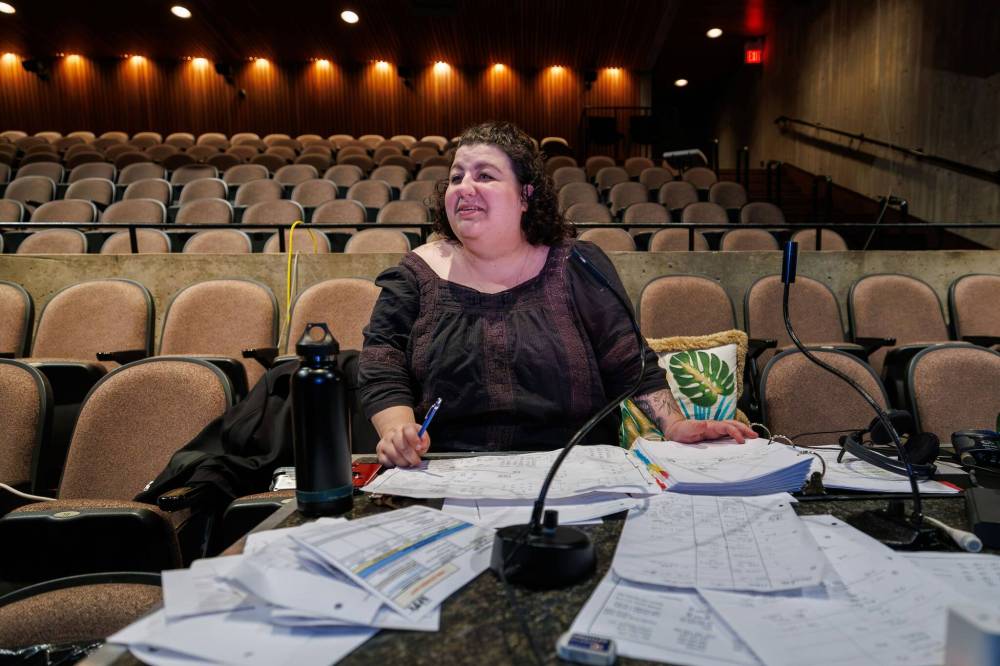
That’s what Goldberg, whose MFA thesis at the University of Alberta was about theatrical adaptations, enjoys most about working on revised and revived works.
“What’s so amazing and beautiful about adaptation is that you’re not creating something new, but you’re getting to speak to — in this case — 200 years of storytellers reinterpreting the same question,” she says.
“For general, contemporary audiences, I think adaptation is necessary because they need to be brought into the world and introduced to how it relates to them. I think for a play to be successful and resonant and to stay with someone, they want to feel close to it.
“We introduce the audience clearly to 1640, and the goal is that by the end of the piece, 1640 feels like today.”
ben.waldman@winnipegfreepress.com


Ben Waldman is a National Newspaper Award-nominated reporter on the Arts & Life desk at the Free Press. Born and raised in Winnipeg, Ben completed three internships with the Free Press while earning his degree at Ryerson University’s (now Toronto Metropolitan University’s) School of Journalism before joining the newsroom full-time in 2019. Read more about Ben.
Every piece of reporting Ben produces is reviewed by an editing team before it is posted online or published in print — part of the Free Press‘s tradition, since 1872, of producing reliable independent journalism. Read more about Free Press’s history and mandate, and learn how our newsroom operates.
Our newsroom depends on a growing audience of readers to power our journalism. If you are not a paid reader, please consider becoming a subscriber.
Our newsroom depends on its audience of readers to power our journalism. Thank you for your support.