Commitment to the craft Author George Toles on daily writing and keeping his eyes open
Read this article for free:
or
Already have an account? Log in here »
To continue reading, please subscribe:

Digital Subscription
One year of digital access for only $205*
- Enjoy unlimited reading on winnipegfreepress.com
- Read the E-Edition, our digital replica newspaper
- Access News Break, our award-winning app
- Play interactive puzzles
*First annual payment billed as $205.00 + GST for one year. This annual subscription will automatically renew at $233.00 + GST every 52 weeks (10% off the regular annual price of $259.35). Offer available to new and qualified returning subscribers only. Cancel any time.
To continue reading, please subscribe:
Add Free Press access to your Brandon Sun subscription for only an additional
$1 for the first 4 weeks*
- Enjoy unlimited reading on winnipegfreepress.com
- Read the E-Edition, our digital replica newspaper
- Access News Break, our award-winning app
- Play interactive puzzles
*Your next Brandon Sun subscription payment will increase by $1.00 and you will be charged $17.95 plus GST for four weeks. After four weeks, your payment will increase to $24.95 plus GST every four weeks.
Read unlimited articles for free today:
or
Already have an account? Log in here »
“When one is deeply stirred, the force of beauty — of whatever kind — launches a blind search for the key and the door of memory. Everything that pierces us has been prepared beforehand, awaiting its chance to return.”
George Toles wrote that.
“How I lost my boxers on the bus this morning shall remain one of life’s little mysteries.”
George Toles wrote that, too.
How about the Guy Maddin-directed films Archangel, The Saddest Music in the World and the dialogue in the filmmaker’s keystone project, My Winnipeg?
Each of those enchanted oddities also sprang from the tireless mind of a man whose daily writing practice is as doggedly devoted to memory excavation as it is considerate of the unknown.
MIKAELA MACKENZIE / FREE PRESS George Toles with his newest book, All the People in My Head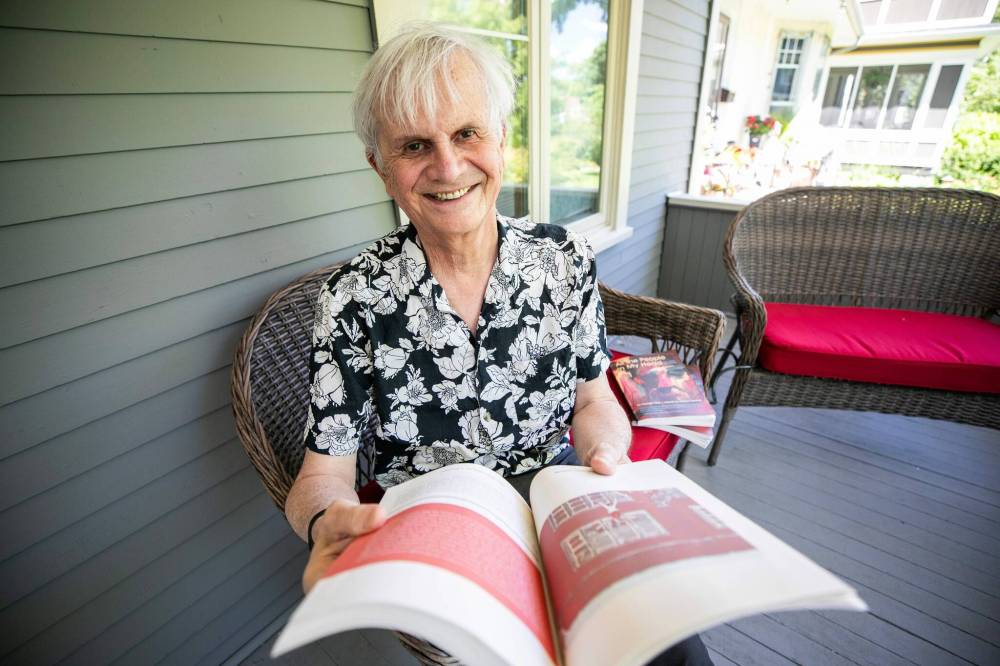
Since 2008, George Toles has not missed a single day of prying original prose from his mental file cabinet.
Last Friday, after eating his lunch, and after posting to his Facebook page a 23-word account of a young woman prone to gnashing her teeth, the 77-year-old — a distinguished professor of theatre and film at the University of Manitoba — walked into the Starbucks coffee shop on Corydon Avenue at Stafford Street at 2:15 p.m.
He doesn’t arrive empty-handed, carrying two books — one by the 19th-century scribe Anthony Trollope, the other The Hill, the debut novel by Harriet Clark published last month — and a neatly folded copy of the New York Review of Books; inside, there’s an article on Rabelaisian scholar Mikhail Bakhtin which Toles plans to devour after fielding questions from the Free Press about his latest tome.
Published last month by Winnipeg’s At Bay Press, edited by Toles’s son Thomas and featuring visual responses by Toles’s childhood friend Robert Fleming, All the People in My Head features 200 “tales of short acquaintance” culled from Toles’s archive of aphorisms, epigrams and short-form diversions into the lives of characters who exist because Toles decided that they just might, and that, therefore, they probably should.
Supplied George Toles’s latest book, All the People in My Head, features 200 ‘tales of short acquaintance.’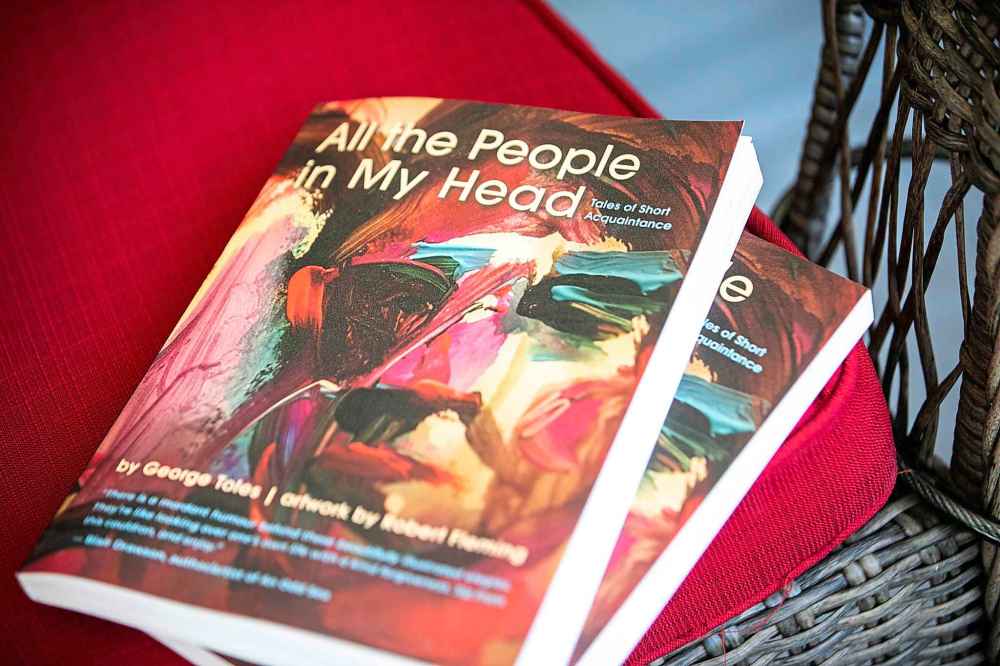
Novelist Allan Gurganus, who studied with short-story master John Cheever at the Iowa Writers’ Workshop in the 1960s, said that when he and his mentor sat down for coffee at a diner, they would tell the tale of each successive customer.
“Most of the meal would be spent in a kind of rivalrous and delightful set of invented narratives, which might then involve moving the story of one table into the story of another table,” Gurganus told the New York Times in 1988.
Toles — whose previous works include a monograph on filmmaker Paul Thomas Anderson’s oeuvre and Status Update, a collection of social-media fiction paired with visual responses by the late Winnipeg artist Cliff Eyland — doesn’t regularly participate in such exercises, he says.
“I always have my eyes open, and I always have my memory eyes open,” says Toles, his dark lenses lightening as they adjust to the coffee shop’s afternoon glow.
He’s called bison country home since the 1970s, but Toles’ personal history is always accented by the elongated vowels of his developmental years in postwar Hamburg, N.Y., a village just south of Buffalo.
The son of a freelance business writer who later collaborated with his wife to run one of Buffalo’s earliest public-relations firms, Toles was at home in the neighbourhood library, cracking the colourful spines of fairy tales written by Andrew and Nora Lang and dozens of books published by the Grosset & Dunlap publishing house, which put out adventure and mystery series starring protagonists such as the Bobbsey Twins, Cherry Ames and the teenage aeronaut Rick Brant.
“If I had to choose one book which was the hub of the wheel, it would be Treasure Island, in terms of stretching my sense of characterization, possibility and exoticism,” recalls Toles.
“It’s a book that seemed to spring everything. I wanted for a while for everything to be like Robert Louis Stevenson.”
In Hamburg, Toles wasn’t preoccupied with any notions of becoming a major league athlete: he once lost focus during a baseball game and jogged into the opposing team’s dugout between innings.
Without any aspirations to become the next Connie Mack either, Toles used his managerial skills to enlist his friends in adventure tales or war games.
“You’re going to be General Bismarck,” he’d say. “I always wanted to make things into dramas,” he says.
Supplied All the People in My Head was published by Winnipeg’s At Bay Press, edited by Toles’s son Thomas and features visual responses by Toles’s childhood friend Robert Fleming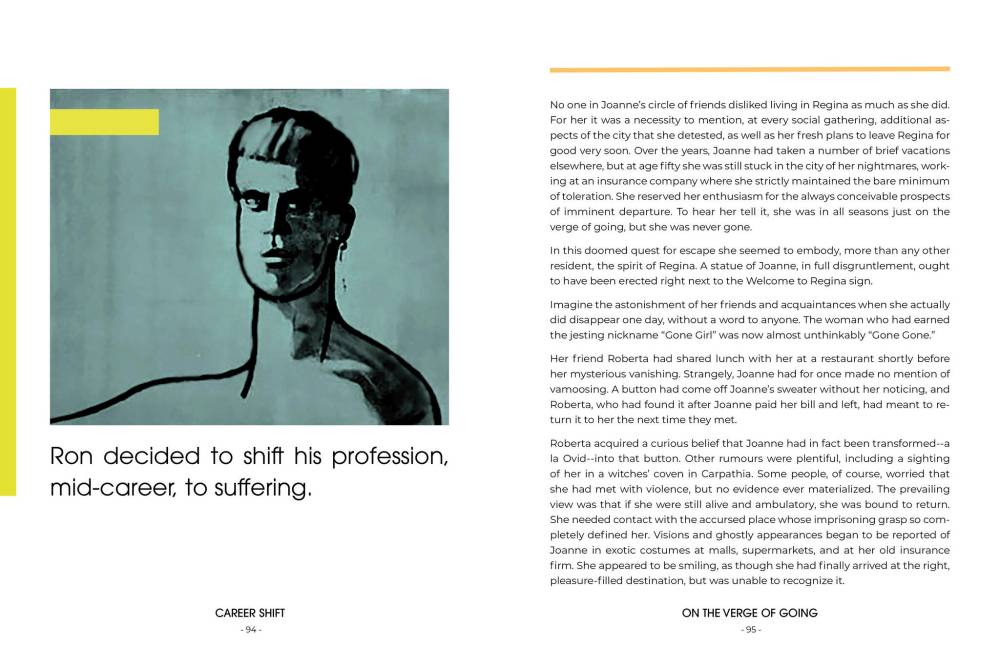
One of the neighbourhood kids whom Toles persuaded to participate was Robert Fleming, who, like the bookish Toles, collected stamps and plastic soldiers.
“He played Captain Hook in the garage rehearsing the Peter Pan musical. Even though theatre was by no means a talent that he had, his participation made it much easier to recruit the others,” says Toles of his more athletic friend.
Some 60 years later, with a trove of personal writing that needed visual accompaniment, Toles once again called upon his childhood friend, who maintains a studio practice in Buffalo.
“I sent him a Hail Mary-pass email,” says the author, who was glad to find a willing helper in his fellow Hamburger, who “breathed the same air and knows the kind of town and street and nature realm as I do. None of that needed to be explained.”
The work with Fleming is another example of Toles’s track record for long-standing, fruitful and responsive partnerships, which has allowed him to explore fantastic extremes within the complex terrain of the creative middle ground.
With Maddin, that work began in earnest for Toles as a scenarist on the Winnipeg director’s 1987 feature Tales From the Gimli Hospital, but the commingling of narrative spirit truly took hold on 1990’s Archangel, a film for which Toles “flipped an invaluable switch” that made his writing come alive.
Friends had often said that as far as central characters went, the ones Toles based on his own person were frequently dull, “even when they were amusing.”
“So I said, ‘I’m going to pretend I’m Guy Maddin writing. I’m in his sandbox, and I’m playing as Guy,’” he says. “Lo and behold, the bullshit aspect of writing as or for myself seemed to have vanished. Throughout our collaboration, I was continuing, to a large extent, to imagine that the things that were coming out of me belonged at least as much, if not completely, to him.”
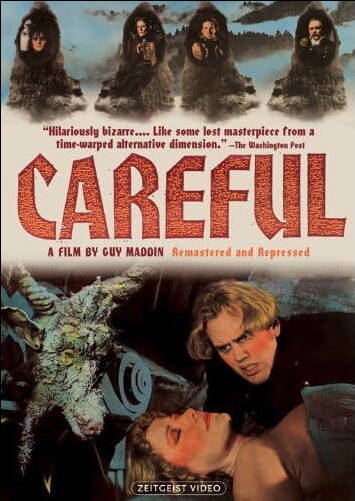
That approach proved invaluable on Archangel, and again two years later on Careful, the filmmakers’ devious play on the long-forgotten genre of “the mountain film” — a subgenre of prewar European isolationist drama told against the backdrop of snowcapped ranges.
The film is set in an alpine village called Tolzbad — described by the New York Times in 1992 as a “community of apple-cheeked villagers whose scrubbed faces belie a Freudian wasp’s nest of incestuous desire and sibling rivalry.”
The taboo-pressing film was on Toles’s mind last week as a new restoration was screening at New York’s vaunted Film Forum alongside Maddin’s Royal Winnipeg Ballet film Dracula: Pages From a Virgin’s Diary. Throughout the summer, Careful will screen in Chicago, Los Angeles, St. Louis, Mo.; Portland, Ore.; and in Rhinebeck, N.Y.
“I won’t use the word proud, but I’ll say that’s the one script I’m absolutely unashamed of,” says Toles, whose son Thomas was brought to the set several times in his infancy.
“It was an icy mountain, built in Winnipeg of all places, but of course the warehouse was swelteringly hot. So there was this climatic split between these glacial heights and always being in danger of swooning from the heat, which I think helped the performers get into the lunatic mindset.”
Toles — who was cast as the main character’s dead mother — could count himself among the crazies.
For a pivotal scene of mourning, he climbed into a casket to lie in state, attempting to remain motionless while a burning candle held by the onscreen son dripped unexpected wax on Toles’ artificially embalmed face, an unscripted moment preserved in the film’s final cut.
“I was nicely made up,” he says.
winnipegfreepress.com/benwaldman
If you value coverage of Manitoba’s arts scene, help us do more.
Your contribution of $10, $25 or more will allow the Free Press to deepen our reporting on theatre, dance, music and galleries while also ensuring the broadest possible audience can access our arts journalism.
BECOME AN ARTS JOURNALISM SUPPORTER
Click here to learn more about the project.

Ben Waldman is a National Newspaper Award-nominated reporter on the Arts & Life desk at the Free Press. Born and raised in Winnipeg, Ben completed three internships with the Free Press while earning his degree at Ryerson University’s (now Toronto Metropolitan University’s) School of Journalism before joining the newsroom full-time in 2019. Read more about Ben.
Every piece of reporting Ben produces is reviewed by an editing team before it is posted online or published in print — part of the Free Press‘s tradition, since 1872, of producing reliable independent journalism. Read more about Free Press’s history and mandate, and learn how our newsroom operates.
Our newsroom depends on a growing audience of readers to power our journalism. If you are not a paid reader, please consider becoming a subscriber.
Our newsroom depends on its audience of readers to power our journalism. Thank you for your support.