A feast for span fans Fusing prudent engineering and impactful design, city’s bridges do much more than get us from here to there
Read this article for free:
or
Already have an account? Log in here »
To continue reading, please subscribe:

Digital Subscription
One year of digital access for only $205*
- Enjoy unlimited reading on winnipegfreepress.com
- Read the E-Edition, our digital replica newspaper
- Access News Break, our award-winning app
- Play interactive puzzles
*First annual payment billed as $205.00 + GST for one year. This annual subscription will automatically renew at $233.00 + GST every 52 weeks (10% off the regular annual price of $259.35). Offer available to new and qualified returning subscribers only. Cancel any time.
To continue reading, please subscribe:
Add Free Press access to your Brandon Sun subscription for only an additional
$1 for the first 4 weeks*
- Enjoy unlimited reading on winnipegfreepress.com
- Read the E-Edition, our digital replica newspaper
- Access News Break, our award-winning app
- Play interactive puzzles
*Your next Brandon Sun subscription payment will increase by $1.00 and you will be charged $17.95 plus GST for four weeks. After four weeks, your payment will increase to $24.95 plus GST every four weeks.
Read unlimited articles for free today:
or
Already have an account? Log in here »
Hey there, time traveller!
This article was published 19/01/2024 (993 days ago), so information in it may no longer be current.
There’s a lovely, slightly obscure word for people who love bridges: “Pontists.”
Landmarks
A monthly series that looks at the structure and spaces that shape Winnipeg. Read more of Alison Gillmor’s Landmarks features here.
You can find these bridge enthusiasts on the internet, talking up their global bridge-spotting bucket lists or musing about which historical bridge builder they would like to share a drink with.
(Maybe Squire Whipple, the American innovator of iron bridges, or the magnificently named 19th-century British engineer Isambard Kingdom Brunel.)
Winnipeg should be a pontist playground. We are a city of bridges, currently with 49 designed for vehicle traffic, along with dozens of pedestrian bridges.
We have a lot of water to cross, with three primary rivers (the Red, the Assiniboine and the Seine), as well as assorted creeks (including Sturgeon Creek, Bunn’s Creek and Omand’s Creek).
For hardcore pontists, Winnipeg’s bridges display a range of structural types, along with some very distinct personalities.
There’s the eminently Instagrammable Esplanade Riel, a side-spar cable-stayed bridge that’s gorgeous and knows it. There’s the hard-working, broad-shouldered through-truss Louise Bridge.
There’s the doomed Arlington Bridge, with its accumulated load of history and legend. There are the bright, happy painted walking and cycling bridges organized by Cool Streets Winnipeg.
In a mostly flat city, the Slaw Rebchuk Bridge offers its users a subtle rise and fall, along with some dramatic vistas, with the Canadian Pacific railyards stretching out on either side and the view that greets drivers, cyclists or walkers as they head toward Dufferin.
(Maybe you remember the iconic rooftop sign that could once be seen from the bridge: “Welcome to the North End: People Before Profits.”)
The Slaw Rebchuk Bridge, as seen from Isabel Street, spans the Canadian Pacific railyards. (Trevor Hagan / Winnipeg Free Press files)
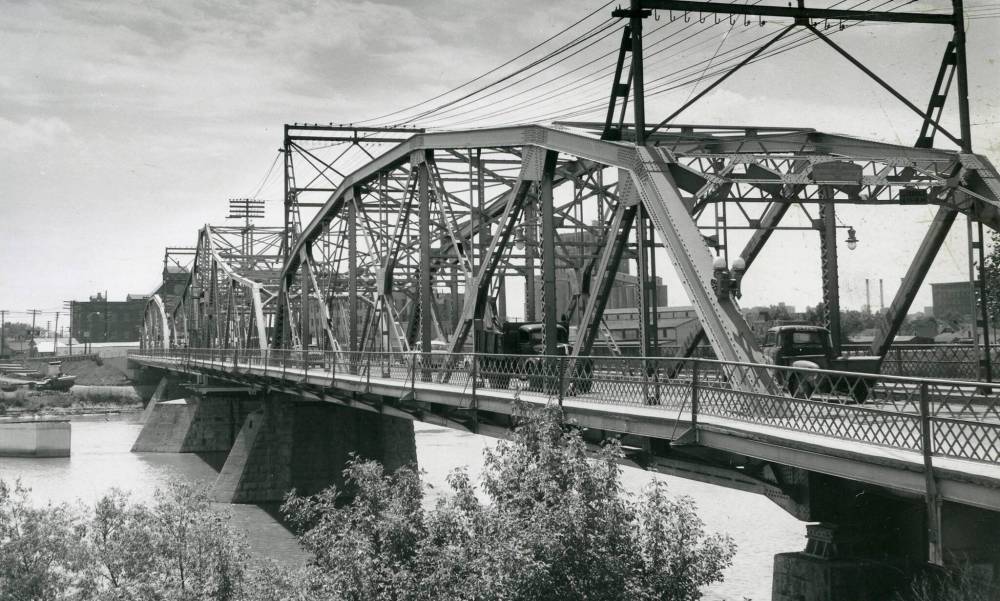
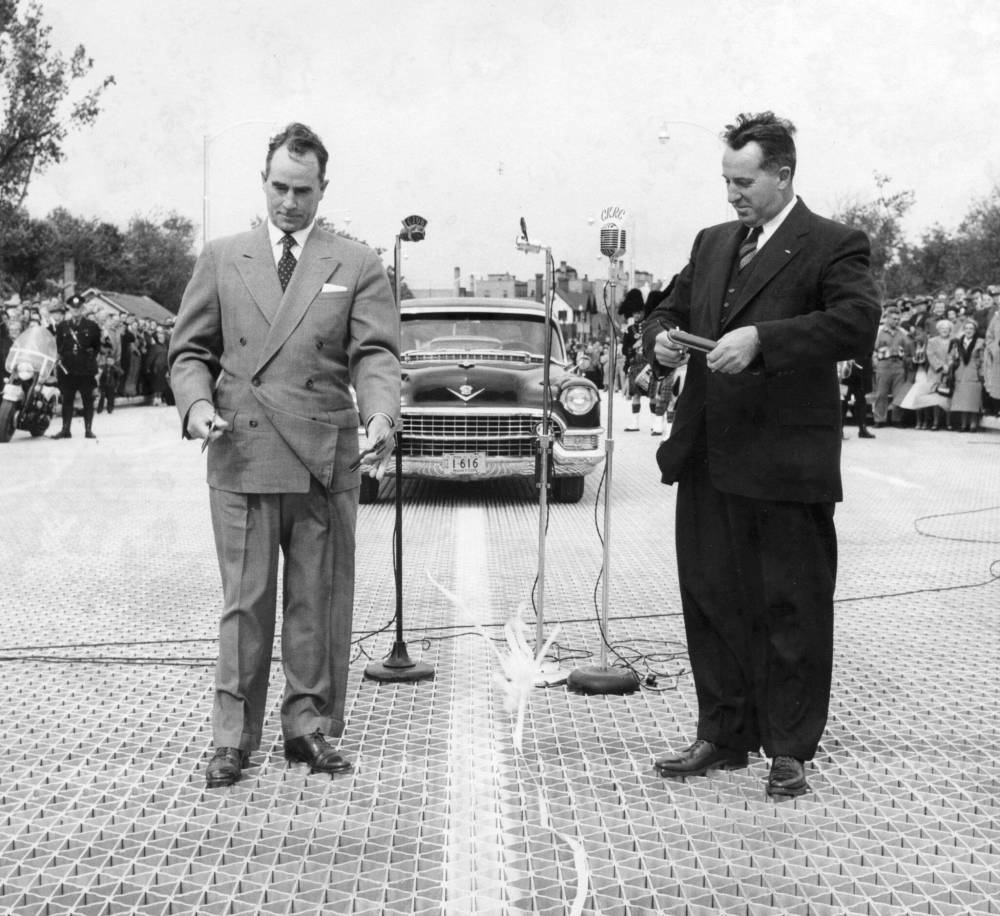
My own favourite bridge is a lost incarnation of the Midtown from back in the 1960s when it had a metal-grate deck that made your automobile vibrate and buzz when you travelled over it. As kids we called it “the humming bridge.”
Every successful bridge, from a simple rope suspension crossing to a span constructed from 21st-century fibre-reinforced polymer, is a work of engineering, a carefully calibrated balance of tensile and compressive forces.
The importance of good bridge engineering is illustrated by the stubborn myth that the rings worn by professional engineers were originally made from the iron of a collapsed bridge.
This is not literally true, but “The Ritual of the Calling of an Engineer,” a ceremony during which many Canadian engineering students receive their rings, was instigated, in part, as a response to two disastrous collapses of the Quebec Bridge over the Saint Lawrence River, in 1907 and 1916, which killed 88 construction workers. For engineers, their rings are meant to be a daily reminder of the grave ethical obligations of their profession.
The fundamental function of a bridge, then, is to get you safely from point A to point B. A good bridge can also link up pragmatic engineering with powerful design. And at their best, bridges can bring together not just places but people, connecting them to each other and to their city.
The Midtown Bridge once hummed under car tires with its now-replaced metal-grate deck. (Mikaela MacKenzie / Winnipeg Free Press files)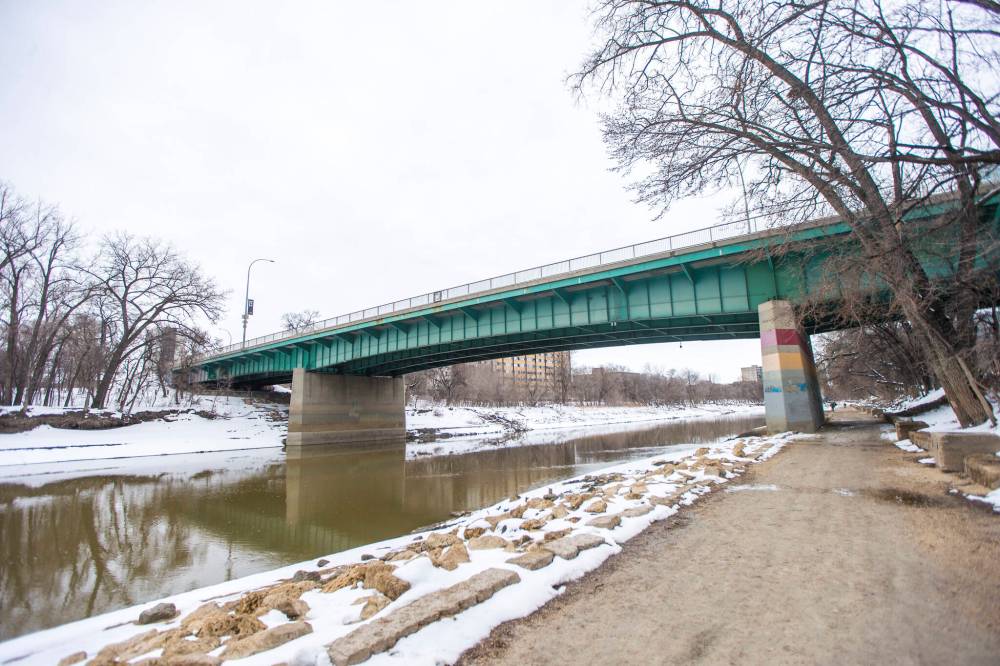
According to Richard Milgrom, head of the Department of City Planning in the Faculty of Architecture at the University of Manitoba: “The engineering approach is, ‘How do we get across the river?’ and we solve that by putting the road across the river. But the bridge can be an opportunity to do more than that, which might be placemaking, or celebration, or just getting a different perspective on the city by looking along the river.
“So many times now, there’s no marking of the crossing, no celebration of the crossing, no recognition that there’s something underneath the bridge, especially the rivers.”
That’s an especially important issue in Winnipeg. Our rivers “should be celebrated, not ignored,” Milgrom says.
“In a place like Winnipeg, they are so much part of why we’re here. They’re important socially, symbolically, historically, ecologically.
“Prairie rivers are so cool. They’re not static. They change and move, go up and down. We’re always fighting with them. I mean they’re literally fluid — always charging and recharging their own courses.”
By offering places to pause, to look, to gather, bridges can open up new ways to experience the city and its rivers.
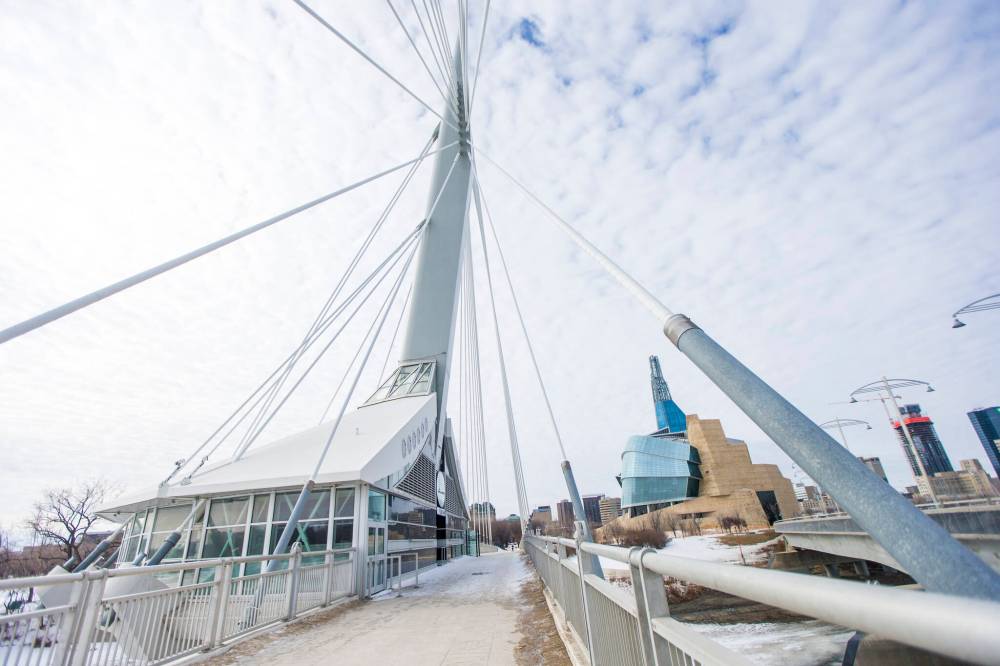
“Esplanade Riel, the bridge people didn’t want to build, has become a very popular thing, and it does a good job of pedestrian connection between Provencher and The Forks,” Milgrom suggests.
The Norwood Bridge offers “bays and alcoves along the bridge where you can sit and watch the trains going by and boats or skaters going underneath.”
Milgrom also talks about the possibilities offered by disused rail or vehicle bridges, which can sometimes be repurposed for active transport.

That’s worked beautifully with the Elm Park Bridge. Completed in 1914, the bridge between Kingston Crescent and Jubilee Avenue originally allowed two-way motor-vehicle traffic, which got a little hair-raising as cars got wider. It was changed over to a pedestrian bridge in the mid-1960s.
The bridge now gets plenty of use from Winnipeggers who are strolling, dog-walking, cycling, jogging or just stopping and staring into the Red, taking in the river’s changing and various moods as it reflects the seasons and the weather.
Walking slowly across the Elm Park Bridge on a perfect summer day, maybe with some ice cream from the nearby Bridge Drive-In — that’s enough to make a pontist out of anyone.

Studying at the University of Winnipeg and later Toronto’s York University, Alison Gillmor planned to become an art historian. She ended up catching the journalism bug when she started as visual arts reviewer at the Winnipeg Free Press in 1992.
Our newsroom depends on a growing audience of readers to power our journalism. If you are not a paid reader, please consider becoming a subscriber.
Our newsroom depends on its audience of readers to power our journalism. Thank you for your support.
Related Articles
Arlington Bridge report delayed until fall