Beauty by design Exchange District's treasured architecture and people captured in dazzling detail

Thank goodness for low population growth and budget constraints of the 1960s. They saved Winnipeg’s historic Exchange District from being razed and replaced by ugly Brutalist buildings, as happened across North America during the era of so-called urban renewal.

Read this article for free:

or

Already have an account? Log in here »

To continue reading, please subscribe:

Subscribe and receive a limited-edition Free Press branded hat or tote.

Digital Subscription

One year of digital access for only $205*

  • Enjoy unlimited reading on winnipegfreepress.com
  • Read the E-Edition, our digital replica newspaper
  • Access News Break, our award-winning app
  • Play interactive puzzles

*First annual payment billed as $205.00 + GST for one year. This annual subscription will automatically renew at $233.00 + GST every 52 weeks (10% off the regular annual price of $259.35). Offer available to new and qualified returning subscribers only. Cancel any time.

To continue reading, please subscribe:

Add Free Press access to your Brandon Sun subscription for only an additional

$1 for the first 4 weeks*

  • Enjoy unlimited reading on winnipegfreepress.com
  • Read the E-Edition, our digital replica newspaper
  • Access News Break, our award-winning app
  • Play interactive puzzles
Start now

*Your next Brandon Sun subscription payment will increase by $1.00 and you will be charged $17.95 plus GST for four weeks. After four weeks, your payment will increase to $24.95 plus GST every four weeks.

Hey there, time traveller!
This article was published 02/04/2021 (1947 days ago), so information in it may no longer be current.

Thank goodness for low population growth and budget constraints of the 1960s. They saved Winnipeg’s historic Exchange District from being razed and replaced by ugly Brutalist buildings, as happened across North America during the era of so-called urban renewal.

Book review

Treasures of Winnipeg’s Historic Exchange

By George J. Mitchell

Heritage House, 272 pages, $50

Buy on mcnallyrobinson.com

The sturdy, built-to-last stone and brick structures still stand, erected between 1896-1914 after the First Nations and Métis were displaced from their ancestral lands. In that time Winnipeg was the fastest growing city in North America.

George J. Mitchell has captured the area’s storied past as well as its vibrant present in Treasures of Winnipeg’s Historic Exchange, a collection of stunning photographs that can’t help but generate an expectation that this heritage area should be preserved.

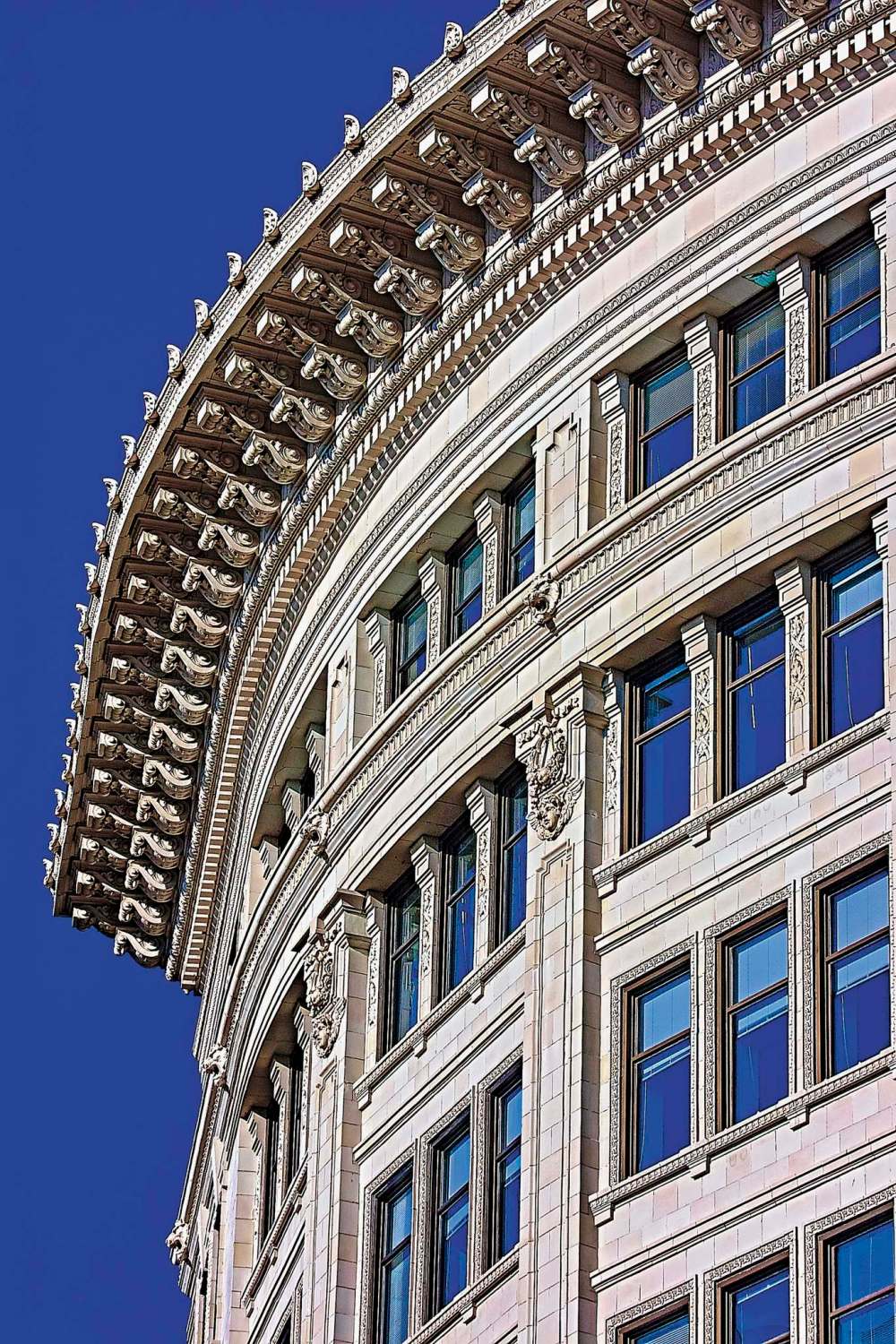
Mitchell’s enhanced digital photographs are uniquely artistic themselves; the sky is white, violet or cerulean blue according to the need, the morning sun bounces off red brickworks, grey and yellow-flecked Manitoba limestone shimmers in the light. Augmented close-ups of intricate cornices, columns and pilasters recall the businessmen, bankers and grain barons who vied for economic dominance. They employed world-class architects to create their visions of empire out in the West. Victorian, Romanesque, Beaux-Arts, Italianate and Chicago designs sit side by side, representing the old and the nouveau riche, their origins and aspirations.

Crisply written sidebars pack in details that bring history to life. Main floor walls of warehouses, for example, were 28 inches thick to support the heavy loads flowing into the booming city. Concrete floors, iron and stone stairs and steel frames were critical design elements for fireproofing.

On Newspaper Row (McDermot Avenue), news was posted on outside walls or shouted through megaphones from windows for major events, such as the outbreak of the First World War. The Winnipeg General Strike was crushed in front of City Hall on Bloody Saturday in 1919 — a testament to the human cost that made the owners wealthy.

Each chapter thoughtfully leads from the past to the present, celebrating the modern use of the buildings and spaces with equal enthusiasm. The key to keeping a city core alive is bringing people in. Warehouses and factories that were written off have been transformed into condominiums. Red River College renovated interiors for current educational use, yet maintained the façades of several buildings on Princess Avenue.
George Mitchell photo
The Confederation Life Building at 457 Main St. was built in 1913.
George Mitchell photo The Confederation Life Building at 457 Main St. was built in 1913.

Mitchell pays due to the theatrical arts, from the ornate Pantages Playhouse, where thousands applauded Charlie Chaplin and Buster Keaton on the Vaudeville circuit, to today’s Jazz Winnipeg Festival, Nuit Blanche and the second-largest theatrical event in North America, the Fringe Festival, which sees crowds thronging Old Market Square — “an oasis of green” — to hear music at the Cube and cool off on patios every summer. Entrepreneurship attracts people, too, from specialty boutiques, haberdashers and galleries lining Albert Street to funky sandwich and doughnut shops along King Street.

Many a bridal party has mugged for cameras in the alleyways where horses once trotted, a textured backdrop for a special day. Mitchell includes chapters for other features of the Exchange we take for granted. Fire escapes making zigzag shadows on brick walls are described as “key adornments” and “urban jewellery or extensions of living spaces.”

George Mitchell photos
The interior of Red River College’s downtown campus was updated, while the original exterior façades were preserved.
George Mitchell photos The interior of Red River College’s downtown campus was updated, while the original exterior façades were preserved.

While the buildings themselves are artistic, the area is also covered in art. Ghost signs still advertise long-defunct factories and goods, thanks to the high percentage of lead in the old oil paint. Modern murals add a contemporary note.

The high-quality paper and bindings literally add weight to the enjoyable content. Mitchell, a former editorial director and publisher of business and trade magazines, has done the city and its citizens a service by reminding us of the value of our past, and how it serves us today.

Harriet Zaidman is a writer in Winnipeg. Many scenes in her middle years novel, City on Strike (Red Deer Press), take place in the Exchange District.


Bank of Hamilton in the Exchange Disrict
Report Error Submit a Tip

More Stories

Sci-fi, fantasy bookstore to land downtown

Ben Sigurdson 4 minute read 2:03 AM CDT

New bookstore alert! New bookstore alert!

On Tuesday at 10 a.m., Other Places Books is slated to open its doors at 436 Graham Ave., just a few doors down from mainstay Bison Books (424 Graham Ave.).

The bookstore’s focus will be science fiction and fantasy, and, says the website (opbooks.store), “will be a friendly, inclusive, and very queer space.” Other Places is the project of Didi Chanoch, who has been chronicling the bookstore’s progress on Bluesky (@didichanoch.northsky.social).

Other Places is the third genre-specific bookstore to open in Winnipeg in recent years. Raven’s End Books (1859 Portage Ave.) opened in 2024, specializing in the horror genre, while Bound to Please (995 McPhillips St.) kicked off selling books in the romance genre in February.

Giant Tiger to close downtown, area residents bemoan dwindling grocery options

Nicole Buffie 4 minute read Preview

Giant Tiger to close downtown, area residents bemoan dwindling grocery options

Nicole Buffie 4 minute read Thursday, Jul. 30, 2026

One of the only remaining grocery-store options for people living downtown and in the Exchange District is closing its doors.

Red notices on the windows at Giant Tiger’s Donald Street and Ellice Avenue location advised passersby the store will close on Nov. 7.

Chain spokesperson Jessica Charbonneau said in an email the decision to shutter stores is “not taken lightly and is made with careful consideration and thorough analysis.”

The store was busy Thursday afternoon.

Read
Thursday, Jul. 30, 2026

Brown goes down, so do Blue

Taylor Allen 7 minute read Preview

Brown goes down, so do Blue

Taylor Allen 7 minute read Updated: Yesterday at 10:15 AM CDT

The Winnipeg Blue Bombers suffered one of their most embarrassing and inexcusable losses in recent memory on Thursday night.

A one-win B.C. Lions team — featuring a rookie quarterback making his first career start, a rookie running back making his first career start and two backup offensive lineman in action — somehow, someway dealt the Blue and Gold a 35-19 defeat in front of 31,509 disgruntled fans at Princess Auto Stadium.

The Bombers, now 1-4 on home turf this season, have dropped back-to-back games to fall to 4-4. The Lions improved to 2-5.

“Shit wasn’t good enough. Offence, defence, special teams. Wasn’t good enough,” said defensive end Willie Jefferson.

Read
Updated: Yesterday at 10:15 AM CDT

Winnipeg police ticketed a man accused of leaving his dog locked in his vehicle in a grocery store parking lot during the intense heat earlier this week, then attacking bystanders who were concerned about the animal’s welfare.

It’s not uncommon for city police to be contacted about pets left locked in cars during heat waves, but typically those calls don’t escalate to the extent of the incident Wednesday afternoon, said Winnipeg Police Service spokesman Const. Claude Chancy.

“It definitely comes up every time we have heat events in the city, we do get concerned citizens calling about pets being left in vehicles, even for a short period of time,” said Chancy.

“Typically, what will happen is that the owner or the caretaker of the pet will present themselves to police and proper, appropriate advice is given about the care of these animals — this is definitely an extreme case.”

Long journey to home ownership for Eritrean couple

Zoe Pierce 4 minute read Preview

Long journey to home ownership for Eritrean couple

Zoe Pierce 4 minute read 2:01 AM CDT

Solomon Ghebru and his family have been building a life together in Winnipeg for the past three years after years of living apart in various countries. Now, they are working toward a new goal: owning a home.

Their story is the focus of this year’s Habitat for Humanity Manitoba Cycle of Hope fundraising ride, a seven-day cycling event through southern Manitoba that begins Monday. The ride aims to raise $150,000 to support Ghebru, his wife, Mehret Awate, and their two daughters as they work toward affordable homeownership.

The couple’s journey to Canada started in Eritrea, where they grew up and attended the same church together. They left Eritrea separately, hoping to build a better life together out of the country. Ghebru travelled through Sudan and Libya before reaching Malta, while Awate travelled to Sudan and then Uganda.

After he found work in Malta, he tried to have his family join him, but government policies prevented them from reuniting. The couple married in Uganda in 2016, and their first daughter, Peniel, was born there the following year.

Read
2:01 AM CDT

The bountiful harvest: Thousands of visitors flock to St. Norbert Farmers’ Market every Saturday

Melissa Martin 17 minute read Preview

The bountiful harvest: Thousands of visitors flock to St. Norbert Farmers’ Market every Saturday

Melissa Martin 17 minute read Yesterday at 6:00 AM CDT

While most of Winnipeg is still sleeping, or perhaps just starting to think about making the morning coffee, a patch of shade and sun just south of the Perimeter Highway is already humming with life.

Read
Yesterday at 6:00 AM CDT